Every learning leader hears the same question from leadership. Does training actually work? A corporate training ROI calculator gives you a clear answer. It turns vague feelings about a course into real numbers that finance teams trust. In this article, you will learn what training ROI means, how to calculate it, and which tools help you track it well.
Companies across the USA spend large budgets on employee development every year. Yet many leaders still cannot say with confidence what that spending returns. This guide fixes that gap. We will walk through simple formulas, useful tools, and practical tips you can apply today.
What Is Training ROI and Why Does It Matter
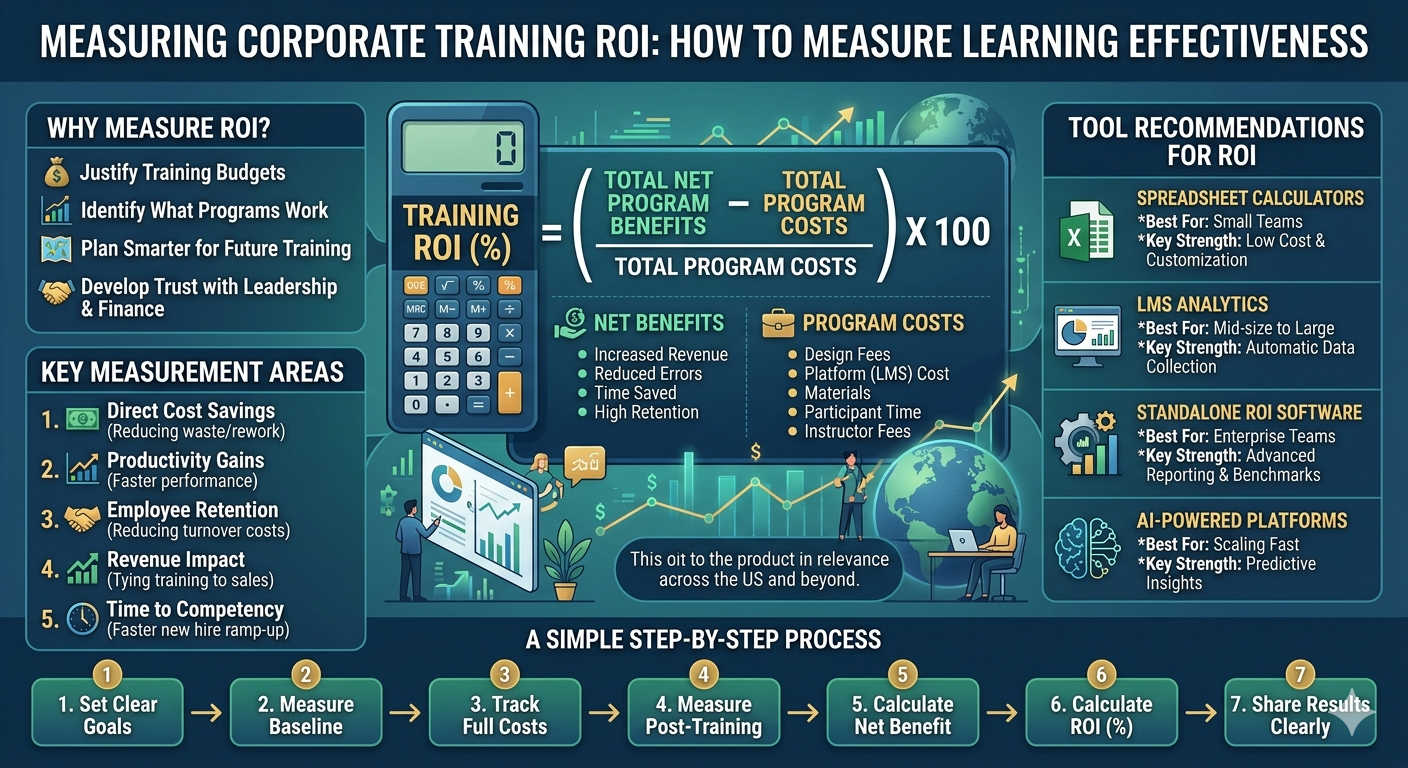
In short, it tells you whether your training budget is paying off. Training ROI is the return on investment of the learning programs. It quantifies the value a training program delivers relative to the cash spent delivering it.
This matters because training budgets are not unlimited. Therefore, every dollar needs to show results. When you measure training ROI properly, you gain a few clear benefits.
- Real-world data that justifies your training budget
- You can tell what programs work and what ones don’t”
- Plan smarter for future training in the US and beyond
- You develop trust with leadership teams and finance teams
Without ROI tracking, training is frequently seen as a cost rather than an investment. That view can lead to budget cuts during tough years. To avoid this, it helps first to get the foundation right, starting with the platform that delivers your training. Our guide on how to choose the right LMS for your organization explains how the right system supports better tracking from day one.
How a Corporate Training ROI Calculator Works
A training ROI calculator uses a simple formula. It takes the net benefit of training and divides it by the cost of training. Then it takes the result and multiplies it by one hundred to get a percentage.
The basic formula looks like this.
Training ROI equals Net Program Benefits divided by Program Costs, multiplied by one hundred.
Measure how training reduces waste, errors, or rework. For example, fewer mistakes on the production line often mean fewer repair costs. The net benefit is thirty thousand dollars. Divide that by the ten thousand dollar cost, and you get a ratio of three. Multiply by one hundred, and your training ROI is three hundred percent.
This formula seems simple at first glance. However, the real challenge is figuring out which numbers to plug in. That is where most learning teams struggle.
What Should You Measure to Prove Training ROI to Your Boss
Your boss does not want a long story. Instead, they want clear proof. To build that proof, focus on a few key measurements.
1. Direct Cost Savings
Track how training reduces waste, errors, or rework. For instance, fewer mistakes on the production line often mean lower repair costs.
2. Productivity Gains
Measure how much faster or better employees perform after training. You can compare output before and after the program.
3. Employee Retention
Replacing an employee costs far more than training one. As a result, retention numbers often carry a lot of weight in ROI reports.
4. Revenue Impact
If the training impacts sales, customer service or client retention, then tie those numbers directly to the program.
5. Time to Competency
Monitor how fast new hires come up to speed. A faster ramp-up time is often a sign of a strong training design.
When you have these numbers together, you can put them into an easy chart or table.
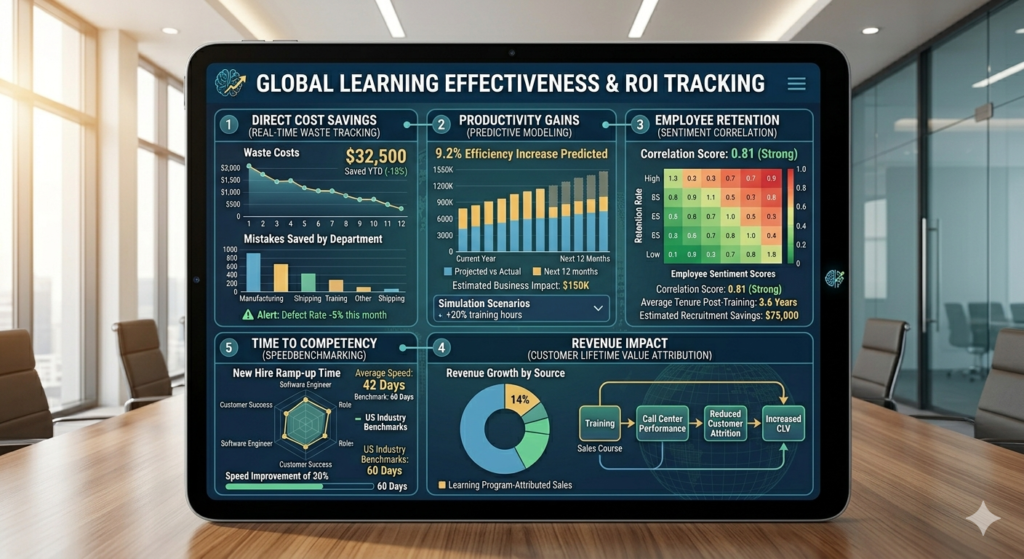
For more on how training design itself can shape these outcomes, take a look at our comparison of AI versus traditional instructional design. It shows how design choices directly affect how fast learners reach competency.
Best Corporate Training ROI Calculators for Measuring Learning Outcomes
Many tools today help teams measure learning outcomes without heavy manual work. The best corporate training ROI calculator usually shares a few traits. First, it pulls data automatically from your learning system. Second, it connects training activity to business outcomes. Third, it presents results in a way non technical leaders can understand.
Below is a quick comparison of common calculator types used by companies in the USA and worldwide.
| Calculator Type | Best For | Key Strength |
| Spreadsheet based calculator | Small teams and quick estimates | Low cost and easy to customize |
| LMS built in analytics | Mid size and large companies | Automatic data collection |
| Standalone ROI software | Enterprise learning teams | Advanced reporting and benchmarks |
| AI powered learning platforms | Companies scaling training fast | Predictive insights and personalization |
Spreadsheets are fine for small programs. But with the scale of the training, manual tracking is slow and error prone. That’s why more teams today rely on smarter, connected platforms.. Our article on AI-powered learning and how it helps train and upskill employees explains how automation reduces this manual burden while improving accuracy.
Recommendations for ROI Calculators That Integrate With LMS Platforms
If your company already has a learning management system, see if you can find an ROI calculator that integrates directly with it. This integration saves time and reduces the risk of human error. Here are some things to watch for.
- Automatic data synchronisation between your ROI Tool and your LMS
- Support for standard data standards for consistent reports
- Dashboards that refresh in real time, not just at quarter-end
- Flexible cost inputs, as training costs vary across departments
One area that often gets overlooked is data standardization. Without it, reports from different systems do not line up well. If you want to understand how learning data moves between systems cleanly, our guide on xAPI and the learning record store breaks down how this works in simple terms.
Another growing trend is connecting AI tools directly to your LMS through open protocols. This setup lets ROI calculators pull live data without manual exports. To learn more about this approach, check out our explainer on the Model Context Protocol for LMS, which covers how modern systems talk to each other.
Which Corporate Training ROI Tool Provides the Most Accurate Cost Benefit Analysis
Accuracy depends less on the tool name and more on the data you feed it. That said, certain tools tend to produce more reliable results because of how they handle data.
Tools that connect directly to payroll, sales, and HR systems tend to give more accurate cost benefit numbers. This is because they avoid manual entry mistakes. On the other hand, tools that rely only on self reported survey data are often less precise, since people may overestimate or underestimate the impact of training.
For the most accurate analysis, look for a tool that does the following.
- Pulls real cost data from finance or HR systems automatically
- Tracks performance metrics before and after training, not just after
- Allows you to set a clear time frame for measuring results
- Lets you separate training impact from other factors, such as market changes
No tool is perfect. However, combining automated data with a bit of human judgment usually gives the most balanced and trustworthy picture.
Corporate Training ROI Calculator vs Employee Engagement Survey Tools: Which to Choose
This is a common question among learning leaders. The honest answer is that these two tools measure different things, so the right choice depends on your goal.
A training ROI calculator will focus on financial and performance outcomes. It answers the question did the training pay off in measurable terms. However, an employee engagement survey tool is about feelings, satisfaction and motivation. It asks a softer, but still important question about how people feel during and after training.
In most cases, you don’t have to pick just one. Use both, then, for a more complete picture.
- Use the ROI calculator when you need to justify budget, or show financial impact
- Use engagement surveys to get a sense of learner experience and morale
- Both from giving a full training report to leadership
For example, a course might show strong ROI numbers but low engagement scores. That mismatch could mean employees feel forced into the training, even though it works. Catching that early helps you fix the experience before it affects future results.
Common Mistakes to Avoid When Measuring Training ROI
Even with the right calculator, mistakes can throw off your numbers. Here are a few common ones to watch for.
- Counting only direct costs and ignoring time spent away from work
- Measuring results too soon, before the training impact fully shows
- Ignoring other factors that could explain performance changes
- Skipping a baseline measurement before training begins
Avoiding these mistakes takes a bit of discipline. However, the payoff is a report that leadership can actually trust.
A Simple Step by Step Process to Calculate Training ROI
If you want a clear path forward, follow these steps.
- Set a clear goal for the training program before it starts
- Measure baseline performance before training begins
- Track full training costs, including time, materials, and tools
- Measure performance again after training, using the same metrics
- Calculate the net benefit by subtracting costs from gains
- Divide the net benefit by total costs and multiply by one hundred
- Share results clearly, using simple charts where possible
This process works whether you run a small workshop or a large company wide program across multiple offices in the USA.
Final Thoughts on Measuring Training ROI
Measuring training ROI does not need to feel complicated. With the right calculator and a clear process, you can turn training from a guessing game into a data backed decision. Start small if needed. Track one program fully, learn from it, then expand your approach across the company.
As your training programs grow, the tools and data behind them matter more than ever. Choosing the right platform, the right data standards, and the right reporting habits will save you time and build trust with leadership for years to come.
Frequently Asked Questions
1. What should I measure to prove training ROI to my boss
Focus on cost savings, productivity gains, retention rates, revenue impact, and time to competency. These numbers give a clear, simple story that leadership can quickly understand.
2. What is the best corporate training ROI calculator for measuring employee learning outcomes
The best calculator depends on your company size. Small teams often do well with spreadsheet based tools. Larger companies usually benefit more from LMS built in analytics or standalone ROI software that connects to multiple data sources.
3. What are some recommendations for corporate training ROI calculators that integrate with LMS platforms
Look for calculators that sync automatically with your LMS, support common data standards, offer real time dashboards, and allow flexible cost inputs. This combination reduces manual work and improves accuracy.
4. Which corporate training ROI tool provides the most accurate cost benefit analysis
Tools that pull data directly from payroll, HR, and performance systems tend to be the most accurate. They reduce guesswork and manual entry errors compared to tools that rely only on surveys.
5. Corporate training ROI calculator vs employee engagement survey tools, which should I choose
Choose an ROI calculator when you need financial proof of training impact. Choose engagement surveys when you want to understand learner experience and morale. For the most complete view, use both together.
References
How to Choose the Right LMS for Your Organization
AI vs Traditional Instructional Design
AI Powered Learning: A Smarter Way to Train and Upskill Employees
Model Context Protocol (MCP) for LMS: Everything You Need to Know
xAPI and Learning Record Store (LRS): Everything You Need to Know
Authorised By
Hifza Naeem