Training teams across the USA are collecting more learner data than ever before. Yet much of that data still lives inside separate tools that never share information with each other. An employee might finish a course inside an LMS, practice a skill inside a simulation, and complete a certification on a mobile app, all without those three systems ever talking to one another. This gap is exactly where a learning record store becomes useful.
A learning record store works quietly in the background. It gathers learning data from many sources and keeps that data in one safe place. In this article, we will explain what a learning record store is, how it works with xAPI, and why it matters for training programs today. We will also walk through the different types of LRS, compare them with a learning management system, and share simple tables you can use as a quick reference. By the end, you should feel ready to talk through LRS options with your own team.
What Is a Learning Record Store?
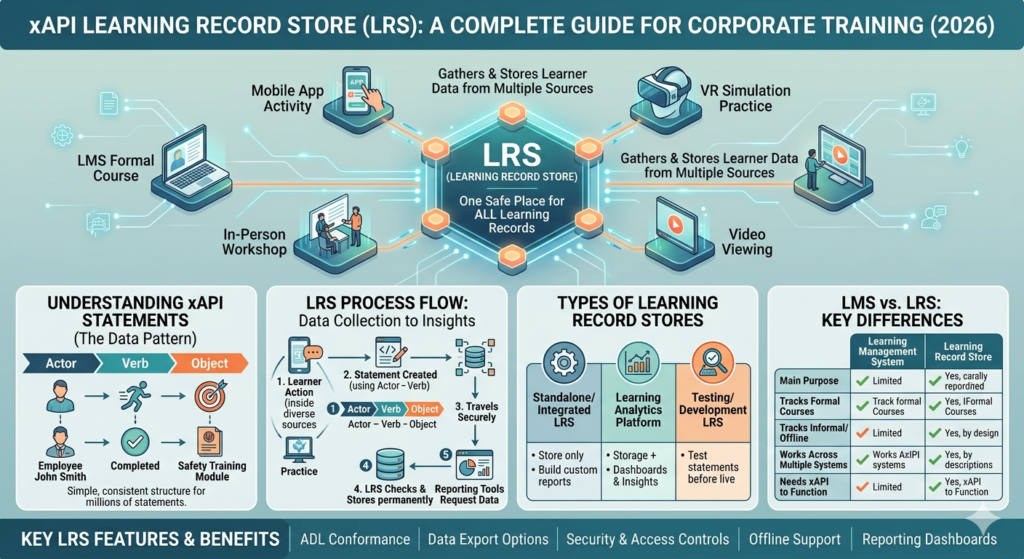
A learning record store, often shortened to LRS, is a system that receives, stores, and shares learning data. The xAPI standard, also called the Experience API, defines exactly how this data should be sent and saved. Together, xAPI and the LRS form the backbone of modern learning analytics.
Every time a learner finishes a task, watches a video, or completes a simulation, a small piece of data called a statement gets created. A statement follows a simple pattern made of three main parts. Once you understand these three parts, the whole idea behind xAPI becomes much easier to follow.
| Part of the Statement | What It Means | Example |
|---|---|---|
| Actor | The person or group taking the action | John Smith |
| Verb | The action being taken | completed |
| Object | The thing the action was taken on | Safety Training Module |
This simple structure makes the data easy to read and easy to reuse later. The learning record store then saves this statement so it can be pulled up again whenever someone needs to review it. Because each statement stays small and consistent, an LRS can hold millions of them without becoming difficult to search.
How Does an xAPI Learning Record Store Work?
The process behind a learning record store is not complicated once you break it into steps.
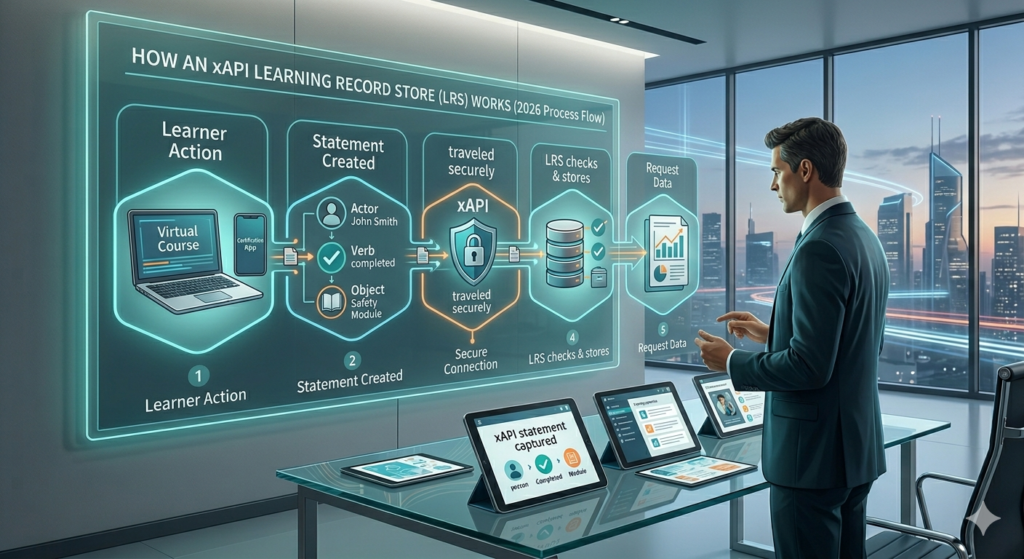
- A learner takes an action inside an app, a course, a game, or even a physical device.
- That action gets turned into an xAPI statement using the actor, verb, object format.
- The statement travels over a secure connection to the learning record store.
- The LRS checks the statement, saves it, and stores it permanently.
- Other systems, such as reporting tools or dashboards, can later request that data from the LRS.
Because xAPI was built to work across many environments, a learning record store can collect data from mobile apps, simulations, virtual reality tools, and even in person training sessions. As a result, training no longer needs to happen only inside an LMS. Learning can happen almost anywhere, and the learning record store still captures it.
Types of Learning Record Store
Not every learning record store works the same way. Generally, LRS products fall into three broad categories. Knowing the difference helps you pick a system that actually matches your needs, rather than paying for features your team will never use.
| Type of LRS | Description | Best For |
|---|---|---|
| Standalone or Integrated LRS | A simple LRS that sits behind another platform and mainly stores xAPI statements without a built in dashboard | Developers who want to build their own reporting tools |
| Learning Analytics Platform | An LRS with added reporting, dashboards, and visualizations on top of basic storage | Teams that want ready made insights without extra development work |
| Testing and Development LRS | A free or low cost LRS used to test xAPI statements before going live | Instructional designers and developers checking a new xAPI setup |
Many organizations start with a free testing LRS, move on to a standalone LRS once their content is ready, and later add a full learning analytics platform once they need deeper reporting.
Learning Record Store vs Learning Management System
People often confuse a learning record store with a learning management system. They are not the same thing, although they usually work together. An LMS manages courses, enrollments, and content delivery. A learning record store, on the other hand, focuses only on collecting and storing learning data.
| Feature | Learning Management System | Learning Record Store |
|---|---|---|
| Main Purpose | Delivers and manages courses | Stores and shares learning data |
| Tracks Formal Courses | Yes | Yes |
| Tracks Informal or Offline Learning | Limited | Yes |
| Works Across Multiple Systems | Limited | Yes, by design |
| Needs xAPI to Function | No | Yes |
Some LMS platforms include a basic LRS inside them already. Others need a separate, standalone LRS to capture data from outside sources. If your organization is still working out the basics of its training platform, it helps to start with a strong foundation first.
Our guide on how to choose the right LMS for your organization in 2026 walks through that process step by step. Once your LMS is in place, adding a learning record store becomes a much smoother step.
What Is cmi5 and How Does It Connect to an LRS?
Many readers researching learning record stores also come across the term cmi5. cmi5 is a set of rules built on top of xAPI. It was designed to bridge the gap between older systems such as SCORM and newer xAPI based tracking. In simple terms, cmi5 tells an LMS exactly how to launch xAPI content and how to send that data to a learning record store in a clear, consistent way.
Because cmi5 still relies on a learning record store behind the scenes, understanding the LRS remains the first step for any organization. Once your LRS is in place, adding cmi5 support later becomes a smaller, far more manageable task.
Why a Learning Record Store Matters
A learning record store matters because it gives organizations a complete picture of learning. Without it, training data stays scattered across many systems. With it, every learning moment becomes visible and easy to find.
This is especially helpful for companies in the USA that must track compliance training across large and spread out teams. Industries such as healthcare, finance, and manufacturing often need clear proof that employees completed required training. A learning record store keeps that proof safe and ready whenever it is needed.
In addition, a learning record store supports better decision making. Managers can see which courses help the most, which content gets ignored, and where learners struggle. This kind of insight pairs naturally with AI powered learning, a smarter way to train and upskill employees, since both rely on accurate data to personalize training paths.
Key Features to Look for When Choosing an LRS
Once you understand the basics, the next step is comparing actual products. A few features matter more than others, no matter which vendor you choose.
| Feature | Why It Matters |
|---|---|
| ADL Conformance | Confirms the LRS correctly follows the official xAPI specification |
| Data Export Options | Makes it easy to move your data into other reporting tools later |
| Security and Access Controls | Protects sensitive employee training records |
| Offline Statement Support | Allows data to sync later when a learner has no internet connection |
| Reporting Dashboards | Saves time by turning raw statements into readable charts |
Reviewing this list before a demo call helps you ask sharper questions and avoid paying for features your team will not actually use.
Learning Record Store and Instructional Design
A learning record store also changes how instructional designers do their work. Traditional design often relied on guesswork and basic completion rates. Today, designers can study real learner behavior and adjust content based on actual results, rather than assumptions.
This shift is part of a larger conversation happening across the training world. We explored this topic further in our article on AI vs traditional instructional design, which looks at how data and automation are reshaping the design process. A learning record store gives instructional designers the raw material they need to make smarter, evidence based choices. For example, if data shows learners repeatedly struggle with the same quiz question, a designer can rework that section instead of guessing what went wrong.
Common Challenges When Adopting a Learning Record Store
Like any new system, a learning record store comes with a few common challenges. Knowing about them early can save your team time later.
- Messy or inconsistent statements. If different tools send statements in slightly different formats, reporting becomes harder. A clear style guide for your team helps prevent this.
- Too much data, not enough insight. Collecting data is easy. Turning it into useful insight takes planning and the right reporting tools.
- Older content that is not xAPI ready. Many companies still rely on training material that was never built with xAPI in mind, which can slow down adoption.
- Unclear ownership. Without a clear owner, an LRS can become a forgotten system that nobody checks. Assign a person or a small team to manage it from day one.
How to Choose the Right Learning Record Store
Choosing a learning record store depends on your goals, your budget, and your technical setup. Some organizations need a simple LRS that just stores data quietly. Others need a full learning analytics platform with dashboards and built in reporting.
Before making a final decision, it helps to map out your training strategy and your spending plan. If budget is part of that conversation, our guide on how to build a corporate eLearning program on a budget, a complete 2026 guide offers practical steps for managing costs without giving up on quality.
It also helps to review your existing training material early. Many organizations still rely on older content that was never built with xAPI in mind. Our guide on how to convert legacy training content to modern eLearning explains how to prepare that content so it works smoothly with a learning record store.
Final Thoughts
A learning record store is no longer just a technical detail tucked away in the background. It has become a key part of how organizations understand and improve training. By collecting data from every corner of the learning experience, a learning record store helps teams make smarter choices and prove real results.
As training continues to move beyond the classroom and beyond the traditional LMS, the learning record store will only grow in importance, both in the USA and around the world.
Frequently Asked Questions
What is the best xAPI learning record store for corporate training programs?
There is no single best learning record store for every company. The right choice depends on your team size, your budget, and how much reporting you need. Some widely used options in the market include SCORM Cloud, Learning Locker, and Watershed. Before choosing, compare features such as conformance testing, reporting tools, and ease of integration with your current systems.
Which xAPI LRS offers the most reliable data analytics for employee learning?
Reliability often comes down to whether the LRS has passed the official ADL conformance test. A reliable learning record store should also offer clear dashboards, simple data exports, and strong support for custom reports. Many learning analytics platforms build extra features on top of basic xAPI storage to give deeper insight into employee progress over time.
Should I choose an open source or commercial xAPI learning record store for my organization?
Open source options give you more control and a lower upfront cost. However, they often need technical staff to manage and update them. Commercial options usually offer better support, regular updates, and an easier setup process. Smaller teams with limited technical resources often do better with a commercial LRS, while larger teams with strong development support may prefer an open source option.
Are there any recommendations for an xAPI LRS that supports offline learning data capture?
Yes. xAPI was designed with offline learning in mind from the start. Many learning record stores can hold statements locally on a device and then send them once a connection returns. This makes xAPI a strong fit for field training, mobile learning, and remote work environments where internet access is not always reliable.
How does xAPI track real world learning that your LMS cannot see?
Traditional LMS platforms usually track only the activity that happens inside their own system. xAPI removes that limit. It can capture actions from mobile apps, simulations, virtual reality programs, and even physical equipment. As long as a system can send an xAPI statement, a learning record store can capture it. Because of this, organizations get a much wider view of how learning actually happens, both inside and outside formal courses.
Keywords
learning record store, xAPI learning record store, what is an LRS, xAPI LRS, learning analytics platform, xAPI statements, LRS vs LMS, corporate training data USA, xAPI for employee training, eLearning data tracking, cmi5 and xAPI, choosing an LRS
References
1. xAPI.com. What Is a Learning Record Store. https://xapi.com/learning-record-store/
2. xAPI.com. xAPI Overview. https://xapi.com/overview/
3. ADL Initiative. xAPI Specification, GitHub Repository. https://github.com/adlnet/xAPI-Spec
4. ELM Learning. xAPI, An All in One Resource to Understanding xAPI. https://elmlearning.com/hub/technology-tools/xapi/
5. xAPI.com. cmi5, What It Is and What Are the Benefits and Tools. https://xapi.com/cmi5/
Authorised By
Hifza Naeem