Remember sitting through a mandatory 4-hour compliance training that had nothing to do with your actual job? You’re not alone. Millions of employees every year endure the same generic, soul-draining modules, and then forget 70% of it within a week. That’s not a training problem. That’s a system problem.
The good news? AI-powered eLearning is tearing that system apart, and it’s doing it fast.
The Problem With Traditional Corporate Training
For decades, corporate training has operated on a simple and deeply flawed formula: create one course, push it out to everyone, tick the compliance box, and move on.
The figures tell a brutal story:
- Only 12% of employees apply the skills learned in corporate training in their job (McKinsey, 2023)
- Gallup estimates that firms waste $13.5 million per 1,000 employees annually on training that doesn’t work.
- 58% of employees would have stayed longer at a company if it offered better learning opportunities (LinkedIn Workplace Learning Report, 2024)
The bottom line is simple: people learn differently. A 22-year-old sales associate and a 45-year-old operations manager have different knowledge gaps, learning paces, and schedules, but traditional LMS platforms treated them the same way.
What Is AI-Powered eLearning?
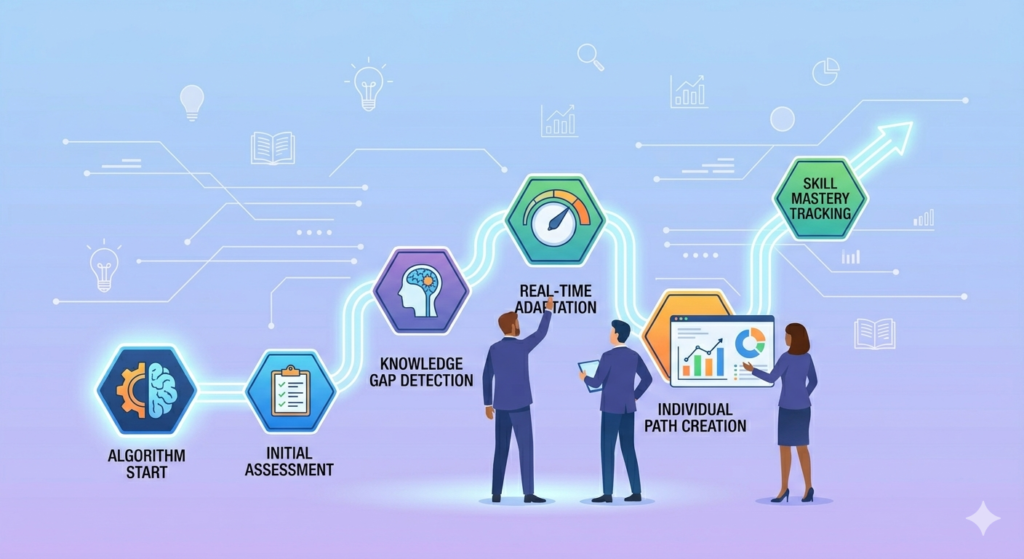
AI-powered eLearning refers to corporate training platforms that use artificial intelligence, including machine learning, natural language processing, and adaptive algorithms, to personalize the learning experience for each employee.
Instead of a fixed course with fixed content, AI systems:
- Analyze each learner’s existing knowledge and skill gaps
- Adapt content difficulty and format in real time
- Predict what a learner needs to know next
- Automate feedback and assessments without human graders
- Track performance patterns across thousands of employees simultaneously
Think of it like having a personal tutor for every employee, one that never sleeps, never gets impatient, and gets smarter with every interaction. This is exactly what TheEduAssist’s AI-powered learning and development solutions are built around.
Key Ways AI Is Replacing One-Size-Fits-All Training
1. Adaptive Learning Paths
This is the biggest shift. In traditional training, everyone starts at Module 1 and ends at Module 10, regardless of what they already know.
AI flips this entirely. Adaptive engines assess a learner’s baseline on Day 1 and build a unique learning path from there. A senior engineer might skip over fundamentals they already know and jump straight into the tough stuff. A new hire is given a scaffolded path where concepts are introduced piecewise. Same company. Same concept. Two very different trips.
Evidence: A 2024 study by the Brandon Hall Group found that organisations that adopted adaptive learning experienced a 41% increase in employee engagement and a 34% improvement in knowledge retention compared to traditional training methods.
2. Microlearning and Real-Time Feedback
Traditional quizzes give you a score. AI gives you a diagnosis.
Modern AI assessment tools don’t just tell you if an answer was right or wrong; they identify why you got it wrong, what concept is causing the gap, and immediately adjust the curriculum to address it. This is especially effective when paired with microlearning and microsimulations, where you deliver small, focused lessons in short bursts that employees can complete without disrupting their workday.
When companies combine AI-based feedback with microlearning, employees retain information 60% longer compared to passive, lecture-based environments.
3. Personalized Content Delivery
AI doesn’t just change what you learn, it changes how you learn it.
Some people absorb information better through video.Some others love to read. Others learn by doing – simulations, scenario-based challenges or gamified tasks.
AI-enabled platforms can track behavioural data (e.g., time spent on different types of content, completion rates, quiz performance) and automatically tailor content delivery to the format that is most engaging to each learner. This is where scenario-based learning and gamified eLearning become powerful tools; they give AI systems rich behavioral signals to personalize from.
Microsoft’s internal learning platform uses AI to surface content in various formats based on patterns of use and says it has reduced training time by 25% with no impact on competency scores.
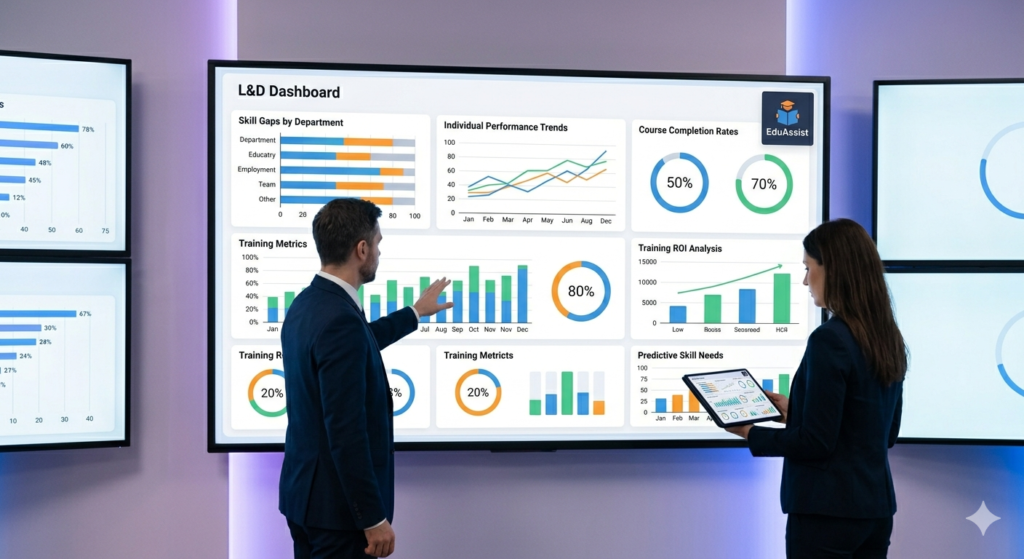
4. Predictive Analytics for Skill Gap Identification
This is where AI really becomes powerful for HR and L&D teams.
AI platforms look at employee behaviour to predict what skills might be missing before they start impacting performance, instead of waiting to find out during performance reviews. IBM’s Watson-powered HR tools have been used to flag teams likely to underperform in upcoming product launches based on detected skill deficiencies, giving managers weeks of lead time to course-correct with targeted training.
This type of intelligence requires a dashboard and analytics that turns raw learning data into actionable decisions for team leaders and L&D managers.
This represents a fundamental shift from reactive training to a proactive learning strategy.
5. Mobile and On-Demand Learning
Traditional training requires scheduling, booking rooms, coordinating calendars, waiting for a trainer. For global teams spread across time zones, this is a logistical nightmare.
AI-driven mobile learning solutions eliminate this friction. Employees can ask questions, role-play practice scenarios, and get guided feedback, on any device, any time, whether they’re at their desk or in the field.
This is particularly transformative for field and frontline staff where access to live training has historically been inconsistent and inequitable. The same high-quality, personalised training experience is now available to a night-shift warehouse worker and a corporate manager at a laptop.
Real-World Results: Companies Leading the Way
| Company | Approach Used | Outcome |
|---|---|---|
| Walmart | AI microlearning | 54% reduction in workplace accidents |
| Accenture | Custom AI learning platform | 30% reduction in onboarding time |
| Unilever | AI-based adaptive training | 16% increase in manager effectiveness |
| Deloitte | Adaptive LMS | 50% increase in course completion rates |
These are not pilot programs. These are large-scale deployments showing that personalized AI learning works at scale across industries. TheEduAssist has worked on similar transformations, including upskilling over 500 corporate employees through data-driven analytics training.
Answering the Skeptics
“Won’t employees just manipulate the AI systems?”
“The modern AI systems use spaced repetition and interleaved practic, mixing up questions and coming back to concepts over time, so you can not just memorise and pass without really understanding.
“And what of human connection in education?”
AI doesn’t replace human facilitators. It liberates them. AI can do the rote work of delivering and assessing content, giving L&D teams their time back for coaching, mentorship and the kind of leadership training that genuinely requires human judgment.
“Is it expensive?”
The upfront investment is real. But if a 1,000-person company wastes $13.5 million annually on ineffective training, even a platform that improves ROI by 30% pays for itself within months. TheEduAssist’s L&D consulting and advisory services can help you build the business case and select the right tools for your budget.
What to Look for in an AI-Powered eLearning Platform
If you’re evaluating platforms, these are non-negotiable features:
- Adaptive learning engine: true path adaptation, not just content recommendations
- xAPI or SCORM 2004 compliance: for deep learning data capture
- Skills taxonomy integration: role-based competency mapping
- Analytics dashboard: with predictive insights, not just completion rates
- LMS integration: theEduAssist offers full LMS integration and migration services to connect your learning platform to existing HR systems
- Multi-format content support: video, simulations, assessments, and social learning
The Future: Where AI-Powered eLearning Is Heading
We’re still early. The platforms available today are impressive, but the trajectory is toward something even more transformative.
Generative AI is already being used to create personalized training content on the fly, building case studies, simulations, and scenarios tailored to an employee’s specific role, industry, and past performance.
VR + AI combinations are entering enterprise training in high-stakes environments, think surgical training, aviation, and manufacturing safety. TheEduAssist’s AR & VR solutions bring exactly this kind of immersive learning to life, where realistic simulation with adaptive AI guidance can replace both physical equipment and live instructors.
Emotion AI tools that detect engagement and cognitive load through interaction patterns are beginning to adjust content difficulty in real time based on how a learner feels, not just how they score.
The one-size-fits-all era isn’t fading. It’s over.
Ready to move beyond generic training? Explore TheEduAssist’s full range of eLearning services or book a free consultation to see what’s possible for your team.
Frequently Asked Questions (FAQs)
Q: What is AI-powered eLearning?
AI-powered eLearning uses machine learning and adaptive algorithms to provide personalized training for each employee. Instead of a standard course for everyone, it changes content, pace, and format in real time depending on how each person learns and performs.
Q: How is AI-powered eLearning different from a traditional LMS? A traditional LMS stores and delivers fixed content to everyone equally. An AI-powered platform adapts, analyzing individual learner behavior and dynamically changing what content is shown, in what format, and at what pace. TheEduAssist offers LMS integration services that can layer AI capabilities onto your existing systems.
Q: Which companies use AI-powered eLearning?
Major companies like Walmart, Accenture, IBM, Unilever, and Deloitte have widely adopted AI-powered learning and achieved results like 50% higher course completion and 30% faster onboarding. It’s not only for big tech; mid-sized businesses are quickly adopting it too.
Q: Is AI-powered corporate training expensive?
There’s an upfront investment, but the return on investment consistently surpasses traditional training costs. When you think about how companies waste millions each year on training that employees forget in a week, a smarter AI-driven system pays for itself quickly through better retention and performance.
Q: Can AI replace human trainers entirely?
No, and it shouldn’t. AI takes care of repetitive tasks like content delivery, assessments, and progress tracking. This actually allows human trainers to focus on what they do best: coaching, mentoring, and developing people in ways that no algorithm can match.
Final Thought
Corporate training has always had a people problem dressed up as a content problem. The real issue was never what to teach, it was how to teach it to wildly different people with wildly different needs, simultaneously, at scale.
AI solves that. Not perfectly, not yet, but well enough that continuing to defend one-size-fits-all training is no longer a budget decision. It’s an organizational risk.
The companies that recognize this now will build more capable, more engaged, and more loyal workforces. The ones that don’t will keep scheduling four-hour compliance modules that nobody remembers by Friday.
References
- McKinsey & Company – Closing the Skills Gap
https://www.mckinsey.com/capabilities/people-and-organizational-performance/our-insights/closing-the-skills-gap - Gallup – The World’s Largest Ongoing Study of Employee Engagement
https://www.gallup.com/workplace/393497/world-largest-ongoing-study-employee-engagement.aspx - LinkedIn Workplace Learning Report
https://learning.linkedin.com/resources/workplace-learning-report - Brandon Hall Group Research
https://www.brandonhall.com/research - Axonify Customer Results and Case Studies
https://axonify.com/results - Accenture – Future of Learning and Workforce Development
https://www.accenture.com/us-en/insights/talent-and-organization/future-of-learning - HireVue Customer Stories (Including Unilever)
https://www.hirevue.com/customers - Deloitte Human Capital Trends
https://www2.deloitte.com/us/en/insights/focus/human-capital-trends.html - Microsoft Learning and Development Resources
https://www.microsoft.com/en-us/learning - IBM Talent Management and AI-Powered Workforce Solutions
https://www.ibm.com/products/talent-management
Authorized by:
Hifza Naeem