Online learning is not about watching videos and reading files anymore. These days, people who are learning online want to have an experience. As educational institutions and corporations continue to invest in novel learning solutions, AR and VR are rapidly becoming an important aspect of modern education.
They want this experience to help them understand learning better and keep them interested in the online learning they are doing. Online learning should be fun and interesting, for people who are learning online. This is where things like augmented reality and virtual reality are making a difference in online education.
By just sitting and watching classes students can now work with digital things, visit virtual places and try out real life skills in a safe and fun way. Augmented reality and virtual reality in education are really changing how people learn. Students can interact with content, go to virtual worlds and practise what they learn in a secure and engaging way.
What Are AR and VR in Online Learning?
AR and Virtual Reality are changing how we learn online.They make learning fun and interactive.
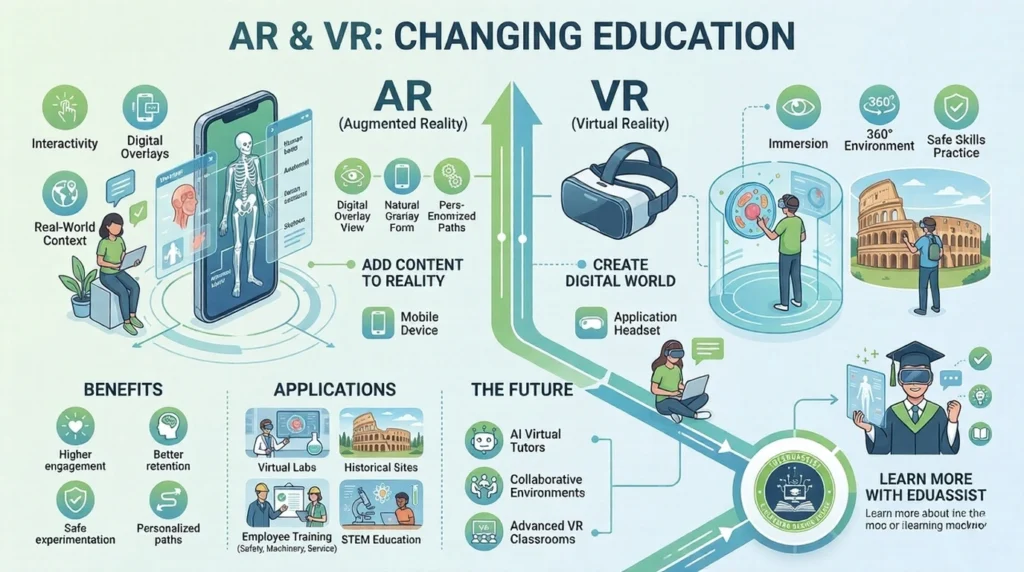
AR adds things to the real world.You can see them on your phone, tablet or smart device.It’s like having objects and animations around you.
Virtual Reality creates a new digital world.You can explore it using a headset.It feels like you are really there not just watching on a screen.These technologies help you take part in learning not just read or watch.You get to do things and learn by doing.
AR and Virtual Reality make learning more interesting.They help you understand and remember things better.
AR vs. VR in Education
| Technology | How It Works | Learner Experience |
| AR | Adds digital content to the real world | Interactive and enhanced learning |
| VR | Creates a fully digital environment | Immersive hands-on experiences |
These technologies work in ways but they both want to help people understand things better, get more involved and remember what they learn about these technologies.
How are Augmented Reality and Virtual Reality changing education?
Augmented Reality and Virtual Reality are really changing the way education works.
AR and VR are making learning fun and interactive, not just something you sit and listen to.
Traditional online courses are pretty basic; they usually have things, like reading materials, slideshows and recorded lectures. It can be boring sometimes for learners
The issue can be resolved by utilizing immersive learning experiences through AR and VR. Students can now directly interact with materials. This makes learning fun and engaging.
With AR and VR students get hands-on experience with the subjects.
As example:
- Medical students can practice procedures in virtual simulations.
- Engineering students have the ability to view machines in a three-dimensional space.
- Language learners can have conversations that’re like the ones they have, in everyday life.
- Employees can practice what they do at work in a simulation that’s safe and does not put them in any danger.
Rather than simply knowing about concepts, students apply them.
Why Is Immersive Learning Getting Popular?
Immersive learning is getting more popular because it helps learners stay focused and involved in immersive learning. One big challenge in education is keeping learners’ attention.Long lectures and lessons with lots of text can make learners lose interest especially when they study from home.
Augmented Reality and Virtual Reality really help with this issue by making learning feel more fun and real.
Companies want to find ways to make learning better.Many companies that make learning tools are now looking at Augmented Reality and Virtual Reality.
Learning-focused organisations like TheEduAssist are paying attention to what is happening.
Immersive learning is about keeping students interested and helping them remember what they learn in school.
When students are a part of their learning they feel more excited to finish their courses.
How Do Schools and Universities Use AR and VR?
Schools and universities use augmented reality and virtual reality in a variety of ways.
They are using Augmented Reality and Virtual Reality to make teaching and learning better. Many things that we learn in school are hard to understand when we just read about them or see pictures.
Augmented Reality and Virtual Reality help us see these things in a way that makes sense.
Virtual Science Labs
Students can do experiments in labs without needing costly equipment or a real lab.They can use these simulated labs to learn and practice.
Historically Remarkable Experiences
Unlike traditional textbooks, students can now access digitally visited historical landmarks and view significant events.
STEM Education
The science, technology, engineering, and mathematics subjects lend themselves well to both visual and interactive learning experiences.
Remote Learning Support
Virtual classrooms are a way to make students from all over the place feel like they are really there.They make learning fun for students.Virtual classrooms also help students understand the stuff better.
The students can learn from home or from any place they like and still feel like they are in a real classroom with other students from diverse locations.
Can AR and VR enhance employee training programs? How do they work?
AR and VR are really becoming useful tools for making workplace training and professional development a lot better. People are using augmented reality and virtual reality more and more to help them learn things at work.
Many organizations struggle with the limitations of traditional training approaches. Classroom sessions and instructional videos often fall short when it comes to preparing workers for the situations they will actually encounter on the job.
Immersive training gives employees a chance to practice and develop skills in realistic environments before they ever need to apply those skills in a real work setting.
Common applications include:
Standard Safety Training
Employees can practise emergency procedures without any actual risk.
Equipment Operation
Workers can practice operating machinery on simulators before they ever touch the real equipment.
Customer Service Training
Employees can use situations to get better at talking to people and solving problems.
Leadership Growth
Managers can try out simulations that help them make decisions and manage their teams.
These kinds of experiences help people learn and feel more confident, without taking risks, which also helps keep the cost of training from getting too high. Employees can use situations to improve their communication skills and problem-solving skills.
In what ways do AR and VR enhance the efficiency of elearning for students?
There are a lot of reasons why people are using Augmented Reality and Virtual Reality more and more.
Augmented Reality and Virtual Reality make learning fun and people are paying attention.
Improved Learner Engagement
When people interact with Augmented Reality and Virtual Reality they learn better than with learning tools.
Better Knowledge Retention
People remember things better when they are actively doing something with Augmented Reality and Virtual Reality.
Secure Learning Environments
Students and professionals can practice what they learn with Augmented Reality and Virtual Reality without getting hurt or making mistakes in life.
Customised Learning
Immersive technologies can make learning fit skill levels and styles.
They help create custom experiences that match how each person learns best.
Improved Confidence
When learners practice regularly in environments they start to feel more confident. This confidence helps them to apply their skills in real-life situations.
Schools, universities and companies are investing in immersive learning tools and environments because of these benefits. They see the value in this type of learning.
Challenges of AR and VR Learning Programs
AR and VR technologies are helpful, but they also have some challenges.
High Cost of Implementation
Creating learning experiences often requires special software, equipment and expertise. This can be expensive.
Hardware Specifications
Some students do not possess compatible VR headsets.
Specific technical constraints
Learning experience can be affected by internet connectivity and device performance at times.
Standard Learning Curve
Immersive technology takes time for people to get used to.It is a bit tricky, at first.
These challenges are there. Technology is getting better.
This means AR and Virtual Reality are becoming easier to use and cheaper.
How can Augmented Reality and Virtual reality provide a solution to differing learning styles?
People learn in ways. Some people understand things better when they see pictures or videos. Other people need to try things out for themselves to really get it. Augmented. Virtual Reality helps with this by giving people many ways to learn.
People who learn by looking at things can use Augmented Reality and Virtual Reality to see pictures and models that make things seem real, and those who learn by actually doing things can join in and be a part of situations that feel like they are really happening.
Because Augmented Reality and Virtual Reality can help people who learn in ways they can make learning better for more people. Augmented Reality and Virtual Reality can make learning available to people who might have had trouble learning before. Augmented Reality and Virtual Reality can really help make learning fun and useful for a lot of people.
How have researchers interpreted the use of Augmented Reality and Virtual Reality in the field of education?
Research findings on these technologies have been mostly positive.Studies show that interactive learning experiences can increase student engagement.They also help people remember information better and support the development of skills.
According to Statista, investment in AR and VR technologies is expected to keep growing.Organizations are pursuing transformation and adopting advanced learning solutions. As these tools become cheaper and more available, schools and businesses will likely use them more. They will use learning environments more often.
What is the future of Online Learning in AR and VR? How will it evolve?
Online learning is going to be a lot more fun and feel more real as time goes on. With technology continuing to advance, AR and VR tools are expected to grow more affordable, widely accessible, and genuinely effective for learners at all levels.
Some of the developments we can likely expect to see include:
- AI-driven virtual tutors
- Customised, comprehensive educational routes
- Advanced virtual classrooms
- Collaborative learning environments
- More realistic workplace simulations
- Enhanced remote training experiences
Artificial intelligence, augmented reality and virtual reality can work together to make learning experiences more engaging than traditional online education.
Many experts think immersive learning will become a part of how education, training and professional development are delivered in the future.
A lot of experts are convinced that immersive learning will be central to education, training and professional development.
How do companies plan for Immersive Educational Learning?
Organizations that want to use Augmented Reality (AR) and Reality (VR) should start by figuring out what they want their learners to achieve. Not every training program needs AR and VR to work well. The best implementations are those that focus on areas where hands-on practice, visual understanding or realistic simulations can really help learners.
Organizations should also:
- Evaluate learner needs
- Assess available technology
- Start with pilot programs
- Gather learner feedback
- Measure learning outcomes
A good plan helps make sure that the money you put into immersive learning really gives you results. Immersive learning should give you something in return. This is why you need a plan for immersive learning.
Conclusion
Augmented Reality and Virtual Reality are changing the way students, employees and professionals learn online. These technologies create immersive environments that help people learn and remember things better than the old ways.
Augmented Reality and Virtual Reality have uses, including virtual classrooms, science labs, employee training and programs to help professionals develop new skills. This shows how Augmented Reality and Virtual Reality are making an impact on education. There are still some problems, like the cost and making sure everyone can use them. It is clear that immersive learning is going to be important in the long run.
As schools, businesses and other organizations look for ways to make learning better Augmented Reality and Virtual Reality are going to become more and more important. They will play a role in the future of online learning and that is why people are so excited about Augmented Reality and Virtual Reality.
FAQs
Can you explain the concept of AR and VR in online education?
AR puts digital things into the real world while VR lets users be in a completely virtual world. Learning becomes fun because of these two tools.
What are the benefits of incorporating augmented reality and virtual reality into education?
They make students more interested, help them remember things better and let them try things out to understand ideas.
Does the use of AR and VR in training enhance employee engagement?
Yes it does. Many companies already use AR and VR for things like safety training to make work safer and more productive. They also use them to train people for customer service and leadership.
Is the cost of AR and VR in Educational Institutions high?
Typically, the initial cost is higher than standard educational materials. However, costs have steadily decreased as the technology becomes more accessible and widespread.
How will AR and VR evolve in online learning in the future?
In the future we can expect to see AR and VR in online learning. This will include things, like:
1. Learning experiences led by Artificial Intelligence (AI).
2. Virtual classrooms.
3. Training programs made for each person.
These changes will help both students and people who are already working.
Authorized by: Humna Mariyam