A strong AI upskilling strategy is no longer optional for businesses. In fact, it is now one of the most urgent priorities for every company in 2026. This is because AI is changing how people work, and consequently, jobs are shifting fast. Unfortunately, most workers are not ready for it yet.
So, what happens if you do nothing? For starters, your team falls behind, your costs go up, and top talent leaves. As a result, your competitors pull ahead while you play catch-up.
To prevent this, you need a proactive plan. Therefore, this guide shows you exactly how to build a smart, scalable AI upskilling strategy. You will also find real data, a real case study, and clear steps you can use right away. Let’s get started.
What an AI Upskilling Strategy Means for Enterprises
An AI upskilling strategy is a structured plan to train employees with AI skills. It helps improve productivity, decision-making, and digital readiness.
It is not a one-day course. Instead, it is an ongoing system built around each person’s job role. Furthermore, it directly aligns learning goals with real business needs so that your team can apply their skills immediately.
Why Enterprises Need It in 2026
AI tools are now everywhere. For instance, marketing teams use AI for content, while finance teams rely on it for forecasting. Similarly, HR teams use it for hiring. However, despite this widespread availability, most employees still do not know how to use these tools effectively.
In fact, according to a 2026 DataCamp survey of 500+ enterprise leaders, 59% of companies report an active AI skills gap. Remarkably, that is true even though most organizations are already investing heavily in training. Consequently, while the money is going in, the actual skills are not coming out.
Ultimately, that gap creates wasted time, poor results, and low team morale. As a result, fixing this bottleneck through a targeted AI upskilling strategy has become a top priority for L&D and HR leaders.
Training vs. Upskilling: Key Differences
| Feature | Training | Upskilling |
|---|---|---|
| Focus | One skill or tool | Broad skill growth |
| Duration | Short-term | Ongoing |
| Goal | Task done | Career ready |
| Approach | Same for everyone | Role-based |
| Outcome | Compliance | Real change |
Training teaches one thing. Upskilling, on the other hand, builds a team that keeps adapting over time.
The Role of L&D Teams
Learning and Development teams must own this process. They find the skill gaps, design the learning paths, and track results. Moreover, they need to work closely with HR and team managers. That way, training stays relevant to real work, not just theory.
Why AI Upskilling Has Become Critical in 2026
AI is growing faster than most workforces can keep up with. That gap is now a serious financial risk.
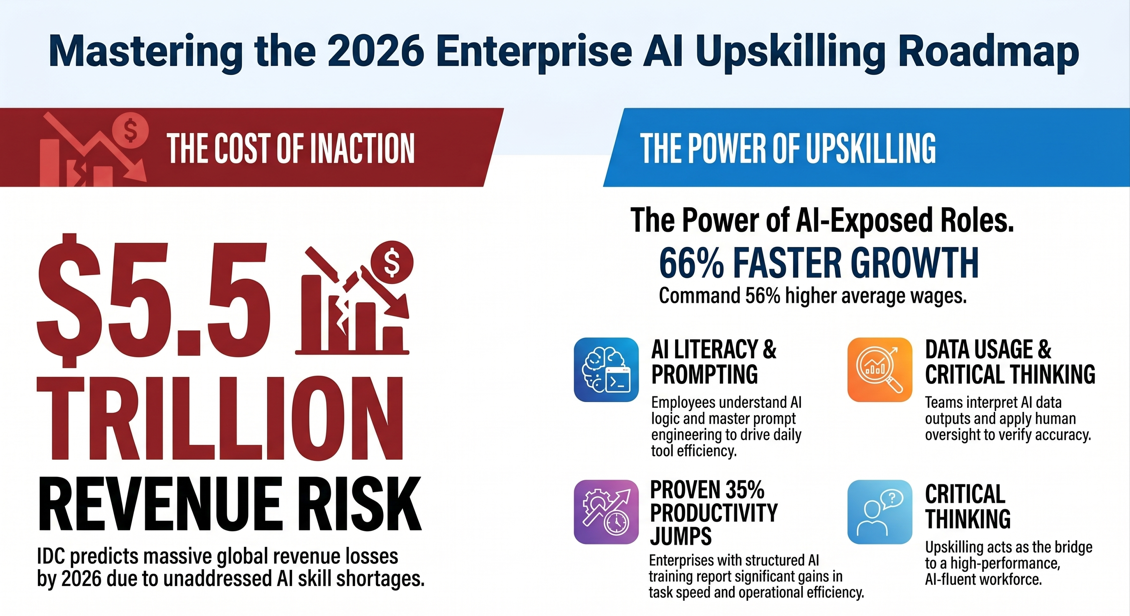
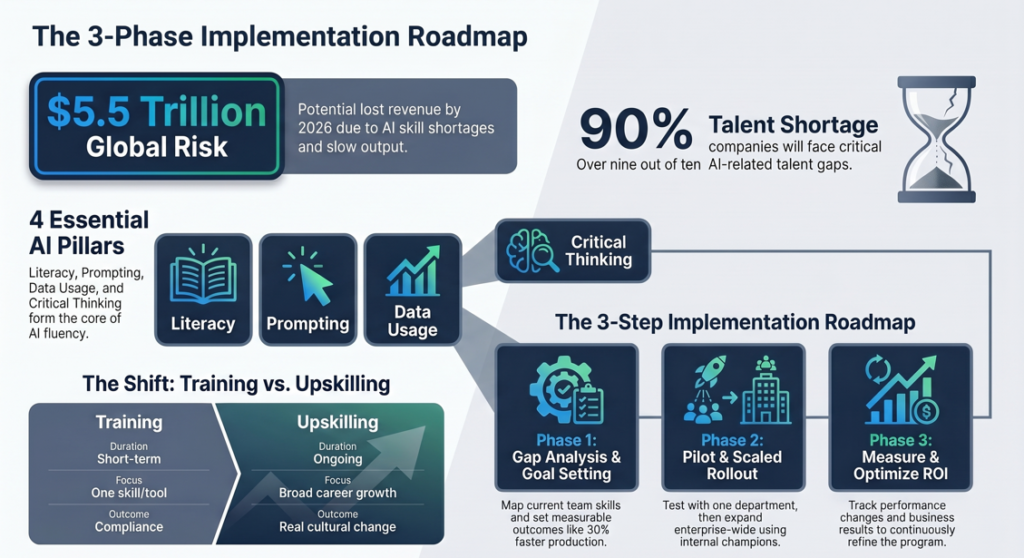
IDC research shows that over 90% of global companies will face critical AI skills shortages by 2026. Furthermore, if those gaps are not fixed, the global economy could lose up to $5.5 trillion in missed revenue, slow products, and weak output.
Those are not small numbers. So, acting now is far cheaper than paying the cost of inaction later.
AI Is Replacing Routine Tasks
AI now handles data entry, basic reports, customer routing, and content formatting. As a result, workers must shift their focus to higher-value tasks. They need to guide, check, and improve what AI produces, not compete with it.
The World Economic Forum’s Future of Jobs Report 2025 breaks this down clearly:
- 29 out of 100 workers will be upskilled and stay in their current role
- 19 out of 100 workers will be retrained and move to a new role
- 11 out of 100 workers will need training but are unlikely to get it; that is roughly 120 million people at risk globally
These numbers are sobering. So, investing in AI training is both a smart business move and a moral responsibility.
AI Tools Are Now the Default
AI tools are no longer extras. They are fast becoming the standard way to work. PwC’s 2025 AI Jobs Barometer found that AI-exposed roles are growing 66% faster than others. They also pay a 56% higher wage on average. Therefore, companies that train their people well gain a real edge in performance and in hiring top talent.
The Skills Gap Hits Every Industry
Demand for AI skills has grown sevenfold in two years, from 1 million to 7 million workers in AI-required roles, per PwC. However, supply has not kept pace at all. In 2026, the talent shortage ratio stands at 3.2:1 across key AI jobs globally. So, growing your own talent through upskilling is now smarter than trying to hire it.
Key Skills Employees Need for AI Readiness
Employees need both technical and soft AI skills to use AI tools well at work.
You do not need to turn your team into data scientists. Instead, the goal is practical AI fluency. That means each person can use AI tools well within their own role.
AI Literacy: The Basics
AI literacy is knowing what AI can do and what it cannot. Employees should understand:
- How AI reaches its answers
- Where it makes mistakes
- How to spot poor outputs
- Why human review still matters
This basic knowledge stops people from over-trusting AI. It also helps them catch errors before they cause real problems.
Prompting and Tool Skills
Prompt engineering is now a core work skill. Employees who write clear, focused prompts get much better results from tools like ChatGPT, Copilot, or Gemini. Furthermore, knowing which AI tool fits which task makes a big difference in daily output quality.
Reading and Using Data
AI gives you charts, scores, forecasts, and summaries. Therefore, your team needs to read and understand that data clearly. Without this skill, AI outputs just sit there unused — or worse, get misread and acted on wrongly.
Critical Thinking
AI gets things wrong often. It can make up facts, miss context, and carry biases from its training data. Consequently, strong critical thinking is essential. Every team member needs to check AI outputs before using them, especially in finance, legal, or health-related work.
How to Design a Scalable AI Upskilling Framework
A scalable AI training framework uses role-based paths, smart tools, and regular skill tracking.
No single program works for every team. However, the best ones share three traits: they are modular, measurable, and matched to real job roles.
Role-Based Learning Paths
Each department needs different AI skills. So, avoid the trap of one course for everyone. Here are some good starting points by role:
- HR teams: AI for hiring, performance reviews, and workforce data
- Marketing teams: Generative AI for content, ads, and campaign insights
- Finance teams: AI for forecasting, fraud detection, and report automation
- IT teams: AI governance, model rollout, and data security
HR teams can use AI for hiring, performance reviews, and workforce data. Read our full guide on AI HR Training Programs to see how this works in practice.
Microlearning: Short and Sharp
Long training sessions have low finish rates. Microlearning cuts content into 5–15 minute modules. As a result, employees can learn between meetings or tasks. Additionally, repeating key ideas in short bursts over time greatly improves how much people actually retain.
AI-Powered LMS Systems
Modern learning platforms now use AI to personalize each person’s path. They adapt based on skill tests, track progress in real time, and flag anyone who needs extra help. Therefore, training scales easily without needing a huge L&D team to manage it manually.
Modern learning platforms track progress and adapt to each learner automatically. For a full setup guide, see our article on LMS Integration.
Track Skills Over Time
You cannot fix what you do not measure. So, build in clear tracking from day one. Good frameworks measure the following:
- Pre- and post-training skill scores
- Module finish rates and engagement
- On-the-job performance changes
- Business results like speed, accuracy, and error rates
Step-by-Step Implementation Plan for Enterprises
Start small, test your program, then scale it across teams once you have proof it works.
Step 1: Run a Skill Gap Analysis
First, map your current team skills against what AI-ready work needs. Use surveys, manager input, and job task reviews. Then focus on the roles where the gap is biggest and the impact is highest.
Step 2: Set Clear Learning Goals
Next, write specific, measurable outcomes before you build anything. For example: “Marketing staff will cut content production time by 30% within 90 days.” Clear goals keep training focused and make results easy to judge.
Step 3: Pilot With One Team
Then, run a small test with one department. Collect feedback on content, relevance, and early results. Use that data to improve the program before you roll it out more widely.
Step 4: Scale Across the Business
Once your pilot proves the approach works, expand department by department. Also, identify internal champions, people who finished early and can help their teammates to speed up adoption.
Step 5: Measure and Improve
Finally, compare results against your starting data. Adjust the content, format, and schedule based on what is working. Above all, treat this as an ongoing system, not a one-off project.
Case Study: How IKEA Trained 30,000 Employees for AI
IKEA launched one of the best-known enterprise AI upskilling programs in 2024. Their goal was clear: train 30,000 employees and 500 leaders to use AI tools with confidence and responsibility.
Their program covered several tracks:
- AI Fundamentals: a base course for all staff
- Specialized tracks: Responsible AI, Mastering Gen AI, and AI Ethics
- AI Exploration Days: leadership sessions linking AI to IKEA’s goals
- Hej Copilot: a generative AI tool built with Microsoft for daily tasks
So, what made it work? The mix of broad access and role-based depth. First, every employee got the same foundation. Then, each person moved into the track that matched their job. That two-level approach is easy to copy, and it scales well across large teams.
Source: Top 5 Companies Investing in Upskilling – Careerminds
Common Mistakes Companies Make in AI Upskilling
Most AI training programs fail because of weak structure, poor adoption, and no link to real work.
Even big-budget programs frequently fall short. Here are the most common reasons behind these failures:
Too Much Theory, Too Little Practice
Teaching AI in the abstract does not help on a busy Monday morning. So, training must connect to the tools and tasks people use every day. Without that link, skills fade fast and engagement drops.
No Role Customization
Generic training treats a developer the same as a sales rep. That wastes everyone’s time. Moreover, it tells employees the company does not really understand their work, and that hurts buy-in.
No Leadership Backing
When leaders do not model or mention AI training, employees treat it as low priority. However, when a VP joins a session or mentions AI skills in reviews, adoption rises fast. So, leadership involvement is not optional; it is critical.
No Way to Measure Progress
In fact, IDC found 35% of leaders feel they have prepared their employees well for AI roles. One big reason is the lack of tracking. Ultimately without data, you cannot see what is working. And without that insight, you keep spending on what does not.
Measuring ROI of AI Upskilling Programs
The return on AI upskilling shows up in better output, lower costs, and smarter decisions across the business.
Real Data: What Trained Teams Achieve
The proof is growing. Here is what research shows:
- Customer support: A Fortune 500 firm saw a 14% jump in issues resolved per hour after giving 5,200 agents an AI tool. For newer agents, productivity rose by 35%.
- Software development: GitHub Copilot users finished coding tasks 55.8% faster, per a 2023 Stanford and GitHub study.
- Industry-wide: In 2024, industries with higher AI use saw 10% higher productivity gains than those with lower use, based on U.S. labor data.
- Cross-function gains: A 2025 study in the Inverge Journal of Social Sciences found that integrated AI use across HR, marketing, and finance led to 20–30% more operational efficiency and up to 75% greater ROI.
So, the data is clear. Trained teams produce more, make fewer errors, and deliver higher value.
Metrics to Track in Your Program
Use these to judge your results:
- Task speed: time before and after training
- Error rates: especially in data, finance, or compliance roles
- Confidence scores: how ready do employees feel?
- Business KPIs: output volume, resolution speed, revenue per person
- Training cost vs. gain: is the investment paying off?
What DataCamp Found in 2026
Organizations with a full, company-wide AI literacy program are nearly twice as likely to report strong AI ROI compared to those with scattered training. That finding is key. It shows that scale and structure both matter, not just content quality alone.
Future of AI Upskilling in Enterprises
AI training will become continuous, personal, and built right into daily work, not treated as a separate activity.
Personalized Learning at Scale
Adaptive platforms will soon assess each employee’s skill level in real time. Then they will serve the right lesson at the right moment. As a result, training becomes far more efficient, and far less generic.
Skills Will Keep Changing
WEF estimates that 39% of core job skills will change by 2030. Moreover, LinkedIn data shows skills have already shifted 25% since 2015 and will be 50% different by 2027. Therefore, one-time training is no longer enough. Instead, learning must become a regular habit built into working life.
Learning Will Live Inside Work Tools
Future training will not sit in a separate app. Instead, it will appear inside tools people already use, a prompt tip in Slack, a coaching nudge in Microsoft 365, a quick lesson inside your CRM. That embedded model reduces friction and keeps learning tied to real work.
FAQs
What is an AI upskilling strategy?
An AI upskilling strategy is a structured plan to train employees in AI-related skills. Ultimately, it improves efficiency and boosts productivity. At the same time, it ensures your organization is completely ready for digital change.
Why is AI upskilling important for enterprises?
It helps companies close the AI skills gap. Furthermore, it boosts team performance. This ensures you stay competitive as AI tools become standard at work.
How do companies implement AI training programs?
They start with a skill gap analysis, then build role-based learning paths, run a pilot, scale it across departments, and track ROI along the way.
What skills are needed for AI in the workplace?
The key skills include AI literacy along with prompt engineering. In addition, workers need strong skills in data reading, followed by the critical evaluation of AI outputs.
What is the biggest challenge in AI upskilling?
Here is a revised version that connects the ideas smoothly while keeping the sentences simple and easy to digest for a high readability score:
However, the biggest challenge is building a structured, role-specific program. This requires strong leadership support along with clear measurement. Ultimately, without these three elements, most programs underperform.
How long does it take to see ROI from AI upskilling?
Consequently, most companies see measurable gains within 60–90 days. This is especially true in support, content, and data-heavy roles.
References
- productivity effects of generative artificial intelligence.
- The Impact of AI on Developer Productivity.
- Generative AI at Work.
Conclusion
Building a successful AI upskilling strategy does not have to be overwhelming. Instead, it is all about taking small, smart steps to prepare your team. In the end, a solid AI upskilling strategy will keep your business ahead of the curve and ready for what comes next.
Authored by: Laiba Ayaz