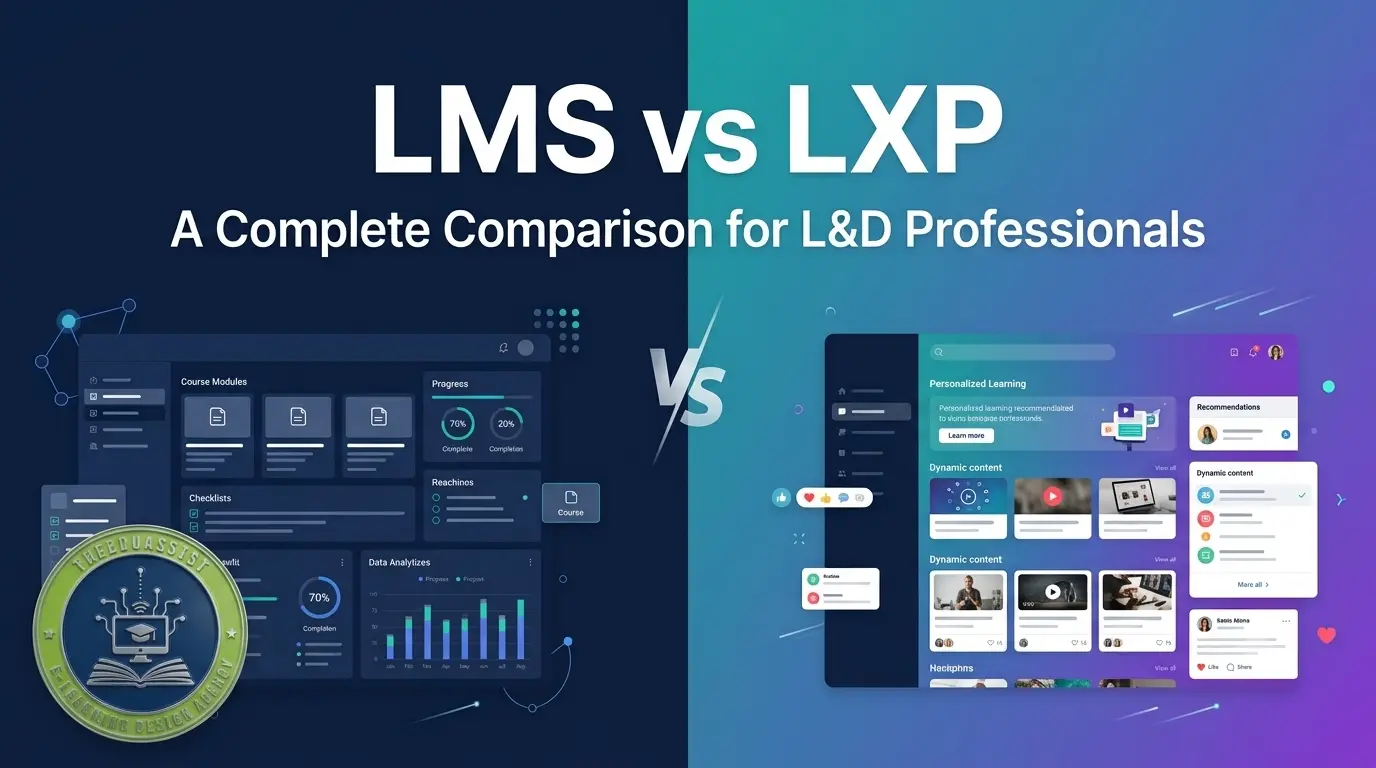
LMS and LXP is an emerging impact on the eLearning industry.
LMS stands for Learning Management Systems that is used tp create manage and track their outcomes.
LXP stands for learning experience platform that is a AI driven learning platform to boost the personalized user experience.
With the emerging markets of eLearning the knowledge of both platform and comparison is also mandatory to get the base line of this.
Why is AI making the LMS vs. LXP debate more relevant than ever?
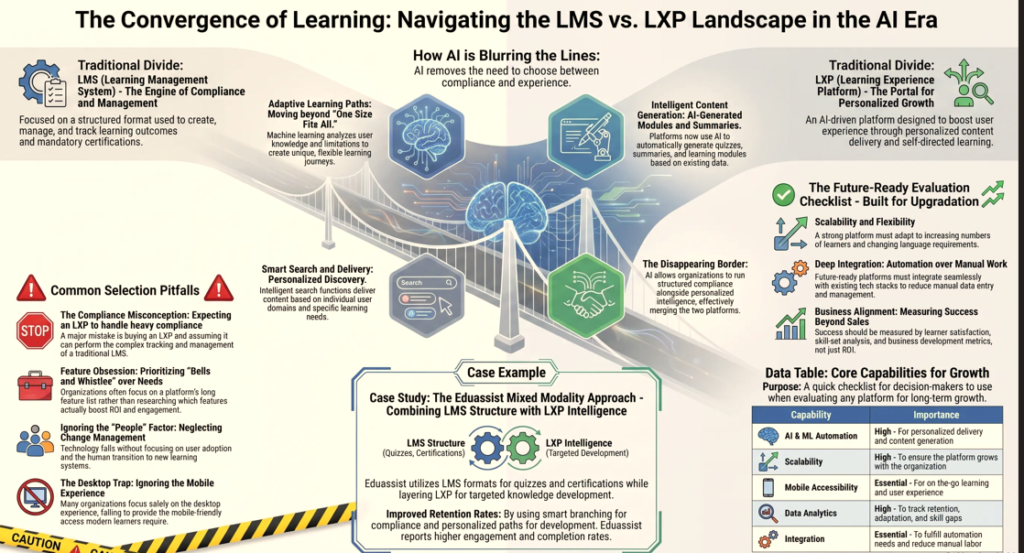
AI is giving us confusion about the LMS and LXP. LMS based on a structured format while the LXP is providing a personalized experience for the users.
In today’s world, AI uses data on user knowledge, domain, and limitations. It also provides structured compliance with the personalized intelligence.AI is making the debate more relevant because the organization did not really have to choose. As they are taking it side by side, by using the compliance and the personalized learning experience as well.in short, Ai is just not making any difference and blurring the traditional lines between LMS vs LXP.
Can AI-powered LMS platforms deliver an LXP-like experience?
Yes, with the passage of time LMS also surpassing the LXP as with the AI automation and experiences improves the LMS with better LXP as well.
At the Eduassist we also using such LMS that is upporting LXP and also are more helpful in boosting the engagment rate and retention.
- Using Machine learning giving the personalized content for learning
- Adaptive Learning paths
- USing the AI generate Modules,Quizzes and Summaries
- More intelligent search and content delivery according to the personalized delivery
How do organizations balance compliance training with personalized learning?
Its is avery critical and thoughtful process that can be filled with intelligent layerings.
- You can use LMs for basic formats like quizzes, certifications etc.
- You can also Layer LXP using AI For developmental tarining.
At Eduassist, we are completely using mixed modality while implementing LMS basic formats of quizzes, certifications, and compliance using smart branching. Side by side. We are using the LXP for more personalized and targeted knowledge that helps us in boosting our engagement, retention rate and completion rate.
What common mistakes do companies make when choosing between an LMS and an LXP?
Buying LXP expectimg that it will also perform compliance is the ajire mistakes make by many organizations.
- Not focusing on needs and requiremnets rather then focused on features.
- Ignoring change management and user adoption
- Choosing based on price rather than scalability and AI readiness
- not focusing on mobile experience and busy in boosting desktop experiemce
How should organizations evaluate learning platforms beyond feature lists?
Instead of saying this that which platform has more features. Must have detailed research on which platform has the most relevant and useful features for us that boost the ROI, engagement, and retention.
Checking out the flexibility of whether the platform will meet our upgradation requirements, like languages, learners, and other requirements.
A strong platform has the capability of strong integration that fulfills the need of Automation and reduces manual work.
It must have the ability to manage customized, organizethe fur and update according to the business needs.
What capabilities define a future-ready learning platform?
the future ready platform can be a combination of many things that includes
- integration
- Flexability
- Sacability
- Combination of AI and ML(Machine Learning)
- Personalization
- Mobil friendly accessible design and much more
https://theeduassist.com/blog/is-absorb-lms-right-for-small-businessthe-strong-eduassist-guide/
How can learning leaders measure the success of an LMS or LXP implementation?
Of course, between both LMS and LXP, which platform provides a better ROI? Not only ROI matter, but also which one is giving more engagement rate, retention, adaptation, and business development metrics. This scale should not be limited to sales and development of business, but also the satisfaction rate of the Learners as well.
How should organizations prepare their learning strategy for AI-driven workforce development?
They should make an engagement with the experts who handle both technical aspect and learning strategies as well
Make a list of your existing gaps and make stratergies to fill those gaps in upcoming futire for netter performance
By making a analysis of their employee skillset and plan accordingly as a group training is not applicable nowadays but a single employees skill set and training matters now a days that boost their performance and learn fast.
Learning is a continuous process it should not be stop.AI is changing the roles quickly so keep up to date is now getting more crucial
What practical criteria should decision-makers use when selecting a learning platform for long-term growth?
While selecting the platform the practical decision is not just the platform has the most features but which platform can modify best according to the changing and demanding needs of the organization’s needs includes ‘
- Best integration
- scalability
- Flexability
- Ai automation
- Analytics
- User experience
- business alignment and many more
https://theeduassist.com/blog/how-to-migrate-to-a-new-lms-a-complete-checklist-for-2026/
Conclusion:
Summing up, both platforms are mandatory, but they should be optimized according to the needs and wants of the organization. It is very important to classify the needs of the business. Getting stuck in the future is very frustrating. So, to avoid it, detailed research and observation is required to finalize the actual platform for your organization.
The Edu Assist can help you in this regard as we are just a call away .For more guidance and assistance you can contact us for your services.
References:
Bersin, J. (2025). AI-powered learning platforms: The convergence of LMS and LXP. Josh Bersin Company. https://joshbersin.com
Deloitte. (2025). 2025 global human capital trends: AI, skills, and the future of work. Deloitte Insights. https://www2.deloitte.com/us/en/insights/focus/human-capital-trends/2025.html
Gartner. (2025). Market guide for learning management systems. Gartner Research.
LinkedIn. (2025). 2025 workplace learning report: AI’s impact on L&D. LinkedIn Learning. https://learning.linkedin.com/resources/workplace-learning-report-2025
McKinsey & Company. (2025). Generative AI in learning and development: Unlocking personalized upskilling. https://www.mckinsey.com/capabilities/people-and-organizational-performance/our-insights/generative-ai-in-learning-and-development
PwC. (2025). The AI-powered learning organization. PricewaterhouseCoopers.
Siemens, G., & Long, P. (2024). Learning analytics and AI: Transforming LMS platforms. Journal of Learning Analytics, 11(2), 45–62. https://doi.org/10.18608/jla.2024.11.2
TheEduAssist. (2026). Custom AI-enhanced eLearning and LMS integration solutions. https://theeduassist.com/
World Economic Forum. (2025). Future of jobs report 2025: AI and workforce transformation. World Economic Forum. https://www.weforum.org/publications/the-future-of-jobs-report-2025/
CTA:
Have questions about LMS vs LXP, AI-powered learning, or how TheEduAssist can support your organization’s training needs? Get in touch with our team to explore tailored solutions for your learning strategy, platform integration, and workforce development goals. Contact us today and let’s build a smarter learning experience together.
Authored By: Atiqa Sajid