Imagine waking up to new leads, booked calls, and course sales without manually sending emails or moving prospects through your sales process.
That’s exactly what a well-built Kajabi pipeline setup can accomplish.
Many course creators, coaches, consultants, and membership businesses spend countless hours manually following up with prospects. While personalization matters, repetitive marketing tasks often become a bottleneck that limits growth.
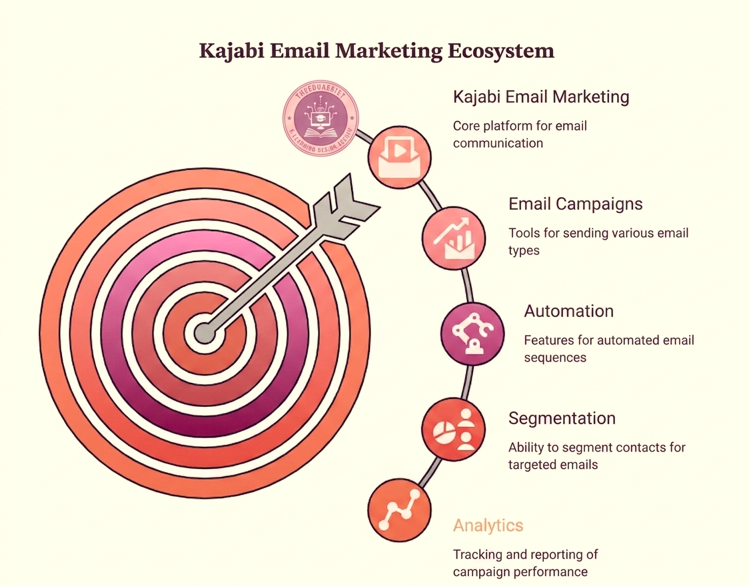
Kajabi solves this challenge through its built-in funnel system, previously known as Kajabi Pipelines and now referred to as Funnels. These automated workflows connect landing pages, email sequences, checkout pages, and offers into a seamless customer journey.
The result? A sales system that nurtures leads and generates revenue even when you’re focused on creating content, serving clients, or scaling your business.
In this guide, you’ll learn how Kajabi Pipelines work, explore real-world Kajabi pipeline examples, and discover the simplest way to automate your sales in 2026.
What Is a Kajabi Pipeline?
A Kajabi pipeline is an automated marketing funnel that guides prospects through a predefined journey—from discovering your brand to becoming a paying customer.
Kajabi describes funnels as a way to automate and organize the connection between landing pages, offers, and email campaigns within a single platform.
Instead of using multiple tools for:
- Landing pages
- Email marketing
- Checkout systems
- CRM automation
- Lead nurturing
Kajabi combines everything into one workflow.
A typical pipeline may include:
- Opt-in page
- Thank-you page
- Email sequence
- Sales page
- Checkout page
- Upsell offer
- Follow-up automation
This all-in-one approach eliminates the complexity of connecting multiple platforms through integrations and third-party automation tools.
Why Automated Sales Funnels Matter?
Research consistently shows that businesses using marketing automation experience improvements in lead management, customer engagement, and conversion efficiency.
The biggest challenge isn’t generating leads. It’s consistently following up.
Most prospects do not buy immediately. They need:
- Education
- Trust-building
- Social proof
- Multiple touchpoints
A Kajabi pipeline automates those interactions. When a visitor downloads a lead magnet, registers for a webinar, or joins your email list, Kajabi can automatically trigger email sequences, tag contacts, and move them toward relevant offers.
This allows creators to scale their businesses without increasing manual workload.
The Core Components of a Successful Kajabi Pipeline Setup
A high-performing Kajabi pipeline setup usually includes several key stages.
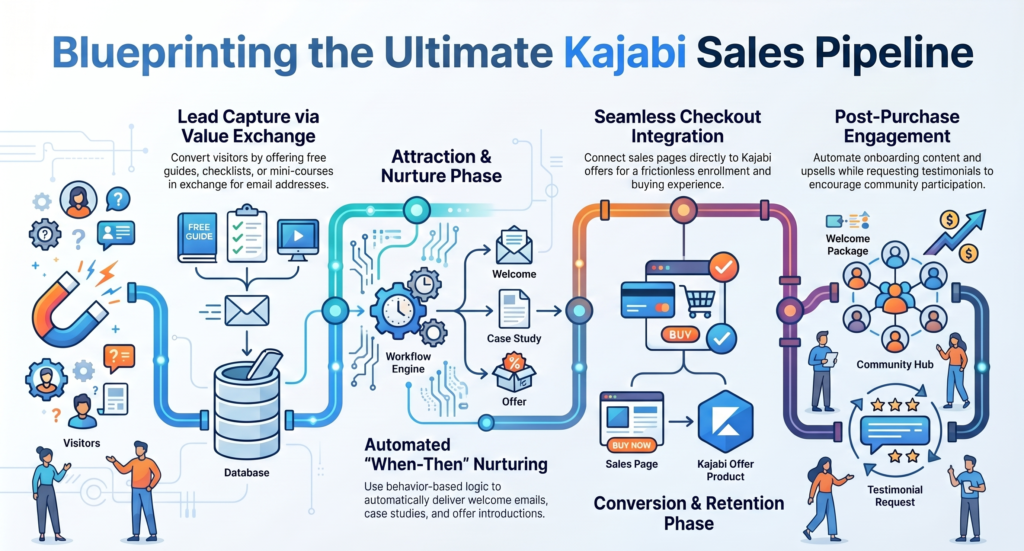
1. Lead Capture
Every funnel begins with capturing attention. Common lead magnets include:
- Free guides
- Mini-courses
- Webinars
- Checklists
- Templates
Visitors exchange their email address for valuable content.
2. Automated Nurture Sequence
After opting in, leads enter an email sequence. Kajabi Automations use “When → Then → But Only If” logic to automatically deliver emails and trigger actions based on user behavior.
Examples include:
- Welcome emails
- Educational content
- Case studies
- Success stories
- Offer introductions
3. Sales Presentation
Once trust is established, prospects are directed toward:
- Sales pages
- Coaching applications
- Webinar offers
- Course enrollment pages
4. Checkout and Purchase
Kajabi’s funnel system connects directly to offers and checkout pages, creating a seamless buying experience.
5. Post-Purchase Automation
The journey doesn’t stop after a sale. Automations can:
- Deliver onboarding content
- Upsell additional products
- Request testimonials
- Encourage community participation
Kajabi Pipeline Examples That Work
Lead Magnet Funnel Flow: Lead Magnet → Thank You Page → Email Sequence → Sales Offer Ideal for: Course creators, coaches, consultants.
Webinar Funnel Flow: Registration Page → Reminder Emails → Webinar → Offer Presentation Works particularly well for: High-ticket coaching, group programs, certification courses.
Product Launch Funnel Flow: Pre-Launch Content → Launch Emails → Sales Page → Checkout Useful for: New course launches, membership openings, digital products.
Coaching Funnel Flow: Lead Magnet → Nurture Emails → Discovery Call Booking → Offer Common among business and executive coaches.
Kajabi provides pre-built templates for these funnel types, reducing setup time significantly.
How to Create an Evergreen Pipeline in Kajabi
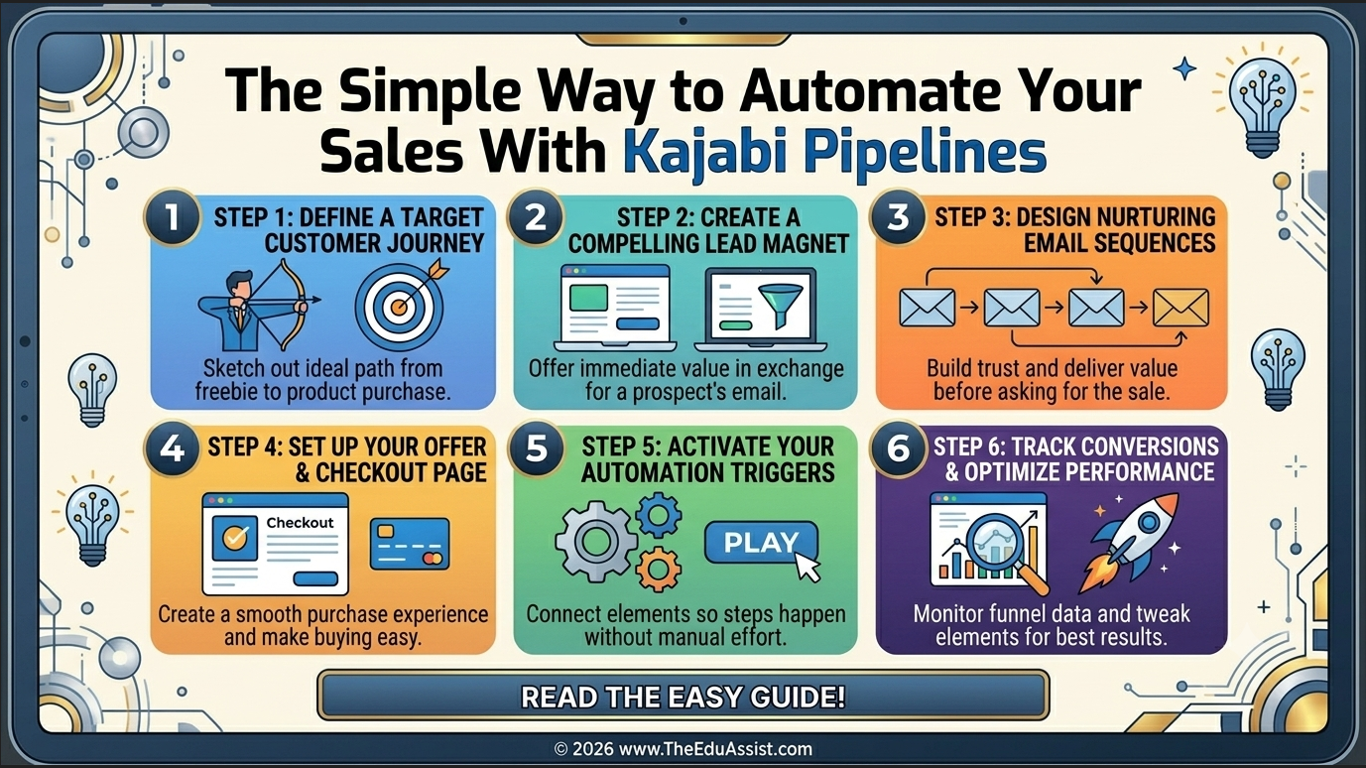
Step 1: Create a Lead Magnet Choose a valuable resource that attracts your ideal customer (free training, checklist, workshop replay, etc.).
Step 2: Build Your Funnel Go to Marketing → Funnels → Create New Funnel and select a template that matches your objective.
Step 3: Connect Email Sequences Create automated emails that deliver value, build trust, address objections, and present offers.
Step 4: Add Behavioral Automations Trigger actions based on link clicks, purchases, form submissions, or product completion.
Step 5: Monitor Analytics Track opt-in rates, email opens, click-through rates, and sales conversions to optimize performance.
How to Duplicate a Pipeline in Kajabi
Duplicating successful funnels allows you to:
- Reuse proven structures
- Launch new products faster
- Maintain consistency across offers
How to Delete a Pipeline in Kajabi
Before deleting:
- Export important content
- Save email copy
- Review analytics
- Document performance benchmarks
Common Kajabi Pipeline Setup Mistakes
- Overcomplicating the funnel
- Sending too many emails
- Ignoring funnel analytics
- Forgetting mobile users
Why Kajabi Pipelines Are Popular Among Course Creators?
Kajabi combines website building, course delivery, email marketing, sales funnels, payment processing, and automations into a single platform.
How Kajabi Pipelines Support Long-Term Growth?
Automation creates repeatable systems so leads enter, emails are sent, offers are presented, and customers are onboarded automatically. Read this detailed kajabi guide to take your Kajabi Marketing to the next level.
Quick Comparison Table
| Funnel Type | Best For | Setup Difficulty | Automation Level |
|---|---|---|---|
| Lead Magnet Funnel | Audience Building | Low | High |
| Webinar Funnel | High-Ticket Sales | Medium | High |
| Coaching Funnel | Service Businesses | Medium | High |
| Product Launch Funnel | Course Launches | Medium-High | Moderate |
| Evergreen Funnel | Continuous Sales | Medium | Very High |
Cost Reality Check
The real cost of avoiding automation often comes from missed follow-ups, lost leads, manual processes, and inconsistent customer journeys.
References
- https://www.kajabi.com/features/funnels
- https://help.kajabi.com/articles/marketing/automations/automations-overview
- https://www.kajabi.com/blog/kajabi-pipelines-sales-funnel
FAQs
What is a Kajabi pipeline? A Kajabi pipeline is an automated sales funnel that connects landing pages, email sequences, checkout pages, and offers to guide prospects toward a purchase.
How do I create an evergreen pipeline in Kajabi? Create a lead magnet, build a funnel template, connect automated emails, add behavioral triggers, and monitor analytics to optimize performance over time.
Can I duplicate a pipeline in Kajabi? Yes. Many creators duplicate existing funnel structures to save time and launch new offers more efficiently.
Can I delete a pipeline in Kajabi? Yes. Before deleting, review analytics and save important assets such as email sequences and page content.
What are the best Kajabi pipeline examples? Lead magnet funnels, webinar funnels, coaching funnels, and evergreen sales funnels are among the most widely used and effective options.
Authored By: Sofia Arif