If you work in corporate training or course design in the United States, you have likely run into the xAPI vs SCORM question. Both are eLearning standards. Both help your LMS track learner activity. Yet they work in very different ways. Choosing the wrong one can cost you time, money, and useful learner data. So this guide breaks down both standards in plain language. By the end, you will know which one fits your training goals in 2026.
What Is SCORM?
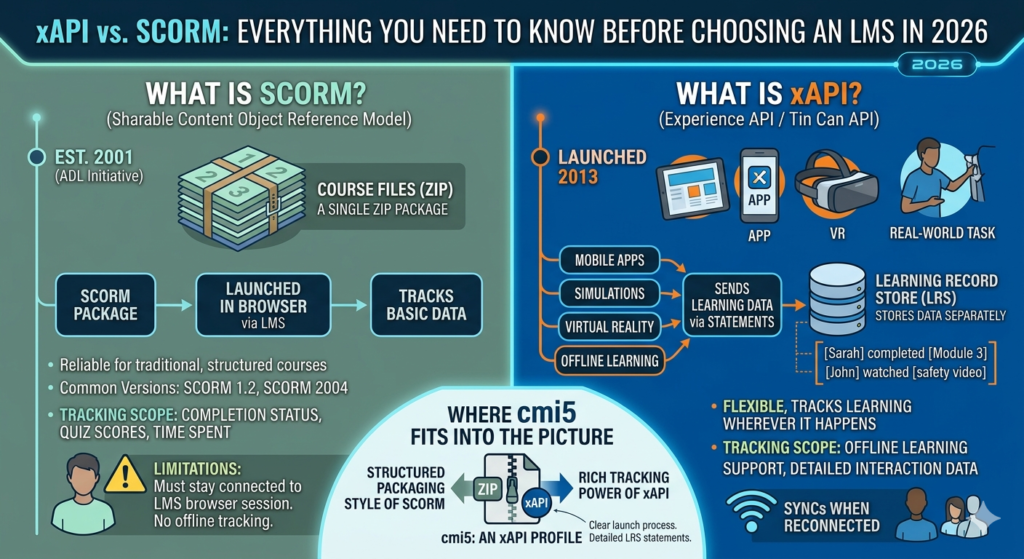
SCORM stands for Sharable Content Object Reference Model. It was created in 2001 by the ADL Initiative, a group backed by the US Department of Defense. Back then, eLearning content built for one LMS often failed to work on another. SCORM solved that problem. It gave the industry a shared language for packaging and tracking courses.
SCORM works by bundling course files into a single ZIP package. This package includes a manifest file that tells the LMS how to launch the content. Once launched, SCORM tracks basic data such as completion status, quiz scores, and time spent. However, it can only do this while the learner stays connected to the LMS in a browser.
Two versions of SCORM are still common today. SCORM 1.2 is the most widely used. SCORM 2004 added better sequencing and navigation rules. Both versions remain reliable for traditional, structured courses.
What Is xAPI?
xAPI, short for Experience API, is also called the Tin Can API. It launched in 2013 as a more flexible alternative to SCORM. Unlike SCORM, xAPI does not need a single LMS to function. Instead, it sends learning data to a Learning Record Store, often called an LRS.
This is where things get interesting. xAPI captures learning activity using simple statements built from a noun, a verb, and an object. For example, “Sarah completed Module 3” or “John watched the safety video.” These statements can come from almost anywhere. That includes mobile apps, simulations, virtual reality training, and even real world tasks performed away from a screen.
Because of this, xAPI supports offline learning too. If a learner finishes a module without internet access, the data syncs to the LRS once they reconnect. This flexibility makes xAPI a strong fit for modern, blended learning environments. Therefore, many organizations use it to track training that happens beyond the LMS.
xAPI vs SCORM: Key Differences
Let’s compare the two standards side by side. This will help you see where each one shines.
- Tracking scope. SCORM only tracks activity inside an LMS delivered course. xAPI, on the other hand, tracks learning wherever it happens, including apps, devices, and offline settings.
- Data storage. SCORM stores data directly inside the LMS. Meanwhile, xAPI sends data to an external LRS, which allows for deeper analysis across multiple systems.
- Connectivity. SCORM needs a constant internet connection to report progress. xAPI, however, supports offline tracking and syncs later.
- Content structure. SCORM requires a strict ZIP package with a manifest file. xAPI has no fixed packaging rules, so it adapts to almost any content type.
- Implementation effort. SCORM is simpler and quicker to set up. xAPI demands more technical skill, plus a properly configured LRS.
- Cost. Since SCORM needs no extra infrastructure, it tends to cost less upfront. xAPI may require new tools or developer support, which raises the initial investment.
- Reporting depth. SCORM gives you basic metrics like pass or fail, completion, and a single score. xAPI captures far richer detail, such as how learners interact with content step by step.
Where cmi5 Fits Into the Picture
You may also come across a third term: cmi5. This is not a separate standard exactly. Rather, it is a profile built on top of xAPI. cmi5 combines the structured packaging style of SCORM with the rich tracking power of xAPI. As a result, it solves two problems at once. It gives content a clear launch process, similar to SCORM, while still sending detailed statements to an LRS.
That said, cmi5 adoption is still growing in 2026. Not every LMS supports it fully yet. So while cmi5 is worth watching, most organizations today are still choosing between standard SCORM and standard xAPI, or running both side by side.
When Should You Use SCORM?
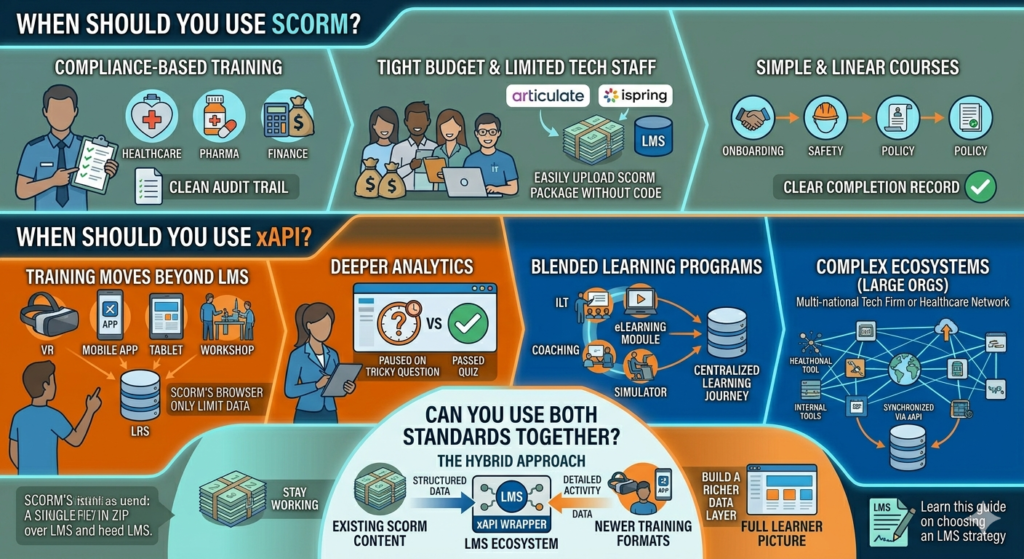
SCORM still makes sense in several situations. First, if your training is mostly compliance based, SCORM works well. Industries like pharma, finance, and healthcare often need a clean audit trail. SCORM delivers that without extra setup.
Second, if your team has a tight budget or limited technical staff, SCORM is the easier path. Most authoring tools, such as Articulate and iSpring, export SCORM packages by default. Most LMS platforms accept them without any extra configuration.
Third, if your courses are simple and linear, SCORM gets the job done. Think onboarding modules, safety training, or policy refreshers. These do not usually need detailed behavioral data. They just need a clear completion record.
When Should You Use xAPI?
xAPI becomes the better choice once learning moves beyond a single platform. If your employees train across mobile apps, simulations, or on the job, xAPI captures that activity. SCORM simply cannot.
xAPI also suits organizations that want deeper analytics. For example, if you want to know not just whether someone passed a quiz, but how long they paused on a tricky question, xAPI can show you that. This level of detail helps L&D teams improve course design over time.
Additionally, xAPI fits well with blended learning programs. If your training mixes instructor led sessions, eLearning modules, and informal coaching, xAPI ties all of that data together in one place. This gives a fuller picture of each learner’s journey.
Finally, large organizations in the United States with complex training ecosystems, such as tech firms or healthcare networks, often lean toward xAPI. Their learning happens across many tools, so they need a standard that keeps up.
Can You Use Both Standards Together?
Yes, and many organizations already do. It is common to use SCORM for structured, LMS based courses while using xAPI to track simulations, mobile learning, or informal activities. Some SCORM packages even include xAPI wrappers, so they report to both systems at once.
This hybrid approach lets you keep your existing SCORM content working as it always has. Meanwhile, you slowly build a richer data layer with xAPI for newer training formats. If you are exploring this path, it helps to first get clarity on your overall LMS strategy. Our guide on how to choose the right LMS for your organization in 2026 walks through the features and questions worth considering before you commit to a platform.
What This Means for LMS Implementation
Before picking a standard, check what your LMS actually supports. Most modern platforms support SCORM out of the box. Fewer offer a built in LRS for xAPI. If yours does not, you can connect a standalone LRS such as SCORM Cloud, Watershed, or Learning Locker.
Also, think about your authoring tools. Not every tool exports xAPI cleanly, so test this early. A mismatch here can cause tracking gaps later, which nobody wants to discover after launch.
Furthermore, consider your team’s instructional design approach. Standards aside, how you design the actual learning experience matters just as much as how you track it. If you are weighing different design methods, our article on AI vs traditional instructional design breaks down how newer tools are changing course creation.
The Buying Intent Behind This Decision
Many teams searching for xAPI vs SCORM are not just curious. They are actively comparing LMS platforms, authoring tools, or training vendors. So if you are at this stage, ask vendors direct questions. Does their LMS include a native LRS? Can their authoring tool export both SCORM and xAPI packages? What support do they offer during migration?
These questions matter because switching standards later is harder than choosing correctly now. A platform that locks you into SCORM only may limit your options as your training needs grow. On the flip side, an xAPI heavy setup might be overkill if your training stays simple and compliance focused.
If your organization is also exploring how artificial intelligence fits into training, it is worth reading about AI powered learning and smarter ways to train and upskill employees. Many AI driven tools rely on xAPI data to personalize learning paths, so your standard choice can directly affect how far you can take automation later.
Making the Final Call in 2026
So, which should you pick? In short, there is no single right answer for every organization. Instead, the answer depends on three things: where your learning happens, how deep your reporting needs to be, and how much technical support you have on hand.
If your training stays inside one LMS and focuses on compliance, SCORM remains a smart, low cost choice. If your learning spans multiple platforms, devices, and real world tasks, xAPI gives you the visibility you need. And if you want the best of both, a hybrid setup, or even cmi5 down the road, may serve you well.
Either way, take time to map out your current and future training needs before committing. The right eLearning standard should support your goals, not limit them.
Frequently Asked Questions
What’s the difference between SCORM and xAPI really?
SCORM tracks learning activity only inside an LMS delivered course. It reports basic data like completion, score, and time spent. xAPI, on the other hand, tracks learning wherever it happens, including mobile apps, simulations, and offline activities, then sends that data to a Learning Record Store for deeper analysis.
Will my LMS work with xAPI or just SCORM?
Most LMS platforms support SCORM by default since it has been the industry standard for over two decades. xAPI support varies, however. Some LMS platforms include a built in LRS, while others need you to connect a standalone LRS such as SCORM Cloud or Watershed. Always check your LMS documentation before assuming support either way.
Should I choose xAPI or SCORM for tracking learner progress in my LMS?
If your training is simple, LMS based, and compliance focused, SCORM is usually enough. If you need to track learning across multiple tools, devices, or offline settings, xAPI gives you a fuller picture. Many organizations use both together for different parts of their training program.
xAPI vs SCORM: which one offers better analytics for employee training?
xAPI offers far richer analytics. It captures detailed statements about learner behavior, not just pass or fail results. This helps L&D teams understand how employees actually engage with content, which in turn supports better course design and more personalized training paths.
Choosing between xAPI and SCORM for interactive course design, which is best?
For highly interactive courses, especially those involving simulations, branching scenarios, or mobile elements, xAPI is generally the stronger fit. It can capture detailed interactions that SCORM is not built to track. That said, if your interactive course still lives entirely within one LMS, SCORM may still cover your needs.
Is cmi5 going to replace both SCORM and xAPI?
Not anytime soon. cmi5 is a profile of xAPI that adds structured packaging similar to SCORM. It is gaining attention in 2026, but adoption across LMS platforms is still uneven. Most organizations continue to rely on SCORM, xAPI, or a mix of both for now.
References
SCORM.com. What Is SCORM and How It Works.
xAPI.com. xAPI (Experience API) Overview.
iSpring Solutions. xAPI vs SCORM: Choosing the Right eLearning Standard.
iSpring Solutions. cmi5 vs SCORM: Choose the Right eLearning Standard.
Authorized By
Hifza Naeem