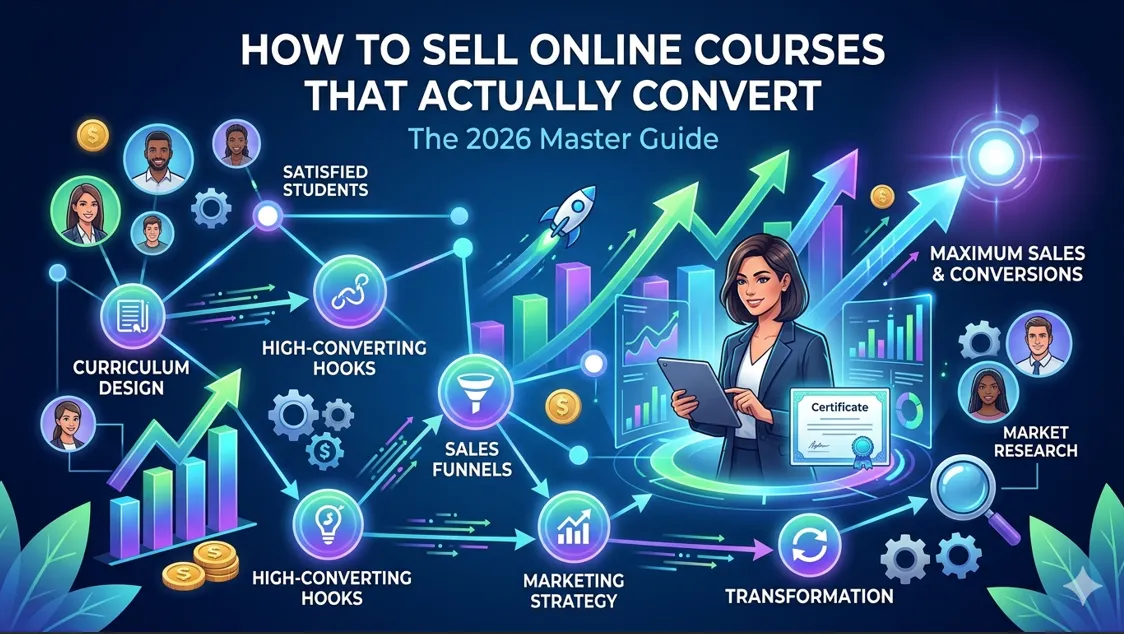
If you want to sell online courses successfully, you must realize that great content is only half the battle. You may have built a course with professional quality and life-changing information; however, your sales dashboard remains stagnant. Many creators assume the problem is the content, but in reality, the issue is almost always a lack of strategic alignment.
To master how to sell online courses effectively, you must align your curriculum, messaging, and marketing into a single, high-performing system. Specifically, we will look at how to turn disinterested visitors into loyal, paying students using a proven 5-step framework to sell online courses at scale.
What Does It Mean to Sell Online Courses That Convert?
To understand how to sell online courses, you must first master the psychology of conversion. In digital marketing, conversion is the moment a lead transitions from a passive observer to an active buyer. Therefore, your marketing must communicate a specific, undeniable transformation.
Instead of selling academic information, you must sell a tangible future. For example, consider these two different approaches:
- Approach A (Weak): “Learn the fundamentals of graphic design.”
- Approach B (High-Converting): “Design your first professional brand identity in under 10 days.”
This shift is vital because 2026 buyers are overwhelmed with information. They are no longer paying for knowledge; they are paying for the speed of the result. As a result, your online course sales strategy must lead with the “After” state of the student.
The 5-Step System to Sell Online Courses and Scale
Step 1: Research Your Market to Sell Online Courses Better
Before you record a single video, you must validate your idea. Most creators fail to sell online courses because they build something no one actually asked for. Consequently, market research is your most important insurance policy.
To begin, focus on:
- Competitor Ad Hooks: What headlines are your competitors using to grab attention on social media?
- Negative Reviews: Visit Amazon or Udemy and read 1-star reviews of similar courses to see what students are missing.
- Language Mirroring: How does your target audience describe their pain? Use their exact words in your sales copy.
In addition, look for market gaps where competitors are being too general. By being specific, you position your offer as the only logical solution, making it much easier to sell online courses in a crowded niche.
For a practical example of market-aligned design, see our guide on building a high-value digital marketing curriculum.
Step 2: Define a Clear Transformation to Sell Online Courses Faster
If you want to master how to sell online courses, clarity is more valuable than cleverness. Your potential students need to know exactly what they are getting. Specifically, your course must answer the internal question: “Is this worth my time and money?”
To fix this, make your promise measurable. For instance:
- “Master Python coding” is too vague.
- “Build your first automated trading bot in 3 weeks” is a clear transformation.
Consequently, your sales page will convert at a higher rate because the value proposition is rooted in a specific outcome. Furthermore, this clarity allows you to charge higher prices, as you are selling a “solution” rather than a “commodity.”
Step 3: Design a Curriculum That Helps You Sell Online Courses
Most instructors treat curriculum design as an academic exercise. However, in the world of online business, your curriculum is a marketing tool. If your students don’t see progress quickly, they will drop out. This is a core pillar of modern course curriculum design.
For example, you should structure your modules to maximize momentum:
- The Quick Win: Your first module should solve a small, nagging problem immediately to build trust.
- The Implementation Phase: This is where the heavy lifting happens. Ensure you provide templates or checklists to reduce friction.
- The Final Transformation: This module ties everything together and delivers the ultimate result promised in your marketing.
Because each section delivers a tangible achievement, your students become your best advocates. Moreover, their success stories provide the social proof you need to sell online courses to skeptics later on.
To ensure your students get the results you promised, learn how to turn passive lessons into interactive experiences.
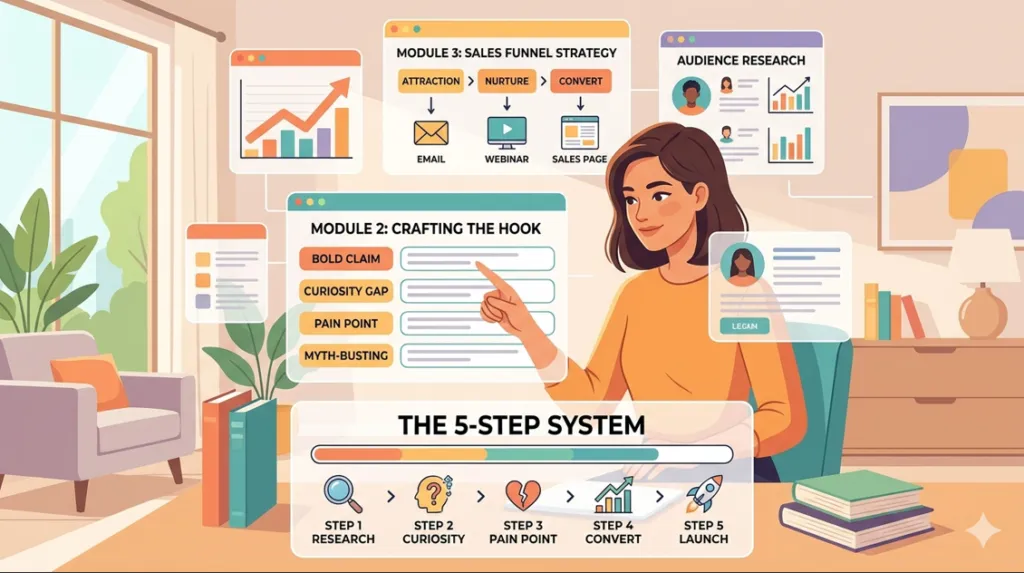
Step 4: Write Hooks That Help You Sell Online Courses to Cold Leads
In a world of short attention spans, your hook is the gatekeeper to your sales page. That is why mastering hooks is non-negotiable if you want to sell online courses successfully. A hook is the first sentence of an email, the first five seconds of a video, or the headline of an ad.
Consider these advanced hook frameworks:
- The Myth-Buster: “Everything you’ve been told about SEO is wrong. Here is what actually works in 2026.”
- The Cost of Inaction: “Every day you wait to launch your course, you are losing potential passive income.”
- The Curiosity Gap: “I used this 3-step formula to turn a $26 launch into a six-figure business.”
By utilizing these psychological triggers, your online course marketing strategy becomes much more effective. Furthermore, it allows you to lower your ad costs by increasing your click-through rates.
Step 5: Implement the Right Funnel to Sell Online Courses at Scale
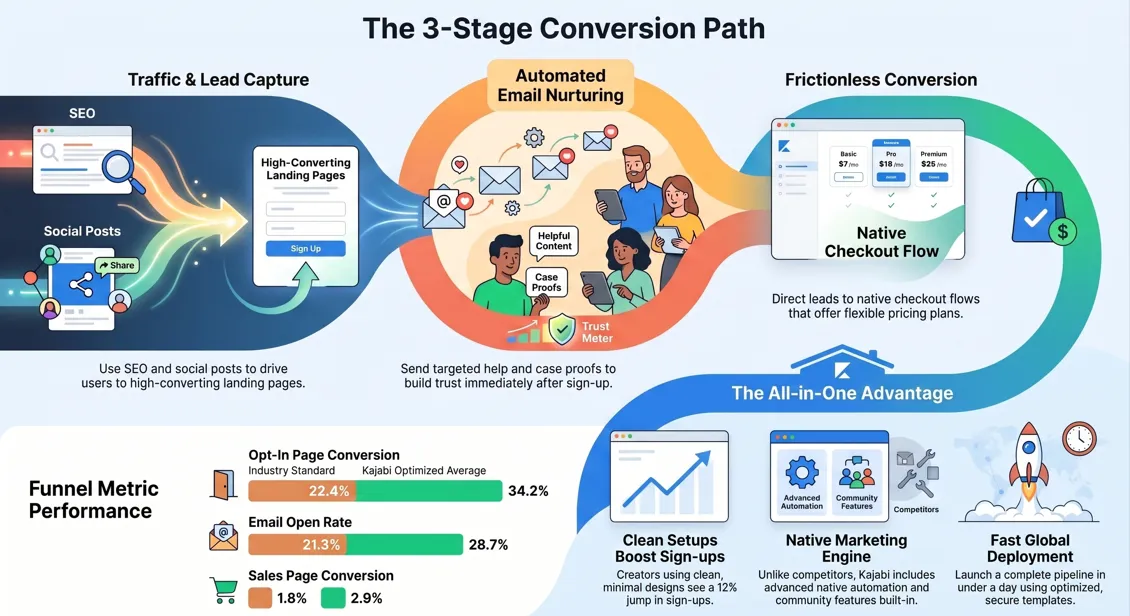
Finally, you must choose a delivery system for your marketing. A funnel is simply the path a stranger takes to become a student. Due to different levels of market awareness, you need a tailored approach.
- The Webinar Funnel: Excellent for high-ticket courses (over $500). It allows you to build deep authority over 45 minutes.
- The Mini-Course Funnel: Great for lower-ticket “tripwire” offers. This gets people into your ecosystem quickly.
- The Email Sequence: Essential for nurturing leads who aren’t ready to buy today.
As a result of having a structured funnel, you stop “guessing” where your sales come from. Consequently, you can accurately predict your monthly revenue based on your traffic.
Comparison: Weak vs. High-Converting Courses
| Element | Weak Course Model | High-Converting System |
|---|---|---|
| Primary Goal | Dumping information | Delivering a transformation |
| Module Logic | Chronological/Topic-based | Achievement/Result-based |
| Marketing | “Buy my course” | “Solve your problem” |
| Launch Style | Random posts | Strategic Funnel |
| Success Rate | High refund rate | High completion rate |
Common Mistakes That Kill Your Conversion Rate
If you find it difficult to sell online courses, look for these specific “conversion killers”:
- The “Everything” Course: Trying to teach too much. Instead, focus on one problem for one person.
- Ignoring Social Proof: People don’t want to be the first to try something. Therefore, always lead with testimonials.
- Weak Call to Action: Don’t just say “Enroll Now.” Instead, tell them exactly what happens next.
By fixing these small errors, you can significantly increase your online course conversions without spending more on ads.
Advanced Psychological Triggers to Boost Sales
To maximize your ability to sell online courses, you can sprinkle these triggers throughout your sales copy:
- Urgency: A limited-time discount or a countdown timer.
- Scarcity: Only allowing a set number of students per cohort to ensure quality.
- Reciprocity: Giving away a high-value freebie (like a PDF or mini-lesson) first.
When these are used ethically, they help hesitant buyers make a decision. Furthermore, they protect your profit margins by preventing “discount hunting.”
Case Study: Using Strategy to Sell Online Courses
To truly understand how to sell online courses, look at the evolution of Amy Porterfield. Her first launch earned only $26. Instead of quitting, she realized her mistake: she was selling “content” instead of “results.”
She shifted her entire business model:
- Firstly, she started building an email list long before her launch.
- Secondly, she used webinars to teach the “Why” and sold the “How” in her course.
- Finally, she refined her messaging to speak directly to the fears of her audience.
By the time she launched again, she had a system that could sell online courses predictably. Her journey proves that the “Information Age” has ended, and the “Transformation Age” has begun.
You can read the full breakdown of her first launch story on her official site.
References
- The Science of Outcome-Based Curriculum Design (Vanderbilt University)
- Mastering the 1-2-3-4 Formula for Sales Copy (Copyblogger)
- A Complete Guide to Building Marketing Funnels (HubSpot)
Conclusion
Learning how to sell online courses is a journey of constant refinement. However, if you follow the 5-step system outlined above, you are already ahead of 90% of your competitors.
Remember, your students are not looking for more videos to watch. They are looking for a bridge from their current pain to a better future. By providing that bridge through an aligned curriculum and marketing strategy, you will not only sell online courses but also change lives in the process.
FAQ: Frequently Asked Questions
How long does it take to sell online courses successfully?
It depends on your audience size, but with a focused funnel, you can see results in as little as 30 days.
What is the most profitable niche to sell online courses?
Health, Wealth, and Relationships remain the “big three,” but specialized tech skills are rising rapidly in 2026.
Do I need expensive equipment to sell online courses?
No, a modern smartphone and a $30 lapel microphone are enough to get started. In fact, “authentic” content often converts better than overly polished videos.
How can I sell online courses if I have a small audience?
Focus on a high-converting “Micro-Funnel” that targets a specific niche rather than a broad audience. By solving one urgent problem for a targeted group, you can successfully sell online courses without a massive following.
What is the most effective way to sell online courses in 2026?
The most successful strategy is selling a measurable transformation rather than just generic information. Prioritizing speed and results over content volume is the key to helping you sell online courses in a crowded market.
How do I increase the conversion rate of my course sales page?
Ensure your page highlights clear student milestones and uses psychological hooks that address specific pain points. Combining these with strong social proof and a clear call to action will help you sell online courses more effectively.
Authored by: Laiba Ayaz