Introduction: Why Digital Marketing Courses Often Fail
Many digital marketing courses overwhelm students with information but rarely teach strategic thinking or real-world application. Creating a digital marketing curriculum that focuses on practical skills, data-driven decision-making, and hands-on experience is essential to help learners succeed.
In this guide, you’ll learn how to create a high-value digital marketing curriculum that produces measurable results and prepares learners for real-world success.
Phase 1: Define Strategy Before Creating Your Digital Marketing Curriculum
Before creating content, clarity is essential. Frameworks like Backward Design and ADDIE help you plan lessons that teach skills, not just theory.
Step 1: Define Goals for Your Digital Marketing Curriculum
Focus on what learners can do, not just what they know. Examples:
- Build a digital marketing strategy
- Launch a high-converting campaign
- Analyze and optimize campaigns using real data
Mindset shift: move from content delivery to skill transformation.
Step 2: Decide How to Measure Success in Your Curriculum
Avoid relying solely on quizzes. Include tasks like:
- Multi-channel campaigns
- A/B testing
- Landing page creation
This ensures your curriculum is hands-on and results-driven.
Step 3: Know Your Audience
Identify whether learners are beginners or advanced, and whether they are active participants or observers. This helps you design relevant and engaging lessons.
Phase 2: Build the Core Digital Marketing Curriculum
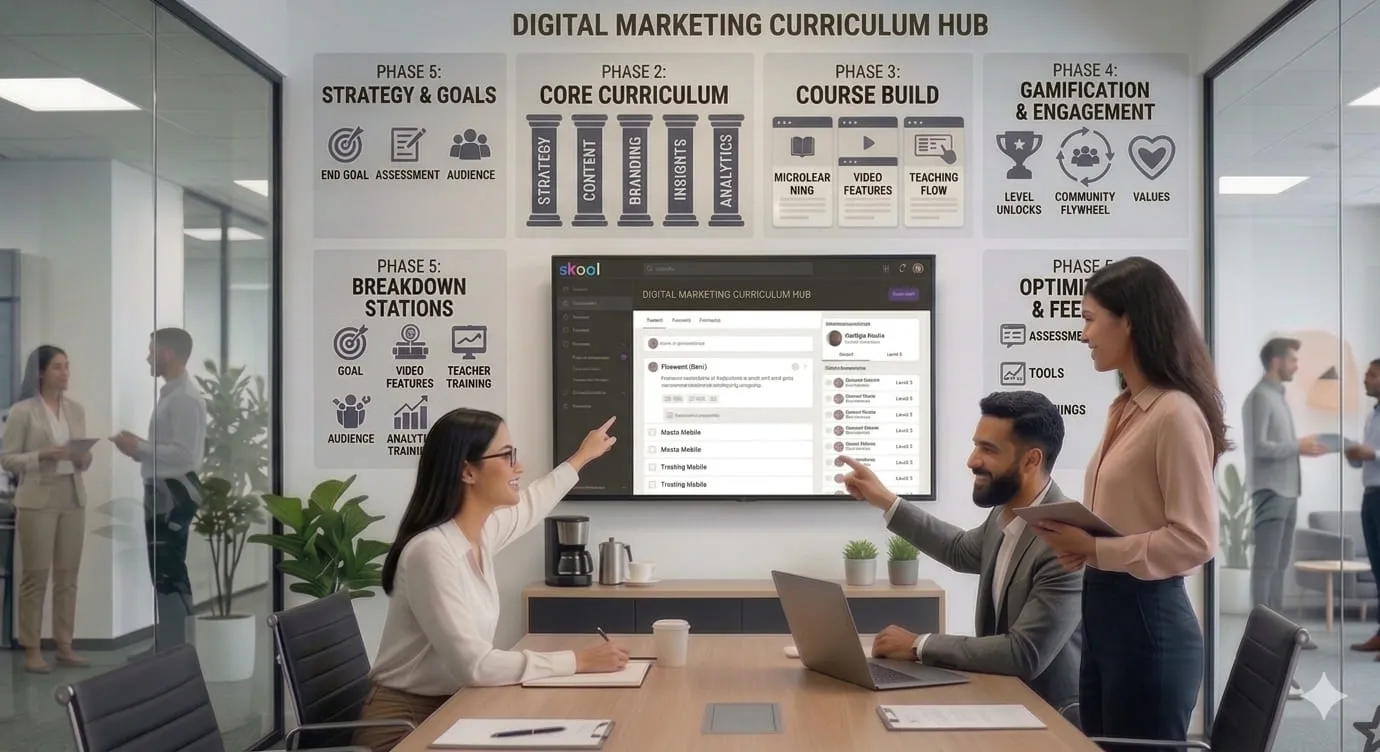
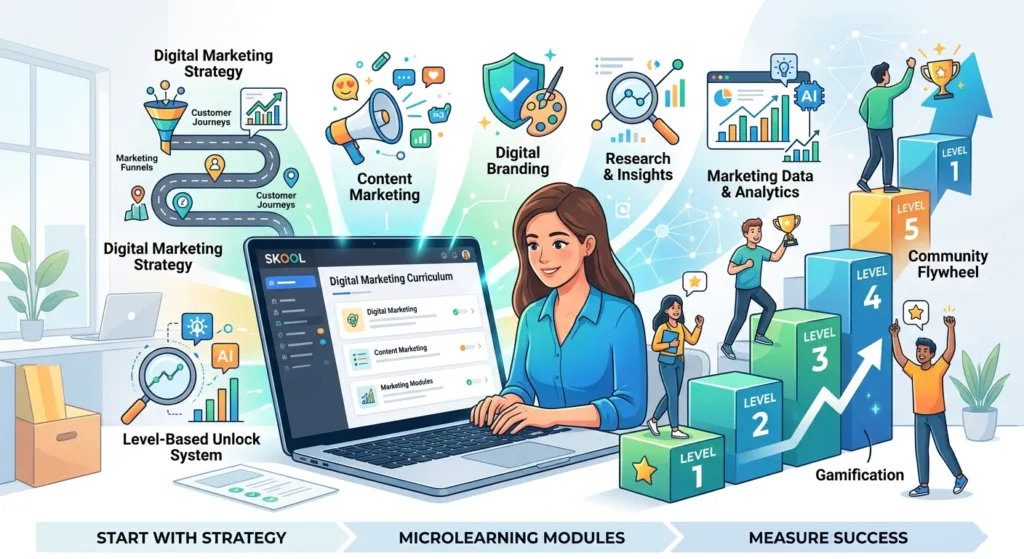
A strong curriculum should cover five pillars:
1. Digital Marketing Strategy
Teach the big picture, including funnels, customer journeys, and positioning.
2. Content Marketing
Focus on storytelling, audience engagement, and content creation.
3. Digital Branding
Help learners build a consistent brand voice and online presence.
4. Research & Consumer Insights
Teach audience behavior analysis and data-driven decisions.
5. Marketing Data & Analytics
Introduce tools like Google Analytics to track, measure, and optimize performance.
Phase 3: Build Your Skool Course Effectively
Use Microlearning
Break lessons into three parts:
- Explanation
- Real-world example
- Action task
Leverage Skool’s Video Features
Use built-in tools to:
- Add captions
- Create chapters
- Keep learners engaged on the platform
Follow a Proven Teaching Flow
Structure lessons: attention → explain → examples → practice.
Phase 4: Use Gamification to Drive Engagement in Your Curriculum
Even great content fails without engagement. Skool provides tools to motivate learners.
Level-Based Unlock System
Lock advanced lessons behind levels:
- Basics (Level 1)
- Strategy (Level 2)
- Advanced Tools (Level 3)
Build a Community Flywheel
Encourage active learners to share insights and results. Learn more about building a high-engagement Skool community here.
Define Community Values
Guide learners through values, not rules:
“We value quality, insights, and real results.”
Phase 5: Continuously Improve Your Digital Marketing Curriculum
Successful courses evolve with learners’ needs.
Use the 4-Level Evaluation
Measure:
- Reaction: Are learners satisfied?
- Learning: Are skills improving?
- Behavior: Are skills applied?
- Results: Are outcomes achieved?
Track Meaningful Metrics
Focus on engagement, retention, and real-world results instead of vanity metrics.
Apply the 3 R’s
- Remind → Guide participants
- Redirect → Keep discussions relevant
- Remove → Eliminate low-value content
Quick Summary Table of Digital Marketing Curriculum Phases
| Phase | Focus | Key Tip |
|---|---|---|
| Strategy | Define goals | Start with outcomes |
| Curriculum | Build pillars | Focus on skills |
| Course Setup | Structure lessons | Use microlearning |
| Engagement | Gamification | Reward activity |
| Optimization | Continuous improvement | Track real metrics |
References
- Google Digital Garage – Fundamentals of Digital Marketing
- Google Analytics
- HubSpot – Content Marketing Guide
- VWO – A/B Testing Guide
- edX – Microlearning Overview
Conclusion
Creating a digital marketing curriculum on Skool is more than just delivering lessons—it’s about teaching practical skills, strategic thinking, and real-world application. By defining clear goals, structuring content around core pillars, leveraging microlearning, and using gamification, you can design a course that truly engages learners and delivers measurable results.
Continuous evaluation and optimization ensure your curriculum evolves with learner needs, helping students not only understand marketing concepts but also apply them effectively. A well-planned digital marketing curriculum can transform your learners into confident, data-driven marketers ready to succeed in the real world.
Frequently Ask Questions
Q1: What is a digital marketing curriculum?
A digital marketing curriculum is a structured learning plan that teaches strategy, content creation, branding, and analytics, helping learners gain real-world skills.
Q2: Why should I build a digital marketing curriculum on Skool?
Skool combines courses, community, and gamification, allowing learners to engage actively, practice skills, and apply what they learn effectively.
Q3: How long should a Skool course last?
A Skool course should be broken into bite-sized lessons that learners can complete in 20–30 minutes, focusing on actionable skills over long lectures.
Q4: How can I measure the success of my digital marketing curriculum?
Use practical tasks, engagement metrics, and the 4-level evaluation: reaction, learning, behavior, and results to track real-world skill application.
Q5: How do I keep learners engaged in my curriculum?
Gamification, community interaction, level-based content, and action-focused tasks motivate learners and ensure they apply skills effectively.
Q6: What are the core pillars of a digital marketing curriculum?
The main pillars include Digital Marketing Strategy, Content Marketing, Digital Branding, Research & Consumer Insights, and Marketing Data & Analytics.
Authored by: Laiba Ayaz