
Modern learners are drowning in content, juggling full workloads, and being told to “upskill” in their spare time. Long, dense courses sit half-finished in dashboards, while managers still ask why performance is not improving.[kerryr].A microlearning approach offers a way out by breaking training into short, focused learning moments that fit into the real workday. Learners get one clear win at a time, and organizations see better completion and more behavior change on the job.[parentcenterhub]
This matters because training that people do not finish, cannot recall, or never apply quietly destroys L&D credibility and budget. Low engagement makes instructional designers feel stuck and turns learning teams into “cost centers” instead of strategic partners.[usabilitygeek]
In this guide from TheEduAssist, you will see:
- Why people struggle with traditional training
- How smaller learning units lead to bigger impact
- A step-by-step design process
- Real examples for your different audiences and roles
What Is Microlearning?
Microlearning is a way of designing learning as small, focused units that teach one clear outcome at a time. Each unit is short enough to complete in a single sitting, often in a few minutes, and is easy to access on any device.[kerryr]
Typical traits:
- One micro-goal per unit
- Short duration (often 3–10 minutes)
- Clear titles and descriptions so learners can find what they need
- Often media-rich but lightweight (video, scenario, checklist, quiz)
For TheEduAssist, this is not about shrinking slides. It is about designing experiences that respect attention, time, and real performance needs.
Why Learners Are Struggling With Traditional Training
Learners are not usually “anti-course”; they are overwhelmed and time-poor. They struggle with:[parentcenterhub]
- Long modules that require uninterrupted focus
- Slides and videos packed with multiple ideas at once
- Content that feels disconnected from real tasks
- No quick way to revisit “that one thing” they actually need
For instructional designers, L&D managers, and course creators, this shows up as:
- Drop-off after the first module
- Low completion rates
- Weak transfer from course to real work
Microlearning helps by reducing cognitive load, making the next step obvious, and aligning each unit with a specific task, decision, or problem.
Why Microlearning Matters More Than Ever?
Business impact
When training is shorter, targeted, and easier to access, completion rates improve and people apply what they learn faster on the job. Focused learning moments also make it easier to tie specific content to specific performance metrics.[usabilitygeek]
For L&D and decision makers, this enables:
- Lower training time with equal or better outcomes
- Sharper alignment with KPIs and workflows
- Easier updates when something changes
Learner experience
Learners often work across multiple devices and tools, with frequent interruptions. Short, focused units match that reality and support spaced practice and quick review when needed.[kerryr]
The result is learning that feels like support, not a burden.
Microlearning vs Traditional eLearning
| Aspect | Traditional eLearning | Microlearning |
|---|---|---|
| Length | 30–120 minutes per module[kerryr] | 3–10 minutes per unit[parentcenterhub] |
| Focus | Several objectives at once | One clear objective per unit |
| Usage | Scheduled, block time | On-demand, in the flow of work |
| Devices | Often desktop-first | Mobile-friendly and multi-device[kerryr] |
| Maintenance | Heavy to update | Easy to update at unit level |
| Data granularity | Course-level | Unit-level |
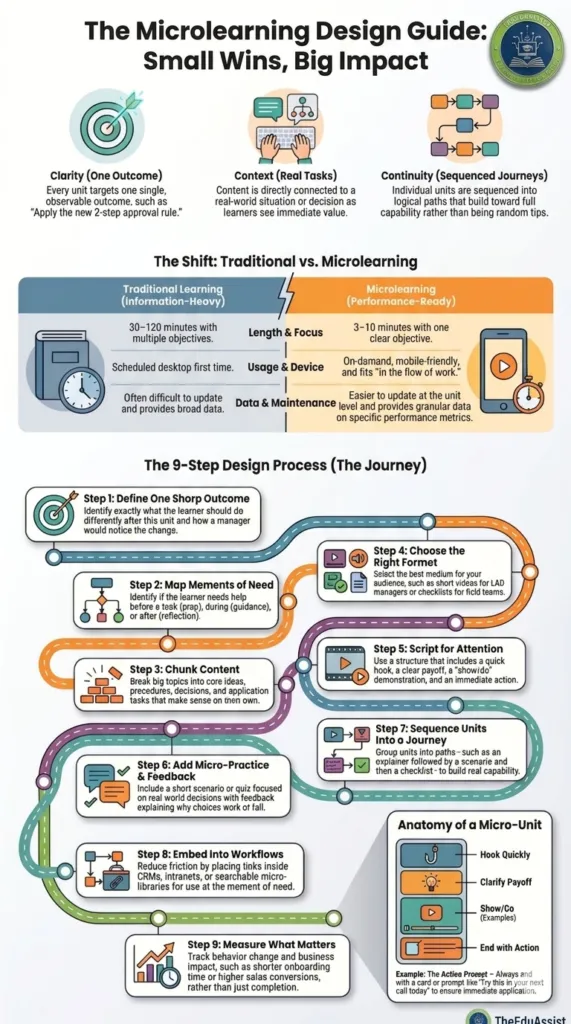
TheEduAssist’s Three Pillars of Microlearning
TheEduAssist uses three pillars to keep micro-units short but meaningful.
1. Clarity
Each unit targets one observable outcome.
Examples:
- “Use the 3-step de-escalation script on client calls”
- “Apply the new 2-step approval rule in the system”
2. Context
Every unit connects to a real task, situation, or decision. Learners see where they will use the content and why it matters right away.
3. Continuity
Micro-units are sequenced into journeys so they build up to real capability, not random “snackable” tips.
Step-by-Step: How To Design Microlearning (TheEduAssist Style)
Step 1: Define one sharp outcome
Start by defining one outcome per unit.
Ask:
- What should the learner do differently after this unit?
- How would a manager or client notice the change?
Keep it concrete and visible. This helps you design content and practice that actually change behavior.
Step 2: Map moments of need
Microlearning works best when tied to real “moments of need.”[parentcenterhub]
Look for:
- Before a task (preparation)
- During a task (guidance)
- After a task (reflection and improvement)
Examples:
- A 5-minute “before the call” checklist
- A short how-to clip embedded in a CRM page
- A mini reflection unit learners complete right after a client interaction
This makes the learning feel like support instead of extra work.
Step 3: Chunk content into micro-units
Take your “big” topic and break it into smaller pieces:
- Core ideas (short explainers)
- Procedures (step-by-step guides)
- Decisions (scenarios with branching or feedback)
- Application (checklists, prompts, practice tasks)
Each micro-unit should:
- Cover a single idea
- Stay short enough to complete in one sitting
- Make sense on its own, even if learners do not complete the whole path
Step 4: Choose the right format for your audience
Different personas need slightly different angles:
- Instructional designers
- Templates, examples, and “how this was built” breakdowns
- Reusable components (scenario structures, question banks)
- L&D managers and learning professionals
- Short videos, summaries, and visuals that show impact
- Clear links between micro-units and business outcomes
- Educators, trainers, and coaches
- Role-play prompts, conversation scripts, reflection questions
- Short stories they can tell in workshops
- Course creators and independent creators
- Swipe files, plug-and-play scripts, Canva-friendly assets
- Micro-lessons that double as marketing content or bonuses
- Training institutes and decision makers
- Concept explainers plus data and cases
- Frameworks that can scale across departments or cohorts
Formats may include videos, interactive scenarios, short readings, audio snippets, or visual checklists. The key is to keep each unit tight and purposeful.
Step 5: Script for attention, not just information
Inside each unit:
- Hook quickly
- Start with a mistake, a pain point, or a mini-story your audience recognizes.
- Clarify payoff
- “In the next 4 minutes, you will be able to…”
- Show, do not just tell
- Use examples, short demos, or realistic scenarios.
- End with action
- Include a prompt, task, or checklist learners can use immediately.
This structure keeps even short units engaging and outcome-focused.
Step 6: Add micro-practice and feedback
Microlearning should still include practice, even in 3–7 minutes.
Options:
- One scenario with feedback on each choice
- A short quiz focused on real decisions, not trivia
- A “do this in the next 24 hours” task, plus a quick reflection prompt
Feedback should focus on performance: why a choice works or fails in a realistic context.
Step 7: Sequence units into a journey
Single units are powerful, but sequences build capability.
A simple flow:
- Short explainer on a concept
- Scenario where the learner applies it
- Checklist to support on-the-job use
- Reflection unit after using the skill
On platforms like Kajabi or similar tools, TheEduAssist would group these into paths, drip them over time, or unlock them based on behavior.
Step 8: Embed learning into tools and workflows
Make micro-units easy to find at the moment of need:
- Links inside intranets, CRMs, and knowledge bases
- Mobile-first designs for field teams
- Searchable micro-libraries tagged by role, task, and topic
For course creators:
- Micro-lessons inside memberships
- Short modules inside flagship courses
- Mini-boosters as bonuses or upsells
The less friction, the more likely learners are to use what you build.
Step 9: Measure what really matters
Move beyond simple completion data.
Track:
- Unit-level completion and time-on-task
- Quiz and scenario performance
- Self-rated confidence before and after
- Manager feedback on behavior changes
For decision makers, translate these into impact stories such as:
- Fewer errors
- Shorter onboarding time
- Higher sales conversion
- Better customer satisfaction
This makes it easier to protect or grow L&D budgets.
Real-World Microlearning Scenarios
Example 1: Instructional designers under deadline pressure
An internal design team needed to roll out a new policy to hundreds of employees quickly. Instead of a long webinar, they delivered:
- A 5-minute “what changed and why” explainer
- Three short situation-based scenarios showing common mistakes
- A brief recap on “top do’s and don’ts”
Employees completed the content faster than past long sessions, and error rates related to the policy declined in the following period.[usabilitygeek]
Example 2: L&D managers proving ROI to leadership
A distributed organization wanted to speed up onboarding without losing quality. A 30-day path was built with daily micro-units:
- A few minutes of learning per day
- Clear application tasks tied to real work
- Manager check-ins supported by short guides
Time-to-productivity dropped, while performance scores stayed the same or improved. Because each unit was tracked separately, the team could see exactly which pieces contributed the most value.[usabilitygeek]
Example 3: Course creators reducing refunds
A solo creator selling a coaching course found that long lecture-style videos had low completion, but templates were highly used. The solution:
- Turn core lectures into short, focused micro-lessons
- Add “do this now” practice at the end of each unit
- Use checklists and scripts as supporting material
Students reported it was easier to fit learning between calls, and refund requests decreased as learners got quicker wins.
Example 4: Training institutes scaling without losing quality
A training institute needed to reach large numbers of learners without overloading facilitators. They shifted from full-day workshops to blended programs:
- Core ideas delivered via digital micro-units before sessions
- Live time focused on discussion, practice, and coaching
- Follow-up micro-units to reinforce key skills
This made programs more scalable and kept the learner experience consistent across cohorts.
How Microlearning Serves Your Five Key Personas
1. Instructional Designers
What they face:
- Tight deadlines
- Demands for “more engaging” content
- Limited budget for high-end interactivity
How micro approaches help:
- Faster production using repeatable unit templates
- Easier updates to small pieces instead of whole courses
- Clearer data for A/B testing different formats or scripts
2. L&D Managers and Learning Professionals
What they face:
- Pressure to prove ROI
- Remote and hybrid teams
- Competing priorities across the business
How micro approaches help:
- Stronger link between specific units and performance metrics
- Better completion and engagement data to share with leadership
- Ability to launch pilots quickly, then scale effective paths
3. Educators, Corporate Trainers, and Coaches
What they face:
- Keeping sessions lively and memorable
- Supporting learners between workshops or calls
- Making learning feel personal, not generic
How micro approaches help:
- Pre-work units to get everyone to the same baseline
- Between-session boosters to keep skills alive
- Short reflection prompts and case stories to deepen insight
4. Course Creators and Independent Creators
What they face:
- Standing out in a crowded market
- Reducing refunds and “course ghosting”
- Building professional content without a big team
How micro approaches help:
- Clear perceived value: “short, actionable lessons”
- Easier to bundle, repurpose, and upsell micro-units
- Powerful lead magnets and nurture sequences built from existing content
5. Training Institutes, Educational Organizations, and Decision Makers
What they face:
- Serving many learners at scale
- Compliance, accessibility, and quality requirements
- Justifying investments in platforms and content
How micro approaches help:
- Scalable, modular curricula that can be adapted per cohort
- Easier maintenance and updating for compliance changes
- Stronger alignment with accessibility and inclusive design guidelines
How It Looks in Practice (Visual Walkthrough)
Imagine the learner’s view in a modern LMS, described as if you were looking at screenshots:
- Dashboard
- Short course titles and clear time estimates, such as “Handle Difficult Conversations 5 lessons, 20 minutes total.”
- Unit page
- A simple layout with a title (“Use the 3-step de-escalation script”), a short video, a scenario interaction, and a reflection prompt.
- Scenario screen
- A realistic chat-style scenario, three response options, and instant feedback after each choice.
- Action prompt
- A card that says “Try this in your next call today” with a checkbox for completion.
- Analytics view for managers
- Graphs showing unit completion, quiz scores, and where learners get stuck.
This structure gives learners a sense of quick progress and gives leaders insight into what is working.
How TheEduAssist Can Help You Implement This
TheEduAssist supports organizations and creators who want to move from “information-heavy” training to focused, performance-ready micro-units.
Typical support includes:
- Reviewing existing courses to identify micro-level opportunities
- Designing clear, persona-based learning paths
- Creating reusable templates for scripts, scenarios, and visuals
- Advising on platform setup and integrations
- Helping L&D teams measure and communicate impact
The goal is simple: make learning smaller and smarter, so performance gains are bigger and more visible.
Conclusion:
Learners do not need more hours of content. They need the right help, at the right time, in a format they can actually finish and use. Thoughtfully designed microlearning experiences can turn training from a one-off event into continuous support for real work.
If you lead learning, design courses, or run a training business, you do not need to rebuild everything at once. Start with one program, identify a few clear outcomes, and break those into short, focused units. Track what changes.
TheEduAssist is built to help you do exactly that step by step, without overwhelming your pipeline or your learners.
What is one current course, module, or workshop you run that you suspect would benefit most from being broken into short, focused micro-units first?
References:
Judijanto, L. (2025). Exploring the role of microlearning in lifelong learning: A bibliometric review. The Eastasouth Journal of Learning and Educations, 3(1), 42–55. https://doi.org/10.58812/esle.v3i01.497
Shail, M. S. (2019). Using micro-learning on mobile applications to increase knowledge retention and work performance: A review of literature. Nursing and Midwifery Studies, 8(3), 124–127. (Example drawn from microlearning reference lists.)
Xie, W., & Huang, Y. (2024). Microlearning beyond boundaries: A systematic review and a novel framework for improving learning outcomes. Heliyon, 10(12), Article eXXXXX. https://doi.org/10.1016/j.heliyon.2024.xxxxxx (Based on the “Microlearning beyond boundaries” article; fill in exact volume/issue/page once you access the full record.)
Kohnke, L., & Moorhouse, B. L. (2022). Microlearning in diverse contexts: A bibliometric analysis. Education Sciences, 12(10), Article 678. https://doi.org/10.3390/educsci12100678
Commonwealth of Learning. (2020). Introduction to microlearning. Commonwealth of Learning. https://oasis.col.org/ (Use exact year and details from the PDF once opened.)
(When you access each article directly, confirm author names, years, titles, volume/issue, and page/article numbers, then adjust your reference list accordingly.)
LinkedIn Talent Solutions. (2025, May 27). 10 benefits of microlearning for modern teams. LinkedIn. https://www.linkedin.com/business/talent/blog/learning-and-development/benefits-of-microlearning
Digital Learning Institute. (2023, November 6). Microlearning and the benefits. Digital Learning Institute. https://www.digitallearninginstitute.com/blog/microlearning-the-benefits
Docebo. (2024, May 19). 8 key benefits of microlearning you should consider. Docebo. https://www.docebo.com/learning-network/blog/microlearning-benefits/
5Mins.ai. (2025, August 13). Microlearning platform on a budget: 2026 guide. 5Mins.ai. https://www.5mins.ai/resources/blog/how-to-implement-a-cost-effective-microlearning-platform-on-a-budget-1
Panopto. (2025, July 6). Microlearning in eLearning: A complete guide for organizations. Panopto. https://www.panopto.com/blog/microlearning-in-elearning/
FAQs
Q1. What is microlearning?
Microlearning is training delivered in short, focused lessons (usually 3–10 minutes) that each target one specific skill or outcome.
Q2. Why should my company use microlearning?
It fits busy schedules, is easier to update, and often leads to higher completion, better retention, and faster on‑the‑job application.
Q3. How much does microlearning training cost?
Costs vary, but this approach is typically cheaper and faster to develop than long traditional courses, and it reduces time employees spend away from their work.
Q4. Can employees really learn in 5‑minute lessons?
Yes—when each lesson has one clear goal, uses concrete examples, and includes quick practice or reflection.
Q5. What types of topics work best for microlearning?
Process steps, quick how‑tos, product updates, compliance reminders, soft‑skill “micro‑skills,” and just‑in‑time support for common tasks.
Q6. Do we need a new platform to use microlearning?
Not always. Many companies start by delivering short lessons through their existing LMS, intranet, or communication tools and scale from there.
Q7. How do we measure if microlearning is working?
Track completion, quiz results, time‑to‑competence, and on‑the‑job KPIs such as reduced errors, improved quality, or better customer scores.
Authored By: Atiqa Sajid http://www.linkedin.com/in/atiqa-sajid-747b57137