So you want to know about VR training costs. You’re not alone.
In fact, it’s one of the most common questions L&D leaders ask today. And honestly, it makes sense. Before you invest in any new training technology, you need real numbers, not vague estimates.
The good news is this: VR training costs are more flexible than most people expect. Furthermore, the return on that investment can be substantial when you plan it right.
This guide walks you through every cost involved. As a result, you’ll leave with a clear picture of what to budget, what to watch for, and how to build a strong business case.
The VR Training Market Is Growing Fast
First, some key context. VR training is no longer a niche tool. Instead, it is now a big, fast-growing market with real data behind it.
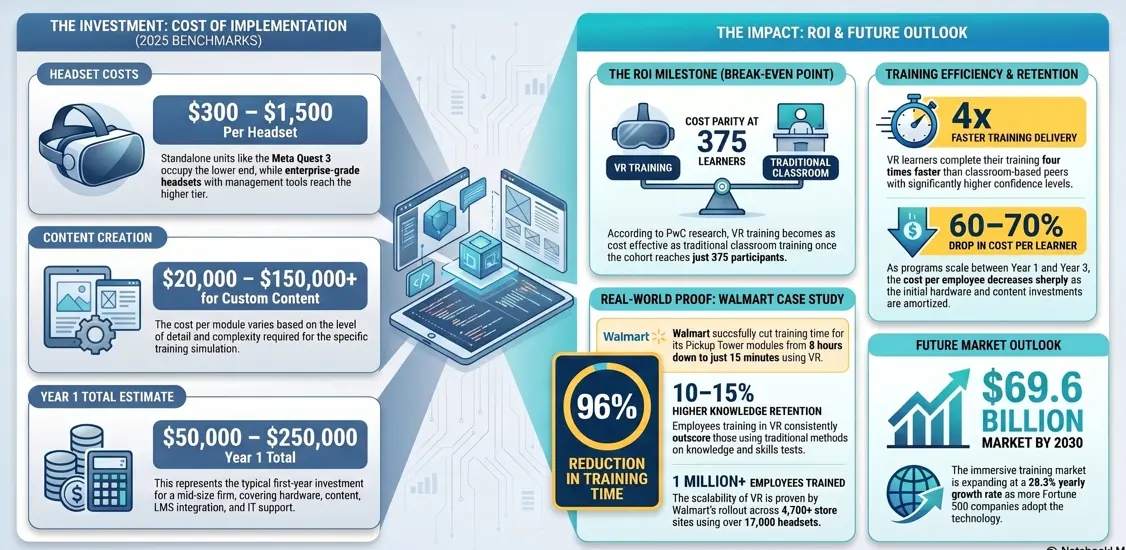
Grand View Research found the global training market hit $16.4 billion in 2024. Moreover, it will reach $69.6 billion by 2030. That means more tools, more content, and lower prices are all coming soon.
Beyond that, a 2024 study found over 60% of large firms have added VR to their training plans. And for Fortune 500 firms, that number is 65%.
So the shift is real. Your rivals are already moving.
What Is VR Training?
Before we get into VR training costs, let’s be clear on what VR training is.
Simply put, VR puts staff inside lifelike digital scenes. Rather than watching a video, they do the real task. And since the brain treats fake events as real ones, skills stick much faster.
Here are the most common use cases:
- Safety and hazard drills
- Tool and gear operation
- Rules and compliance training
- Soft skills and leadership
- Customer service roleplay
The value is clear. Staff practice tough situations before they face them at work. As a result, they make fewer errors, feel more sure of themselves, and hold on to what they learn far longer.
How Much Do VR Training Costs Run?
To begin with, VR training costs generally depend on three main factors. First, your firm’s size plays a big role. Next, the type of content you choose changes the price. Finally, it matters how deep your LMS (Learning Management System) setup goes.
Consequently, here is a clear cost overview for 2025:
| Cost Item | Typical Range |
|---|---|
| VR headset (per unit) | $300 – $1,500 |
| Off-the-shelf content | $5,000 – $30,000/year |
| Custom content build | $20,000 – $150,000+ |
| LMS setup and link | $5,000 – $25,000 |
| IT and deploy support | $10,000 – $50,000/year |
| Year 1 total (mid-size firm) | $50,000 – $250,000 |
That range looks big. However, most mid-size firms don’t need to hit the top end at first. A small pilot can run for $30,000–$75,000 and still show clear ROI.
VR Headset Costs
Hardware is often the first cost you see. To give you an idea of the baseline, basic standalone headsets like the Meta Quest 3 run $499–$599 each. Enterprise headsets with extra management tools, however, can reach $1,000–$1,500 per unit.
For context, Walmart put 17,000 VR headsets into its U.S. stores. Even so, costs stayed low over time because each device ultimately ran millions of training sessions.
VR Training Software Costs
Software is where VR training costs vary the most. Here is how it breaks down:
- Off-the-shelf content: $5,000–$30,000/year for ready-made modules
- Custom modules: $20,000–$150,000+ per course, based on detail level
- Cloud platform license: $2,000–$10,000/year for online delivery
Custom content costs more at first. However, the cost per learner drops fast once you train hundreds of staff. At that point, the ROI case builds itself.
LMS Setup Costs
Most firms already have an LMS. Therefore, adding VR means linking the new tech rather than rebuilding your whole system from scratch. To get started, the initial setup costs roughly $5,000 to $25,000. After that initial investment is made, you get a single, centralized place to track all your learners, pull detailed reports, and see clean data.
If you want to handle the technical roadmap yourself, check out our step-by-step guide on how to master LMS VR integration.
The Full Cost of Ownership
Setup fees are just the start. In addition, you need to plan for costs that grow over the first three years.
Here is a real three-year cost table for a mid-size firm:
| Cost Type | Year 1 | Year 3 Total |
|---|---|---|
| Hardware | $15,000 | $22,000 |
| Software and license | $25,000 | $65,000 |
| Content updates | $10,000 | $35,000 |
| IT support | $15,000 | $45,000 |
| Total | $65,000 | $167,000 |
Here is the key point: costs level off after year one. Meanwhile, your learner count keeps growing. So the cost per learner falls by 60–70% between year one and year three. That trend keeps going as you scale.
Hidden VR Training Costs That Catch Teams Off Guard
Crucially, this is where most budgets fall apart. Beyond the clear line items, several hidden VR training costs hit teams hard every year.
Watch for these hidden costs:
- Device management tools: These cost roughly $5 to $15 per headset per month. Consequently, for a fleet of 50 devices, that adds up to $9,000 a year before your actual training even starts.
- Content refresh costs: Plan for 20–30% of your VR modules to need updates each year. Old scenes go out of date fast.
- IT staff learning time: Your IT team needs time to learn how to run new VR gear. Budget for this learning curve.
- Change management: Getting staff to trust and use new tech takes real effort. One email is not enough.
- Headset hygiene: Shared headsets need foam inserts, wipes, and clean kits. It’s a small cost, but it adds up fast.
- Floor space: Full VR needs open floor space. Not every office has it. And fixing that costs money too.
Skipping just two or three of these items will blow your budget in year one. So plan for all of them from day one.
VR Training Costs vs. Old-Style Training
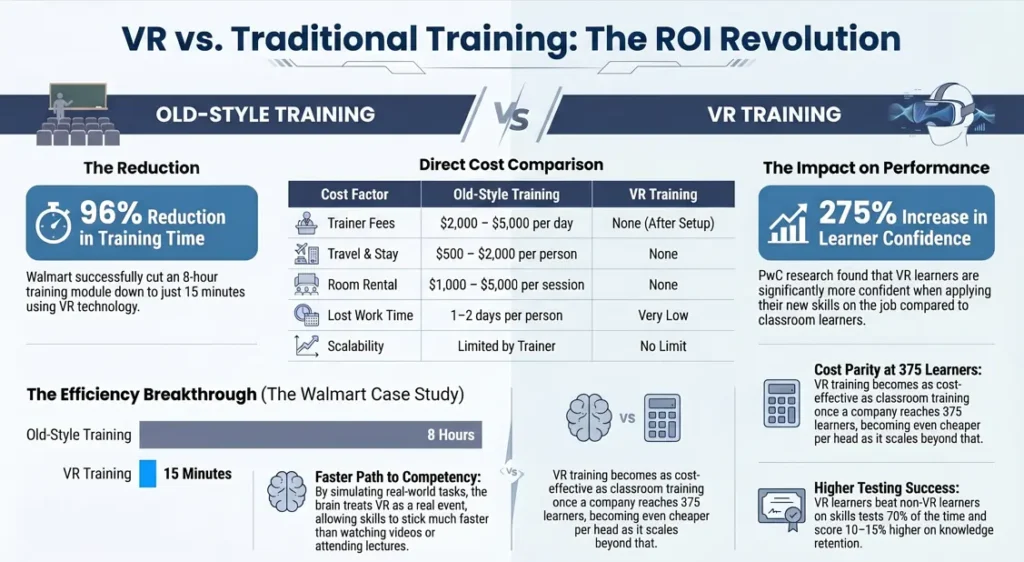
Here is where the real math gets fun. As it turns out, old-style instructor-led training (ILT) has a massive price tag too. In fact, it is one that most L&D budgets quietly absorb every single year without ever actually tallying it up.
| Cost Factor | Old Training | VR Training |
|---|---|---|
| Trainer fees | $2,000–$5,000/day | None after setup |
| Travel and stay costs | $500–$2,000/person | Gone |
| Room rental | $1,000–$5,000/session | Gone |
| Lost work time from travel | 1–2 days/person | Very low |
| Training consistency | Varies by trainer | Same every time |
| How far it scales | Limited by trainer | No limit |
Consider what Walmart found. Before VR, their Pickup Tower training took 8 full hours per person. After they launched VR with Strivr, that same training took just 15 minutes. That is a 96% cut in training time. Moreover, VR learners beat non-VR learners on skills tests 70% of the time and scored 10–15% higher on knowledge tests.
Those results are in both the Strivr case study and Chief Learning Officer magazine. They are not guesses. They happened.
What Real Research Says About VR Training ROI
Let’s look at what real studies say. These are not estimates. They are data points from peer-reviewed work and big firm case studies.
PwC’s 2020 VR Soft Skills Study
To look at the hard evidence, PwC ran the biggest ever enterprise study on VR soft skills training. Specifically, researchers tested three distinct formats: classroom, e-learning, and VR. They carried out these tests across 12 U.S. sites, focusing entirely on new managers to see exactly how the methods compared.
The results were clear:
- VR learners trained 4x faster than classroom learners
- VR learners were 275% more confident when using skills on the job
- Emotional link to content was 3.75x higher in VR than in class
- VR hit cost parity with classroom at just 375 learners and with e-learning at 1,950
So once you hit 375 learners, VR costs the same as a classroom. After that, each new learner you add makes VR cheaper per head.
Walmart’s VR Rollout at Scale
Ultimately, Walmart’s VR story stands as the most well-documented case study in corporate training history. Specifically, based on long-term data from Strivr and the Chief Learning Officer:
- Over 1 million employees trained via VR across 4,700+ store sites
- Training time cut from 90 minutes down to 20 minutes for most modules, with no drop in quality
- Knowledge retention was 10–15% higher than old-style training
- Training satisfaction was 30% higher among VR learners
- 70% of VR learners did better on tests than non-VR learners
Furthermore, Walmart cut millions in travel and coach costs by going digital. The ROI was not small. It was huge.
How to Work Out Your Own VR Training ROI
Before you pitch this to leadership, run this simple formula first:
ROI = (Total Gain – Total Cost) ÷ Total Cost × 100
Here is a worked example for a 500-person firm:
| Metric | Old Training | VR Training |
|---|---|---|
| Annual training cost | $320,000 | $85,000 |
| Safety events (per year) | 12 at $15,000 each | 4 at $15,000 each |
| Lost work hours | 1,800 hours | 450 hours |
| Total Annual Cost | $500,000+ | ~$145,000 |
Year 2 ROI: ~245%
Of course, your numbers will differ. Nevertheless, this trend holds in every major case study across retail, health, and industry training.
VR Training Budget Ranges by Firm Size
Not sure where to start on budget? Here are real figures by firm size:
| Firm Size | Pilot Budget | Full Rollout |
|---|---|---|
| Small firm (under 100 staff) | $15,000–$30,000 | $40,000–$80,000 |
| Mid-size (100–1,000 staff) | $30,000–$75,000 | $80,000–$200,000 |
| Large firm (1,000+ staff) | $75,000–$150,000 | $200,000–$500,000+ |
To set yourself up for success, you should always start with a pilot program. For instance, pick just one high-impact training problem first to test the waters. Then, run the numbers carefully based on that initial trial. After that, you can use your own real-world data to make a strong case for a wider rollout. Ultimately, that path works much better than asking for a full, risky budget upfront.
5 Ways to Cut VR Training Costs Without Losing Quality
Smart planning cuts VR training costs while keeping outcomes high. Here is what works in real programs:
1. Start small and focused Pick one high-stakes training problem first. Prove the ROI clearly. Then use those results to grow the program. Trying to swap out all training at once leads to budget overruns fast.
2. Try off-the-shelf content first: Pre-built safety, compliance, and soft-skills modules exist for most common needs. These cost far less than custom builds. Moreover, they can go live in days rather than months.
3. Connect VR to your LMS from the start: Running VR apart from your LMS creates a mess. Linking them cuts admin work. As a result, you get much cleaner data on how learners are doing. TheEduAssist’s AR & VR team handles this from start to end.
4. Deliver through the cloud: Cloud tools cut the cost of running local servers. Additionally, updates push out in seconds; no manual work needed on each headset.
5. Track every metric from session one: Completion rates, test scores, error drops, and time-on-task track all of them from day one. Because data is what convinces a skeptical CFO. Also, it shows you where to improve next.
Frequently Asked Questions
How much do VR training costs run for a small firm?
To start, small firms can launch a VR pilot for roughly $15,000 to $30,000 by utilizing basic headsets and off-the-shelf content. Following that initial phase, a full rollout typically runs about $40,000 to $80,000 per year. Even so, the substantial savings generated from cutting travel and trainer fees often pay back that entire investment within just 12 to 18 months.
To begin with, the most missed costs are device management tools ($5–$15 per headset per month), yearly content updates (20–30% of modules), IT learning time, change management work, and headset cleaning kits. Together, these hidden expenses can easily add an extra $20,000–$50,000 to your year-one spend. Because of this, you should always add a 15–20% buffer to your budget plan.
How long does it take to see ROI from VR training?
According to PwC’s study, VR hits cost parity with classroom training at just 375 learners. Crucially, beyond that point, VR costs less per learner than any other format. As a result, most teams see clear ROI within 12–18 months of going live. Meanwhile, safety programs often break even faster because savings from fewer incidents show up right away.
Is VR training worth it for compliance work?
Yes, especially for high-stakes compliance. VR gives the same training every single time. That matters a lot for audits and records. Moreover, it beats video and slides on both engagement and retention. According to VirtualSpeech, 95% of learners who practiced in VR said it helped them prepare better for real work than any other method.
Conclusion: Are VR Training Costs Worth It?
Here is the short answer: Yes, when you plan it right.
Ultimately, VR training costs are real. However, so is the return on investment. Furthermore, the firms with the strongest results are not necessarily the biggest spenders. Rather, they are the ones who start focused, track everything, and grow steadily based on hard data.
Key points to keep in mind:
- Year 1 VR training costs run $50,000–$250,000 for most mid-size firms
- Total costs drop sharply in years 2 and 3 as your learner count grows
- PwC showed VR hits classroom cost parity at just 375 learners
- Walmart cut training time by 96% and raised test scores by 10–15% using VR
- Hidden costs are real, but easy to manage if you plan for them from
References
1. PwC VR Soft Skills Training Study (2020)
Key data: 4x faster training, 275% more confidence, cost parity at 375 learners.
2. PwC UK VR Training Effectiveness Study
Data on emotional link (3.75x), focus (4x), and readiness to deploy at scale.
3. Strivr Walmart Case Study: 96% Training Time Cut
Real results from Walmart’s VR rollout across 4,700+ U.S. store sites.
4. Chief Learning Officer Walmart VR Case Study (2021)
Full editorial review of Walmart’s VR plan, outcomes, and learner scores.
5. Grand View Research Immersive Training Market Report (2024–2030)
Market data: $16.4B in 2024, set to reach $69.6B by 2030 at a 28.3% yearly growth rate.
6. VirtualSpeech VR Stats for Training (2026)
Data on VR learning gains, including the 95% learner readiness finding.