Employee training has become a strategic priority for businesses of all sizes. Whether you’re onboarding new hires, ensuring regulatory compliance, or helping employees develop new skills, delivering effective learning experiences is essential for maintaining productivity and staying competitive.
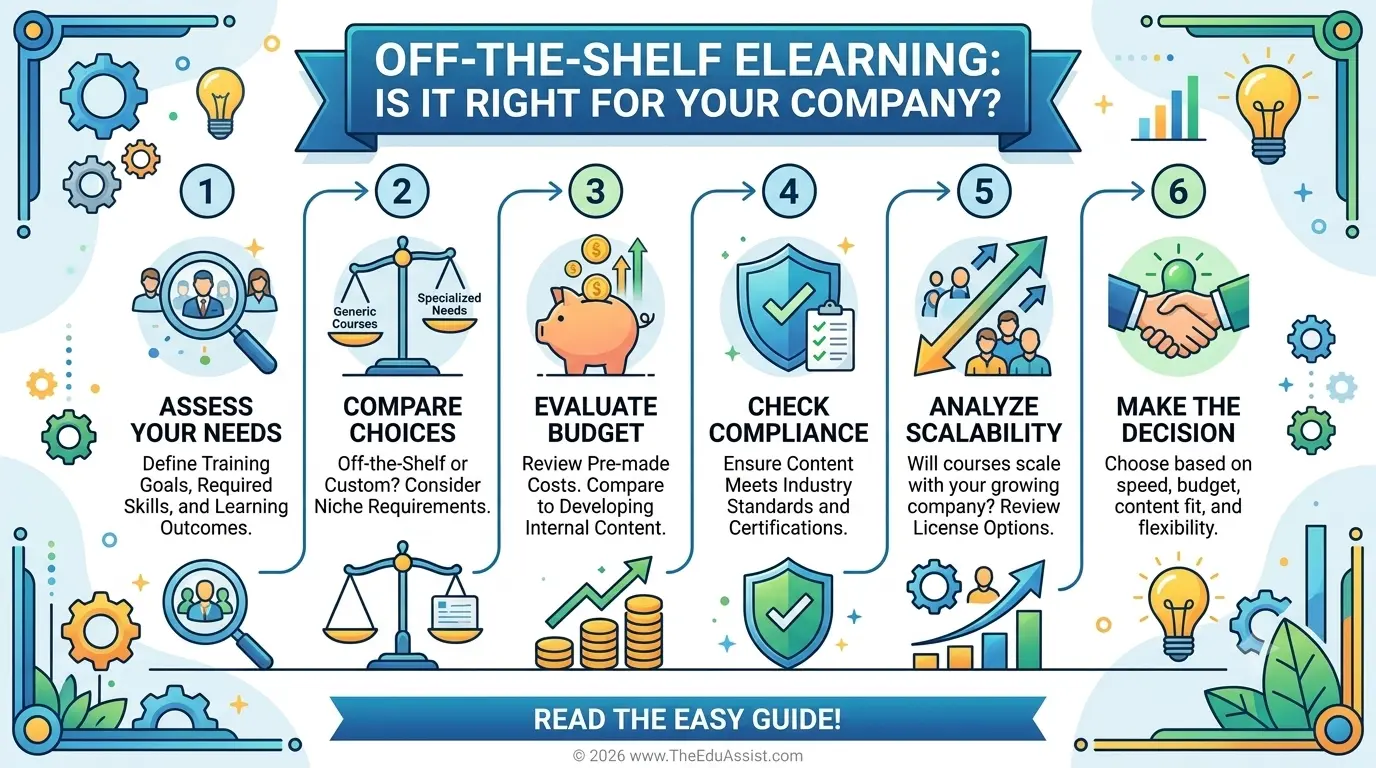
However, building training programs from scratch isn’t always practical. Custom course development requires time, expertise, and financial investment—resources that many organizations may not have readily available. That’s why many companies turn to off-the-shelf eLearning: ready-made digital courses designed to address common training needs across industries.
According to LinkedIn’s 2025 Workplace Learning Report, organizations continue to prioritize learning and development (L&D) to bridge skills gaps and improve workforce adaptability. Similarly, the Association for Talent Development (ATD) has consistently found that organizations investing in employee training experience higher productivity and stronger business performance.
But is off-the-shelf eLearning the right solution for your company?
The answer depends on your business goals, training requirements, and long-term learning strategy. In this guide, we’ll examine the advantages and disadvantages of off-the-shelf eLearning and help you determine when it’s the right choice—and when custom elearning offers greater value.
What Is Off-the-Shelf eLearning?
Off-the-shelf eLearning refers to pre-built online training courses created for a broad audience rather than a specific organization. These courses are developed by instructional designers and subject matter experts and can be purchased individually or accessed through subscription-based learning libraries.
Common topics include:
- Compliance training
- Workplace health and safety
- Cybersecurity awareness
- Leadership development
- Communication skills
- Customer service
- Microsoft Office and digital productivity
- Diversity, equity, and inclusion (DEI)
Because the content is already developed, organizations can deploy training almost immediately through a Learning Management System (LMS) or the vendor’s platform. This makes off-the-shelf courses especially attractive for businesses that need to train employees quickly or meet mandatory compliance requirements.
Benefits of Off-the-Shelf eLearning
- Faster Deployment
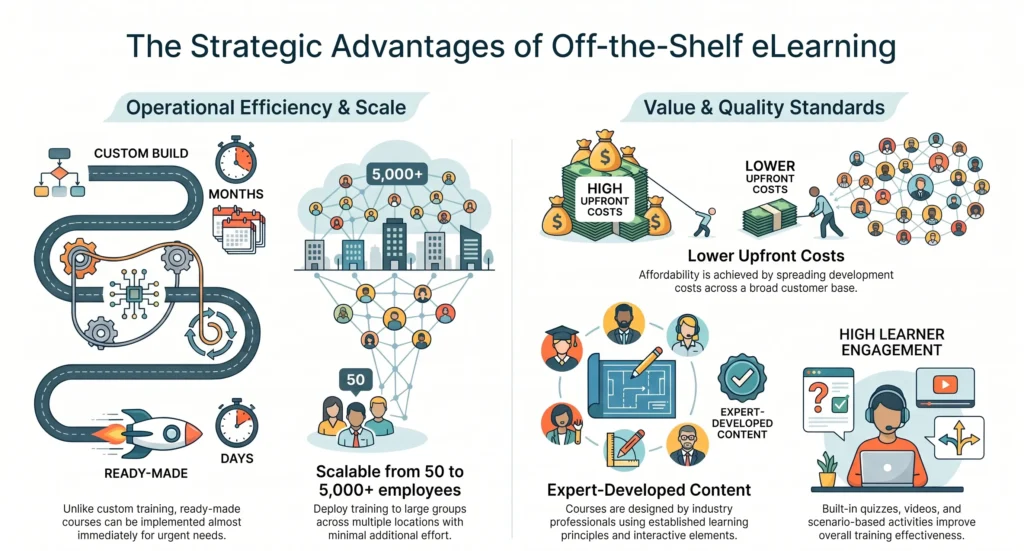
One of the biggest advantages of off-the-shelf eLearning is speed. Unlike custom training, which can take weeks or months to design and develop, ready-made courses can often be implemented within days. This is particularly valuable for organizations facing urgent compliance deadlines, rapid hiring, or large-scale onboarding initiatives. - Lower Upfront Costs
Developing custom training involves instructional design, content development, multimedia production, and quality assurance. Off-the-shelf courses spread these development costs across many customers, making them significantly more affordable for organizations with limited training budgets. - Expert-Developed Content
Many off-the-shelf courses are created by experienced instructional designers and industry professionals. As a result, they often follow established learning principles and incorporate interactive elements such as quizzes, videos, and scenario-based activities to improve learner engagement. - Scalability
Whether your organization has 50 employees or 5,000, off-the-shelf eLearning can typically be deployed to large groups with minimal additional effort. This scalability makes it ideal for businesses operating across multiple locations or departments.
The Limitations of Off-the-Shelf eLearning
Despite its advantages, off-the-shelf eLearning isn’t the perfect solution for every organization.
Limited Customization
Since these courses are designed for general audiences, they rarely include your company’s branding, policies, workflows, or proprietary systems. Employees may find it difficult to connect generic examples to their daily responsibilities.
Generic Learning Experience
Every organization has unique goals, processes, and challenges. Generic content may not fully address the specific skills your workforce needs to develop, reducing the overall effectiveness of the training.
Lower Engagement for Specialized Roles
Employees are generally more engaged when training reflects real workplace scenarios. Custom elearning can incorporate company-specific examples, case studies, and simulations that feel more relevant than standardized content.
Limited Competitive Advantage
If your competitors use the same training library, your learning programs are unlikely to create a meaningful competitive differentiator. Organizations focused on innovation or specialized expertise often benefit more from tailored learning experiences.
Off-the-Shelf vs. Custom eLearning
| Feature | Off-the-Shelf eLearning | Custom eLearning |
|---|---|---|
| Development Time | Very Fast | Weeks to Months |
| Initial Cost | Lower | Higher |
| Customization | Limited | Fully Customized |
| Branding | Generic | Company-Specific |
| Scalability | High | High |
| Best For | Compliance, onboarding, general skills | Specialized processes, proprietary knowledge, strategic training |
While off-the-shelf courses provide speed and affordability, custom elearning offers greater flexibility and alignment with business objectives. Organizations often achieve the best results by combining both approaches.
When Is Off-the-Shelf eLearning the Right Choice?
Off-the-shelf eLearning works well when:
- You need to launch training quickly.
- Your budget is limited.
- Training covers standardized topics such as compliance or workplace safety.
- You want to onboard employees efficiently.
- Your organization lacks internal instructional design resources.
It can also be an excellent starting point for businesses beginning their digital learning journey before investing in more customized learning experiences.
When Should You Choose Custom eLearning?
Custom elearning becomes the better investment when:
- Employees need to learn proprietary products or services.
- Training involves company-specific procedures.
- You want to strengthen your organizational culture.
- Learner engagement and knowledge retention are high priorities.
- Training directly impacts revenue, customer experience, or operational performance.
Personalized and context-specific learning experiences often improve learner engagement and knowledge retention compared to generic instructional materials.
Can You Combine Both Approaches?
Absolutely. Many organizations adopt a blended strategy that uses off-the-shelf eLearning for universal topics while developing custom courses for specialized business needs.
For example, a company may purchase compliance and cybersecurity courses while creating custom onboarding modules that introduce employees to its products, culture, and internal systems.
This hybrid approach helps organizations balance cost efficiency with learning effectiveness while supporting long-term L&D goals.
Cost Reality Check
While off-the-shelf eLearning usually has lower upfront costs, it’s important to consider long-term value. If employees struggle to apply generic training to their daily work, organizations may experience lower engagement, reduced knowledge retention, and additional training requirements later.
In contrast, custom elearning requires a larger initial investment but can deliver stronger business outcomes when training is closely aligned with organizational objectives.
The right choice depends on whether your priority is immediate deployment, long-term performance improvement, or a balance of both.
References
- https://elearningindustry.com/off-shelf-elearning-benefits-drawbacks-consider
- https://business.linkedin.com/learn/resources/workplace-learning-report
Frequently Asked Questions
What is off-the-shelf eLearning?
Off-the-shelf eLearning consists of pre-built digital courses designed for broad audiences and ready for immediate deployment.
Is off-the-shelf eLearning cheaper than custom eLearning?
Yes. It generally has lower upfront costs because development expenses are shared across multiple customers.
Can off-the-shelf courses be customized?
Some providers allow limited branding or content modifications, but extensive customization usually requires custom elearning development.
Which businesses benefit most from off-the-shelf eLearning?
Small and medium-sized businesses, organizations with limited training budgets, and companies requiring compliance or onboarding programs often benefit the most.
Should companies replace custom training with off-the-shelf courses?
Not necessarily. Many organizations achieve better results by combining standardized courses with custom learning experiences tailored to their unique business needs.
Final Thoughts
Off-the-shelf eLearning offers an affordable, scalable, and efficient way to deliver training across organizations. For compliance programs, onboarding, and foundational workplace skills, it provides an excellent starting point with minimal implementation time.
However, businesses seeking to improve employee performance, support complex workflows, or build a competitive advantage should also consider investing in custom elearning and strategic content development. A tailored learning experience can better reflect your organization’s goals, culture, and operational requirements while supporting long-term workforce development.
As elearning trends 2026 continue to emphasize personalized learning and measurable outcomes, organizations that carefully evaluate their training strategy will be better positioned to build skilled, engaged, and future-ready teams.
Choosing Between Off-the-Shelf and Custom eLearning?
Choosing between off-the-shelf and custom eLearning doesn’t have to be an either-or decision. At TheEduAssist, we help organizations evaluate their training needs and develop learning solutions that align with their business objectives. Whether you need ready-to-deploy learning resources, custom elearning, instructional design expertise, or end-to-end consulting services, our team can help you create impactful digital learning experiences that drive real results.
Authored By: Sofia Arif