
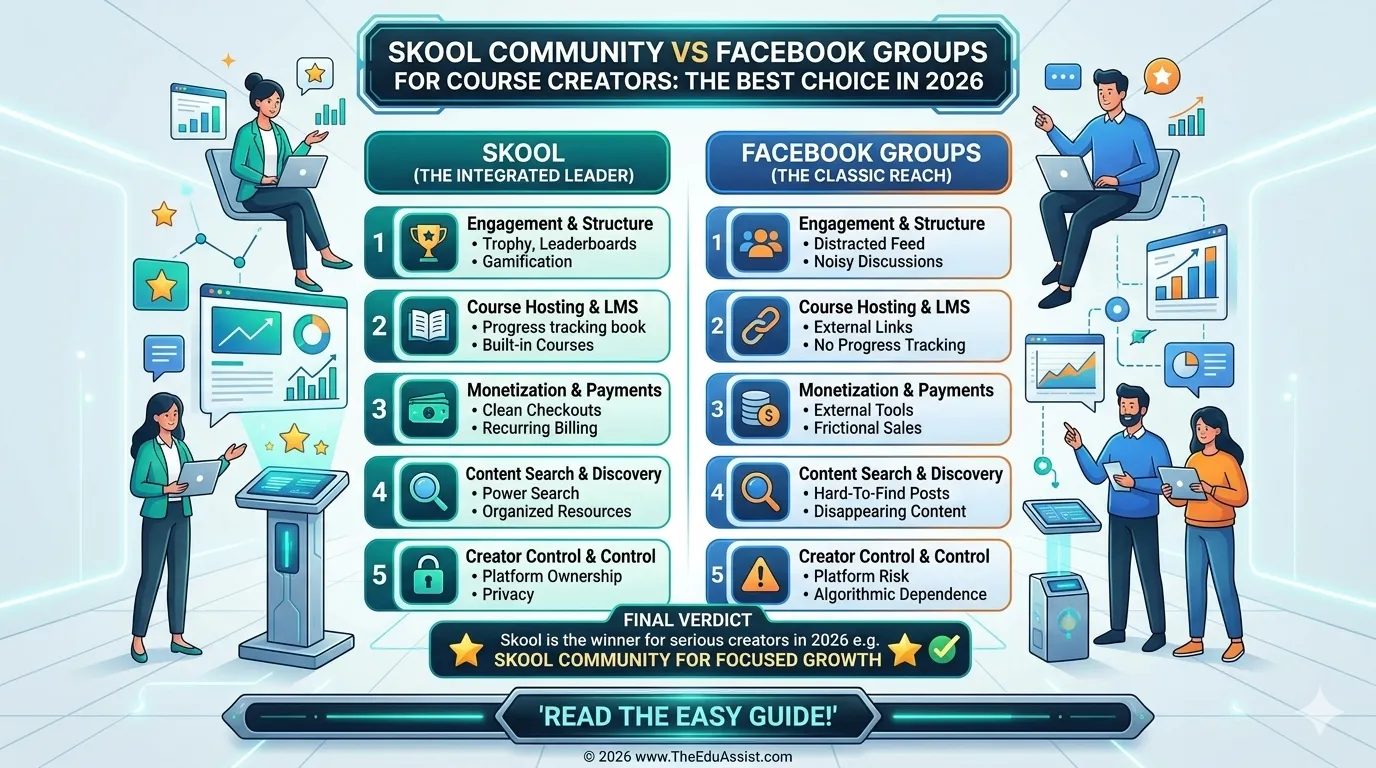
The debate around Skool Community vs Facebook Groups has become one of the biggest decisions facing modern course creators in 2026.
For years, Facebook Groups dominated the world of online communities. They were free, familiar, and easy to launch. But creators are increasingly frustrated with:
- Declining organic reach
- Algorithm dependency
- Constant distractions
- Notification fatigue
- Weak course organization
At the same time, the Skool platform has rapidly gained popularity as an all-in-one online community platform built specifically for learning communities, memberships, and coaching programs.
So when comparing Skool vs Facebook Group options today, the real question is:
Which platform actually helps students stay engaged, complete courses, and remain active inside your community?
For many creators, this isn’t just a tech decision anymore; it directly impacts retention, revenue, and long-term brand growth.
What Is a Skool Community?
Skool is a modern community platform for creators that combines:
- Online courses
- Discussion communities
- Gamification
- Memberships
- Progress tracking
…all inside one clean interface.
Unlike traditional LMS systems that separate learning from community interaction, Skool combines both experiences into a single dashboard.
Why Course Creators Are Switching to Skool
The biggest attraction of the online course community model inside Skool is focus.
Instead of competing with:
- Social media feeds
- Ads
- Reels
- Endless notifications
…the platform creates a distraction-free learning environment.
Key Features of the Skool Platform
- Gamification leaderboards
- Structured course hosting
- Community discussions
- Mobile-friendly experience
- Simple onboarding
- Searchable conversations
- Membership monetization
The platform is especially popular among coaches, consultants, educators, and creators selling paid communities. Learn more about the pros and cons of a Skool community here: Is a Skool Community Actually Worth Creating in 2026?
What Are Facebook Groups Used for in Online Learning?
Meta Facebook Groups became popular because they allowed creators to build communities for free.
Creators commonly use Facebook Groups for:
- Audience building
- Free communities
- Lead generation
- Peer discussions
- Live streams
- Announcements
For beginner creators, Facebook still feels attractive because most users already have accounts. But by 2026, several major problems have become harder to ignore.
Common Problems with Facebook Groups
- Notification fatigue
- Declining engagement
- Distractions from unrelated content
- Spam and promotional posts
- Poor course organization
- Weak search functionality
Most importantly: Facebook was designed for social interaction; not structured learning.
Skool Community vs Facebook Groups: Quick Comparison Table
| Feature | Skool Community | Facebook Groups |
|---|---|---|
| Pricing | Paid subscription | Free |
| Course Hosting | Built-in | Limited |
| Gamification | Yes | No |
| Community Experience | Learning-focused | Social-focused |
| Searchability | Organized and searchable | Difficult to navigate |
| Mobile Usability | Streamlined | Cluttered |
| Monetization | Membership-ready | External tools needed |
| Admin Tools | Creator-focused | Basic moderation |
| Distraction Level | Low | Extremely high |
| Engagement Quality | Higher accountability | Lower consistency |
| Progress Tracking | Yes | No |
| LMS-Style Features | Included | Missing |
User Experience: Which Platform Keeps Members More Engaged?
This is where the biggest difference appears. Research in online learning consistently shows that social engagement and structured interaction improve course completion rates.
Why Facebook Often Hurts Engagement
Facebook is built around dopamine-driven content loops:
- Notifications
- Reels
- Ads
- Viral content
- Endless scrolling
Even if students enter with good intentions, they quickly get distracted. This affects student engagement, accountability, member retention, and course completion.
Why Skool Performs Better for Learning Communities
Skool’s biggest strength is focus. Features like gamification leaderboards, visible progress, simplified navigation, and centralized learning create stronger accountability.
Course Hosting and Content Delivery Comparison
Facebook Groups are not designed for structured learning. Lessons get buried in feeds with no progress tracking and weak organization.
Skool combines video lessons, modules, community discussions, and member progress inside a single seamless experience.
Community Management Features Compared
Skool offers better onboarding, centralized content, creator-focused moderation, searchable conversations, and structured permissions.
Facebook Groups struggle with spam, poor visibility, algorithm limitations, and weak analytics as communities grow.
Pricing Breakdown: Is Skool Worth Paying For?
While Facebook is free, the hidden costs of low engagement (lower completion rates, weaker retention, creator burnout) are significant.
Many creators find that Skool’s monthly subscription pays for itself through higher retention, better member experience, simplified workflows, and increased monetization.
SEO and Discoverability Differences
Facebook Groups are closed ecosystems with poor Google visibility.
Skool communities are better organized, internally searchable, and support stronger branded learning ecosystems.
Which Platform Is Better for Different Types of Course Creators?
- Best for Beginner Creators → Facebook Groups (free to start, fast setup)
- Best for Coaches and Consultants → Skool (accountability and paid memberships)
- Best for Paid Membership Communities → Skool
- Best for Corporate Training → Skool
- Best for Audience Growth → Facebook Groups
When Facebook Groups Still Make Sense
Facebook Groups remain useful for:
- Free communities
- Casual audiences
- Early-stage creators
- Audience growth and visibility
Many creators use a hybrid model: Facebook for marketing and Skool for paid members.
Final Verdict: Skool vs Facebook Groups in 2026
Choose Skool if you sell courses, run paid memberships, want stronger engagement, accountability, and a distraction-free learning environment.
Choose Facebook Groups if you are just starting, want free audience growth, or your community is casual.
For many serious course creators, Skool is becoming the preferred all-in-one platform because it combines LMS-style learning, community engagement, gamification, and monetization in one focused environment.
References
- https://scholarworks.umb.edu/ciee/vol3/iss1/9/
- https://research-portal.uea.ac.uk/en/publications/massive-open-online-courses-are-social-learners-more-likely-to-co/
- https://www.mdpi.com/2076-3417/10/20/7065
- https://link.springer.com/article/10.1007/s10639-020-10362-6?
- https://www.researchgate.net/publication/311165274_How_Learners%27_Interactions_Sustain_Engagement_A_MOOC_Case_Study
FAQs
Is Skool better than Facebook Groups for course creators?
For structured learning and paid communities, many creators now prefer Skool.
Why are creators moving from Facebook Groups to Skool?
Main reasons include distractions, declining engagement, and poor course organization on Facebook.
Can Skool replace Facebook Groups completely?
For paid learning communities, yes. Facebook still helps with audience growth.
Does Skool improve student engagement?
Yes. Its gamification and focused environment often improve accountability and participation.
Is Skool worth the monthly cost for coaches and educators?
For most creators, improved retention and workflow efficiency justify the cost.
What is the best community platform for online courses in 2026?
Many creators now consider Skool one of the strongest all-in-one community platforms for online learning.
Ready to Build a Better Learning Community in 2026?
For many modern course creators, coaches, and L&D businesses, a structured online community platform is becoming essential for long-term growth.
If you’re planning to launch:
a paid learning community
a coaching membership
a SCORM-based training system
a custom elearning platform
…the right strategy matters just as much as the platform itself.
Explore more EdTech insights, LMS comparisons, and eLearning growth strategies at TheEduAssist.
Authored By: Sofia Arif