AI-generated video is no longer experimental. In 2026, businesses, educators, course creators, and L&D teams are rapidly adopting tools like Synthesia to create training videos, onboarding modules, multilingual corporate learning videos, and scalable internal communication content.
But one major question keeps surfacing:
Can Synthesia actually replace a traditional video production team?
The short answer is: partially, but not completely.
AI video creation platforms have dramatically reduced production timelines, localization costs, and repetitive editing workflows. At the same time, organizations are discovering that AI avatars still struggle with emotional storytelling, advanced branding, and high-end creative production.
This guide explores:
- What is Synthesia AI
- How Synthesia AI works
- Whether it can realistically replace production teams
- Pricing and hidden costs
- LMS and SCORM workflows
- Limitations businesses face in real deployments
What Is Synthesia AI and How Does It Work?
Many people still ask:
What is Synthesia?
What is Synthesia AI?
How does Synthesia work?
Synthesia is an AI video creation platform that converts written scripts into avatar-led videos using synthetic presenters and AI-generated voiceovers.
Instead of:
- Cameras
- Actors
- Studios
- Microphones
- Editing suites
…users simply:
- Write a script
- Select an AI avatar
- Choose voice/language
- Generate the video in-browser
How Synthesia AI Works
The platform combines:
- AI avatars
- Text-to-speech engines
- Facial animation
- Multilingual voice synthesis
- Template-based editing
This enables rapid production of:
- Corporate learning videos
- Onboarding videos
- Compliance training
- Customer education
- Microlearning modules
The workflow is especially appealing for companies needing large-scale localization across multiple countries.
Recent educational research also suggests that AI-generated learning videos can produce learner outcomes comparable to traditionally produced instructional videos in some online learning environments.
Why Businesses Are Replacing Traditional Video Workflows With AI
The biggest driver is not creativity.
It’s operational efficiency.
Cost Savings
Traditional production teams involve:
- Videographers
- Editors
- Actors
- Voice talent
- Motion designers
- Studio rentals
AI tools compress many of these workflows into a single browser-based platform. However, businesses still need to evaluate whether these tools justify their long-term costs and production value. Our detailed breakdown of Synthesia’s pricing, ROI, and practical use cases explores this in greater depth: https://theeduassist.com/blog/is-synthesia-worth-it-in-2026/
Speed
Training teams can update videos in hours instead of weeks.
This matters for:
- Compliance training
- SOP updates
- Onboarding changes
- Software walkthroughs
Scalability
One script can instantly become:
- 10 languages
- Multiple avatars
- Regional variants
Localization
Global organizations increasingly require multilingual learning content.
AI localization dramatically reduces turnaround time for:
- LMS content
- Sales enablement
- HR training
- Internal communication
This is one reason why AI-generated training video platforms are growing rapidly in enterprise learning environments.
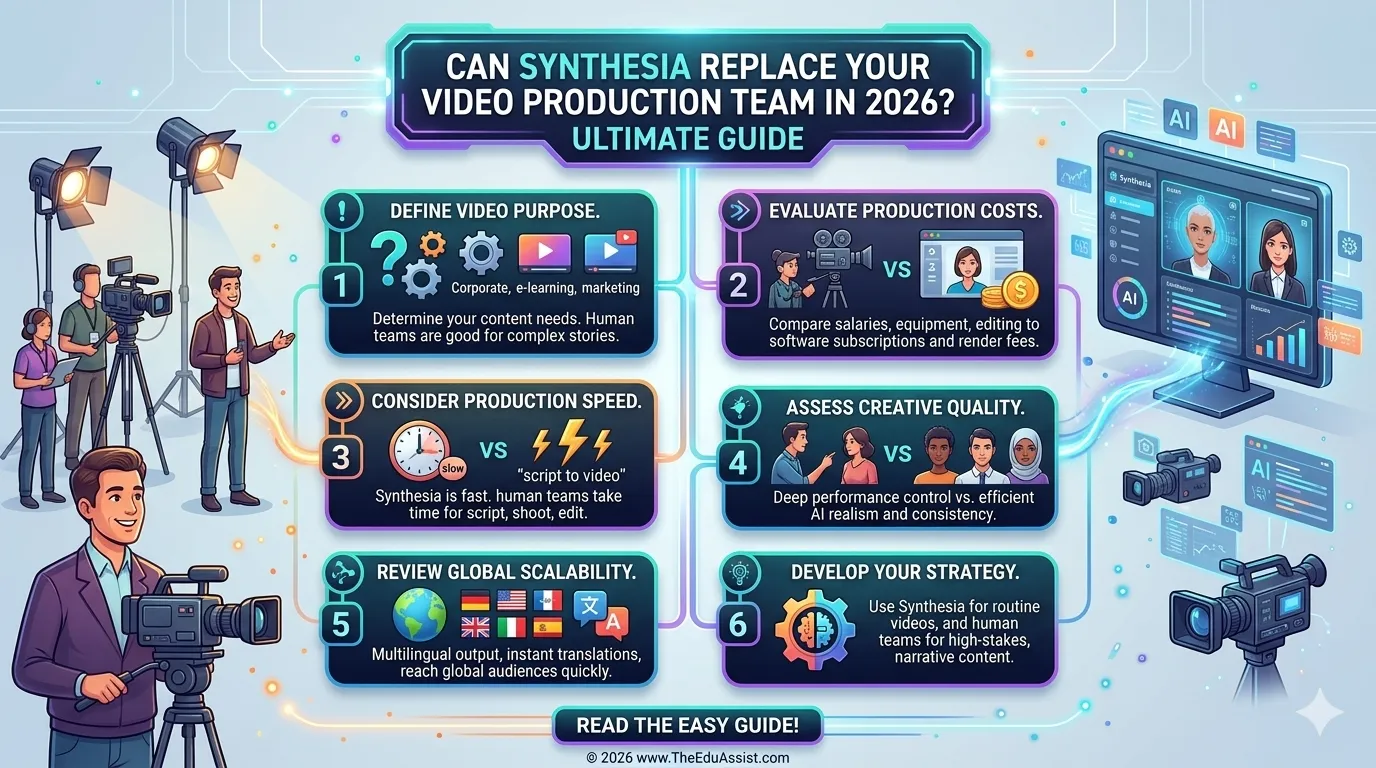
Can Synthesia Actually Replace a Video Production Team?
This is where the conversation becomes more nuanced.
Where Synthesia Performs Better Than Traditional Video Teams
- Rapid Training Updates: Traditional re-shoots are expensive. Synthesia allows teams to edit scripts, regenerate videos, and update compliance modules quickly.
- Multilingual Localization: One of Synthesia’s strongest advantages. Organizations can generate localized training content almost instantly.
- Scalable Internal Communications: Large enterprises use AI video for policy updates, leadership announcements, and onboarding sequences.
- Course Updates: For eLearning and custom elearning projects, frequent updates are common. AI tools dramatically reduce maintenance costs.
Where Human Video Teams Still Win
- Emotional Storytelling: AI avatars still struggle with subtle emotional delivery, persuasive storytelling, and authentic human presence.
- Cinematic Marketing: High-end brand campaigns require lighting direction, cinematography, creative editing, and real environments.
- Complex Demonstrations: Hands-on product demos and physical demonstrations still benefit from live-action production.
- Custom Motion Graphics: Advanced animation and branded visual storytelling remain stronger in traditional workflows.
Research and learner feedback repeatedly show that viewers can still detect AI-generated presenters, especially during longer educational sessions.
The Hybrid Workflow Most Companies Use in 2026
Most organizations are not fully replacing production teams. Instead, they are using:
| Workflow Type | Typical Use |
|---|---|
| AI-generated video | Training, onboarding, localization |
| Human production | Branding, marketing, executive storytelling |
| Hybrid workflows | Corporate learning ecosystems |
This balanced approach tends to produce faster production, lower costs, and better learner engagement.
How Much Does Synthesia Cost in 2026?
Starter Plans
Basic plans generally target solo creators, freelancers, and small businesses. These typically include limited video minutes, standard avatars, and basic templates.
Enterprise Pricing
Enterprise plans usually add team collaboration, custom avatars, advanced branding, API workflows, and localization support.
Pricing varies significantly depending on video volume, languages, team size, and enterprise integrations.
Hidden Costs Most Teams Ignore
- Scriptwriting
- Instructional Design
- Editing
- Avatar Customization
- Localization Review
- SCORM Packaging
Synthesia itself is not a full SCORM authoring tool. Many organizations still use Articulate Rise 360, Articulate Storyline, LearnDash, Thinkific, or Kajabi for LMS-ready deployment workflows.
Is Synthesia Worth It for Course Creators and L&D Teams?
For repetitive educational content? Usually yes.
Strong ROI Areas:
- Onboarding
- Compliance
- Multilingual training
- Microlearning
- Internal SOP videos
Biggest Advantage: Production turnaround speed.
Biggest Weakness: Viewer fatigue from repetitive AI avatar presentation styles.
Which Is Better: HeyGen or Synthesia?
| Feature | Synthesia | HeyGen |
|---|---|---|
| Corporate training | Strong | Moderate |
| AI avatars | Excellent | Excellent |
| Localization | Strong | Good |
| SCORM/LMS workflows | Better | Limited |
| Marketing videos | Moderate | Strong |
| Team collaboration | Better | Moderate |
Generally:
- Synthesia performs better in corporate learning workflows.
- HeyGen often feels stronger for social and marketing-style content.
Does Synthesia Support LMS and SCORM Workflows?
Not directly as a full SCORM authoring system.
Most teams embed Synthesia videos into Articulate Rise 360, Storyline, LearnDash, Thinkific, or Kajabi. This creates SCORM packaging, quiz tracking, LMS analytics, and learning pathways.
Best workflow in 2026:
AI video generation + instructional design platform + LMS integration.
Common Problems Teams Face With Synthesia
- AI Avatars Can Feel Robotic
- Generic Scripts Hurt Engagement
- Editing Limitations
- Compliance and Brand Consistency Issues
- Localization Errors in Training Content
Real-world feedback consistently highlights uncanny valley effects, repetitive pacing, voice inconsistencies, and reduced emotional engagement.
Best Use Cases for Synthesia in 2026
- Onboarding
- Customer education
- SOP walkthroughs
- Software demos
- Internal HR training
- Multilingual compliance training
- Microlearning
- LMS-based training videos
- Corporate learning videos
Final Verdict: Should You Replace Your Video Team With Synthesia?
Synthesia can absolutely replace:
- Repetitive production workflows
- Basic training video creation
- Localization-heavy content pipelines
But it does not fully replace creative video teams.
The companies seeing the best results in 2026 are using AI-assisted production + human creative oversight.
That hybrid workflow currently delivers the strongest balance of speed, scalability, engagement, and brand quality.
References
- https://arxiv.org/abs/2304.03784
- https://bmjopenquality.bmj.com/content/14/4/e003704?
- https://pubmed.ncbi.nlm.nih.gov/39655341/
- https://www.sciencedirect.com/org/science/article/abs/pii/S1366562624000445
- https://journals.sagepub.com/doi/10.1177/23821205261437352?
FAQs
What is Synthesia AI used for?
Synthesia is primarily used for AI-generated training videos, onboarding content, corporate learning videos, and multilingual educational content.
How does Synthesia AI work?
It converts text scripts into avatar-led videos using AI voice synthesis and facial animation.
Is Synthesia worth it for course creators?
Yes, especially for scalable training workflows and fast production cycles.
Can Synthesia replace traditional video production?
Partially. It replaces repetitive training workflows more effectively than high-end creative production.
How much does Synthesia cost in 2026?
Pricing varies from starter subscriptions to enterprise-level custom pricing.
Is Synthesia good for corporate training videos?
Yes. Corporate learning and compliance training are among its strongest use cases.
Which is better: HeyGen or Synthesia?
Synthesia is generally stronger for corporate learning workflows, while HeyGen performs well for marketing content.
Does Synthesia support SCORM or LMS integration?
Indirectly. Most teams combine Synthesia with LMS or SCORM authoring tools.
What are the limitations of Synthesia AI?
Robotic avatars, editing limitations, and reduced emotional storytelling.
Do businesses still need video editors if they use Synthesia?
Often yes, especially for polishing professional learning experiences.
What industries benefit most from Synthesia?
Corporate training, healthcare education, SaaS onboarding, compliance training, and eLearning.
Ready to Build Smarter AI-Powered Training Content?
Whether you’re exploring Synthesia AI, scaling multilingual training videos, or trying to streamline your LMS workflows, the biggest challenge is rarely the tool itself — it’s creating learning experiences that still feel engaging, structured, and learner-focused.
At TheEduAssist, we help:
- Course creators
- Coaches
- EdTech startups
- Corporate L&D teams
- Training organizations
…build scalable AI + eLearning workflows that combine:
- instructional design
- SCORM-ready development
- AI video creation
- LMS integration
- microlearning strategy
- content development
From Synthesia-based training videos to complete custom e-learning ecosystems, we help teams move faster without sacrificing learning quality.
Authored By: Sofia Arif