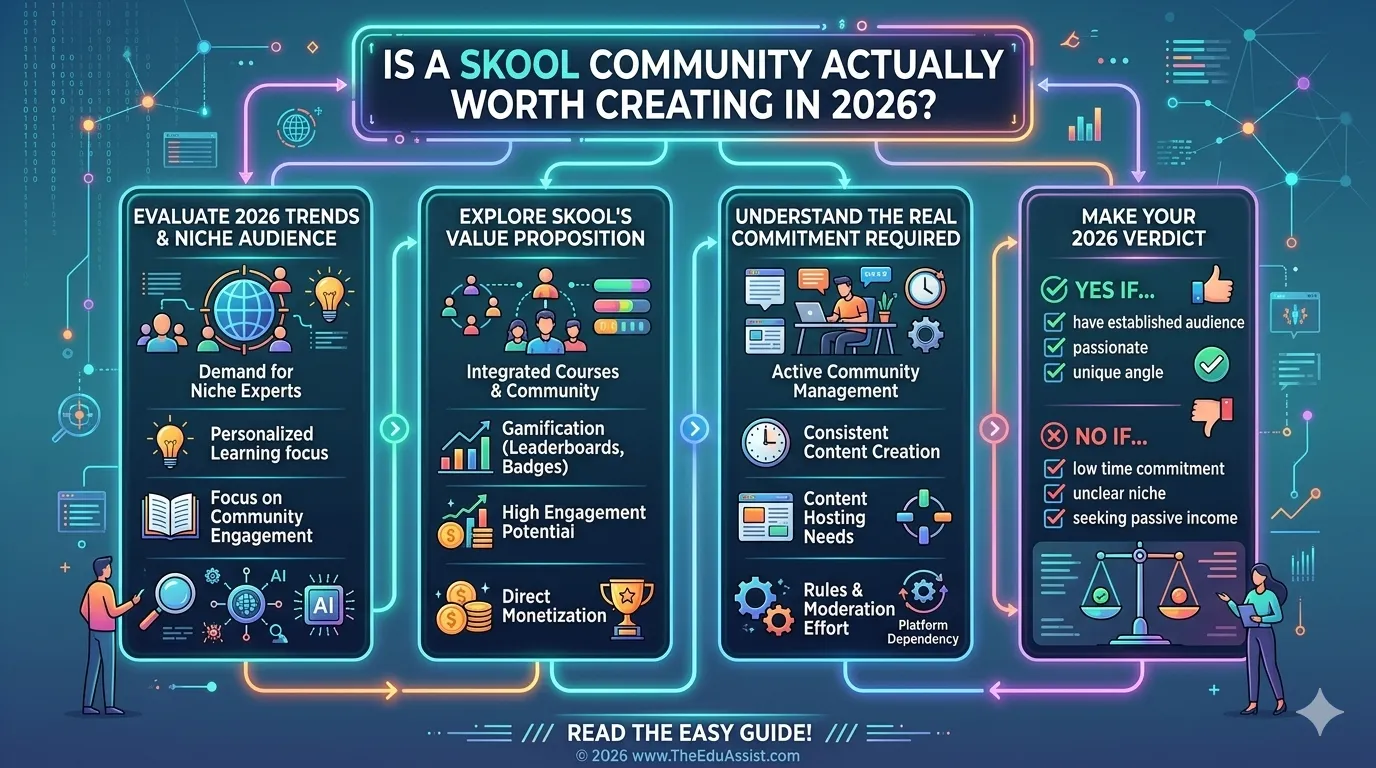
A Skool community is an all-in-one platform that combines:
- Online communities
- Courses
- Gamification
- Group learning
- Membership monetization
Unlike traditional LMS platforms, Skool communities focus heavily on engagement and interaction rather than just hosting videos.
The platform combines:
- Community feed
- Classroom/course hosting
- Calendar/events
- Leaderboards and gamification
- Mobile-friendly design
This is why many creators see it as a hybrid between:
- Facebook Groups
- Discord
- Kajabi
- Circle
- Traditional LMS platforms
In 2026, the platform is becoming especially popular among:
- Coaches
- Consultants
- Educators
- Course creators
- Membership businesses
- Creator-led brands
The shift aligns with broader research showing that online learning communities improve engagement, participation, and long-term retention when social interaction is central to the learning experience.
Why Are So Many Creators Building a Skool Community in 2026?
The creator economy has changed dramatically.
Creators no longer want:
- Complex tech stacks
- Multiple disconnected tools
- Low-engagement courses
Instead, they want:
- Community-first learning
- Recurring membership revenue
- Cohort-based engagement
- Simpler user experiences
That’s why more businesses are building a Skool community instead of relying only on standalone LMS platforms.
Research around online learning communities also shows that collaborative participation and social presence significantly improve engagement and loyalty.
Why the timing matters in 2026
Several major trends are driving growth:
- Community-Based Learning
People increasingly learn through peer accountability, group interaction, challenges, and cohorts. - Microlearning
Users prefer short lessons, fast wins, and interactive discussion. - Creator-Owned Audiences
Creators want direct ownership instead of relying entirely on YouTube algorithms, Instagram reach, or Facebook visibility. - Recurring Revenue Models
Membership communities generate monthly subscriptions, higher retention, and better customer lifetime value.
That’s why searches for how to build a Skool community continue growing.
Skool Community Features That Matter Most
The biggest reason creators choose Skool is simplicity.
Here are the most important Skool community features in 2026:
- Community Feed
The feed works similarly to a social platform with discussions, questions, wins, updates, and announcements. This keeps users active daily. - Classroom Feature
The classroom lets creators upload courses, organize modules, gate lessons, and combine learning + discussion. - Gamification & Leaderboards
Users earn points through comments, participation, and engagement. This improves retention, activity, and habit formation. - Calendar Integration
Useful for live coaching, group calls, cohort launches, and workshops. - Mobile Usability
Skool’s simplified interface works well for mobile-first communities.
Skool Community Pricing Explained
Current Skool Community Pricing (2026)
Skool typically charges a flat monthly subscription with no transaction fees on memberships.
How Much Does It Cost to Run a Skool Community?
Cost Reality Check (2026)
| Expense | Estimated Monthly Cost |
|---|---|
| Skool subscription | ~$99/month |
| Email marketing tools | $30–$200 |
| Design/content tools | $20–$100 |
| Ads & marketing | Variable |
| VA/community manager | Optional |
| Video editing/content creation | Variable |
Estimated startup range:
- Low-budget creator: $150–$300/month
- Growth-focused business: $500–$3,000+/month
Key takeaway: The platform itself is affordable. Audience growth is the expensive part.
The Biggest Advantages of Creating a Skool Community
- Higher Engagement – Active participation improves retention.
- Recurring Income Potential – Predictable revenue and better customer lifetime value.
- Simpler User Experience – Avoids feature overload.
- Community-Driven Learning – Networking, peer support, and accountability.
- Faster Launch Speed – Quick setup without heavy technical work.
Potential Downsides Before You Build a Skool Community
- Limited Customization – Prioritizes simplicity over design flexibility.
- Growth Still Depends on Your Audience – The platform doesn’t create success by itself.
- Community Saturation Is Growing – Strong positioning and niche clarity matter more.
- Retention Can Become a Challenge – Requires consistent content and active discussions.
Who Should Create a Skool Community in 2026?
Skool works best for:
- Coaches (business, health, career)
- Educators & Course Creators (especially cohort and hybrid programs)
- Consultants
- Membership Businesses
Skool vs Other Platforms
- Kajabi vs Skool: Kajabi = broader business suite | Skool = community-first simplicity
- Thinkific vs Skool: Thinkific = structured course delivery | Skool = engagement + interaction
- Circle vs Skool: Circle = more customization | Skool = simpler UX + gamification
Final Verdict: Is a Skool Community Worth It?
Yes — for the right creator.
A Skool community can absolutely be profitable in 2026 if you already have an audience, prioritize engagement, and focus on community-first learning.
Success depends more on your positioning, consistency, and community strategy than on the platform itself.
People no longer just buy courses. They buy accountability, interaction, and belonging.
References
- https://www.tandfonline.com/doi/full/10.1080/15332969.2024.2364128?
- https://flr.journals.publicknowledgeproject.org/index.php/journal/article/view/1325?
- https://www.sciencedirect.com/science/article/pii/S266655732400075https://www.emerald.com/oth/article-abstract/33/2/199/1255342/Factors-of-online-learning-engagement-and-their?redirectedFrom=fulltext
- https://journals.sagepub.com/doi/10.1177/21582440241305594
FAQs
How much does a Skool community cost in 2026?
Typically around $99/month for the platform itself, excluding marketing and operational costs.
What are the best Skool community features?
Community feed, gamification, classroom hosting, leaderboards, and mobile usability.
Is building a Skool community profitable?
Yes, especially for creators with engaged audiences and recurring membership models.
How do you build a successful Skool community?
Focus on consistent engagement, clear niche positioning, community interaction, and valuable recurring content.
What types of creators should use Skool?
Coaches, educators, consultants, course creators, and membership-based businesses.
Call to Action
Ready to Build a Profitable Skool Community in 2026?
If you’re exploring:
community-based learning
custom elearning solutions
membership business models
scalable course creation systems
choosing the right strategy matters just as much for you as the platform itself.
At TheEduAssist, we help creators and EdTech businesses build high-retention learning ecosystems using modern tools, instructional design strategies, and audience-focused engagement models.
Authored By: Sofia Arif