

A spiritual awakening online course can truly change lives. It is not just about sharing information. Instead, it offers a clear path to personal growth and inner transformation. Therefore, how you design your course matters a lot.
However, many creators make a common mistake. They treat spiritual courses like any other online program. As a result, their content often lacks depth and emotional connection.
Fortunately, you can do better. With the right approach, you can create a spiritual awakening online course that deeply impacts your students.
In this guide, you will learn key steps. For example, we will cover curriculum design, slide creation, video production, platform choice, and community building. So, let’s begin.
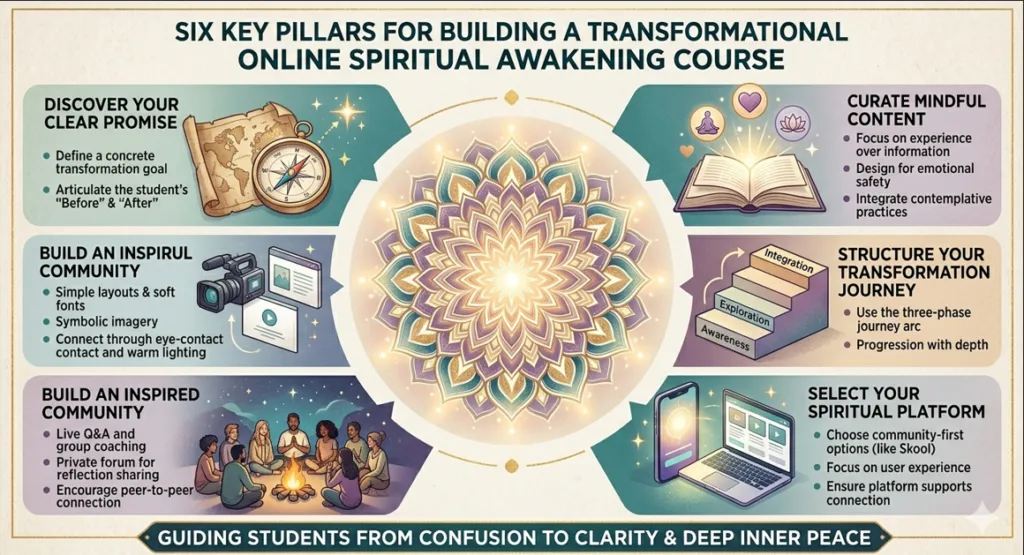
1. Start With a Clear Transformation Promise
Why Your Promise Matters
First of all, before you build anything, you need one thing above all else. That is a clear transformation promise. In other words, you must clearly define what change your student will experience by the end of your course.
Without this clarity, your course will feel scattered. In addition, your marketing may fall flat because students will not understand why they should enroll. Therefore, your transformation promise becomes the foundation of everything else.
How to Write Your Transformation Promise
Writing a strong promise is simpler than it sounds. First, identify where your student is right now. Then, describe clearly where they will be after completing your course. Finally, explain what tools and practices will get them there.
For example, a good promise might say: “By the end of this course, you will move from feeling lost and disconnected to living with daily clarity and a sustainable spiritual practice.” This kind of promise gives your curriculum a clear direction to follow.
Here is what your transformation promise must include:
- The specific pain point your student feels right now
- The clear outcome they will achieve by the final lesson
- The key practices and tools that bridge the gap
- A tone that feels believable, warm, and emotionally honest
2. Build a Strong Curriculum Foundation
What Is Curriculum Design
First, curriculum design is how you organize your lessons in a clear and logical way. In simple terms, it helps your student move from confusion to clarity, step by step. In addition, in spiritual learning, good curriculum design also creates a sense of emotional safety at each stage.
Next, effective instructional design always starts with your transformation promise. Therefore, each module and lesson should lead toward that final result. As a result, every part of your course has a clear purpose. Finally, nothing should be added just to fill space or make the course look longer.
Key Elements of a Strong Spiritual Curriculum
A great spiritual curriculum always includes these core elements:
- A transformation promise stated clearly in the very first lesson
- A modular structure with five to eight focused sections
- Progressive depth moving from basic awareness to deep personal application
- Reflection activities and journaling prompts after every single module
- Short assessments that help students track their own inner progress
3. Structure Your Modules the Right Way
Follow the Three Phase Journey
To begin with, a well-structured spiritual awakening online course follows a simple journey. For example, you can think of it as a hero’s path. First, the student starts by feeling lost. Then, they explore new ideas and simple practices. Finally, they leave feeling calm, grounded, and transformed.
Next, most successful courses follow three clear phases. In general, each phase includes two to three modules. In addition, each module has three to five short and focused lessons. As a result, the course feels easy to follow. Finally, every lesson should end with a simple action step that students can apply the same day.
Phase One: Awareness
This phase introduces students to your core spiritual concepts. In addition, it builds trust and emotional safety. As a result, students feel ready and more open to go deeper in the next phase.
Phase Two: Exploration
This phase dives into the practices at the heart of your course. For example, breathwork, meditation, energy awareness, and reflective journaling all work well here. Moreover, exercises should build progressively in depth and intensity throughout this phase.
Phase Three: Integration
This final phase helps students embed their learning into daily life. In other words, transformation must move from the screen into the real world. Therefore, use daily rituals, journaling habits, and community accountability to make the change last.
4. Choose the Right Platform for Your Spiritual Awakening Online Course
Choosing the right platform shapes your entire student experience. Each option below serves a different type of creator. Therefore, review the table carefully before making your decision.
| Feature | Kajabi | Skool | ClickFunnels |
|---|---|---|---|
| Best For | All-in-one course and marketing | Community-first learning | Funnel building and sales |
| Course Hosting | Yes | Yes | Yes |
| Built-in Community | Yes basic | Yes advanced | Limited |
| Email Marketing | Yes built-in | Needs integration | Yes |
| Sales Funnels | Yes | No | Yes core feature |
| Gamification | No | Yes | No |
| Mobile App | Yes | Yes | No |
| Starting Price | $69 per month | $99 per month | $97 per month |
| Best Fit for Spiritual Courses | Excellent | Very Good | Good |
Which Platform Should You Choose
To start, if you are launching your first spiritual awakening online course, Kajabi is a simple all-in-one option.However, if community and group growth matter most, Skool is a better fit.On the other hand, if you need strong sales funnels, ClickFunnels is worth considering.
5. Case Study: How Mindvalley Built a Spiritual Awakening Online Course
Company: Mindvalley Course: Becoming Limitless Founder: Vishen Lakhiani Students Reached: 20 million across 195 countries Reference: mindvalley.com/becoming-limitless
Mindvalley is one of the best real examples of a spiritual awakening online course built with genuine design thinking. Their program Becoming Limitless was built around a clear promise, smart content sequencing, and strong community integration.
What They Did Right
- Stated a specific transformation outcome clearly from lesson one
- Alternated between teaching and hands-on experiential exercises throughout
- Grouped students into small peer accountability circles called Tribes
- Used clean and cinematic video production to create an immersive atmosphere
- Re-engaged students regularly through email sequences and live events
Results
| Metric | Result |
|---|---|
| Completion Rate | Three to five times above industry average |
| Student Base | 20 million learners worldwide |
| Countries Reached | 195 countries |
Key Takeaway
You do not need a large budget to apply these principles. Simply start with a clear promise, sequence your content with intention, keep your video clean and focused, and build community into your course from day one.
6. Design Slides That Support Spiritual Awakening online course Learning
Why Slide Design Matters
Visual design is often overlooked in spiritual courses. However, it dramatically affects how students receive your message. Slides that feel cluttered or generic can break the focused atmosphere you are trying to create. Therefore, every design decision should reflect the tone and depth of your spiritual content.
Simplicity is your greatest design ally. Specifically, clean layouts, generous white space, and consistent colors all help students feel calm and focused. Furthermore, meaningful imagery reinforces your spiritual message without the need for extra words.
Slide Design Best Practices
Follow these simple rules for every slide in your course:
- Use only one key idea per slide to avoid overwhelming your students
- Choose calm fonts such as serif or soft sans-serif styles throughout
- Use symbolic imagery like nature, soft light, or sacred geometry
- Stick to a consistent color palette of three to four tones across all slides
- Add occasional quote slides to reinforce key teachings in a visual way
- Always design for mobile since many students watch lessons on their phones
7. Produce Videos That Create Real Connection
What Makes a Great Course Video
To begin with, high-quality video is key for a spiritual awakening online course. It feels close to learning in person. As a result, it builds trust and keeps students engaged.
However, you do not need a studio. Instead, focus on three basics. First, use good lighting. Next, ensure clear audio. Then, keep your framing simple and clean. In addition, natural window light works well because it feels warm and real.
Recommended Setup:
- A USB condenser microphone for clear and professional audio
- Natural window light or a soft ring light for warm and flattering visuals
- A clean and calm background with minimal distractions
- A modern smartphone or entry level camera for recording
Types of Videos to Include in Your Course
Including a variety of video types keeps your course fresh and engaging. Therefore, consider mixing the following formats throughout your program:
- Talking head videos for personal teaching and direct student guidance
- Guided meditation recordings for immersive relaxation and breathwork sessions
- Screencast lessons for journaling exercises and downloadable worksheets
- Live session recordings for group coaching calls and community Q&A sessions
- Short animated explainers for complex concepts like chakras or energy systems
8. Build a Community That Drives Transformation
Why Community Changes Everything
To begin with, the average completion rate for online courses is only about 15 percent. However, courses with an active community often perform much better. Therefore, in a spiritual awakening online course, community is not just a bonus. Instead, it is a key part of the transformation.
In fact, spiritual growth becomes faster in a group setting. When students share their thoughts and progress with others on the same path, learning feels deeper and more real. In addition, this shared journey builds a strong sense of belonging. As a result, students stay motivated and are more likely to finish the course.
What a Strong Course Community Looks Like
Here is what an engaged and thriving spiritual course community includes:
- Students share weekly reflections in a dedicated and private group space
- Peers hold each other accountable between lessons and live sessions
- Members celebrate milestones together which builds collective motivation
- Group discussions deepen spiritual understanding beyond the video lessons
- Guest teachers and community challenges keep energy and excitement high
Practical Community Building Strategies
Additionally, here are the most effective strategies for building your community:
- Host live Q&A sessions at least twice per month for direct student interaction
- Create a private Skool group or Facebook Group for your enrolled students only
- Assign weekly journaling prompts and encourage open sharing among students
- Publicly recognize and celebrate student wins no matter how small they seem
- Invite guest spiritual experts for occasional bonus live sessions that add real value
In summary, a well managed community does not just support your course. It becomes the most transformational part of the entire student experience.
Learn more about Transforming Passive Lessons into Interactive Experiences to keep your completion rates high
References
- Mindvalley — Becoming Limitless Program
- eLearning Industry — Instructional Design Models and Theories
Frequently Asked Questions
1. How long should a spiritual awakening online course be?
Most spiritual awakening online courses run between four and twelve weeks. For example, shorter courses suit simple topics like meditation basics. However, deeper transformation needs eight to twelve weeks of structured learning. Therefore, choose the length based on how deep the change should be.
Q2. What is the best platform for a spiritual awakening online course?
Kajabi is the best all-in-one choice for beginners. However, if community interaction is central to your model, Skool is the stronger option. On the other hand, ClickFunnels works best when sales funnels are your top priority. In short, your choice depends on your business model and course goals.
Q3. Do I need professional video equipment?
No. Many successful creators record on a smartphone with a quality microphone and natural lighting. What matters most is clear audio and a clean background. Furthermore, you can always upgrade your equipment gradually as your course revenue grows.
Q4. How should I price my spiritual awakening online course?
Entry-level courses usually cost between $97 and $297. In addition, mid-range programs fall between $497 and $997. Moreover, premium courses with coaching and certification often cost $1,000 or more. Therefore, set your price based on the level of transformation and support you offer.
Q5. Can AI tools help me design my course?
Tools like ChatGPT, Canva AI, and Descript help with curriculum mapping, slide design, and meditation scripts. As a result, you can reduce production time significantly without sacrificing content quality. Furthermore, AI tools are now widely used by professional instructional designers worldwide.
Q6. How do I keep students engaged throughout the course?
Keep video lessons between eight and twelve minutes to respect attention spans. Additionally, combine lessons with reflection prompts and community challenges. Furthermore, use progress tracking on Kajabi and gamification on Skool to reward consistency. In other words, make engagement a built-in part of your course structure from day one.
Q7. What makes a spiritual course different from a standard online course?
Spiritual courses need emotional safety, slower pacing, and hands-on learning because the transformation is deep and personal. Therefore, your design should focus on emotional connection, community support, and giving students time to reflect before moving forward.
Q8. Should I offer a certificate of completion?
Offering a certificate adds value and motivates students to complete your program. Therefore, it also attracts serious learners and supports higher pricing, especially for energy healing or mindfulness courses.
Conclusion
To begin with, building a spiritual awakening online course takes more than good content. Instead, you need a clear promise, a simple curriculum, clean visuals, the right platform, and a strong community. Together, these create real impact.
For example, Mindvalley shows that good design and active communities lead to better results. However, you do not need big resources. Rather, you need care and clear intent in each step.
So, start with your promise. Then, build your course around it. Next, pick the right platform. After that, use simple videos and slides. Finally, stay active with your students.
Therefore, your spiritual awakening online course can guide real and lasting change.
Ready to turn your vision into a reality? Follow our How to Create an Online Course From Scratch — Step-by-Step Guide to get started today.
Authored by: Laiba Ayaz