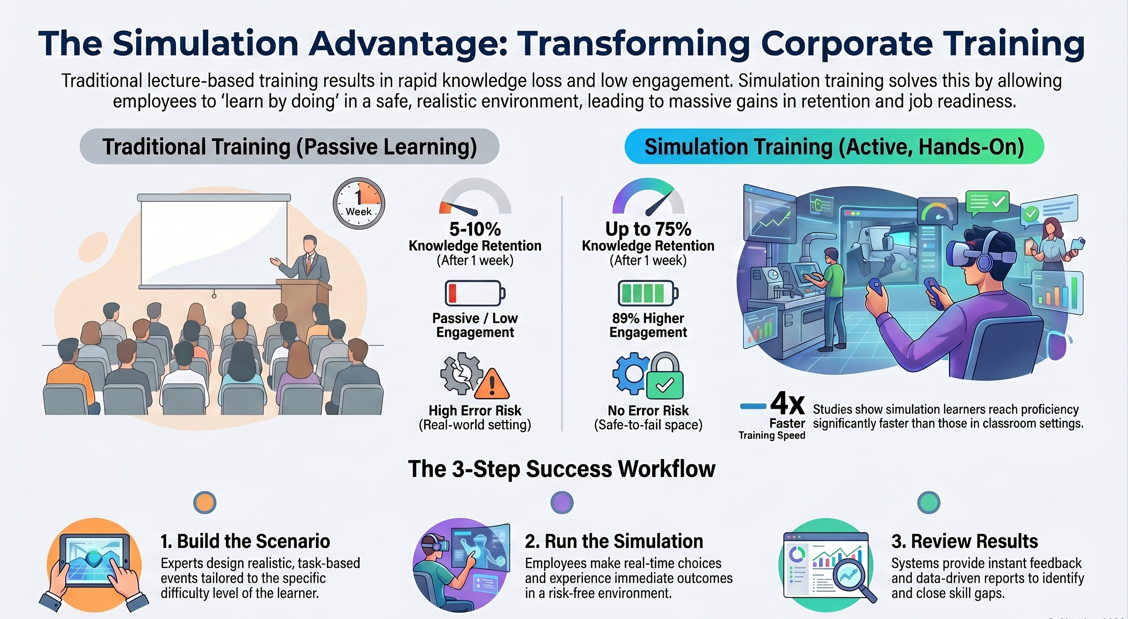
Old corporate training simulations and traditional training methods are slow. For example, workers often sit through long lectures. As a result, most of what they hear is soon forgotten.
Fortunately, corporate training simulations change all of this. Specifically, they put workers inside real job scenarios. Therefore, employees learn by doing, not just by listening.
To help you get started, this guide covers what these simulations are, how they work, and why they get results. In addition, you can learn how to build successful employee development programs to see how these tools drive business growth. Finally, you will find real data and company examples below.
What Are Corporate Training Simulations?
corporate training simulations copy real work events. Because of this, employees can step right in and practice. So, instead of just reading about a task, they carry it out.
Three core ideas make this work:
- Real scenarios: training mirrors actual job tasks.
- Safe space: mistakes cost nothing here.
- Active learning: workers do, not just listen.
To begin with, traditional training relies heavily on lectures and printed guides. However, listening alone does not build real skills. On the contrary, doing does.
Because of this, simulations shift training from dull theory to real practice. Ultimately, that one simple change makes a huge difference.
Why Corporate Training Simulations Matter
Business moves fast today. As a result, workers must be job-ready from day one. Yet old onboarding often leaves new staff feeling lost.
Because of this, more companies are turning to simulation-based training. Below are three key reasons why.
1. Staff Get Job-Ready Faster
To begin with, simulations expose workers to hard scenarios before they start. As a result, new hires adapt to their roles in less time. For instance, they have already faced tough situations, so they know exactly what to do.
2. Better Choices Under Pressure
To start, workers practice making choices in a safe space. Then, after each choice, they see what happens next. Consequently, they build sharper thinking habits. As a result, fewer errors are made when real pressure arrives.
3. On-the-Job Mistakes Drop
Practicing a task many times builds strong muscle memory. In addition, the simulation catches weak spots early. As a result, costly real-world errors are cut before they ever happen.
Types of Corporate Training Simulations
| Simulation Type | Main Use | Skill Developed | Industry |
| Customer Service Simulation | Handle complaints | Communication | Retail, Banking |
| Technical Skill Simulation | IT troubleshooting | Tech proficiency | IT, Engineering |
| Leadership Simulation | Crisis & team decisions | Decision-making | Corporate, Military |
| VR Safety Simulation | Hazard response | Risk management | Aviation, Healthcare |
| Sales Role-Play Simulation | Objection handling | Persuasion skills | Sales, Finance |
Key Benefits of Corporate Training Simulations
Simulations beat old methods in many ways. Here are the top gains companies report.
Higher Employee Engagement
Many workers find standard training boring. As a result, focus drops, and little information is retained. In contrast, simulations are hands-on and fun. According to WiFi Talents’ 2026 training report, gamified learning raises engagement by 89%. Furthermore, active learners feel more invested in their jobs.
Better Knowledge Retention
People forget 50% of what they hear within one hour. However, doing a task makes the memory stick far longer. Murf.ai’s 2025 training data shows eLearning retention is 25% to 60% higher than classroom learning. Moreover, simulation-based training pushes those numbers even higher.
Stronger Return on Investment
Zippia’s training statistics show that firms with strong training earn 218% more income per worker. Additionally, those firms keep 30-50% more staff. So, the savings on hiring alone can be huge.
In short, the top benefits are the following:
- Higher focus workers stay engaged throughout.
- Stronger memory skills stick much longer.
- Fewer errors in practice before the real event.
- Lower-cost modules are reused again and again.
- Faster onboarding: new staff hit the ground running.
How Corporate Training Simulations Work
The process is easy to follow. Just three steps take a learner from start to finish.
Step 1: Build the Scenario
Experts design a realistic event based on a real job task. Roles are set. Difficulty is matched to the learner’s level. So, every session feels relevant and fair.
Step 2: Run the Simulation
The employee enters the scenario. Choices must be made in real time. After each decision, the outcome is shown. Therefore, learners see the impact of every choice they make.
Step 3: Review Results
Once done, the system gives instant feedback. Reports highlight strong points and skill gaps. Managers then use this data to plan the next stage of training.
Traditional Training vs. Simulation-Based Training
| Factor | Traditional Training | Simulation Training |
| Engagement | Passive / Low | Active / High |
| Knowledge Retention | 5-10% after 1 week | Up to 75% after 1 week |
| Error Risk | High (real setting) | None (safe setting) |
| Feedback Speed | Delayed | Immediate |
| Scalability | Limited | Highly scalable |
| Long-Term Cost | High (repeat sessions) | Lower (reusable modules) |
Technologies That Power Corporate Training Simulations
Three tools drive modern simulation training. Each one plays a key role.
Learning Management Systems (LMS)
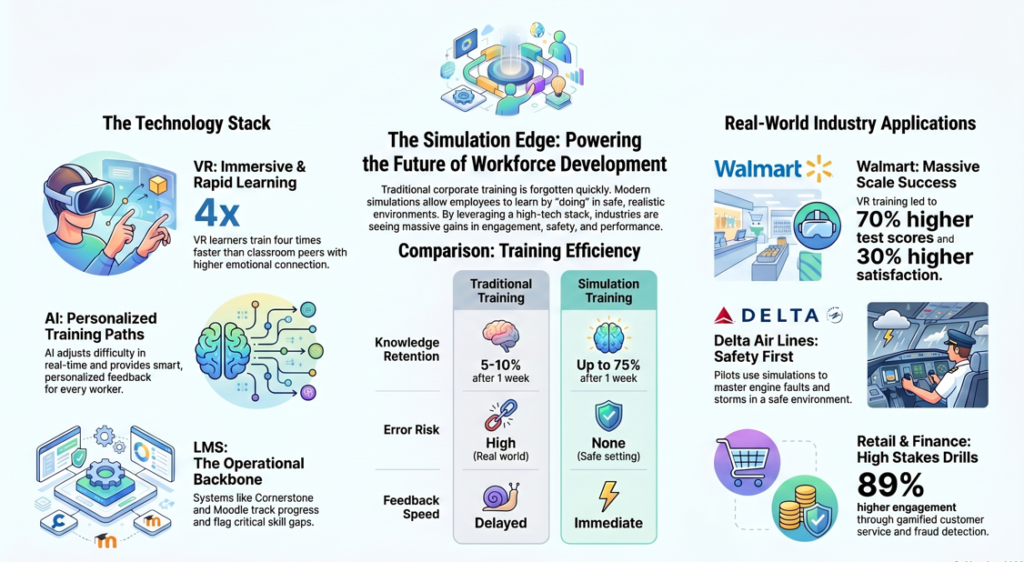
An LMS sends training to learners and tracks their progress. It stores scores, flags gaps, and works on any device. Popular options include Cornerstone, SAP SuccessFactors, and Moodle.
Virtual Reality (VR) Training
VR places employees inside a live 3D world. As a result, the training feels completely real. A PwC study found VR learners train four times faster than classroom peers. Moreover, VR users show 3.75 times more emotional connection to the content.
AI-Powered Training
AI makes each session personal. It raises or lowers the difficulty based on performance. Furthermore, it gives smart feedback after every attempt. Over time, each worker gets a training path built just for them.
Real-World Examples of Corporate Training Simulations
Top global companies already use simulation training. Their results are impressive.
Walmart VR Training for Over One Million Staff
Walmart began VR training in 2017. Since then, headsets have been rolled out to every US store. Workers practice customer service, Black Friday prep, and new tech. According to Walmart’s VR training case study (SHRM), the results are clear:
- VR trainees score higher on tests 70% of the time.
- Satisfaction is 30% higher than in standard training.
- Knowledge retention rises by 10-15%.
- 90-minute classes are cut down to just 20 minutes.
Ernst & Young Fraud Detection Simulations
EY needed auditors to spot fraud faster. So, the firm used simulations with fake company data. Auditors had to find hidden financial crimes. According to MDA Training’s case study, EY saw a big rise in fraud detection rates. As a result, client reports became more accurate and reliable.
Delta Air Lines Pilot Simulator Training
Delta trains all pilots in flight simulators. These systems copy engine faults, storms, and emergencies. Pilots face rare but deadly events safely. Because of this, commercial aviation now has one of the best safety records of any high-risk industry.
Which Industries Use Simulation-Based Training?
Corporate training simulations now reach almost every sector. Below is a quick look:
- First, healthcare uses these tools for patient care drills, surgery practice, and emergency response.
- Next, IT and cyber teams run phishing tests, breach response, and system debug practice.
- In addition, finance firms rely on them for compliance training, risk checks, and fraud spotting.
- Similarly, retail companies use customer service roleplay and conflict resolution to train staff.
- Then, manufacturing plants focus on equipment drills and workplace safety training.
- Finally, aviation brands rely heavily on cockpit crisis training and crew management simulations.
Challenges of Implementing Corporate Training Simulations
Simulations are powerful tools. However, they do come with real challenges. Here are the three main ones.
High Setup Costs
To begin with, building a simulation takes time and money. For example, VR content is the most costly to produce. However, prices are falling fast. As a result, off-the-shelf tools now offer solid options for smaller firms too.
Staff Adoption Issues
Next, some workers resist new digital tools. In fact, others simply find them hard to use at first. Therefore, good onboarding and clear communication are essential. Because of this, staff need to feel supported, not pressured. To make this transition easier, you can use scenario-based learning to build comfortable, realistic spaces where employees can practice at their own pace.
Keeping Content Fresh
Finally, simulations can go out of date quickly. This happens because processes, laws, and tools all change. As a result, content must be reviewed and updated on a set schedule. For this reason, companies need to budget for this from the start.
The Future of Corporate Training Simulations
The road ahead looks exciting. Three major trends are set to reshape how companies train their staff.
- First, AI will tailor every session to each worker in real time.
- Next, VR and AR will produce cheaper, more lifelike learning worlds.
- Finally, biometric tools, like eye tracking, will help simulations react to how a learner feels.
According to eLearning Industry’s 2025 workforce report, simulation learning is now a standard part of leadership and technical training worldwide. Furthermore, firms that invest early will have a clear edge in building a skilled, ready workforce.
References
Enhancing Knowledge Retention by Simulation-Based Learning Cureus / PubMed.
Simulation-Based vs. Non-Simulation-Based Training: A Meta-Analysis BMC Anesthesiology / PubMed.
The Effects of Training on Employee Performance IJSRP.
Frequently Asked Questions
What are corporate training simulations?
They are tools that copy real work events. Employees step in, make choices, and learn from results. All of this happens in a safe, controlled space.
Are simulations effective for employee training?
Yes, strongly so. Studies show better retention, higher engagement, and fewer job errors. For example, Walmart’s VR trainees score better on tests 70% of the time.
Which industries use simulation training?
Almost all of them do. Healthcare, aviation, IT, finance, retail, and manufacturing are the biggest users. Moreover, new sectors are adopting simulations every year.
What technologies power corporate training simulations?
Three main ones: Learning Management Systems (LMS), Virtual Reality (VR), and Artificial Intelligence (AI). Together, these tools make training fast, smart, and scalable.
How do simulations improve employee performance?
Practise builds habits. Workers repeat a skill until it feels natural. Furthermore, instant feedback after each attempt helps them improve fast. By the time they face the real task, they are already prepared.
Conclusion
Corporate training simulations are the most effective way to train workers today. The core idea is simple because you practice before the real thing.
As a result, employees engage more, remember more, and make fewer errors. In addition, companies save money because modules are reused at scale.
For example, Walmart, EY, and Delta have all shown what is possible. Furthermore, the data backs it up. So, the only real question left is: when will your company start using simulation-based training?
Authored by: Laiba Ayaz