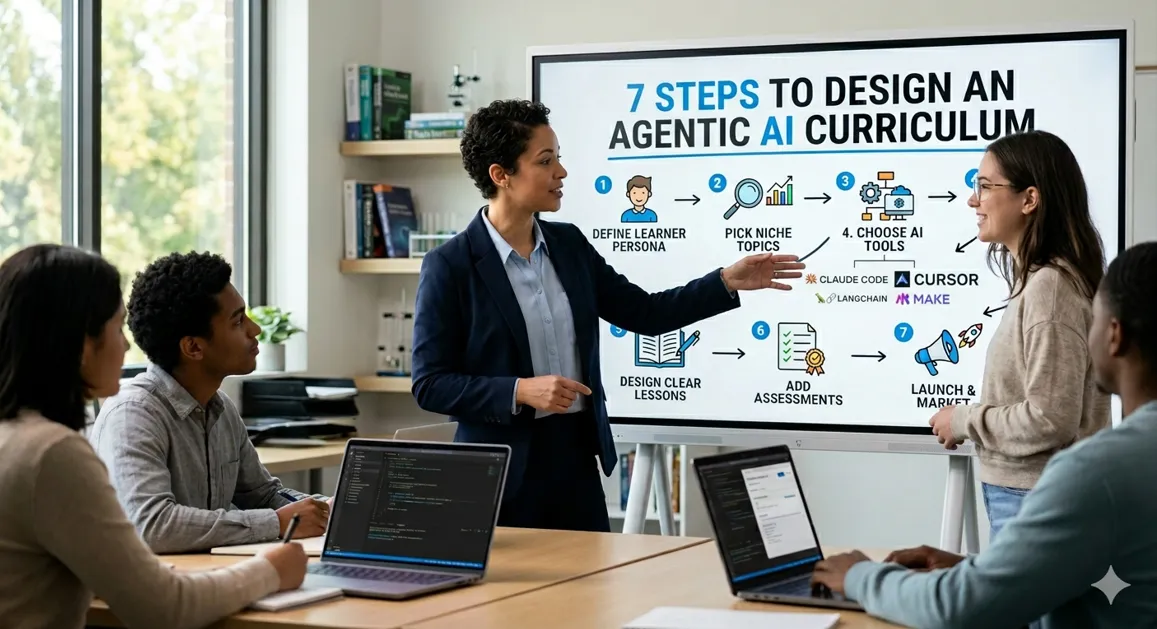
Agentic AI curriculum design can truly transform how your students learn. Currently, AI agents are managing complex tasks across every professional field. Consequently, creators who teach these essential skills early will likely lead the market. To help you succeed, this guide provides seven clear steps to follow, even if you are starting from zero.
What Is an Agentic AI Curriculum?
An agentic AI curriculum teaches learners how AI agents can plan and act on their own. Specifically, unlike a basic AI course, this program focuses entirely on real-world use cases. Furthermore, students learn to build and guide AI systems that work without constant human help. As a result, this specific skill is now one of the most in-demand in the current market.
According to IBM, agentic AI systems can plan, decide, and act on their own making this one of the fastest-growing skills to teach right now. IBM What Is Agentic AI
Agentic AI Curriculum vs Traditional AI Course
| Feature | Traditional AI Course | Agentic AI Curriculum |
|---|---|---|
| Focus | Concepts and theory | Real-world task work |
| Tools Used | Python, notebooks | Claude Code, Cursor, LangChain |
| Learner Outcome | Basic AI knowledge | Build and run AI agents |
| Best For | General audience | Creators, coaches, developers |
Why You Should Build This Course Right Now
Most AI courses still cover old tools. Because of this, a huge gap exists for fresh, easy, hands-on content. Filling that gap now gives you a head start. Furthermore, solo creators are earning steady income by teaching niche AI skills on Kajabi, Skool, and ClickFunnels.
Also, this topic can rank well on Google. Low-competition terms like “agentic AI for beginners” get real searches. However, very few teachers target them yet. So, your course can rank fast and pull in ready learners.
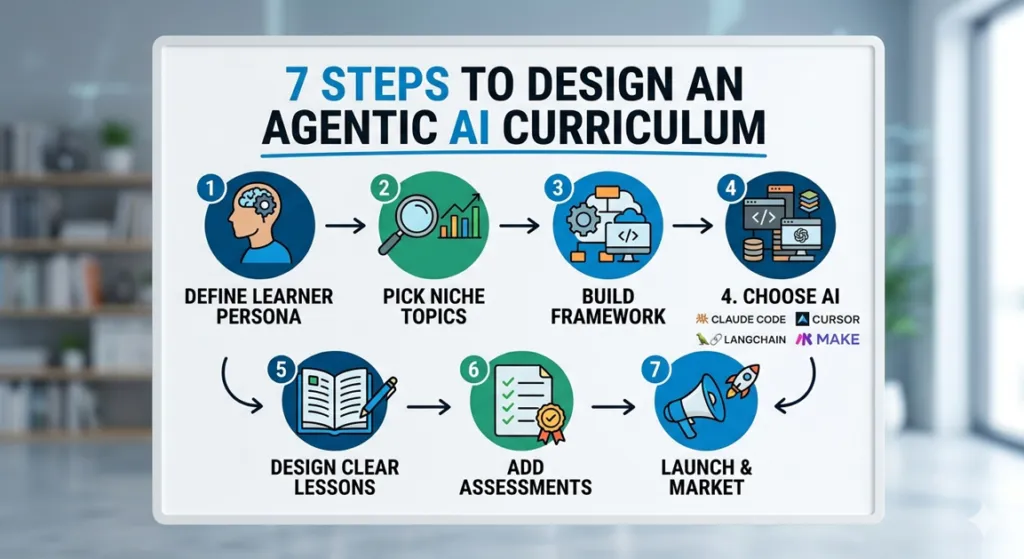
Step 1: Define Your Learner Persona
Before you write one lesson, know exactly who you are teaching. Ask yourself is this person a new learner, a coach, or a solo business owner? Each group needs a very different style. Therefore, defining your learner first is always the right move.
Also, think about what they already know. A total beginner needs simple words and more support. An advanced learner, on the other hand, needs context and real tasks. Getting this clear early saves hours of rework later.
- Write down their current skill level
- List their top three pain points with AI tools
- Define the one clear outcome they want after finishing
Step 2: Pick Low-Competition Topics That Can Rank
Smart topic choice helps your agentic AI curriculum rank with less effort. Instead of broad terms like “AI course,” go narrow. Niche topics rank faster and bring in more focused learners. Moreover, they tend to convert better because the search intent is clear.
Here are some easy, low-competition topics to include:
- How to use Claude Code for total beginners
- Build AI agents with no coding needed
- Agentic AI bootcamp design guide
- Using Cursor AI to save time at work
- AI agent steps for small business owners
These topics get real searches but face little competition right now. So, adding them to your course helps both your students and your rankings.
Step 3: Build Your Agentic AI Curriculum Framework
A clear structure keeps learners on track and cuts drop-off rates. Furthermore, it makes your course look pro from the very first lesson. Without a solid plan, even great content feels hard to follow.
Try this simple five-part plan as your base:
- First, understand what AI agents are and how they actually work
- Next, set up your AI coding space using Claude Code or Cursor
- Then, build your very first basic AI agent step by step
- After that, use agentic AI to automate real everyday tasks
- Finally, launch your skills and start selling your AI course with confidence
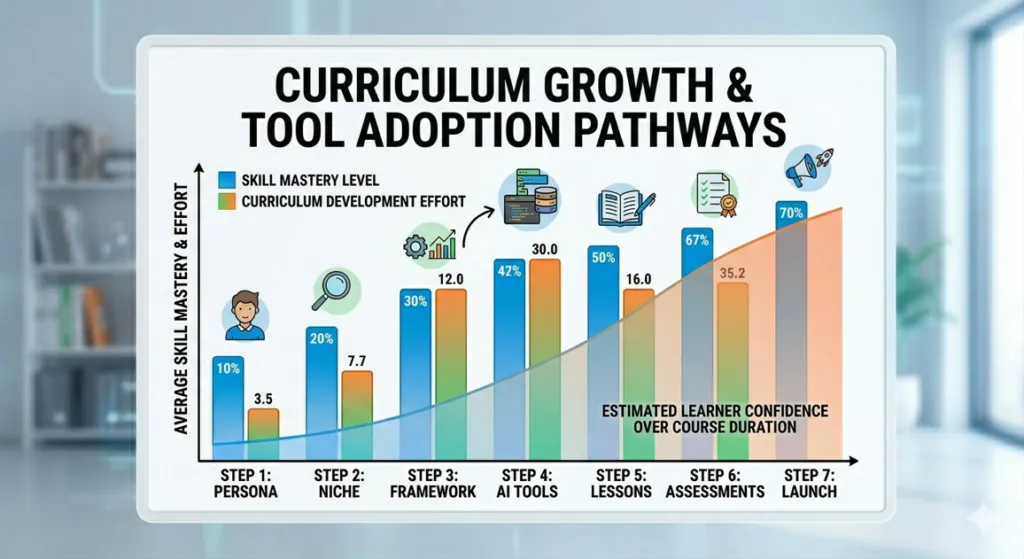
Microlearning can improve retention by 25% to 60% compared to other learning. eLearning Industry: Microlearning improves retention by 25% to 60%
Step 4: Choose the Right AI Tools for Beginners
Your tool choice shapes the whole learner experience. Luckily, easy AI coding tools have improved a lot in 2026. Picking the right ones lowers the barrier and keeps students moving forward.
Here are the best tools to add to your course:
- Claude Code: Great for plain-language coding tasks
- Cursor: An AI-first code editor that feels simple to use
- LangChain: Links AI models to real-world tools fast
- n8n or Make: No-code tools perfect for non-coders
First, always show students how each tool leads to a real result. Rather than just listing features, you should focus on the outcome. Instead, show them exactly what they can build today. In doing so, you make the learning process much more practical and exciting.
Step 5: Design Clear Lessons With Simple Goals
Every lesson needs one clear goal. Students should know exactly what they can do once they finish. This is the core of good course design. Moreover, clear goals remove confusion and build strong momentum fast.
Use this five-part lesson plan for every session:
- Hook: Open with a real problem (2 minutes)
- Teach: Explain the idea in plain words (5 to 8 minutes)
- Demo: Show it live with the AI tool (5 to 10 minutes)
- Practice: Give a short hands-on task (5 minutes)
- Recap: Sum up the key point in one sentence
This format works well for both live bootcamps and self-paced courses. Furthermore, it specifically cuts drop-off rates because learners always know what comes next. Consequently, your students stay more engaged and finish the program with ease.
Step 6: Add Assessments to Your Agentic AI Curriculum
Tests prove that learning took place. Projects give learners real confidence. Together, they turn a passive course into a skill-building tool. Therefore, never skip this step in your agentic AI curriculum plan
Include these simple assessment types:
- Short quizzes after each module, three to five questions
- A “build your first AI agent” final project
- Peer review rounds for live bootcamps
- A short portfolio submission at the end
Final projects are very powerful. They give learners something real to show clients or employers. As a result, your course becomes a true asset, not just content they forget.
Step 7: Launch and Market Your Agentic AI Curriculum
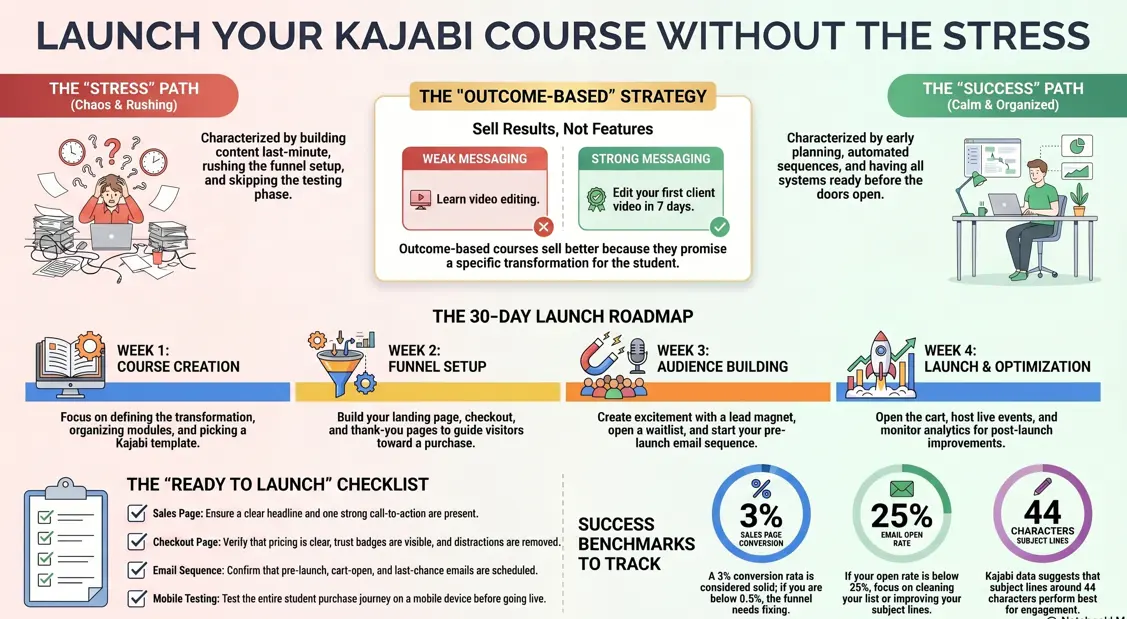
A great course still requires a smart launch plan to succeed. For instance, Kajabi and Skool allow you to host, sell, and market your content in one unified place. In contrast, ClickFunnels works best if you prefer a funnel-first sales setup. Regardless of the tool you choose, your launch strategy matters just as much as the content itself.
Follow this simple pre-launch checklist:
- Build a waitlist page three weeks before launch
- Share free tips on LinkedIn and YouTube to gain trust early
- Offer an early-bird deal for the first 20 to 30 students
- Gather feedback from beta students before going live
- Set up email sequences to answer common questions
Read our AI HR training guide at TheEduAssist
Conclusion
So, now you have a clear plan to build your agentic AI curriculum. Each step is simple and easy to follow. Therefore, you do not need a big team or a huge budget to get started. Just take it one step at a time. Moreover, the demand for AI skills is growing fast, so the sooner you launch, the better. Go ahead and take that first step today. As a result, your students will thank you for it.
Frequently Asked Questions
What is an agentic AI curriculum?
It teaches students how to build AI agents that work on their own. The focus is on tools like Claude Code and Cursor not just theory.
Do I need coding skills to design this course?
No, you do not need advanced coding skills at all. Many tools in this type of course, like n8n and Cursor, need very little code to use.
How long should an agentic AI bootcamp run?
A live bootcamp usually runs four to six weeks. Self-paced learners can finish it in four to eight hours based on their own speed.
Which platform is best for hosting this course?
Both Kajabi and Skool work very well for this type of course. Pick Skool for community tools or Kajabi for a full built-in sales system.
Can I sell this curriculum in Pakistan?
Yes, Pakistan has a fast-growing need for AI skills. Global platforms like Skool support easy payments, and local pricing can raise your sign-up rates a lot.
How is this different from a basic AI course?
A basic AI course covers ideas and theory only. An agentic AI curriculum goes further it teaches learners to build agents that take real actions and run tasks on their own.
Authored by: Laiba Ayaz