
Digital product creation is the fastest way to build a scalable online business in 2026.
Many creators struggle to turn their knowledge into a product that sells. However, this process becomes simple when you follow the right framework.
Therefore, this blueprint covers every step, from instructional design to sales funnels. In fact, it includes everything you need to launch your first digital product this year.
Platforms like Kajabi, Skool, and ThriveCart make the process easier than ever. As a result, even beginners can launch a professional product quickly without any technical difficulty.
What Is Digital Product Creation?
Digital product creation means packaging your expertise into a sellable online format. Furthermore, it requires zero physical inventory.
Your profit margins are much higher than a traditional business. Additionally, you create the product once and sell it many times.
Common digital products include:
- Online courses and video programs
- E-books, PDF guides, and templates
- AI certification programs
- Financial literacy courses
- Membership sites and communities
- Toolkits and swipe file libraries
Therefore, digital product creation is one of the highest-leverage income models available today.
Why Instructional Design Matters in Digital Product Creation
Most creators build products based on what they know. However, the best products are built around how people learn.
Instructional design is the science of creating learning experiences that get real results. Additionally, it increases student satisfaction and reduces refund rates.
As a result, courses built on instructional design principles see up to 40% higher completion rates, according to the eLearning Industry.
Core Adult Learning Principles to Use
- Adults learn best when content solves a real, immediate problem
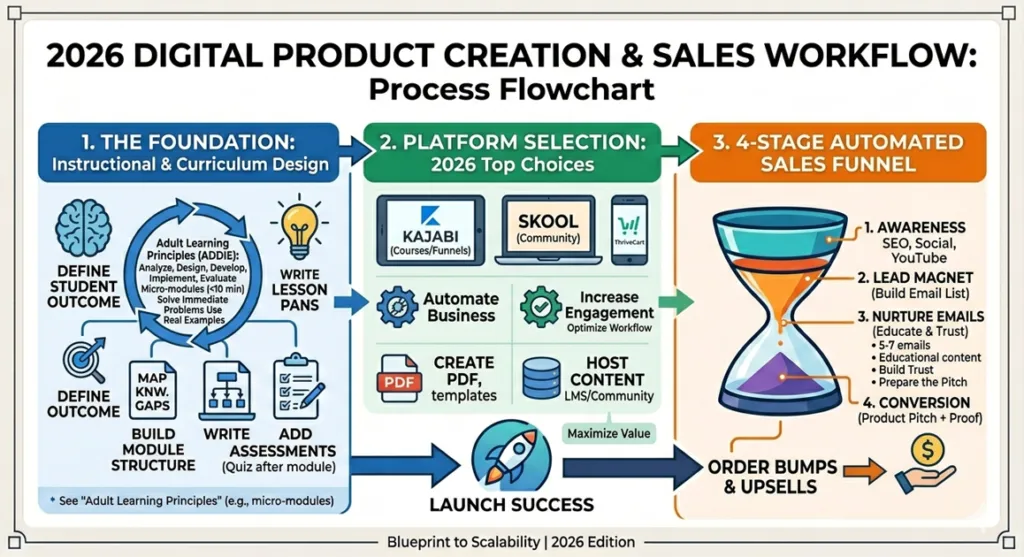
- Use the ADDIE model: Analyze, Design, Develop, Implement, Evaluate
- Break content into short micro-modules under 10 minutes each
- Add a quiz or action step after every module
- Use real examples and case studies to make learning stick
Moreover, well-structured products attract more testimonials. Because of this, your word-of-mouth growth increases over time.
Curriculum Design Steps for Digital Product Creation
A clear curriculum design process is the backbone of every successful digital product. Therefore, plan your content before you create a single lesson.
However, many creators skip this step. Consequently, they end up with a disorganised product that confuses students.
The 5-Step Curriculum Design Framework
Step 1: Define the outcome. Decide exactly what students will achieve. For example: ‘Students will launch their first product in 30 days.’
Step 2: Map the knowledge gaps. List what your audience already knows. Then identify what they still need to learn.
Step 3: Build your module structure. Group related lessons into clear modules. Each module should answer one key question.
Step 4: Write lesson plans. Every lesson needs a clear goal, a teaching method, and one action step.
Step 5: Add assessments. Include a short quiz or reflection prompt at the end of each module.
Because of this structure, your students get better results. As a result, your product earns more five-star reviews and referrals.
Real Case Study: Sarah Cordiner’s Digital Product Success
Source: sarahcordiner.com
Sarah Cordiner is a globally recognised course creation expert. She built her digital product business using structured curriculum design and adult learning principles.
She started with one online course on course creation. As a result, she scaled to over 280,000 student enrolments across 181 countries.
Furthermore, she built a 7-figure education business over a decade. She did this without paid ads — using only content marketing and strong product design.
Key Lessons From Sarah’s Digital Product Creation Journey
- She solved one specific, painful problem for her audience .
- Adult learning principles were applied to every lesson she built.
- Before every launch, email funnels helped nurture her leads.
- Business automation became possible through an all-in-one platform.
- A strong community was built to increase retention and referrals
Therefore, you can follow the same path. Moreover, you do not need a huge audience to get started.
Best Platforms for Digital Product Creation in 2026
Choosing the right platform is a critical decision. However, the best choice depends on your goals, budget, and product type.
Therefore, use the comparison table below to find the right fit for your digital product creation journey.
| Platform | Best For | Price/Month | Free Plan | Top Feature |
| Kajabi | All-in-one courses | From $149 | No | Full funnel + email + community |
| Skool | Communities | $99 | No | Gamification + group learning |
| ThriveCart | High-ticket sales | $495 one-time | No | Upsells + order bumps + affiliate |
| Nas.io | AI-powered launch | Free | Yes | AI product ideation from social media |
| Beehiiv | Newsletter + products | From $39 | Yes | SEO site + ad network + referrals |
| Teachable | First course | From $39 | Yes | Easy LMS + quizzes + affiliates |
Kajabi: Best All-in-One for Digital Product Creation
Kajabi combines courses, email marketing, funnels, and community in one place. Furthermore, it has no transaction fees on any plan.
However, it is the most expensive option on this list. Therefore, it is best suited for creators who are ready to scale.
- Best for: Premium courses and coaching programs
- 2026 update: New AI content tools for course builders
Skool: Best Community Platform
Skool blends structured courses with community discussions. Additionally, it uses gamification to keep students engaged every day.
Because of its simplicity, it is one of the fastest-growing platforms in 2026. Moreover, it now supports affiliate programs and paid events.
- Best for: Group coaching and membership communities
- 2026 update: Affiliate programme and paid events now live
→ The Ultimate Skool Community Setup Guide for Course Creators
ThriveCart: Best for Maximising Sales Revenue
ThriveCart offers a one-time payment of $495. As a result, you pay no monthly fees ever.
Furthermore, it includes upsells, order bumps, and a built-in affiliate centre. Additionally, ThriveCart Learn+ now supports full course delivery.
- Best for: High-ticket digital products and upsell sequences
- 2026 update: Gamification and quizzes added to Learn+
Nas.io: Best AI-Powered Platform
Nas.io uses AI to help you create your digital product fast. For example, it scans your social media and suggests product ideas based on your audience.
Therefore, it is the best choice for beginners who want to launch quickly. However, it is still growing compared to older platforms.
- Best for: Social-first creators and AI-powered product launches
- 2026 update: Zero Links for instant payment — no website needed
Beehiiv: Best for Newsletter-Based Products
Beehiiv is a newsletter platform that now supports direct digital product sales. Furthermore, every newsletter comes with a built-in SEO website.
Because of its referral and ad network features, it is ideal for writers and educators. Additionally, paid subscriptions are available on all plans in 2026.
- Best for: Writers and content creators with newsletter audiences
- 2026 update: Direct digital product sales on all plans
Teachable: Best for First-Time Course Creators
Teachable is a simple, affordable platform for new course creators. Moreover, it includes quizzes, video hosting, and a student dashboard out of the box.
However, lower-tier plans charge transaction fees. Therefore, upgrade as soon as your revenue allows.
- Best for: Educators building their first online course
- 2026 update: Improved AI course outline generator
How to Build a Sales Funnel for Your Digital Product
Creating a great digital product is only half the battle. Consequently, you also need a system to attract and convert your audience.
Furthermore, a well-built funnel works for you around the clock. Therefore, set it up once and let it sell on autopilot.
The 4-Stage Digital Product Sales Funnel
Stage 1: Awareness:
Use SEO blog posts, YouTube videos, and social media to attract your ideal audience.
Stage 2: Lead Magnet:
Offer a free resource, a PDF guide, mini-course, or webinar in exchange for an email address.
Stage 3: Nurture Emails:
Send 5 to 7 emails that educate your subscriber and build trust before you pitch.
Stage 4: Conversion:
Present your digital product with strong social proof and a clear call to action.
In addition, adding an upsell at checkout, such as a Skool community, increases your average order value. As a result, your revenue per customer grows without extra marketing spend.
Top Niches for Digital Product Creation in 2026
Choosing the right niche is critical. However, not all niches are equal in terms of demand and earning potential.
Therefore, here are the two highest-demand niches for digital product creation right now.
Financial Literacy Courses
Over 57% of Americans are financially illiterate, according to the FINRA Foundation. Therefore, demand for money management and investing courses is rising fast.
Furthermore, financial literacy products command premium prices. Additionally, students in this niche are highly motivated to take action and pay for results.
- Price range: $197 to $997 per course
- High repeat-buyer rate — students return for advanced programs
- Strong community potential on platforms like Skool
AI Certification Programs
AI skills are among the top-searched topics globally in 2026. Moreover, professionals want structured, credentialed learning not just free YouTube videos.
Because of this demand, AI certification products can command $500 to $2,000 per program. Furthermore, the audience spans every industry and profession.
- Price range: $500 to $2,000 per certification
- High perceived value due to the certification element
- Rapidly growing audience — new learners enter every week
Digital Marketing Strategies to Sell Your Product
Even the best digital product creation process fails without consistent marketing. Therefore, here are the top strategies for 2026.
- SEO content marketing: publish blog posts targeting keywords your audience searches for
- Email marketing: Build and nurture your list before and after every launch
- YouTube organic: Create free tutorials that show your expertise and drive traffic
- Podcast guest spots: Reach new targeted audiences and build authority fast
- Affiliate partnerships: Let others promote your product for a commission
- Paid Meta and Google ads: Scale what is already converting organically
Moreover, consistency matters more than perfection. Because Google rewards fresh, helpful content, publishing regularly is one of the best long-term strategies.
As a result, creators who combine SEO with email marketing see compounding growth over time. Furthermore, this reduces your dependence on paid ads.
References
1. eLearning Industry — Instructional Design Principles That Improve eLearning
2. FINRA Foundation — National Financial Capability Study, Fifth Edition (2022)
3. Sarah Cordiner — Course Creation Specialist & Digital Product Expert
Frequently Asked Questions
1. What is digital product creation?
Digital product creation is the process of designing and selling knowledge-based products online. Examples include online courses, e-books, templates, and AI certification programs.
2. Which platform is best for digital product creation in 2026?
Kajabi is best for an all-in-one solution with courses, email, and funnels. However, Nas.io is the best free option for beginners who want to use AI to launch quickly.
3. How do I start digital product creation with no audience?
Start by publishing free SEO content and building an email list. Furthermore, use a lead magnet to attract subscribers before you launch your first product.
4. How much money can I make from digital product creation?
Earnings vary widely depending on your niche and funnel. However, many creators earn between $5,000 and $50,000 per launch with a well-designed product.
5. Do I need instructional design skills for digital product creation?
You do not need a formal degree. However, using the ADDIE model and adult learning principles significantly improves your product quality and completion rates.
6. What is the best niche for digital product creation in 2026?
Financial literacy and AI certification are the two highest-demand niches. Both offer premium pricing and large, growing audiences that actively search for structured learning.
7. How long does digital product creation take?
A focused creator using a structured curriculum design process can launch in 4 to 8 weeks. Therefore, planning before you create is the most important step.
8. What is the best free marketing strategy for digital product creation?
SEO content marketing and YouTube are the most cost-effective free strategies. Additionally, building an email list from day one gives you a direct channel for every future launch.
Conclusion:
Digital product creation is one of the most scalable business models available in 2026. Moreover, today’s tools and platforms make it easier than ever to get started.
As we covered in this blueprint, strong instructional design and clear curriculum design are the two most important foundations. Furthermore, choosing the right platform, whether Kajabi, Skool, or ThriveCart, can significantly improve your results.
Therefore, take action today. Start with your transformation statement. Build your curriculum. Choose your platform. As a result, you will move faster toward launching a successful digital product.
Authored by: Laiba Ayaz