
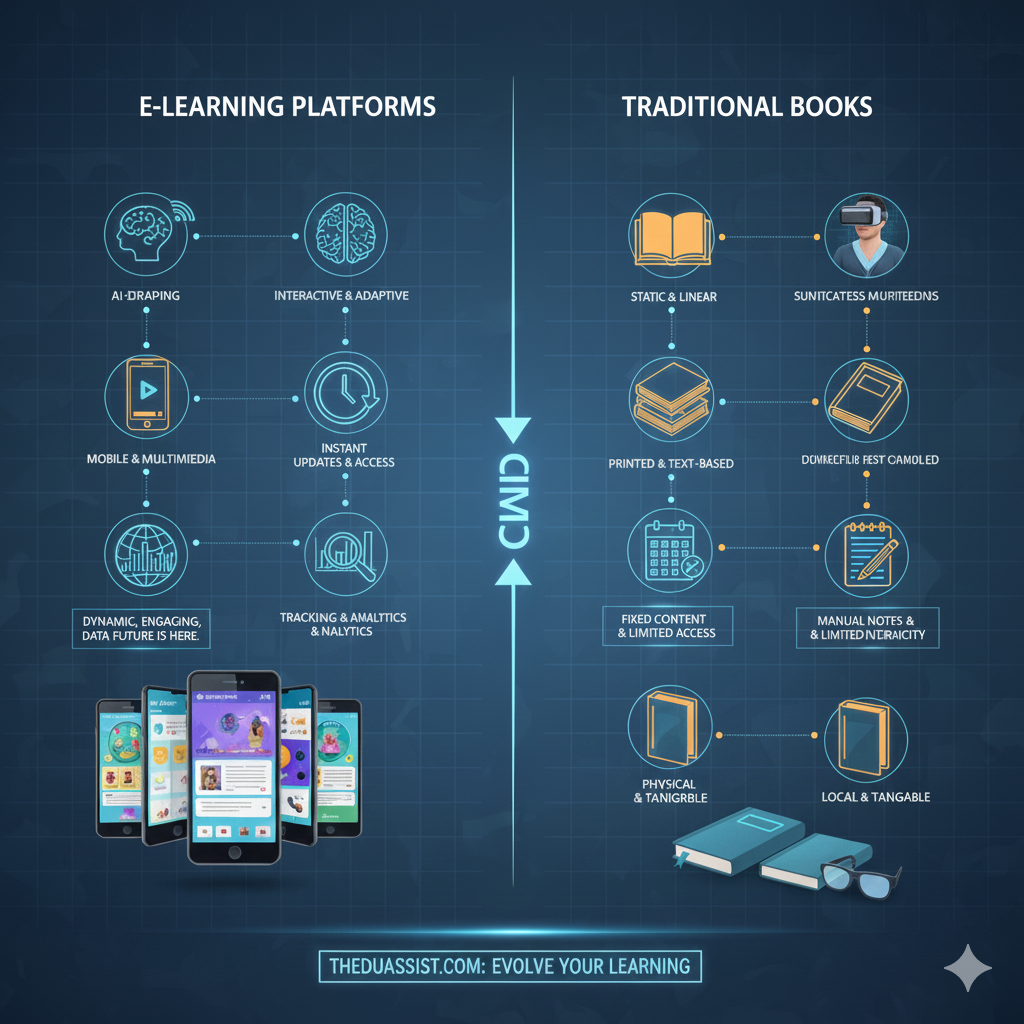
- How AI Is Transforming the eLearning Industry in 2025
- Recent trends of mobile learning and microlearning
- Modern LMS Platforms for Today’s Learners
- Gamification Trends for Digital Learning 2025
- Individualized and Intelligible Learning
- VR/AR in eLearning: Immersive Learning Structures
- Trends: Future of Corporate Training and Upskilling in 2025
- Trends in online learning Worldwide
- Conclusion
- Call to Action: TheEduAssist.com: The Future of Learning
- Frequently asked questions
Artificial Intelligence (AI), adaptive learning systems, mobile-first microlearning, gamification strategies, and immersive technologies are reshaping the eLearning.
How AI Is Transforming the eLearning Industry in 2025
AI-powered learning systems, automated course development, intelligent assessments, and generative content processes are the future of eLearning. The learning design based on AI, the automated SCORM content generation, and the intelligent LMS analytics are the features being used by modern organizations to ensure that training will be scaled in a faster and more efficient way.
AI-Powered Course Creation
- AI-generated SCORM content
- Robotic storyboards, scripts, and evaluation.
- AI video characters & AI voice recognition
- Quality improvement AI content audits.
- Custom eLearning Development
Intelligent Learning Algorithms
- Individualized journeys with machine learning.
- On the fly difficulty modulation.
- Specific reinforcement and micro remedial.
Artificial Intelligence based Learning Analytics
- Anticipatory learner performance information.
- Skill gap analysis
- Automation in engagement forecasting.
Gamification Trends for Digital Learning 2025
E-learning and microlearning modules based on mobile first are the training strategies in 2025. Students like miniature training, immediate response, bite sized video, and smartphone interactive micro simulations.
Microlearning 2025: Innovations That Make Learning Faster and More Effective
- Mobile-first learning apps
- AI-powered micro reminders
- Scenario-based micro-simulations
- Brief interactive learning sessions
Modern LMS Platforms for Today’s Learners
The modern LMS systems have added such features as AI-powered personalization, skill mapping, adaptive paths, real-time analytics, and native mobile applications. The trend of LMS is developing to be flexible, integrated, and automated to scale to an enterprise level.
Modern LMS Capabilities
- Tutoring helpers that are based on AI.
- Machine learning-based smart content tagging.
- Dashboards are designed on a learner-by-learner basis.
- Data-driven LMS analytics
- SCORM, xAPI & LRS automation
Boost Learner Engagement with Latest Gamification Trends
The features will be available in 2025 include behavior-based game maps, an AI-based reward engine, smart badges, progress-based missions, and dynamic competition. gamification strategies eLearning has integrated motivational psychology, and with the addition of adaptive difficulty, learning becomes an addictive process.
2025 Gamification Strategies
- Story-based interactive missions.
- AI-generated game scenarios
- Real performance-based leaderboards.
- Progressive learning: based on rewards.
- Challenges: Simulation-driven practice.
Personalized and Intelligent Learning Experiences
Adaptive learning engines, real-time difficulty adjustments, skill-based sequences, and predicting behavior are now part of organizations to provide learners with personalized learning patterns. This guarantees an increase in performance, retention, and the satisfaction of the learner.
VR & AR in eLearning: The Rise of Immersive Learning Experiences
The training of healthcare, aviation, factory, sales, and onboarding is undergoing changes with VR/AR simulations, 3D training, and virtual practice areas. Students obtain practical learning without exposure to physical danger.
Inner connection: See our Simulations and Demonstrations Services.
The Future of Corporate Training and Workforce Upskilling in 2025
Corporate L&D is swiftly taking an AI-led upskilling approach, skill mapping based on competencies, role-specific skill mapping, and automation of learning. To keep afloat, companies now favor tailor-made eLearning in place of generic material.
Internal link: Corporate Training Solutions.
Upcoming EdTech Innovations Set to Dominate 2025
By 2025, there will be significant usage of AI content generators, adaptive assessment engines, virtual coaching applications, learning analytics systems, as well as automated SCORM builders. These tools save development time and enhance the results of training.
Global Trends Shaping the Future of Online Learning
The different regions are taking eLearning differently:
- The US & Canada oriented towards AI and VR training.
- Europe focuses on compliance and reskilling of its workforce.
- The Middle East invests much in training on digital transformation.
- Asia is the leader in mobile learning.
High Skills in the Future and the Support of eLearning
The needs of 2025 include AI literacy, digital skills, critical thinking, data-based decision-making, cybersecurity, and leadership; eLearning should use to provide scalable and personalized skill development to address these requirements in an efficient way.
Conclusion
The future of eLearning in 2025 is characterized by such potent technologies as AI, microlearning, gamification, VR/AR, and advanced LMS ecosystems. Companies that embrace such next-generation solutions will remain on top of the changing digital learning and workforce development environment.
Call to Action
TheEduAssist.com is your partner in case you need AI-based course development, LMS consulting, training based on SCORM, microlearning, gamification, or custom eLearning solutions.
Change your training now go to TheEduAssist.com.
Frequently asked questions
Which is the largest eLearning trend in 2025?
The most important one is AI-driven course development and adaptive learning, which allows making the training process faster and smarter.
What is the effectiveness of microlearning?
Microlearning enhances retention, is mobile learning friendly, and allows busy learners to be trained in shorter, condensed microlearning.
What is the benefit of VR/AR in training?
It allows safe, immersive, and practical learning, particularly of high-risk or complex skills.
What can we say about the change in LMS platforms?
Up-to-date LMS solutions are based on AI, analytics, automation, and mobile first learning to enhance engagement and performance.
What are the most significant skills in 2025?
AI literacy, data analysis, leadership, cybersecurity, as well as digital communication are high demand skills.
Leave a Reply