The education technology business has been growing at a faster rate. There are new AI-based authoring tools, course-creating tools, and feature-rich learning strategy being introduced every year. Applications like the AI called Mexty AI are offered as fast-growing systems and are capable of creating content and engaging with users, whereas the old systems, like Moodle, will keep adding analytics and engagement tracking tools.
Most organizations, though not all, record little improvement in actual learning outcomes despite this technological advancement. This has elicited a critical debate: are we putting more emphasis on the tools, as opposed to the quality of instructional design?
Without any doubt, technology is on the rise in today’s world, and as a consequence, it is gradually becoming the center of attention.
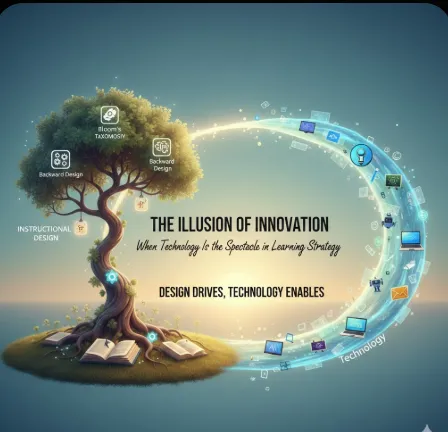
The Illusion of Innovation: When Technology Is the Spectacle in Learning strategy.
Innovation through artificial intelligence, gamification, dashboards, and automation is a recent focus in modern EdTech marketing. Some tools, like Figma, improve the process of interface visualization and creating interactive experiences.
Nevertheless, interface design innovation does not necessarily translate to innovation in learning effectiveness. Most organizations believe that the solution to engagement problems can be found in upgrading technology. The fact is that tools only enhance the already existing design structures. In case the instructional framework is not strong, the higher features can only bring the weaknesses into the limelight.
The Crux of the Issue: Incompatible Learning strategies.
Among the most prevalent instructional failures are undefined or immeasurable objectives. Learning goals are not specific, which makes it impossible to measure performance, or the learners are not directed.
An example is when a student is told to learn about compliance policies, but that is not a behavioral definition. Conversely, a goal that teaches learners to detect compliance violations in real-life situations sets some objective parameters.
Aligning objectives, activities, and assessments is necessary, without which even the most developed LMS will not be able to make a difference. Technology delivers the content, and design determines the comprehension.
The reason why effective e-learning strategy continues to be based on instructional design is as follows.
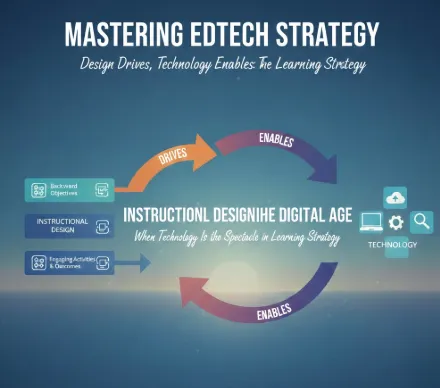
Instructional design is based on instruction theory and cognitive science. Taxonomies: Backward Design, Bloom Taxonomy, and Cognitive Load Theory place an emphasis on the sequential development and quantifiable results.
Constructive alignment is the main principle that forms successful learning experiences when the goals determine activities and evaluations. This will make sure that the learners do not passively consume information, but rather, they are actually putting the learning into practice.
Simple tools can be used to produce considerable outcomes when the instructional design is strong. On the other hand, in the lack of design structure, AI-enhanced systems cannot fill conceptual gaps.
Technology, Not a Replacement.
It is necessary to state that tools are not problematic in nature. Artificial intelligence can speed up the process of creation. The analysis of LMS can give data about learner behavior. User experience can increase through interactive design environments.
The matter comes about when the technology is determining strategy and not aiding it. Before determining learning outcomes, organizations do at times choose platforms according to feature sets. This change of priorities has resulted in platform-driven content versus performance objectives.
we supposed that Technology act as an enabler of sound instructional design. It cannot be an alternative to it.
A Sustainable Learning strategies Impact Design Framework.
In order to get the priorities back on track, the organizations should start by determining the performance gap. What is the behavior that should be changed? What skill must improve? What error must decrease?
After defining the problem, it is possible to write measurable objectives. These are then the objectives that drive the design of activities. Activities must entail the display of mastery by the learners through realistic application, and not passive review of the content.
Tool selection should only come when this structure developed. The platform used should be efficient and effective in supporting the planned activity. This order is used to make sure that the strategy is ahead and technology is behind.
Real learning strategies can be measured in two ways: post-event ratings and pre-event ratings.
The success indicators are frequently confused with completion rates and engagement measures. Nonetheless, the actual effectiveness of learning is determined by behavior change and performance enhancement.
The Four Levels of evaluation suggested by Kirkpatrick focus on the necessity of measuring reaction, learning, behavior, and results. Technology can be used to help in data collection, but this does not mean good things will come.
Companies should not be content with surface measures and examine whether training interventions can really resolve the found problem.
Frequently Asked Questions
Is the automatic upgrade of an LMS capable of enhancing engagement?
No. The interaction enhances where the content is pertinent, interactive in a significant sense, and in accordance with the learner’s requirements. Poorly designed content cannot be fixed using a new LMS.
Do AI writing systems hold value?
Yes, when used strategically. AI tools will speed up the production process and have to rely on clear purposes and planning of instructions.
What is the greatest error of the digital learning strategy?
Choosing the tools without any identification of the learning strategies, problem or measurable outcomes.
Are the courses that are designed to be less complicated more efficient?
Often, yes. Strict order and aim provide less load on the mind and enhance the memorization of the knowledge.
Conclusion
The fast-changing development of EdTech is quite thrilling and urgent. But the effect on sustainable learning requires a disciplined instructional strategy. Effective e-learning is still based on clear goals, coordinated action, and measurable results.
Organizations need to move beyond the question of what tool is most appropriate to the question of what learning problems are we addressing?
In a scenario where design takes the frontline and technology backs up, the digital learning becomes not only innovative but effective.