In an era where cyberattacks evolve faster than defenses, cybersecurity awareness training for employees has become a non-negotiable pillar of organizational resilience. By 2026, the human factor often cited as the root cause of up to 60% of breaches remains the weakest link, even as AI-driven threats like generative phishing, deepfakes, and agentic social engineering proliferate. Traditional annual compliance modules no longer suffice. Effective programs must deliver adaptive, behavior-changing experiences that blend adult learning principles from educational technology research with cutting-edge corporate L&D strategies.
This article draws on the latest insights from LinkedIn’s 2025 Workplace Learning Report, the World Economic Forum’s Future of Jobs Report 2025 and Global Cybersecurity Outlook, Gartner’s cybersecurity and corporate learning trends, Brandon Hall Group research, Training Industry resources, and peer-reviewed studies from journals such as the British Journal of Educational Technology, Internet and Higher Education, and Australasian Journal of Educational Technology. It provides a comprehensive, step-by-step blueprint for designing cybersecurity awareness training that not only meets 2026 threats but drives measurable cultural and performance outcomes.
The Evolving Cybersecurity Landscape in 2026: Why Training Must Adapt Now
The WEF Future of Jobs Report 2025 identifies “networks and cybersecurity” as one of the fastest-growing skill clusters after AI and big data, with demand surging due to geopolitical fragmentation, AI proliferation, and digital expansion. Employers anticipate significant structural job transformation by 2030, creating new roles while displacing others many tied to security management specialists. Yet a persistent skills gap persists: many organizations cite cybersecurity expertise shortages as a top barrier.
Gartner’s 2026 cybersecurity trends warn that GenAI is actively undermining legacy awareness tactics. Over 57% of employees now use personal GenAI tools for work, often inputting sensitive data, while traditional “awareness” fails to address adaptive, AI-generated attacks like QR phishing or BEC variants. The WEF Global Cybersecurity Outlook highlights accelerating AI adoption, widening cyber inequity, and supply-chain vulnerabilities as defining risks.
LinkedIn’s 2025 Workplace Learning Report underscores the shift toward “career champions”organizations with mature development programs that outperform peers in retention, adaptability, and business impact. AI moves from experimentation to application in L&D, with skills becoming the new currency. In this context, cybersecurity awareness training must evolve from checkbox compliance to strategic capability-building.
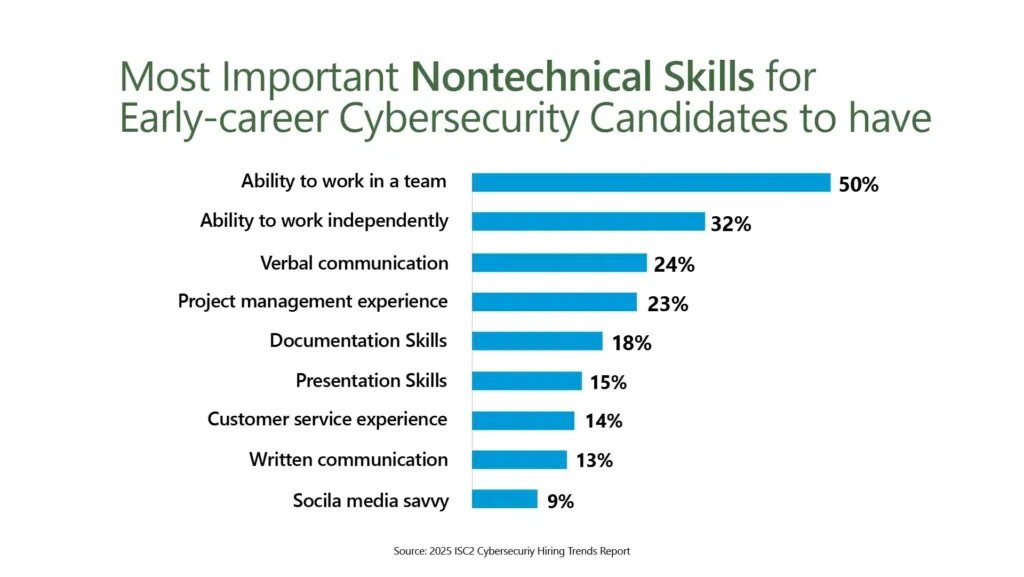
Source: https://www.uscsinstitute.org/content/images/articles/trending-cybersecurity-skills-2026.png
The Business Case: Human Risk Reduction Through Evidence-Based Training
Employees cause the majority of incidents through phishing, credential sharing, or poor hygiene. Yet organizations with continuous, engaging cybersecurity training report fewer successful phishing attacks. Brandon Hall Group research shows forward-looking L&D teams now prioritize predictive needs analysis and measurable behavior change over completion rates.
EdTech research reinforces this. Studies demonstrate that gamified e-training significantly boosts employees’ security self-efficacy and reduces phishing click rates by enhancing information quality, enjoyment, and behavioral intent. Journals like the British Journal of Educational Technology highlight how AI-supported self-regulated learning (SRL) and immersive technologies improve retention in complex domains.
Theoretical Foundations: Leveraging EdTech Research for Cybersecurity Design
Effective cybersecurity training draws on decades of educational technology scholarship. Distance Education and Internet and Higher Education studies emphasize adult learning principles (andragogy): relevance, problem-centeredness, and immediate applicability. Microlearning and spaced repetition outperform long sessions.
Gamification emerges as a proven lever. Research shows it improves system quality, enjoyment, and actual security behaviors. Australasian Journal of Educational Technology research on full-immersion VR demonstrates experiential learning’s power for high-stakes scenarios without real-world risk.
AI integration aligns with recent BJET meta-analyses on SRL: generative tools enable personalized pathways, just-in-time feedback, and adaptive scaffolding critical for nontraditional or busy employees.
Gartner’s Market Guide for Corporate Learning Technologies stresses maturing ecosystems that combine content authoring, skills tracking, and delivery platforms ideal for embedding cybersecurity modules.
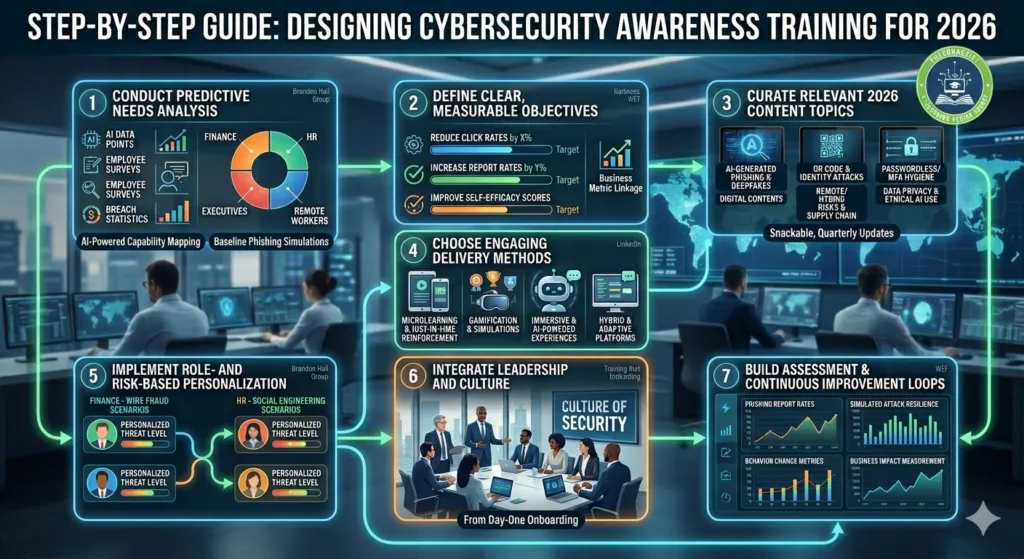
Step-by-Step Guide to Designing Cybersecurity Awareness Training for 2026
Step 1: Conduct Predictive Needs Analysis Brandon Hall Group advises moving beyond traditional audits to AI-powered capability mapping. Survey employees, analyze breach data, run baseline phishing simulations, and segment by role/risk level (finance, HR, executives, remote workers). LinkedIn data shows high-performing organizations align learning with business strategy and career growth.
Step 2: Define Clear, Measurable Objectives Objectives should target behavior change: reduce click rates by X%, increase report rates by Y%, improve self-efficacy scores. Tie to business metrics (reduced incidents, faster incident response). WEF and Gartner emphasize resilience and human-centric skills alongside technical ones.
Step 3: Curate Relevant 2026 Content Topics Core modules must address current threats:
- AI-generated phishing, deepfakes, and BEC
- QR codes, device-code, and identity attacks
- Passwordless/MFA hygiene and credential stuffing
- Remote/hybrid work risks and supply-chain vulnerabilities
- Data privacy, reporting protocols, and ethical AI use
- Role-based scenarios (e.g., finance wire fraud, HR social engineering)
Make content snackable (5–10 minutes) and updated quarterly.
Step 4: Choose Engaging Delivery Methods
- Microlearning + Just-in-Time Reinforcement: Deliver via mobile/LMS with triggers after risky behavior.
- Gamification & Simulations: Leaderboards, badges, adaptive phishing campaigns. Research confirms behavior change.
- Immersive & AI-Powered Experiences: VR for breach simulations or GenAI chatbots for personalized coaching.
- Hybrid & Adaptive Platforms: Gartner recommends ecosystems supporting personalization. Integrate with existing corporate learning tech.
Step 5: Implement Role- and Risk-Based Personalization One-size-fits-all fails. Adaptive programs tailor by department, past behavior, and exposure.
Step 6: Integrate Leadership and Culture Executives must model behaviors. Training Industry stresses a “culture of security” from day-one onboarding.
Step 7: Build Assessment and Continuous Improvement Loops Shift metrics from completion to behavior: phishing report rates, simulated attack resilience, self-efficacy surveys. Use analytics dashboards. Brandon Hall and LinkedIn emphasize business-impact measurement.
Emerging Trends Shaping 2026 Cybersecurity Training
- AI as Co-Pilot: Generative tools for content creation, adaptive pathways, and real-time feedback—already transforming L&D per LinkedIn and Brandon Hall.
- Behavioral Nudges & Simulations: Real-world, in-the-moment training outperforms lectures.
- Skills-Based Ecosystems: Align cybersecurity with broader career development (LinkedIn “career champions”).
- Immersive & Experiential: VR/AR for experiential education.
Implementation Challenges and Proven Best Practices:
Common pitfalls include low engagement, outdated content, and lack of measurement. Solutions: start small with pilot groups, secure C-suite sponsorship, and budget for continuous updates. Training Industry recommends twice-yearly refreshers plus ongoing reinforcement. Foster psychological safety so reporting is rewarded, not punished.
Measuring Success and Demonstrating ROI:
Track leading indicators (engagement, knowledge retention) and lagging ones (incident reduction, cost savings). High-maturity programs show clear links to revenue, innovation, and retention.
Real-World Momentum and Future Outlook:
Leading organizations already blend these elements: adaptive simulations, AI personalization, and gamified microlearning deliver measurable risk reduction. As WEF notes, cybersecurity skills are now core to workforce transformation.
By 2026 and beyond, cybersecurity awareness training will not be an annual event but a living, intelligent capability embedded in daily work. Organizations that invest in evidence-based, technology-enhanced programs rooted in edtech research and aligned with L&D megatrends will build human firewalls that turn employees from vulnerabilities into the strongest line of defense.
The time to design for 2026 is now. Start with rigorous needs analysis, embrace adaptive and experiential methods, and measure what matters: behavior change that protects the enterprise. Your people—and your bottom line will thank you.
Conclusion:
By 2026, cybersecurity awareness training must transition from periodic compliance exercises to a dynamic, intelligent, and embedded capability that actively shapes secure behaviors every day. The convergence of AI-driven threats, geopolitical risks, and rapid digital transformation demands programs grounded in evidence-based adult learning principles, powered by adaptive technologies, and aligned with broader L&D strategies that treat skills as the new organizational currency.
Organizations that invest in predictive needs analysis, role-based personalization, gamified simulations, just-in-time microlearning, and continuous measurement will not only reduce human-enabled breaches but also build a resilient security culture where employees become proactive defenders rather than potential vulnerabilities. Leadership commitment, psychological safety for reporting, and integration with career development pathways will amplify impact and drive tangible ROI through fewer incidents, faster response times, and stronger overall organizational resilience.
The window to design and implement these forward-looking programs is now. Start with rigorous assessment, embrace experiential and AI-enhanced methods, and relentlessly measure behavior change. In doing so, your people will transform from the weakest link into the strongest line of defense protecting assets, reputation, and the future of your enterprise in an increasingly complex threat landscape.
References:
https://www.sciencedirect.com/science/article/pii/S0148296324001899
https://arxiv.org/pdf/1811.09024
https://people.cs.uchicago.edu/~grantho/papers/oakland2025_phishing-training.pdf
https://www.sciencedirect.com/science/article/pii/S0001691825005402
https://bera-journals.onlinelibrary.wiley.com/doi/10.1111/bjet.70058?af=R
FAQs
Q1: Why is traditional annual cybersecurity training no longer effective in 2026?
Traditional once-a-year compliance modules fail to address rapidly evolving AI-powered threats such as generative phishing, deepfakes, and QR code attacks. Research shows they do not produce lasting behavior change. Modern programs must use continuous, adaptive, microlearning, and simulation-based approaches to drive measurable reductions in risky behaviors.
Q2: What are the most critical cybersecurity awareness training topics for 2026?
Key topics include AI-generated phishing and deepfakes, Business Email Compromise (BEC), QR code (quishing) and smishing attacks, MFA fatigue, credential hygiene, safe use of generative AI tools, remote/hybrid work risks, and role-specific scenarios (e.g., wire fraud for finance teams or social engineering for HR).
Q3: How can organizations personalize cybersecurity training for better results?
Use role-based and risk-based tailoring. Segment employees by department, job function, and past behavior or exposure levels. Adaptive platforms can deliver customized content and simulations, making training more relevant and effective than one-size-fits-all modules.
Q4: What metrics should be used to measure the success of cybersecurity awareness training?
Move beyond completion rates to behavior-focused KPIs: phishing click rates, reporting rates of suspicious activity, simulated attack resilience, self-efficacy scores, and actual incident reduction. Leading organizations also track business impact such as cost savings from prevented breaches and improvements in overall security culture.
Q5: How does AI influence cybersecurity awareness training design in 2026?
AI serves as both a threat (generating sophisticated attacks) and a powerful tool for training. It enables personalized learning pathways, real-time feedback, adaptive simulations, content generation, and just-in-time reinforcement. Gartner recommends shifting from general awareness to adaptive behavioral programs that address GenAI-specific risks.
Q6: What role should leadership play in cybersecurity training programs?
Executives must actively model secure behaviors and visibly support the program. Leadership involvement helps build a strong security culture from onboarding onward and encourages employees to report incidents without fear of punishment.
Q7: How often should cybersecurity awareness training be refreshed?
Content should be updated quarterly to reflect new threats, with core training delivered through continuous microlearning and twice-yearly refreshers. Just-in-time reinforcement triggered by risky behavior or simulation results is highly effective for long-term retention and behavior change.
Authored By: Atiqa Sajid http://www.linkedin.com/in/atiqa-sajid-747b57137