Lifestyle courses are one of the fastest-growing segments in the eLearning industry. From home décor and gardening to wellness and personal branding, creators are turning their expertise into engaging online courses.
But here’s the challenge many creators face:
- They have a strong concept (like “From Garden to Sofa”)
- They have content outlines and inspiration
- But they struggle to turn it into a visually engaging, structured, and professional course
Across cities like New York City, Los Angeles, and Chicago, course creators are realizing that success in lifestyle education depends on more than just ideas; it requires instructional design, content development, and high-quality video production.
This guide walks you through how to transform your concept into a polished, interactive lifestyle course ready for platforms like Teachable or Kajabi.
Why Most Lifestyle Courses Fail (Even With Great Ideas)
Many creators assume that:
- Good content = successful course
But in reality, courses fail due to:
- Poor visual presentation
- Inconsistent branding
- Lack of structured learning flow
- Weak engagement strategies
Research in digital learning highlights that well-structured multimedia content significantly improves learner engagement and retention.
This means your course must combine:
- Visual storytelling
- Structured curriculum
- Interactive elements
Start With a Structured Curriculum (Not Just Ideas)
You already have an 8-module outline and that’s a strong start.
Now refine it using instructional design principles:
Example Structure:
| Module | Focus |
|---|---|
| Module 1 | Introduction to lifestyle design |
| Module 2 | Indoor styling fundamentals |
| Module 3 | Plant styling and selection |
| Module 4 | Outdoor garden aesthetics |
| Module 5 | Blending indoor and outdoor spaces |
| Module 6 | Budget-friendly styling |
| Module 7 | Personal style development |
| Module 8 | Final project |
Each lesson should:
- Focus on one outcome
- Include visuals and examples
- End with a small task or reflection
This aligns with microlearning and modern eLearning trends 2026.
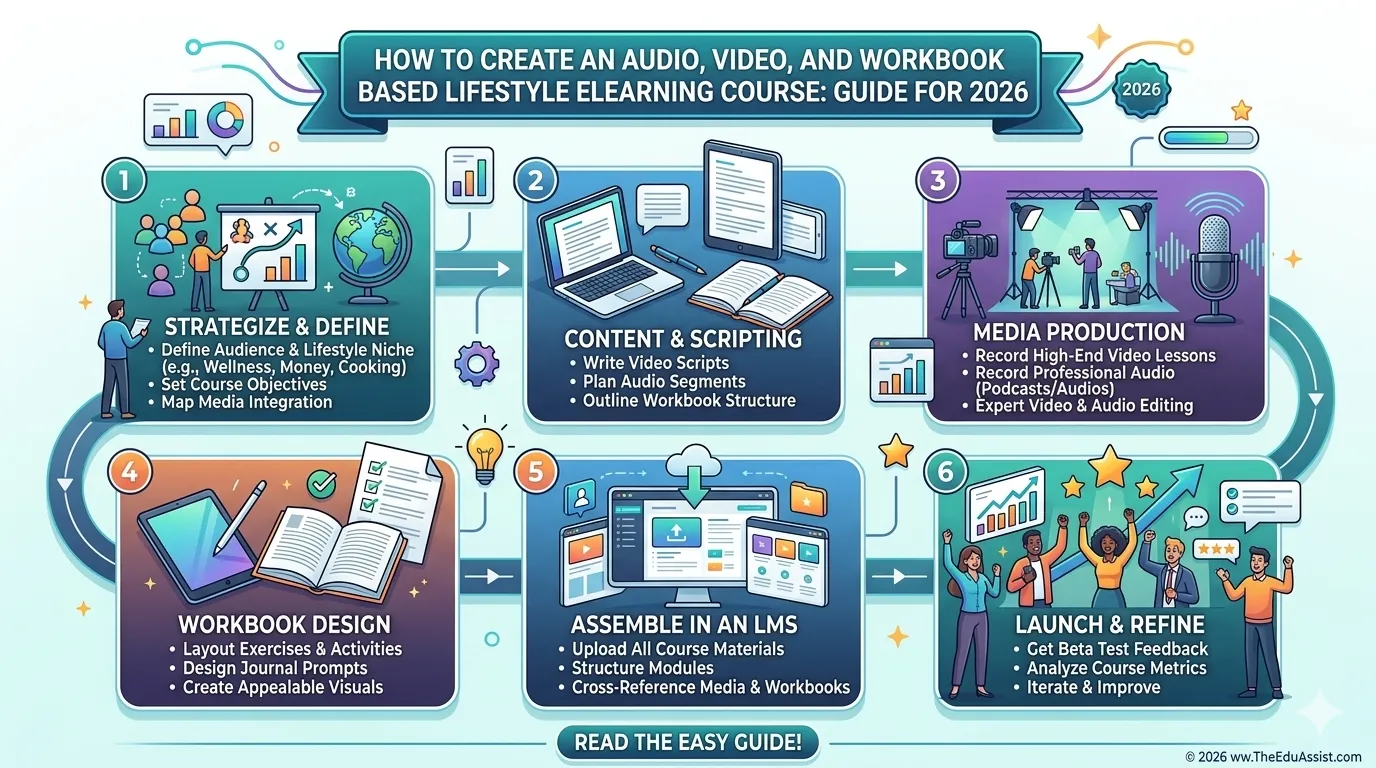
Step 1: Turn Your Content Into Visual Slide Decks
Lifestyle courses are highly visual.
Use tools like:
- Canva
- PowerPoint
- Keynote
Your slides should include:
- Minimal text
- High-quality images (interiors, plants, décor)
- Consistent brand colors and fonts
Avoid text-heavy slides and focus on visual storytelling.
Step 2: Create High-Quality Video Lessons
Video is the core of your course.
You can:
- Record yourself teaching
- Combine voiceovers with visuals
- Use stock footage for aesthetic shots
Editing tools include:
- Adobe Premiere Pro
- Final Cut Pro
Key editing elements:
- Text overlays
- Smooth transitions
- Background music
- B-roll footage (plants, homes, outdoor spaces)
Well-edited videos make your course feel premium and professional.
Step 3: Design Downloadable Learning Resources
Supporting materials improve learning outcomes.
Create:
- Checklists
- Plant care guides
- Shopping lists
- Workbooks
These resources:
- Reinforce lessons
- Increase course value
- Support different learning styles
This is a key part of custom eLearning and content development strategies.
Step 4: Build a Consistent Visual Brand
Consistency is critical in lifestyle courses.
Ensure:
- Same color palette across slides and videos
- Consistent fonts
- Uniform layout style
Your course should feel like a cohesive brand experience, not separate pieces.
Step 5: Add Interactive Learning Elements
Even lifestyle courses need interactivity.
Include:
- Reflection prompts
- Mini assignments
- Before-and-after exercises
- Design challenges
Interactive learning improves:
- Engagement
- Retention
- Completion rates
This aligns with findings that active participation enhances learning effectiveness.
Step 6: Choose the Right LMS for Delivery
Once your content is ready, upload it to an LMS.
Popular platforms include:
- Teachable
- Kajabi
- Thinkific
These platforms allow you to:
- Organize modules
- Upload videos and PDFs
- Track learner progress
Quick Comparison Table: Best Platforms for Lifestyle Courses
| Platform | Best For | Key Advantage |
|---|---|---|
| Kajabi | Course businesses | Built-in marketing tools |
| Teachable | Beginners | Easy setup |
| Thinkific | Educators | Flexible design |
Cost Reality Check: Creating a Lifestyle Course
| Category | Estimated Cost |
|---|---|
| Video editing | $1,000 – $4,000 |
| Slide design | $500 – $2,000 |
| Learning materials | $500 – $1,500 |
| LMS subscription | $39 – $199/month |
While DIY is possible, investing in professional instructional design and consulting services improves quality significantly.
Unique Perspective: Lifestyle Courses Are “Experience Products”
In 2026, lifestyle courses are not just educational; they are experiential.
Learners expect:
- Inspiration
- Transformation
- Visual storytelling
This means your course must:
- Look beautiful
- Feel cohesive
- Deliver practical value
For platforms like theeduassist.com, this involves combining content development, custom eLearning, and visual design expertise.
Final Thoughts
Creating a lifestyle course like “From Garden to Sofa” is not just about teaching; it’s about crafting an immersive learning experience.
By combining:
- Instructional design
- Video editing
- Visual branding
- Interactive learning
- LMS delivery
you can create a course that is:
- Engaging
- Professional
- Scalable
References
- https://link.springer.com/article/10.1186/s12909-024-05141-7
- https://pmc.ncbi.nlm.nih.gov/articles/PMC5613210/
FAQs
What tools are best for creating lifestyle courses?
Tools like Canva and Adobe Premiere Pro are widely used.
How long should each lesson be?
Lessons should be 8–15 minutes to maintain engagement.
Do lifestyle courses need video editing?
Yes, high-quality video editing improves engagement and perceived value.
Which platform is best for hosting courses?
Platforms like Teachable, Kajabi, and Thinkific are popular.
How can TheEduAssist help create a lifestyle course?
Through edu-assist consulting services, theeduassist.com supports creators with custom eLearning, content development, video structuring, and LMS-ready course design.
Authored By: Sofia Arif