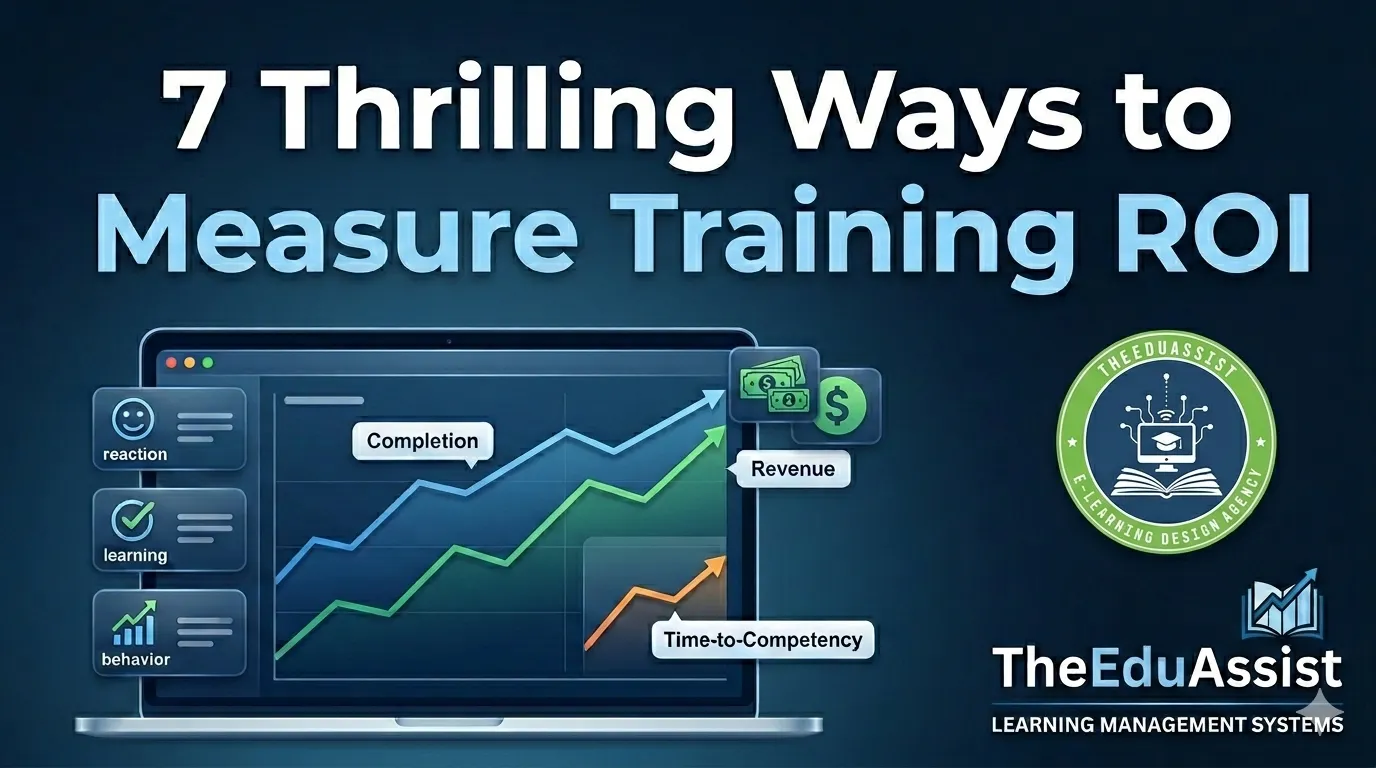
For TheEduAssist, proving Training ROI isn’t optional it’s how you justify budgets, win trust, and scale impact. In this article, you’ll see 7 proven, research‑backed methods to measure training ROI, tailored for:
- corporate L&D teams,
- educational institutions,
- and independent course creators using TheEduAssist platforms and workflows.
Organizations and course creators are no longer asking, “Did they like the training?”
They’re asking, “What did this training actually move the needle on revenue, retention, productivity, or compliance?”
1. Start with the Right Question: What ROI Means for TheEduAssist
Before diving into “7 ways,” clarify what ROI actually is in the learning world.
ROI (Return on Investment) for training is usually framed as:
ROI=Total Training CostsMonetary Benefits of Training−Total Training Costs×100%
For TheEduAssist, this translates into:
- reduced implementation time for institutional programs,
- higher completion rates for courses built through TheEduAssist systems,
- lower drop‑offs and better performance in client‑deployed training.
But ROI isn’t just a formula; it’s a story of business outcomes driven by better learning experiences.
2. Use the Kirkpatrick‑Phillips Framework as Your Backbone
The most widely cited structure for training evaluation is the Kirkpatrick Model, later expanded by Phillips to include monetary ROI.
Kirkpatrick × Phillips in Practice
- 1 – Reaction: How did learners feel about the experience?
- 2 – Learning: Did they actually gain knowledge or skills?
- 3 – Behavior: Are they applying what they learned on the job?
- 4 – Results: What business impact did this create?
- 5 – ROI: How much revenue, cost saving, or productivity gain did this training produce versus the cost?
For TheEduAssist, you don’t just design courses; you embed measurement into every layer:
- Micro‑surveys at Level 1 in your LMS dashboards.
- Embedded quizzes and branching simulations at Level 2.
- Real‑world check‑ins and manager feedback loops at Levels 3 and 4.
- Business‑impact dashboards at Level 5 for your clients.
If you want one ROI chassis for all your training projects, this is it.
3. Way 1: Measure Productivity & Time‑to‑Competency
Target personas:
- L&D managers
- Instructional designers
- Institute decision‑makers
Why productivity matters
Time is money. If your learners reach “competent” faster after training, clients save on ramp‑time, reduced errors, and slower payroll drag.
How TheEduAssist implements this
- Before a course launch, establish a baseline:
- How many hours does it take a new hire or student to be “ready” without your training?
- How many errors or support tickets occur in the first 30 days?
- After TheEduAssist‑delivered training, measure again after 60–90 days.
- Convert time saved into dollars using average hourly wage or trainer cost.
Example ROI narrative for a client
For a corporate client using TheEduAssist’s onboarding workflow:
- Old ramp‑time: 40 hours of mentoring + 120 hours of shadowing.
- New ramp‑time with structured micro‑learning and simulations: 10 hours more effective onboarding + 60 hours of targeted practice.
- Savings: 70 hours per learner × hourly cost = recurring savings.
This becomes a central ROI slide for leadership and procurement teams.
4. Way 2: Track Revenue or Performance Impact
Target personas:
- L&D managers
- Course creators
- Decision‑makers
Linking training to money
If your training improves sales, customer success, or student outcomes, you can directly tie it to revenue.
TheEduAssist‑friendly approach
- Compare pre‑training vs. post‑training performance for the same cohort.
- Or compare trained vs. untrained groups (control group design).
- Turn the difference into incremental revenue:
- Higher close rates,
- Faster task completion,
- Better assessment scores.
Example in practice
Imagine a corporate sales onboarding program:
- TheEduAssist modules, average deal size: $10,000, conversion rate: 25%.
- After structured scenario‑based training, conversion rate jumps to 32%.
- Apply this % gain to average deal pipeline; subtract TheEduAssist program cost.
- That’s hard ROI you can show in a board‑ready report.
For independent course creators, this becomes:
- Track completion rates, upsell conversions, and repeat enrollments after you optimize through TheEduAssist’s design frameworks.
5. Way 3: Quantify Cost Savings from Errors, Rework & Compliance
Target personas:
- L&D managers
- Decision‑makers
- Training institutes
Where training really saves money
Training‑driven fixes can:
- Reduce rework,
- Cut customer complaints,
- Lower compliance penalties.
TheEduAssist advantage
- Build real‑time scenario‑based checks into your courses.
- For regulated or compliance‑heavy environments, use decision‑tree simulations that surface the right answer before mistakes happen.
Simple savings formula
- Identify cost drivers (errors, rework, fines, support tickets).
- Measure how often these occur before training.
- Measure again after training.
- Multiply the reduction by the estimated cost per incident.
Use‑case for TheEduAssist
A healthcare‑aligned training program:
- Before training: 12 incidents per month of wrong documentation.
- After TheEduAssist‑driven scenario‑based compliance module: 4 incidents per month.
- If each incident costs $500,
- Monthly savings ≈ 8 × $500 = $4,000.
- Subtract TheEduAssist program cost; the positive ROI is clear.
6. Way 4: Measure Retention, Engagement & Completion
Target personas:
- Educators & trainers
- Course creators
- Instructional designers
Why retention is ROI
High drop‑off means wasted tuition, lost revenue, or stalled skill growth. Strong retention and engagement directly improve the value of a training investment.
How TheEduAssist tracks this
- Use completion rates by module, not just “course finished.”
- Track time‑on‑task, log‑ins, and repeat visits.
- Monitor peer interaction and forum activity as proxies for engagement.
Monetizing retention gains
For in‑company or institutional clients:
- Lower turnover = fewer recruitment and onboarding costs.
For course creators: - Higher completion = fewer refunds, more referrals, stronger testimonials.
Example ROI angle
- If a cohort of 50 learners drops from 40% completion to 70% completion after TheEduAssist‑optimized micro‑learning paths and personalization layers,
- That’s 15 more “fully converted” learners per cohort.
- Scale that across 10 cohorts: 150 more completed learners with no extra marketing spend.
7. Way 5: Use Skill Application at 90 Days (Behavior Change)
Target personas:
- L&D managers
- Trainers
- Decision‑makers
From “I learned” to “I apply it”
At Level 3 (Behavior) of the Kirkpatrick‑Phillips model, you must prove that learners apply skills on the job, not just pass a quiz.
TheEduAssist best practice
- Build on‑the‑job check‑ins into your delivery:
- 30‑day and 90‑day manager evaluations.
- Follow‑up micro‑tasks or “apply this week” missions.
- Use KPIs aligned to the training goal:
- Speed of resolving tickets,
- Quality of student projects,
- Coaching‑session effectiveness.
How this boosts ROI stories
When you show leadership:
“Three months after TheEduAssist coaching‑skills program, 82% of managers use the feedback framework in their 1:1s, and direct‑report satisfaction scores rose by 23%.”
That’s behavior change tied to business outcomes—not just “the course was fun.”
8. Way 6: Compare Trained vs. Untrained Cohorts (Control‑Group Design)
Target personas:
- L&D managers
- Decision‑makers
- Research‑oriented educators
Why control groups matter
The most convincing ROI evidence comes from isolating the training effect.
How TheEduAssist can embed this
- For corporate clients:
- Apply TheEduAssist‑designed modules to one department, keep another similar group without the new training.
- For institutes:
- Offer one cohort traditional instruction, another TheEduAssist‑enhanced (interactive, micro‑chunked, AI‑supplemented).
What you compare
- Assessment scores,
- Time to complete tasks,
- Supervisor ratings,
- Customer satisfaction or learner feedback.
Any statistically significant improvement in the trained group becomes a bulletproof ROI claim.
9. Way 7: Build an ROI Dashboard for Your Clients (Level 5 Integration)
Target personas:
- L&D managers
- Decision‑makers
- Instructional designers
From data to decision
Most organizations collect data but never connect it to ROI.
TheEduAssist’s strategic edge
Design custom dashboards that marry:
- Learning metrics (completion, scores, engagement) with
- Business metrics (revenue, productivity, retention, support load).
Typical dashboard elements:
- Time‑to‑competency savings vs. prior year.
- Incremental revenue or performance improvement.
- Cost‑avoidance from errors or rework.
- Retention and engagement lift.
How this positions TheEduAssist ROI:
- For independent creators, offer a “ROI‑ready cohort report” as a premium add‑on.
- For institutes and corporate L&D, position TheEduAssist as a strategic partner, not just a course‑design vendor.
When you show a C‑suite or HR director:
“This is how much we saved or generated in value for your organization last quarter, thanks to TheEduAssist‑designed training,”
you transform learning design into a profit center.
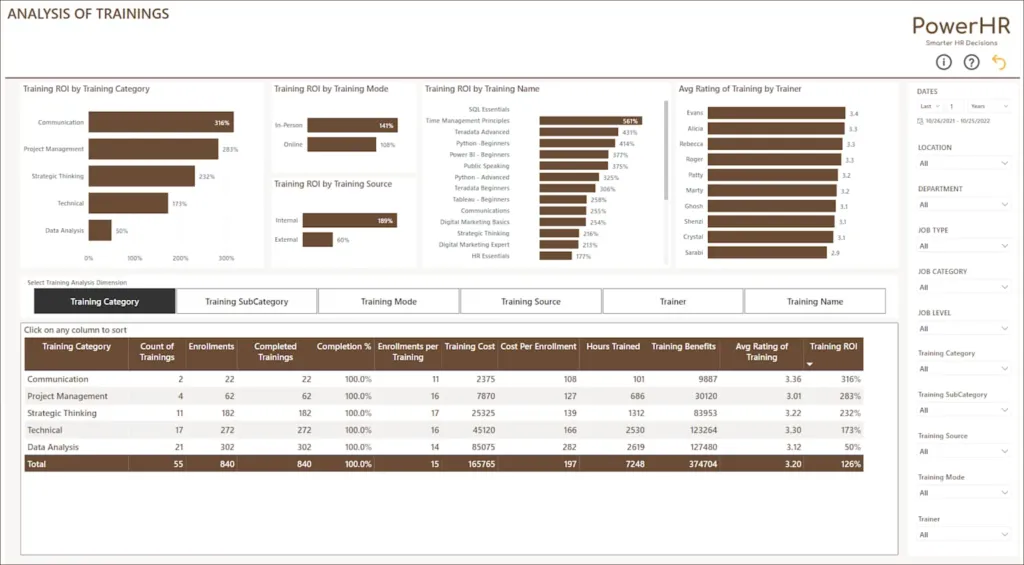
Source:https://indzara.com/product/hr-templates/training-dashboard-power-bi-template/
10. How TheEduAssist’s Five Personas Use These 7 Ways
1. Instructional Designers (IDs) for ROI:
For IDs, ROI is about designing intentionally toward outcomes, not just “covering content.”
Practical tips:
- Start every brief with a clear business outcome (e.g., “Reduce onboarding time by 30%”).
- Choose interactive formats (simulations, branching scenarios, drag‑and‑drops) that make behavior change measurable.
- Use pre‑ and post‑quizzes with real‑world tasks to capture Level 2 and Level 3 evidence.
When IDs design for TheEduAssist, they aren’t just building slides—they’re building ROI‑ready learning experiences.
2. L&D Managers & Learning Professionals with ROI
L&D managers are under pressure to prove value to leadership.
How they use the 7 ways:
- Run before‑and‑after analytics on productivity, revenue‑linked performance, and retention.
- Demand control‑group data for major programs.
- Ask vendors (including TheEduAssist) for pre‑designed ROI dashboards and behavior‑change check‑ins.
For TheEduAssist, this means you can pre‑package ROI‑ready evaluation plans as part of every L&D engagement.
3. Educators, Corporate Trainers & Coaches with ROI
Educators and coaches care about engagement and human outcomes, but they still need to show impact.
ROI‑friendly moves:
- Use project‑based assessments tied to real‑world work.
- Track learner confidence vs. actual performance over time.
- Collect stories and testimonials, then connect them to quantitative gains (e.g., higher grades, fewer help‑desk tickets).
TheEduAssist empowers this by giving them:
- Templates, rubrics, and micro‑assessment frameworks that turn qualitative feedback into measurable progress.
4. Course Creators & Independent Creators with ROI
For solo creators, ROI often means more revenue with less churn.
What they can track :
- Completion rates,
- Upsell/continuation rates,
- Referral‑driven enrollments,
- Survey feedback that links training to tangible gains (new clients, higher income, better performance at work).
TheEduAssist can help them:
- Chunk courses into micro‑modules that boost completion.
- Add interactive checkpoints that reduce refunds by showing early wins.
- Provide ROI‑style success stories they can use in marketing and sales.
5. Training Institutes, Educational Organizations & Decision‑Makers
Decision‑makers think in scale, compliance, and institutional reputation.
ROI‑relevant focuses:
- Standardized evaluation frameworks (Kirkpatrick‑Phillips).
- Accessibility and WCAG‑compliant design that reduces risk and improves inclusion.
- Pilot‑to‑scale strategies that let you test ROI on a small cohort before rolling out to thousands.
For TheEduAssist,ROI this means:
- You can position yourself as the architect of scalable, ROI‑aware learning systems, not just a one‑off course designer.
11. Turning ROI into a Marketing Asset for TheEduAssist
Once you’ve measured ROI, share it but thoughtfully.
How to package ROI stories
- Create case studies around specific clients:
- “How TheEduAssist Helped [Client] Reduce Onboarding Time by 35%.”
- Build ROI‑calculator templates so prospects can plug in their own numbers.
- Use before‑and‑after dashboards in sales decks and webinars.
Align with your research‑rich ecosystem
Because you’re already pointing to ScienceDirect, SpringerLink, JSTOR, ERIC, and training‑journal databases, you can:
- Anchor your ROI claims in peer‑reviewed research on Kirkpatrick, productivity, and learning‑performance linkages.
- Say things like:“These methods are aligned with widely cited evaluation frameworks from the International Journal of Training and Development and Training Industry.”
Conclusion: ROI as a Mindset, Not Just a Metric
For TheEduAssist, measuring training ROI isn’t a one‑time exercise. It’s a design‑and‑delivery mindset baked into every course, every cohort, and every client conversation.
By using these 7 proven ways, you turn TheEduAssist into the clear choice for organizations that want:
- faster time‑to‑competency,
- higher completion and engagement,
- lower error and compliance risk,
- and hard dollars linked directly to your training.
References:
Kirkpatrick, D. L., & Kirkpatrick, J. D. (2006). Evaluating training programs: The four levels (3rd ed.). Berrett‑Koehler Publishers.
https://www.bkconnection.com/books/evaluating-training-programs-0787997293
Parry, S. B. (1996). Measuring training’s ROI. Training and Development, 50(5), 72–77.
https://eric.ed.gov/?id=EJ524057
Phillips, J. J. (1997). Return on investment in training and performance improvement programs. Butterworth‑Heinemann.
https://www.routledge.com/Return-on-Investment-in-Training-and-Performance-Improvement-Programs/Phillips/p/book/9780750699698
Phillips, J. J., & Phillips, P. P. (2016). Handbook of training evaluation and measurement methods (4th ed.). Routledge.
https://www.routledge.com/Handbook-of-Training-Evaluation-and-Measurement-Methods/Phillips-Phillips/p/book/9781138657936
SHRM. (2025, November 12). Measuring the ROI of your training initiatives. SHRM Resource Center.
https://www.shrm.org/labs/resources/measuring-the-roi-of-your-training-initiatives
AccessPlanit. (n.d.). The Phillips ROI model (Phillips learning evaluation model). AccessPlanit blog.
https://www.accessplanit.com/en-gb/ap-blogs/phillips-roi-model
PeopleHum. (2025, June 18). How to calculate ROI of employee training and development. PeopleHum blog.
https://www.peoplehum.com/blog/how-to-calculate-roi-of-employee-training-and-development
Executive Development Australia. (2025, May 31). How to measure the ROI of your training programs. ED Australia blog.
https://executivedevelopmentaustralia.com.au/articles/how-to-measure-the-roi-of-your-training-programs/
Zhang, L., & Baker, S. P. (2022). A methodology for projecting the return on investment of training programs. Journal of Applied Psychology, 107(8), 1520–1537.
https://pmc.ncbi.nlm.nih.gov/articles/PMC10790803/
Disrupt Learning. (n.d.). Kirkpatrick–Phillips training ROI: How to measure learning impact. Disrupt Learning blog.
https://www.disruptlearning.org.uk/kirkpatrick-phillips-training-roi-how-to-measure-learning-impact/
FAQs: Measuring and Optimizing Training ROI
1. What is ROI in training and why does it matter for L&D?
ROI (Return on Investment) in training measures how much value an organization gains from its investment in learning programs versus the total cost.
For L&D teams and training providers like TheEduAssist, it answers:
- Did learners perform better?
- Did productivity, revenue, or retention improve?
- Was the cost of training justified by the outcome?
Tracking ROI helps you justify budgets, refine course design, and show leadership that training moves business metrics, not just engagement scores.
2. How do you calculate training programs?
The basic training formula is:
ROI=Total Training CostsMonetary Benefits of Training−Total Training Costs×100%
Monetary benefits can include:
- Increased revenue per learner or team,
- Cost savings from fewer errors or rework,
- Reduced turnover or onboarding time.
To calculate ROI:
- Identify pre‑training KPIs (e.g., time‑to‑competency, revenue per rep).
- Measure the same KPIs after training.
- Convert the difference into dollar impact, then plug into the formula.
3. Which training ROI model should I use Kirkpatrick or Phillips?
Most L&D teams start with the Kirkpatrick Model (4 levels: reaction, learning, behavior, results) and extend it with Phillips’ 5th level: monetary
- Kirkpatrick helps you evaluate learner experience and behavior change.
- Phillips adds the financial layer: “How much did this training really earn or save?”
For SEO‑focused content, mention “Kirkpatrick‑Phillips model” as a long‑tail signal that you’re grounded in mainstream L&D research.
4. How do I measure ROI for online courses and e‑learning?
For online courses and e‑learning, you can combine:
- Completion and engagement (time‑on‑task, log‑ins, video‑watch‑time).
- Performance metrics (quiz scores, project quality, certification pass rates).
- Business outcomes (higher sales, better support, or academic performance post‑course).
To turn this into ROI in e‑learning:
- Track before‑and‑after performance for a cohort.
- Estimate revenue or cost‑savings attributed to that improvement.
- Divide by total course cost (platform, content development, support).
5. How can I increase my training ROI quickly?
Three high‑impact:
- Align training to business KPIs (e.g., sales conversion, onboarding time, error rate).
- Use micro‑learning and simulations to boost retention and behavior change.
- Measure and compare trained vs. untrained groups to prove impact.
For TheEduAssist, this means:
- Chunk content into short, outcome‑focused modules that drive measurable behavior.
- Track completion and skill‑application data and tie it to your client’s targets.
6. How long should I wait before measuring training ROI?
For evaluation, many organizations use:
- 30 days for short‑term reaction and learning (Level 1–2).
- 60–90 days for behavior change and performance (Level 3–4).
- 12 months for full financial ROI (Level 5).
For course creators and L&D managers, create a 30‑60‑90‑day evaluation plan:
- 30 days: Satisfaction and initial behavior check.
- 60 days: Performance and KPIs.
- 90 days: Monetary impact and ROI calculation.
7. Can I measure ROI for free or low‑cost training programs?
Yes. Even low‑cost or free training can have ROI, especially when it:
- Reduces errors or compliance risks,
- Cuts support tickets,
- Improves onboarding speed or learner autonomy.
To measure in low‑cost programs:
- Focus on cost‑avoidance or time‑savings rather than direct revenue.
- Compare pre‑ and post‑training incident rates or support load.
- Multiply the difference by hourly cost or incident cost.
8. What ROI metrics should HR, L&D, and course creators track?
Key metrics:
- Time‑to‑competency and onboarding time (hours saved).
- Completion and retention rates (more learners finishing = more value).
- Performance lift (sales, quality, grades, or customer satisfaction).
- Error or rework reduction (cost savings).
- Turnover reduction (recruitment and onboarding savings).
For GEO‑aware SEO, you can localize these by mentioning:
- “For L&D teams in [country/region], ROI in internal training reduces hiring costs and compliance risk.”
9. How does ROI in corporate training differ from ROI in education and coaching?
- In corporate training, ROI is often tied to revenue, cost reduction, and key performance indicators (KPIs).
- In education and coaching, ROI is often measured via learning outcomes, retention, grades, or career advancement.
However, both use the same underlying:
- Compare value created (better performance, fewer mistakes, stronger skills)
- Against cost (time, money, opportunity).
10. How can I use ROI data to improve my courses and content?
ROI data is feedback, not just a report card. Use it to:
- Double down on modules that strongly correlate with performance or completion.
- Re‑design or chunk sections where learners drop off or fail key tasks.
- Assemble ROI‑ready case studies for marketing and sales.
For TheEduAssist, this turns
- A product‑improvement loop,
- A content‑marketing asset, and
- A credibility signal for leadership and clients.
Authored By: Atiqa Sajid http://www.linkedin.com/in/atiqa-sajid-747b57137