Employee Development Programs play a key role in how companies grow and improve performance.
Last year, a mid-size company hired 40 skilled workers. Recruitment went smoothly. Onboarding was fast. Yet six months later, output was still low. Two strong performers had quit. The training budget was spent on a single workshop that no one applied.
This type of situation is not rare. It happens in companies of all sizes. Leaders often invest heavily in hiring but ignore what comes after. As a result, performance stays flat, costs increase, and valuable employees leave.
This is exactly where Employee Development Programs make a difference. They help companies turn hired talent into long-term performance growth instead of temporary output. So why do some companies grow faster using the same talent?
Employee development becomes more effective when companies use structured learning systems. To understand how training improves engagement, read this guide:Corporate Training Improves Employee Engagement
The Hidden Role of Employee Development
Hiring alone will not fix a performance problem. Growth also comes from building up the people already on your team. That is the core idea behind employee development programs.
These programs improve skills, raise output, and keep staff engaged. Moreover, they build a culture where people feel valued. When done well, they drive business growth over the long term.
Unfortunately, many firms still skip this step. Leaders assume their staff already know enough. But work changes fast. Therefore, learning must be ongoing, not a one-time event.
What Most Companies Get Wrong
The same errors come up again and again. Here are the most common ones:
- Focusing only on new hires instead of building current staff
- Viewing training as a cost rather than a long-term investment
- Using old, one-size-fits-all methods that do not fit today’s work
- Running one-day events with no follow-up or real practice
- Never checking if training changed anything on the job
Because of these gaps, even big training budgets go to waste. The fix is not more spending. Instead, it is smarter planning and better follow-through.
A Simple Example: Two Companies, Same Talent
Picture two firms. Both hire the same type of workers. Both have equal budgets. But each takes a different path when it comes to staff growth.
Company A: No Development Focus
Company A brings in good people. After that, though, nothing changes. Structured training is missing. Coaching is absent. A clear growth plan does not exist.
Skills stay flat over time. Output becomes patchy. Workers feel stuck with nowhere to go. So they leave. Turnover climbs, and hiring costs pile up fast.
Company B: Strong Development Program
Company B starts with the same workers. However, it invests in regular employee training from day one. Staff get practical sessions each month. Managers coach their teams and back the process.
As a result, skills grow steadily. People stay engaged and feel valued. Furthermore, output rises because staff know how to work better. Costs drop, and the business scales with ease.
The difference was not talent. It was development.
Where ROI Actually Comes From
Leaders often ask if employee development programs are worth the cost. The answer is yes, but only when you track the right outcomes. Here is where real ROI shows up:
Productivity Gains
Trained staff work faster and make fewer mistakes. Projects finish on time. As a result, the same team gets more done without adding new headcount. Output grows without extra cost.
Reduced Hiring Costs
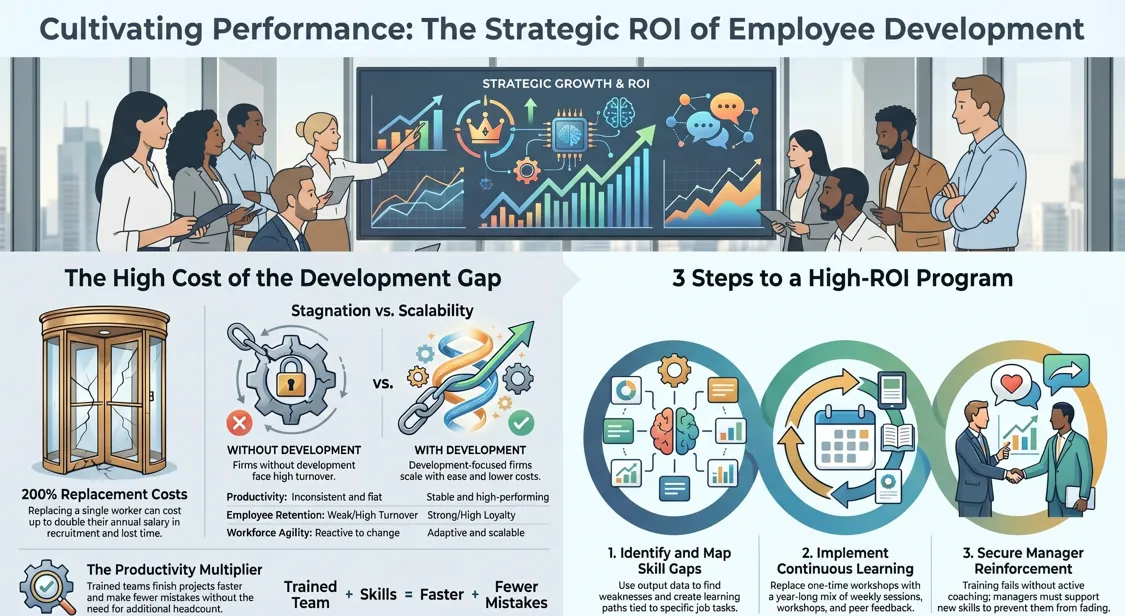
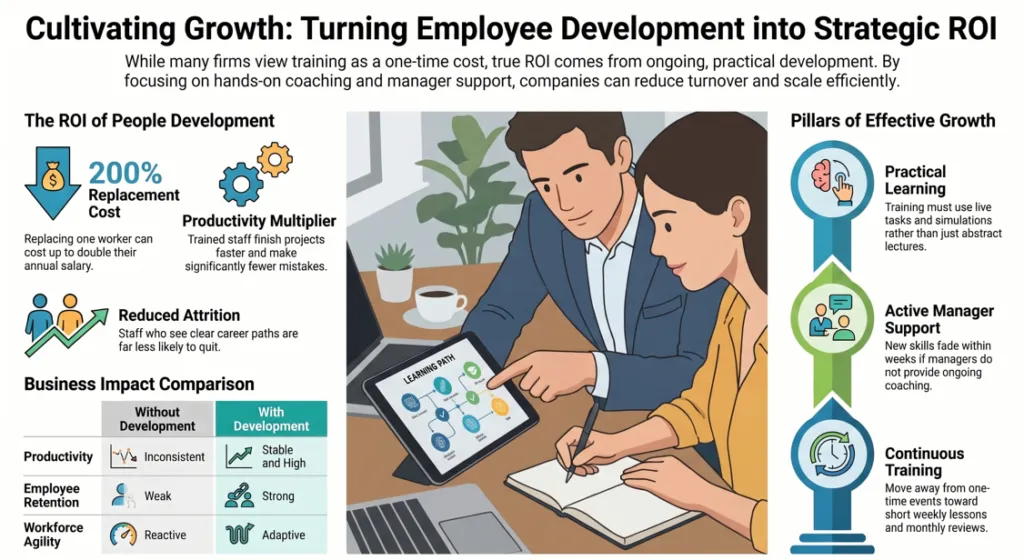
Replacing one worker can cost up to 200% of their salary. Therefore, keeping staff through strong development saves a lot of money. Internal growth also cuts the need for costly outside hires.
Lower Employee Turnover
People quit when they feel stuck. On the other hand, staff who see a clear path forward tend to stay. Corporate training benefits include lower attrition, which cuts both disruption and recruitment spend.
Faster Task Execution
Skilled workers make better choices with less guidance. Consequently, managers spend less time fixing errors. They can focus on bigger goals instead of daily problem-solving.
What Makes Development Programs Actually Work
Not all training programs get results. The ones that do share a few key traits. Keep these four factors in mind when building your plan:
Learning Must Be Practical, Not Just Theory
Real skill grows from real practice. So training should use live tasks, case studies, and job simulations. Abstract lectures rarely shift behavior. Hands-on work does.
Managers Must Support the Process
Training fails fast when leaders do not back it up. Therefore, managers must actively coach their teams after each session. Without that support, new skills fade within weeks.
Training Must Be Ongoing, Not One-Time
A single event will not build lasting skills. Instead, learning must flow through the whole year. Short weekly lessons, monthly reviews, and peer feedback all help it stick. Additionally, regular check-ins show staff that growth is a priority.
Employees Must See a Clear Career Benefit
People work harder when learning links to personal gain. Therefore, connect each program to promotions, raises, or new roles. When staff see a clear reward, engagement goes up sharply.
Why Most Training Programs Fail
Good intent does not always lead to good results. Many firms waste their training budgets on programs that do not work. Here are the main reasons why:
Too Much Theory
Slides and readings alone do not change how people work. Without real practice, knowledge fades fast. Theory must always connect to action.
No Follow-Up System
When a session ends, most people go back to old habits. As a result, skills learned in class never reach the job. Without reinforcement, even great training loses its impact quickly.
No Measurement of Success
You cannot fix what you do not track. Many firms count who attended but never check if work improved. Therefore, they repeat the same weak programs year after year.
No Link to Job Performance
Staff dismiss training that feels disconnected from their daily work. If they cannot see the point, engagement drops. Consequently, business growth stalls even after spending on programs.
The Real Business Impact: An ROI View
Strong employee development programs do more than sharpen skills. They change how an entire business runs. Look at what shifts when a firm commits to staff growth:
| Area | Without Development | With Development |
| Productivity | Inconsistent | Stable and High |
| Employee Retention | Weak | Strong |
| Training Cost | Wasted | Smart Investment |
| Business Growth | Slow | Scalable |
| Workforce Agility | Reactive | Adaptive |
This shift goes far beyond skill level. It builds a workforce that can adapt fast and grow with the business. That is where real, long-term ROI lives.
How Companies Should Start Employee Development
You do not need a big budget to get started. What you need is a clear plan and the will to follow through. Use these four steps to build a program that works:
Step 1: Identify Skill Gaps
Start by finding out where your team falls short. Use reviews, manager input, and output data. This focus helps you put training where it will matter most.
Step 2: Build a Structured Learning Plan
Map out a learning path for each role. Set short goals and longer milestones. Furthermore, tie each module to a real job task so staff see the direct value right away.
Step 3: Use a Continuous Training Model
Drop the one-off event model. Instead, spread learning across the full year. Mix short weekly sessions, monthly workshops, and peer learning. Additionally, blend online tools with hands-on practice to keep interest high.
Step 4: Measure Performance Improvement
Track both course completion and on-the-job results. Compare output, quality, and retention before and after each program. As a result, you get clear proof of ROI and a solid base for future improvements.
References
FAQs About Employee Development Programs
What are employee development programs?
These are planned efforts to grow the skills and output of your current staff. They include training, mentoring, coaching, and ongoing learning. Overall, the goal is to help people do better work today and prepare for bigger roles tomorrow.
How do they improve ROI?
Strong programs cut turnover, raise output, and build talent from within. Additionally, trained staff make fewer errors and finish tasks faster. Therefore, the business saves money and grows without always hiring from outside.
Are they better than hiring new employees?
In most cases, yes. Growing your current staff costs far less than outside hiring. Moreover, existing workers already know your processes and culture. As a result, they step into new roles faster and with less risk.
How long does it take to see results?
Engagement and confidence often improve within 30 to 60 days. However, measurable output gains usually take three to six months. Furthermore, results compound over time, so the longer the program runs, the stronger the return.
What is the biggest mistake companies make?
Most firms treat training as a one-time fix with no follow-up plan. Additionally, they rarely track whether performance changed at all. Without clear measurement, it is hard to know what worked and what needs to change.
Final Thoughts
That company with 40 new workers had everything it needed. Good people, budget, and time. But it skipped the one thing that turns potential into performance development.
Strong businesses know that growth is not just about headcount. It is about building the people already on your team. Employee development programs, done right, turn average output into high performance. They lower costs, build loyalty, and create growth that hiring alone can never match.
Companies do not grow because they hire more people. They grow because they develop the people they already have through employee development programs.
Start with one skill gap. Build one clear plan. Measure one real outcome. Then grow from there. Your best competitive edge is already on your payroll, and employee development programs are how you unlock it.
Authored by: Laiba Ayaz