Corporate training is no longer a side activity; it is a strategic lever for productivity, retention, and competitive advantage. Yet,However,most corporate‑learning programs still feel like “sit‑and‑get” PowerPoint marathons that employees endure, not enjoy.
This article shows how to design Ultimate Thrilling Corporate Training That Actually Works—content that employees want to complete, practitioners can reuse, and leaders can measure against business outcomes, all under TheEduAssist’s brand and methodology. Therefore, The piece is written explicitly around Corporate Training as the core keyword, while remaining suitable for a long‑form blog, LinkedIn article, or gated resource.
Why Most Corporate Training Fails
The broken status quo
Traditional corporate training follows a predictable pattern:
- Long in‑person or recorded sessions.
- Generic slides with minimal interaction.
- One‑time quizzes and a smile‑sheet survey.
The result is low completion, poor retention, and little behavior change. A 2023 synthesis of corporate‑training research notes that many programs fail because they are not aligned to real‑world tasks, lack engagement, and skip rigorous evaluation beyond Level‑1 (satisfaction).
The psychology behind disengagement
Cognitive load theory and workplace‑learning research consistently show:
- Adults have short attention spans for formal instruction, especially when content feels abstract or irrelevant.
- Passive listening leads to rapid forgetting; most learners retain under 20% of lecture‑style training within a few days.
- When employees cannot see clear links between a course and their daily work or career growth, intrinsic motivation drops sharply.
Corporate‑training programs that ignore these realities may check compliance boxes, but they rarely move Kirkpatrick Level‑3 (behavior) and Level‑4 (business impact) metrics.
The costly gap between “taken” and “used”
Several studies show that organizations often:
- Measure completion and test scores, but rarely observe on‑the‑job application.
- Spend hours per employee per year on training, yet find diminishing returns once time exceeds 50 hours annually if not well‑designed.
This gap is where TheEduAssist can position itself: not just another training provider, but a design partner that closes the “takes it” vs. “uses it” divide.
What “Thrilling” Corporate Training Actually Means
Beyond buzzwords: four psychological drivers
Calling training “thrilling” may sound like a marketing gimmick.However however, it is grounded in learning science and behavioral psychology. At its core, thrilling corporate training delivers:
- Ownership: Learners feel they choose what and how to learn, not that it is forced upon them.
- Relevance: Content maps directly to real tasks, problems, and goals they face daily.
- Momentum: Short, focused micro‑modules and progress signals keep learners in flow.
- Reward: Clear, visible progress (badges, points, leaderboards, certificates) reinforces effort.
Therefore, when these elements are combined, completion rates, recall, and application all rise.
The shift from “lecture” to “simulation”
Thrilling corporate training replaces monologues with interactions:
- Scenarios and branching‑choice exercises where learners must decide, not just watch.
- Short simulations (e.g., CRM workflows, customer‑complaint handling, sales objections) that mirror real‑time decision‑making.
Research on microlearning and gamification shows these formats increase engagement, motivation, and skill retention compared with traditional e‑learning.
The role of emotion and storytelling
Human‑centered learning theory emphasizes that emotion and narrative drive memory. Thrilling corporate training:
- Uses real‑world case studies (before/after, success and failure stories).
- Embeds mini‑stories where learners step into the shoes of peers, managers, or customers.
This turns abstract policies into vivid, memorable experiences, which is especially powerful for trainers, coaches, and educators who want to make content feel personal rather than “corporate boring.”
A Science‑Backed Design Framework for Corporate Training
The four‑phase design cycle
Effective corporate training should follow a tight, iterative design cycle you can brand under TheEduAssist’s methodology.
Phase 1: Needs analysis with real‑world tasks
Rather than starting with content, start with work and outcomes.
- Conduct job‑task analysis and stakeholder interviews to identify the critical skills that impact performance (e.g., pipeline‑management, onboarding new hires, handling escalations).
- Link each skill to a business KPI (e.g., sales conversion, first‑response time, customer satisfaction score).
This ensures training is not “nice‑to‑have” but tied to measurable organizational goals a message that resonates strongly with L&D managers and decision‑makers.
Phase 2: Design for “learn by doing”
Cognitive science and instructional‑design research converge on one principle: people learn by doing, not hearing.
- Convert each learning objective into active tasks:
- Drag‑and‑drop sequencing of steps.
- Branching scenarios where choices lead to different consequences.
- Reflection prompts that ask learners to connect concepts to their own experiences.
- Use constructivist design: learners build understanding through practice and reflection, not passive reception.
For instructional designers and course creators, this is where TheEduAssist can provide templates, branching‑logic maps, and quick‑win examples they can reuse.
Phase 3: Micro, mobile, and modular
Modern work rhythms favor short, flexible, and accessible learning.
- Break programs into microlearning modules of 5–15 minutes, each focused on one skill or decision.
- Optimize for mobile‑first delivery and WCAG accessibility so remote workers, field staff, and global teams can learn on any device.
- Structure content as modular building blocks that can be reordered for different roles or regions.
This approach aligns with findings that bite‑sized, learner‑centric formats improve retention and reduce friction in workplace learning.
Phase 4: Evaluate beyond smiles and quizzes
The final step is where many corporate training programs fall short: measurement and iteration.
- Apply the Kirkpatrick model in practice:
- Level‑1: Satisfaction and perceived value.
- Level‑2: Knowledge and skill checks (quizzes, short tasks).
- Level‑3: On‑the‑job behavior change (observations, manager feedback, 30‑/60‑/90‑day follow‑ups).
- Level‑4: Business impact (productivity, error rates, customer satisfaction, revenue, retention).
Fewer than 35% of organizations consistently measure Level‑4, which is why “training that actually works” feels rare. TheEduAssist can help clients build simple follow‑up mechanisms and data pipelines that make ROI visible.
How TheEduAssist Structures Thrilling Corporate Training
Pillar 1: Hyper‑practical, not theoretical
Most practitioners crave actionable tools, not abstract theory. TheEduAssist can brand its corporate‑training offering around plug‑and‑play templates, checklists, and AI‑assisted scripts.
- Provide ready‑made micro‑scenario scripts for sales, customer service, and leadership conversations.
- Offer checklists for rapid course design (e.g., “Turn one workshop into 12 micro‑modules”).
- Show before‑and‑after case studies:
- “How we reduced onboarding time by 40% for a 500‑person contact‑center team.”
- “How a 2‑hour sales‑enablement workshop increased pipeline‑conversion by 22% over three months.”
This resonates strongly with instructional designers, L&D managers, and independent creators who need to move fast and prove value quickly.
Pillar 2: Microlearning + AI shortcuts
AI‑coaching and AI‑assisted design are emerging as powerful enhancers of corporate‑training effectiveness. TheEduAssist can position itself as a guide that makes cutting‑edge tools accessible to solo creators and small teams.
- Offer AI‑prompt packs for:
- Generating micro‑scenario scripts.
- Creating branching‑logic options for different learner paths.
- Show how to repurpose one live workshop into multiple micro‑modules for platforms like Skool, Kajabi, or an LMS.
This helps course creators stand out from the crowd, reduce refunds, and increase completion by making content feel sharp, relevant, and easy to consume.
Pillar 3: Gamification that drives results
Gamification is more than badges and points; it’s a behavioral design layer that can lift engagement and reduce retraining costs.
Research and case studies show that well‑designed gamification can:
- Increase completion rates and time‑on‑task.
- Improve knowledge retention through spaced repetition and feedback loops.
TheEduAssist can help clients build low‑friction gamification without big budgets:
- Short quizzes with immediate feedback.
- Optional “challenge tracks” for high‑performers.
- Leaderboards and progress bars that create healthy competition.
Notably, firms like KPMG have reported that gamified training modules lifted fee collection and new‑business opportunities by encouraging employees to apply newly learned behaviors more consistently.
Pillar 4: Human‑connection hooks for trainers and coaches
For educators, corporate trainers, and coaches, the primary pain point is making content feel personal and engaging, not “corporate boring.”
TheEduAssist can equip them with:
- Ice‑breakers and reflection prompts that spark conversation and self‑reflection.
- Live‑online interaction techniques:
- Quick polls.
- Breakout‑room challenges.
- Real‑time chat‑based prompts (“What would you say next?”).
Phrasing this in experience‑based language (“One thing that made a big difference for my coaching clients was replacing 45‑minute lectures with four 10‑minute scenarios”) makes it feel relatable rather than theoretical.
Pillar 5: ROI‑storytelling for decision‑makers
CLOs, L&D managers, and HR directors need to justify training spend to executives. TheEduAssist can help them tell a clear story:
- Show how targeted corporate training correlates with 17% higher productivity and 21% higher profitability in some studies.
- Link retention and engagement to training investment:
- Over 90% of employees say they’d stay longer at a company that invests in their learning and development.
- Build simple pilot‑test frameworks and vendor‑selection criteria for LMS, LXP, and gamification tools.
This positions TheEduAssist as a strategic partner, not just a vendor, and appeals directly to decision‑makers and procurement teams.
Writing for Your Five Corporate Training Personas
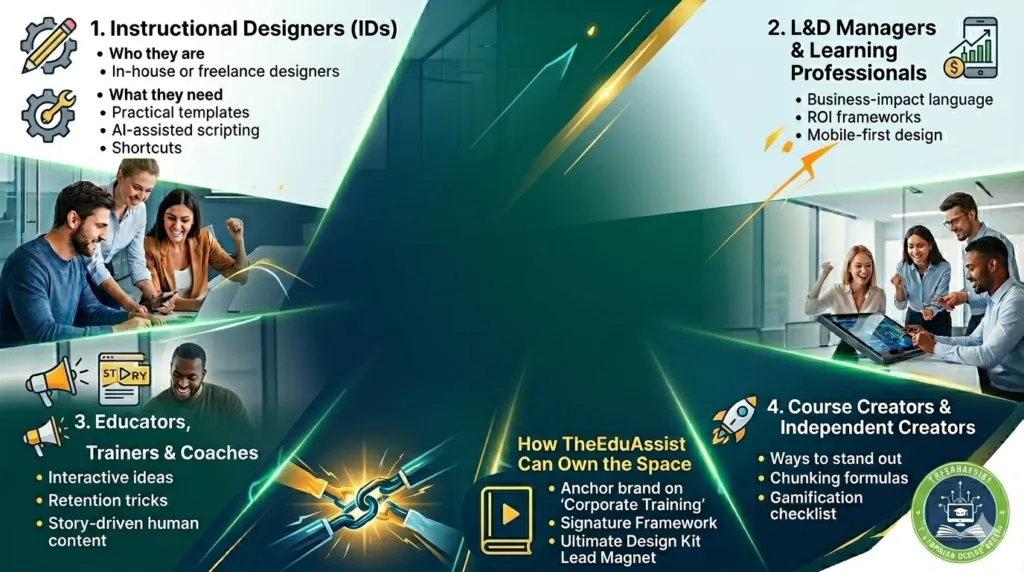
1. Instructional designers (IDs)
Who they are
In‑house or freelance designers who build courses daily.
What they need
- Practical templates, checklists, and microlearning hacks.
- AI‑assisted scripting ideas and ADDIE/SAM/Action‑Mapping shortcuts.
How to write for them
- Use tactical, colleague‑style language:
- “Here’s exactly what I do when a client wants interactivity but has zero budget…”
- Offer quick‑win examples and reusable blueprints they can tweak for their own projects.
How to improve
If IDs engage heavily in comments or DMs, double down on “quick‑win” templates and AI‑prompt libraries tailored to corporate‑training scenarios.
2. L&D managers & learning professionals
Who they are
Mid‑to‑senior managers who run company‑wide training programs and control budgets.
What they need
- Business‑impact language and ROI frameworks.
- Mobile‑first design guidance and accessibility‑compliance tips.
How to write for them
- Keep tone professional but friendly, focusing on outcomes:
- “One thing that cut completion time by 35% for my team was shortening all modules to 7 minutes and embedding a progress tracker.”
- Use before‑and‑after metrics whenever possible (productivity, retention, error rates).
How to improve
If L&D managers reply with lots of ROI questions, deepen coverage of Level‑3 and Level‑4 tracking, KPI‑mapping templates, and simple dashboards.
3. Educators, corporate trainers & coaches
Who they are
Teachers, corporate trainers, life/business coaches, and workshop leaders who deliver learning in person or online.
What they need
- Interactive ideas (branching scenarios, simulations, drag‑and‑drop).
- Quick retention tricks and ways to add personality.
How to write for them
- Use encouraging, experience‑based framing:
- “One thing that made a big difference for my coaching clients was…”
- Show how to make corporate‑training content feel human and story‑driven, not robotic.
How to improve
If coaches respond enthusiastically, add more “human‑connection” examples, such as empathy‑building scenarios and reflection‑based micro‑exercises.
4. Course creators & independent creators
Who they are
Solopreneurs, consultants, and creators selling online courses, workshops, or coaching programs.
What they need
- Ways to stand out, reduce refunds, and create professional‑looking content quickly.
- Chunking formulas, interactivity shortcuts, and mobile‑friendly UX tips.
How to write for them
- Be practical and inspiring:
- “I’ve seen solo creators double completion rates by doing this one simple thing…”
- Offer templates they can reuse, such as:
- A microlearning storyboard for 5–10‑minute modules.
- A gamification checklist for adding points, badges, and progress tracking.
This positions TheEduAssist as a “studio‑in‑a‑box” for solo creators: you give them the design systems, copywriting formulas, and small‑budget interactivity tricks that let them build thrilling corporate training that actually works without a big team.
How TheEduAssist Can Own the “Corporate Training” Space
To position TheEduAssist as the go‑to design partner for ultimate thrilling corporate training, you can:
- Anchor your brand around Corporate Training as the core keyword, then layer in sub‑keywords such as “corporate training design,” “thrilling corporate training,” and “AI‑assisted corporate training.”
- Create a signature framework (e.g., “TheEduAssist 4‑Phase Corporate Training Framework”) that mirrors the design cycle outlined above.
- Turn this long‑form article into a Lead Magnet/Checklist Bundle (e.g., “Ultimate Corporate Training Design Kit” with:
- Microlearning storyboard templates.
- Gamification checklist.
- Kirkpatrick Level‑3 & Level‑4 follow‑up script.
- AI‑prompt pack for corporate training).
This structure makes the article feel like a complete playbook rather than a shallow blog post, while keeping every section tightly tied to Corporate Training as your central keyword and TheEduAssist as the brand that makes it thrilling and measurable.
Conclusion: Making “Corporate Training” Work for Your Brand
Thrilling corporate training is not about flashy graphics or endless modules—it is about designing with purpose, psychology, and measurable outcomes. By anchoring everything in needs analysis, “learn by doing,” microlearning, and robust evaluation, you move training from a compliance checkbox to a true growth engine for your organization.
For TheEduAssist, this is the perfect opportunity to own the “Corporate Training” keyword space with a clear positioning:
- Not just another designer, but a design‑and‑impact partner for IDs, L&D managers, trainers, and course creators.
- The brand that turns theory into actionable templates, AI‑assisted scripts, and gamified micro‑experiences that actually change behavior.
References:
- Calderon, E. (n.d.). The corporate university: Effective strategies used to create a productive corporate training program. University of Northern Iowa, Graduate Research Papers.
- Muñoz, J. (2023). Evaluating microlearning strategies in the corporate environment: A mixed‑methods study. University of Kentucky, Doctoral Theses and Dissertations.
- Fegade, T., & Sharma, P. (2022). Exploring the impact of employee training and development on organizational efficiency and effectiveness: A systematic literature review. IOSR Journal of Business and Management, 25(4), 56–63.
- Al‑Alwan, A. M., Al‑Imran, A., & Al‑Zoubi, M. (2023). Overcoming challenges in corporate training: A framework for effective implementation. SCIRP‑indexed journal (exact title page).
- Kirkpatrick, D. L., & Kirkpatrick, J. D. (2006). Evaluating training programs: The four levels (3rd ed.). Berrett‑Koehler.
- General overview: https://www.kirkpatrickpartners.com/ (for contextual background on the model)
- Castellano, J. (2023). Exploring the impact of training and development on organizational performance. International Journal of Research and Innovation in Social Science (IJRISS), 7(5), 112–120.
- Raccoon Gang. (2025). Gamified microlearning in corporate learning: How to improve engagement and retention.
- eLearning Industry. (2025). Gamified microlearning to boost corporate training impact.
- Pryor Learning. (2026). Corporate training: A complete guide to developing your workforce.
- Hubken Group. (2024). Top corporate training trends you need to know in 2025.
Frequently Asked Questions About Corporate Training with TheEduAssist
1. What exactly is corporate training?
Corporate training is structured learning designed to help employees develop skills, improve performance, and support business goals. It covers areas like onboarding, compliance, leadership, sales, and technical skills, delivered in‑person or digitally.
CTR‑style angle for your audience:
- For IDs and creators, it’s “design‑driven performance change,” not just content delivery.
2. Why does corporate training often fail?
Many programs fail because they:
- Focus on coverage over behavior change.
- Use long, passive formats employees can’t finish.
- Skip Level‑3 and Level‑4 impact tracking.
TheEduAssist helps you fix the design, not just the content, so training actually sticks.
3. How can TheEduAssist help my corporate training actually work?
TheEduAssist supports you by:
- Turning generic topics into micro‑modules tied to real‑world tasks.
- Adding interactive, story‑driven scenes and gamification that boost engagement and retention.
- Providing Kirkpatrick‑aligned follow‑up templates so you can prove ROI to leadership.
Each of these points is a mini‑CTA seed: “Read how to implement this in your next program.”
4. How much time does effective corporate training take employees away from work?
Well‑designed corporate training minimizes disruption by using:
- Microlearning modules (5–15 minutes, on‑demand).
- Just‑in‑time learning that employees grab when they need it.
You can frame this as:
“Your team stays productive and grows skills no more 3‑hour mandatory sessions the week before launch.”
5. Isn’t gamified training just a gimmick?
No. When aligned with learning objectives, gamification:
- Improves motivation, completion, and retention in workplace‑learning contexts.
- Makes practice feel like progress, not another test.
TheEduAssist focuses on simple, low‑budget gamification (points, badges, progress bars) that leaders can actually measure.
6. Can TheEduAssist help if I’m a solo course creator or small agency?
Yes. TheEduAssist is ideal for independent creators who want to:
- Turn one workshop into 10–15 micro‑modules for Kajabi, Skool, or an LMS.
- Add AI‑assisted scripting and interaction templates without a big team.
This FAQ is a perfect place to drop a soft CTA:
“How to go from one‑time webinar to a full corporate training program in 2 weeks—download the step‑by‑step guide.”
7. How do we measure if our corporate training actually works?
Use a Kirkpatrick‑style approach:
- Level‑1: Satisfaction and perceived value (short surveys).
- Level‑2: Knowledge checks (quizzes, quick tasks).
- Level‑3: On‑the‑job behavior (manager observations, 30‑/60‑/90‑day check‑ins).
- Level‑4: Business impact (productivity, retention, revenue, error rates).
Position TheEduAssist as the partner that gives you ready‑to‑use templates for Levels 3 and 4, so you can answer “Does this training work?” with data.
8. What’s the fastest way to make corporate training more engaging?
Quick‑win moves from TheEduAssist’s playbook:
- Replace 30‑minute videos with 5–10‑minute micro‑scenarios.
- Add simple quizzes with instant feedback after each module.
- Use one branching‑choice challenge per key concept.
Authored By : Atiqa Sajid http://www.linkedin.com/in/atiqa-sajid-747b57137