Launching a structured online course is one of the fastest ways to turn expertise into a scalable digital product. However, many course creators struggle when transitioning from raw content to a fully functional LMS-based course.
Across Tasmania, especially in Hobart, Launceston, Devonport, and Burnie, educators, coaches, and EdTech startups are increasingly building structured programs, but often face the same challenge:
- Content is ready
- Lessons are recorded
- But the course is not properly structured, sequenced, or deployed on an LMS
This is where most 6-week courses fail, not because of poor content, but due to a lack of instructional design, LMS planning, and structured delivery.
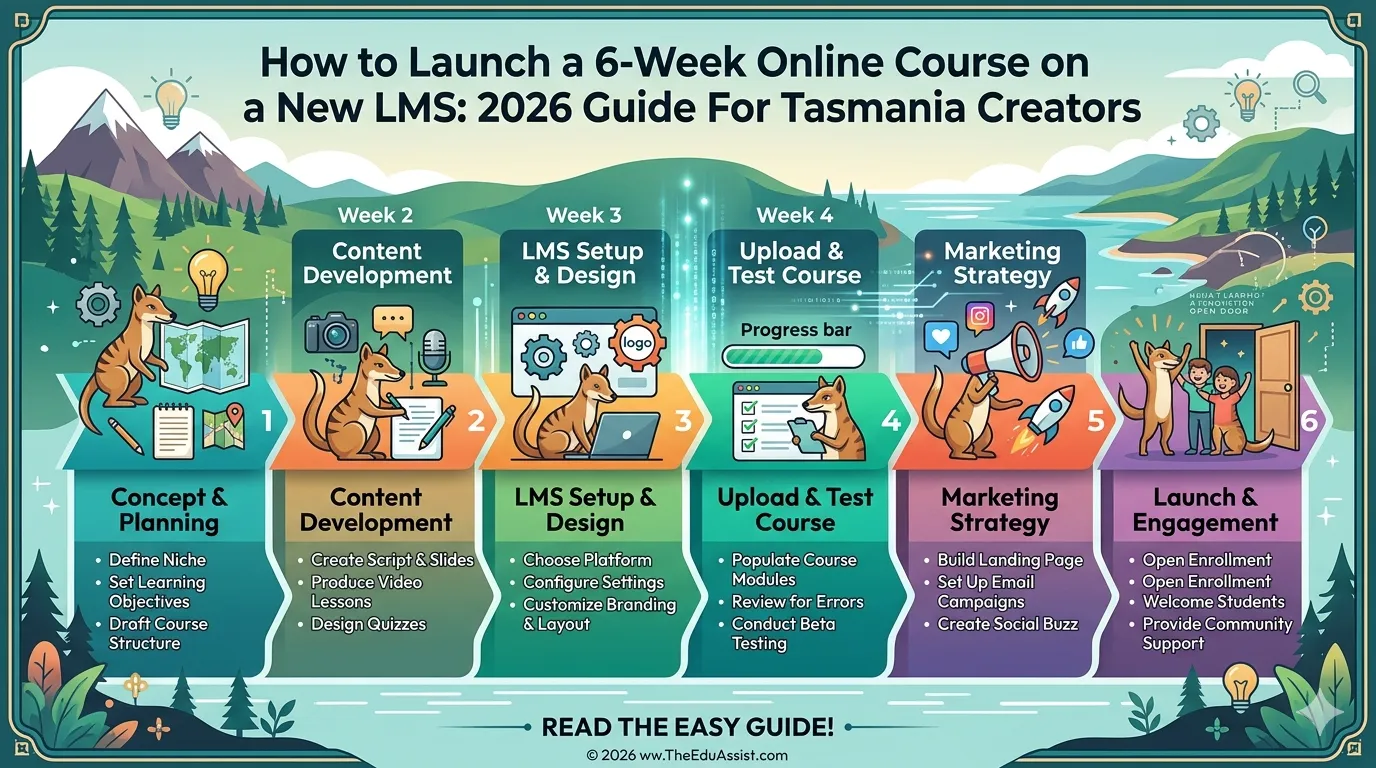
This guide explains how to launch a 6-week online course on a new LMS in 2026, using a research-backed, E-E-A-T aligned framework.
Why Structured eLearning Programs Work (Research Insight)
Research shows that well-designed eLearning programs improve knowledge acquisition, skill development, and real-world performance when they include structured delivery and relevant content.
Additionally, effective eLearning programs combine:
- Synchronous learning (live sessions)
- Asynchronous learning (self-paced modules)
- Practical application
These blended approaches significantly improve learner engagement and outcomes.
Another key insight:
Courses that use short lessons, sequential release, and frequent assessments show higher engagement and completion rates.
This is exactly what a 6-week course model is designed to achieve.
The Core Problem: Why Most 6-Week Courses Fail
Many creators design 6-week courses as:
- A collection of videos
- Loosely organized modules
- Inconsistent lesson delivery
This leads to:
- Low completion rates
- Learner confusion
- Poor engagement
The missing element is structured curriculum design and LMS strategy.
Step 1: Define the 6-Week Transformation
A successful course starts with a clear outcome.
Instead of:
“Teach a topic over 6 weeks”
Define:
“What transformation will learners achieve in 6 weeks?”
Example:
- Week 1–2 → Foundational knowledge
- Week 3–4 → Skill development
- Week 5–6 → Application and mastery
This aligns with instructional design best practices and ensures logical progression.
Step 2: Structure Weekly Modules (The 6-Week Framework)
A well-designed 6-week course should follow a consistent structure:
| Week | Focus |
|---|---|
| Week 1 | Introduction + fundamentals |
| Week 2 | Core concepts |
| Week 3 | Applied learning |
| Week 4 | Advanced strategies |
| Week 5 | Real-world projects |
| Week 6 | Final implementation + review |
Each week should include:
- Short video lessons
- Interactive activities
- Assignments
- Feedback loops
This supports microlearning and structured content development.
Step 3: Choose the Right LMS Platform
Your LMS determines how learners experience your course.
Popular platforms include:
- Kajabi
- Thinkific
- Teachable
These platforms allow you to:
- Organize weekly modules
- Drip content over 6 weeks
- Track learner progress
- Manage student engagement
For creators in Tasmania, LMS platforms ensure your course is scalable and professionally delivered.
Step 4: Use Drip Content for Better Engagement
One of the biggest mistakes is releasing all content at once.
Instead, use drip scheduling:
- Release content weekly
- Guide learners step-by-step
- Prevent overwhelm
Research shows that sequential content delivery improves engagement and completion rates.
This approach is essential for 6-week programs.
Step 5: Build Interactive Learning Experiences
To increase engagement, include:
- Quizzes and assessments
- Scenario-based exercises
- Practical assignments
- Discussion prompts
Interactive elements help learners:
- Apply knowledge
- Stay engaged
- Retain information
This is a core part of custom eLearning and modern L&D strategies.
Step 6: Combine Live + Self-Paced Learning
A high-performing 6-week course uses a blended learning model:
- Self-paced lessons (videos + modules)
- Live sessions (Q&A, coaching, feedback)
Research shows that combining synchronous and asynchronous learning improves outcomes and learner satisfaction.
Step 7: Track Progress and Optimize
Use LMS analytics to monitor:
- Completion rates
- Quiz scores
- Engagement levels
This helps you:
- Identify weak modules
- Improve content
- Optimize learner experience
Data-driven improvement is a key part of consulting services and advanced course optimization.
Quick Comparison Table: LMS Platforms for 6-Week Courses
| Platform | Best For | Key Advantage |
|---|---|---|
| Kajabi | Course businesses | Marketing + LMS combined |
| Thinkific | Educators | Flexible structure |
| Teachable | Beginners | Easy setup |
Cost Reality Check: Launching a 6-Week Course
| Category | Estimated Cost |
|---|---|
| Instructional design | $2,000 – $6,000 |
| Video production | $1,000 – $4,000 |
| LMS subscription | $39 – $199/month |
| Content development | $500 – $2,000 |
While many creators start DIY, investing in custom eLearning and structured content development significantly improves results.
Unique Perspective: The “Cohort-Based Learning Advantage”
In 2026, 6-week courses are evolving into cohort-based programs.
This means:
- Learners move together
- Deadlines create accountability
- Interaction increases engagement
Cohort-based models often result in:
- Higher completion rates
- Better learner outcomes
- Stronger community building
This aligns with eLearning trends 2026 and modern course design strategies.
Final Thoughts
For creators in Tasmania, launching a 6-week online course is a powerful way to scale expertise into a structured digital product.
However, success depends on:
- Clear learning outcomes
- Structured weekly modules
- LMS-based delivery
- Interactive learning design
- Data-driven optimization
By combining instructional design, content development, and LMS strategy, you can create a course that is not only functional, but engaging, scalable, and results-driven.
References
- https://pmc.ncbi.nlm.nih.gov/articles/PMC11367904/
- https://pmc.ncbi.nlm.nih.gov/articles/PMC8056247/
- https://pmc.ncbi.nlm.nih.gov/articles/PMC11316167/
FAQs
What is the best structure for a 6-week online course?
A 6-week course should include weekly modules, progressive learning, assignments, and final implementation projects.
Which LMS is best for launching a course?
Platforms like Kajabi, Thinkific, and Teachable are popular choices.
Should I release all course content at once?
No, drip content delivery improves engagement and prevents overwhelm.
How long should lessons be in a 6-week course?
Short lessons (5–10 minutes) are ideal for maintaining engagement.
How can TheEduAssist help launch a 6-week course?
Through edu-assist consulting services, theeduassist.com helps creators design custom eLearning programs, LMS setup, and structured content development for scalable courses.
Authored By: Sofia Arif