
Leadership Training has become a strategic imperative for organizations navigating New York’s fast-paced, diverse, and competitive business landscape. From Wall Street’s financial powerhouses to emerging tech hubs in Brooklyn and robust healthcare systems across the five boroughs, effective leadership training equips executives, managers, and high-potentials with the skills to drive innovation, foster inclusion, and deliver measurable results. Yet the true differentiator lies not just in content but in instructional design the systematic process of creating, delivering, and evaluating learning experiences that produce lasting behavioral change.
Instructional design transforms generic workshops into tailored, high-impact leadership training programs that align with organizational goals and adult learning principles. In New York, where hybrid work, cultural complexity, and rapid technological disruption define daily operations, well-designed leadership training programs yield significant returns: improved retention, higher productivity, and revenue growth. This article examines the foundations of instructional design for leadership training, New York-specific demands, proven models and best practices, standout local programs, evaluation frameworks, and emerging trends. With an average ROI of $7 for every $1 invested in leadership development, organizations that invest thoughtfully in instructional design position themselves for sustained success.
Why Leadership Development Curriculum Matters
Modern organizations face rapid change driven by digital transformation, global competition, and evolving workforce expectations. A well-designed leadership curriculum helps:
- Build decision-making and strategic thinking skills
- Improve team management and communication
- Strengthen business development capabilities
- Support small business growth and consulting effectiveness
For cities like New York and Sydney, where competitive business environments demand strong leadership pipelines, structured curriculum design is essential.
Foundations of Instructional Design in Leadership Training
Instructional design (ID) is the disciplined approach to crafting learning solutions that bridge performance gaps. For leadership training, ID ensures programs move beyond theoretical lectures to experiential, application-focused experiences that develop self-awareness, decision-making, emotional intelligence, and change management core competencies every modern leader needs.
Two dominant models shape most leadership training design: ADDIE and SAM. The ADDIE model (Analyze, Design, Develop, Implement, Evaluate) provides a linear, comprehensive framework ideal for complex leadership training initiatives. In the Analyze phase, designers conduct needs assessments to identify leadership gaps through surveys, interviews, and performance data. Design involves creating clear, measurable objectives aligned with business outcomes. Development builds engaging materials—case studies, simulations, and tools. Implementation delivers the program, often in blended formats, while Evaluation measures effectiveness. NYU School of Professional Studies’ Certificate in Learning Design explicitly trains professionals in ADDIE, emphasizing its application to workplace training challenges, including leadership development.
The Successive Approximation Model (SAM) offers an agile alternative, emphasizing rapid prototyping and iterative feedback—perfect for New York’s dynamic corporate environment where leadership training must adapt quickly to market shifts. SAM’s “Prepare, Design, Develop” cycles allow early testing of leadership modules (e.g., a prototype on inclusive decision-making) before full rollout, reducing risk and accelerating impact. Many experts note SAM suits fast-evolving leadership training needs better than rigid ADDIE, especially when incorporating emerging topics like AI ethics or hybrid team leadership.
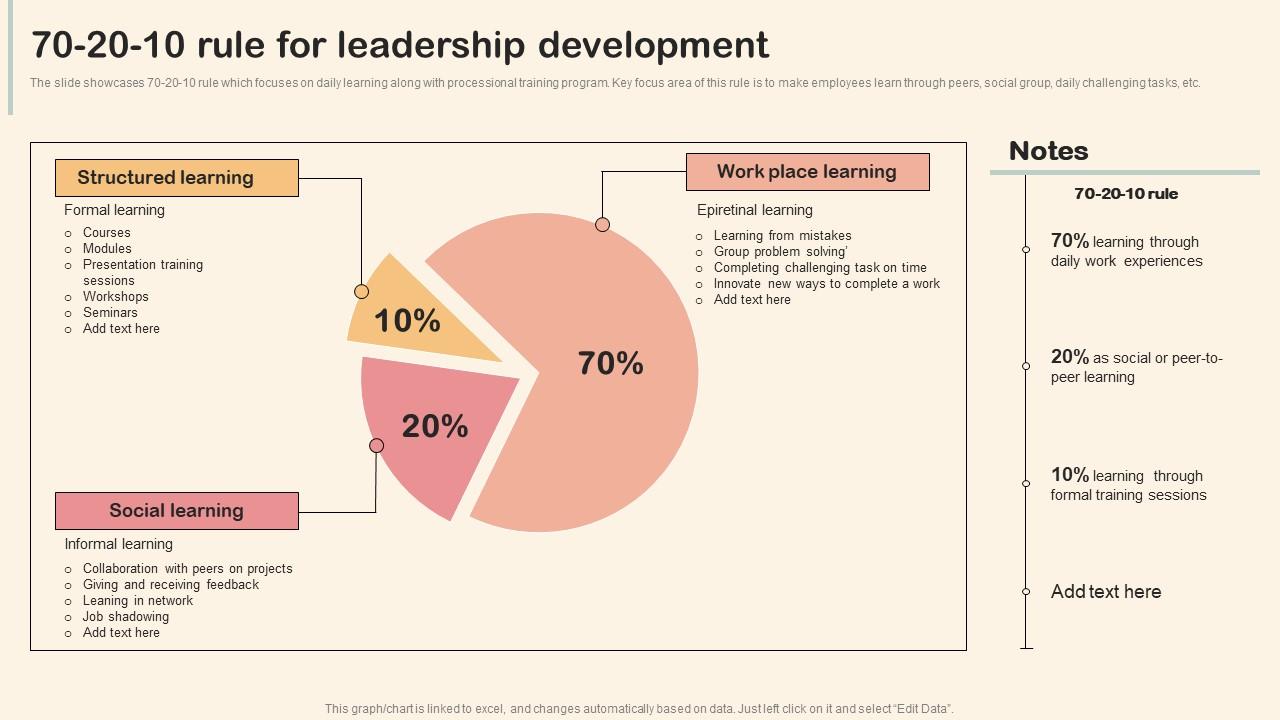
Effective instructional design for leadership training also draws on adult learning theory (andragogy), recognizing that leaders learn best when content is relevant, problem-centered, and immediately applicable. The 70-20-10 model reinforces this: 70% of development comes from challenging on-the-job experiences, 20% from relationships and feedback, and 10% from formal coursework. High-quality leadership training programs integrate all three, using formal sessions as catalysts for real-world application and peer coaching.
New York’s Unique Leadership Training Landscape
New York City’s economy demands specialized leadership training. As a global finance capital, the city faces intense pressure on ethical decision-making, risk management, and regulatory navigation amid high taxes and talent competition. Tech’s rapid growth in areas like fintech and media requires leaders skilled in innovation and digital transformation. Healthcare systems grapple with workforce shortages, equity issues, and post-pandemic recovery, while nonprofits and government agencies prioritize inclusive leadership to address economic disparities and infrastructure challenges.
Leadership training programs in New York must therefore address hybrid/remote team dynamics, cultural intelligence in a melting-pot workforce, and resilience amid economic volatility. Instructional designers tailor content to these realities—incorporating local case studies from Wall Street crises or Silicon Alley disruptions—while ensuring accessibility through in-person Manhattan sessions and virtual options for outer-borough or tristate participants.

Core Principles and Best Practices for Instructional Design in Leadership Training
Successful instructional design for leadership training begins with rigorous needs analysis: organizational (strategic alignment), task (specific competencies), and learner (existing skills and motivations). In New York, this often reveals gaps in change leadership or inclusive practices, leading to customized modules.
Blended learning proves highly effective. Programs combine instructor-led sessions with digital tools, role-playing simulations, and 360-degree feedback instruments. Columbia Business School’s High Impact Leadership program exemplifies this: participants complete pre-program 360 assessments, engage in five days of lectures, discussions, peer coaching, and self-reflection exercises, then create personalized action plans. This design fosters self-awareness and immediate application, aligning with adult learning principles.
Experiential elements are non-negotiable. Leadership training incorporates stretch assignments, mentorship pairings, and real-business projects embodying the 70-20-10 framework. Small-group dynamics and inclusive leadership exercises build synergy and cultural competence, critical in diverse New York teams.
Evaluation follows the Kirkpatrick Model’s four levels: Reaction (participant satisfaction), Learning (knowledge/skills gained), Behavior (on-the-job application), and Results (organizational impact). Leading New York programs track these rigorously through post-training surveys, manager observations, and metrics like retention rates or revenue attributed to better leadership ensuring accountability and continuous improvement.
Best practices also include accessibility, scalability, and technology integration. Instructional designers use learning management systems for asynchronous modules, micro-learning videos for busy executives, and data analytics to personalize paths. In New York, programs often partner with local institutions like NYU or CUNY, whose instructional design master’s and certificates supply skilled designers fluent in these methods.
Exemplary Leadership Training Programs in New York
New York hosts world-class leadership training programs that demonstrate instructional design excellence.
Columbia Business School Executive Education’s High Impact Leadership stands out as a premier in-person offering in Manhattanville. Spanning five days, it targets upper-level executives and combines 360 feedback, one-on-one coaching, lectures on change management and group dynamics, and action planning. Faculty-led sessions emphasize self-management and organizational culture, producing leaders who align teams with strategic objectives. Participants earn credits toward a Certificate in Business Excellence, underscoring its rigorous design.
NYU Stern Executive Education delivers flexible, high-impact options such as the Great Leadership Series: Developing Practical Leadership Skills, Change Leadership, and Leading in the Age of AI. These short, intensive programs blend theory with practical tools, breakout discussions, and faculty expertise, enabling immediate workplace application. Their interactive format featuring peer networking across global cohorts—embodies strong instructional design focused on real-world relevance.
Other notable programs include Dale Carnegie’s leadership and public speaking training in New York City, which emphasizes influence and communication through experiential exercises, and Coro’s Leadership New York, a cross-sector fellowship fostering civic leadership via immersive projects and mentorship. For mid-level professionals, the New York Alliance’s Mid-Level Leadership Development Series combines in-person sessions with coaching.
Local educational institutions further strengthen the ecosystem. NYU SPS’s Certificate in Learning Design equips L&D professionals to design leadership training using ADDIE and adult learning principles, directly supporting corporate programs across finance, tech, and healthcare. SUNY and CUNY programs similarly prepare instructional designers for New York’s demanding market.
Measuring Success and ROI
Robust evaluation distinguishes effective leadership training. Using Kirkpatrick’s framework, organizations quantify impact beyond smilesheets. Level 4 Results often reveal tangible gains: reduced turnover, higher engagement scores, and revenue growth. Industry data confirms an average $7 return per $1 invested, with some programs achieving $3–$11 ROI through better sales performance, internal promotions, and retention savings. New York firms in competitive sectors report even stronger outcomes when programs link directly to business metrics.
Challenges, Trends, and the Road Ahead
Challenges persist: sustaining behavior change post-training, scaling programs for large workforces, and proving long-term ROI amid budget pressures. Instructional designers counter these with follow-up coaching, manager accountability tools, and data-driven iteration.
Future trends point to greater personalization via AI-driven adaptive learning paths, virtual reality simulations for crisis leadership, and micro-credentials stackable into broader leadership training journeys. New York’s innovation ecosystem evident in programs like NYU Stern’s AI leadership offering positions the city as a leader in tech-enhanced development.
In conclusion, instructional design is the cornerstone of impactful leadership training programs in New York. By leveraging proven models like ADDIE and SAM, embracing experiential and blended approaches, and measuring outcomes rigorously, organizations create leaders equipped for the city’s unique demands. As New York continues to evolve, investing in thoughtfully designed leadership training is not merely an HR initiative—it is a competitive advantage that drives innovation, inclusion, and enduring success. Organizations that prioritize instructional excellence in their leadership training programs will thrive in the years ahead.
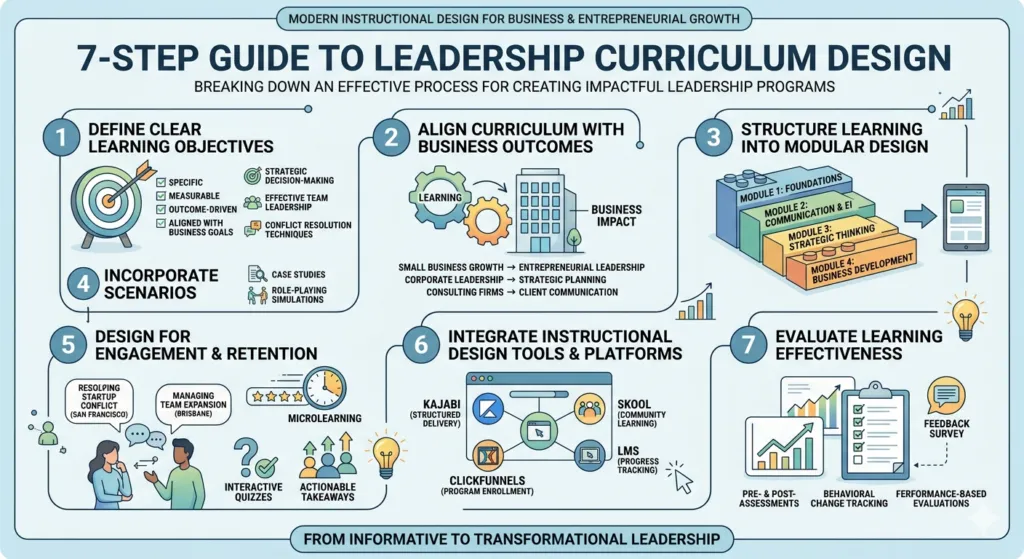
Step 1: Define Clear Learning Objectives
The foundation of any strong leadership program is well-defined learning objectives. These should be:
- Specific
- Measurable
- Outcome-driven
- Aligned with business goals
Example Learning Objectives:
- Develop strategic decision-making skills in complex business scenarios
- Demonstrate effective team leadership in small business environments
- Apply conflict resolution techniques in workplace settings
- Analyze business challenges and propose leadership-driven solutions
Instructional designers should ensure each module maps directly to one or more objectives.
Step 2: Align Curriculum With Business Outcomes
A leadership curriculum must connect learning with real business impact. For example:
| Business Need | Curriculum Focus |
|---|---|
| Small business growth | Entrepreneurial leadership & decision-making |
| Corporate leadership | Strategic planning & team management |
| Consulting firms | Client communication & problem-solving |
In cities like Los Angeles and Melbourne, many programs focus on entrepreneurial leadership and consulting skills.
Step 3: Structure Learning Into Modular Design
Effective instructional design uses modular learning structures. A leadership program can be broken into:
- Module 1: Foundations of Leadership
- Module 2: Communication & Emotional Intelligence
- Module 3: Strategic Thinking & Decision Making
- Module 4: Business Development & Growth Leadership
- Module 5: Real-World Leadership Simulation
This structure supports flexible learning, especially for online platforms like Skool or Kajabi.
Step 4: Incorporate Real-World Scenarios
Leadership cannot be learned through theory alone. Instructional designers should include:
- Case studies from real businesses
- Role-playing simulations
- Decision-making exercises
- Group discussions and peer feedback
For example, a scenario might involve resolving a leadership conflict in a startup based in San Francisco or managing a team expansion in Brisbane.
Step 5: Design for Engagement and Retention
To maximize learning outcomes:
- Use microlearning (short, focused lessons)
- Add interactive quizzes and assessments
- Include reflection exercises
- Provide actionable takeaways after each module
Engagement increases when learners can immediately apply concepts in their work environment.
Step 6: Integrate Instructional Design Tools & Platforms
Modern leadership curriculum design often uses platforms such as:
- Kajabi – for structured course delivery
- Skool – for community-based learning
- ClickFunnels – for program enrollment funnels
- LMS platforms for tracking progress and assessments
Instructional designers should ensure seamless integration between content, delivery, and learner experience.
Step 7: Evaluate Learning Effectiveness
A leadership program must include evaluation methods such as:
- Pre- and post-assessments
- Behavioral change tracking
- Performance-based evaluations
- Feedback surveys
This ensures the curriculum is not just informative—but transformational.
Conclusion:
Designing a leadership development curriculum requires a balance between instructional design theory and real-world application. Whether building programs for New York startups, Sydney enterprises, or global consulting firms, the goal remains the same: create leaders who can think critically, act strategically, and drive business success.
For instructional designers, this is not just curriculum creation it is leadership transformation architecture.
References :
https://elearningindustry.com/addie-vs-sam-model-best-for-next-elearning-project
https://coursebricks.io/blog/how-to-measure-training-effectiveness
https://leadershippipelineinstitute.com/products-the-702010-model
Frequently Asked Questions (FAQs) – Leadership Training
1. What is Leadership Training?
Leadership Training is a structured learning process designed to develop essential leadership skills such as decision-making, communication, emotional intelligence, and strategic thinking for professional growth.
2. Why is Leadership Training important for organizations?
Leadership Training helps organizations build stronger managers, improve team performance, enhance communication, and support long-term business growth and stability.
3. What should a good Leadership Training program include?
A strong Leadership Training program should include clear learning objectives, modular curriculum design, real-world case studies, interactive activities, and performance-based assessments.
4. How do instructional designers create effective Leadership Training programs?
Instructional designers align Leadership Training with business goals, define measurable outcomes, and structure content into engaging, outcome-driven learning experiences.
5. Which platforms are best for delivering Leadership Training online?
Popular platforms for Leadership Training include Kajabi for course delivery, Skool for community learning, ClickFunnels for funnels, and LMS platforms for tracking learner progress.
6. How does Leadership Training improve business performance?
Leadership Training improves business performance by strengthening leadership capabilities, improving decision-making, and creating more efficient and motivated teams.
7. Can Leadership Training be customized for small businesses?
Yes, Leadership Training can be tailored for small businesses, startups, and consulting firms to address specific leadership challenges and growth goals.
8. What makes Leadership Training effective?
Effective Leadership Training is practical, interactive, outcome-focused, and aligned with real-world business challenges and performance goals.
Authored By: Atiqa Sajid http://www.linkedin.com/in/atiqa-sajid-747b57137