The realities of coaching today are vastly different from what they were five years ago. During the 2020 pandemic, online coaching and elearning gained prominence, but today, it has become the center of pedagogy. Today, the conversation is not about when and where online coaching should be used but about how it can be scaled in a strategic, smart manner with AI. Origin Performance is one such player in Dickinson, North Dakota, that is aware of these potentials and is working to unlock them.
Trends in AI-assisted Coaching:
Integration of AI in coaching is turning out to be the most talked about trend in online coaching. This is because AI learning has the potential to enhance the efficiency of online coaching platforms while keeping the actual coaching experience rooted in one-on-one human interaction. Data suggests that between 2023 and 2025, the integration of AI in coaching platforms has increased from 12% to 30%.
AI is allowing coaches to employ AI clones to replicate their guidance during the time when they are unavailable. AI tools are also making it possible for learners to get a personalized learning experience tailored to their learning speed and interests.
Perks of Online Coaching Are Flexibility and Profit:
Online coaching trends also reveal that selection of specific niches for coaching and working with a targeted group of learners can allow coaches to charge premium fees ranging up to $10k to $20k. With traditional coaching, earning such profits would be a dream. Flexibility is yet another perk of online coaching, where coaches are able to interact with learners without getting overwhelmed. Wellness Warrior in Bismarck, North Dakota, is one such platform that is employing online coaching to boost its earnings.
Rise of All-In-One Coaching Platforms:
The emergence of all-in-one coaching platforms is yet another trend in 2026. Earlier, coaches had to rely on separate platforms for creating courses, interacting with learners, scheduling payments, and delivering lectures. With platforms like Delenta, that has integrated CRM, the need for admin is removed and the processes have been made smooth.
With such platforms, the coaching has been made smooth, accessible, and scalable for coaches and learners alike.
Avoiding Burnout by Flipping Planning:
With online coaching, individuals are embracing flipping models that focus on building websites and courses that make long-term sales without requiring continuous input from the owners. This creates passive earning opportunities for online coaches. Hatch Coaching (Fargo, North Dakota) is using online courses and e-books as assets in this regard.
With this opportunity, online coaching has become a passive income stream.
Emerging Technologies for Immersive Experiences: AR/VR:
Immersive technologies such as virtual reality (VR) and augmented reality (AR) are beginning to influence the coaching experience too. Although this feature is still in infancy, the potential for it to transform the coaching landscape is high. Strategic application of technologies can enhance learning by allowing clients to apply insights immediately rather than simply discussing them with their instructors.
Latest Strategies to Scale Online Coaching:
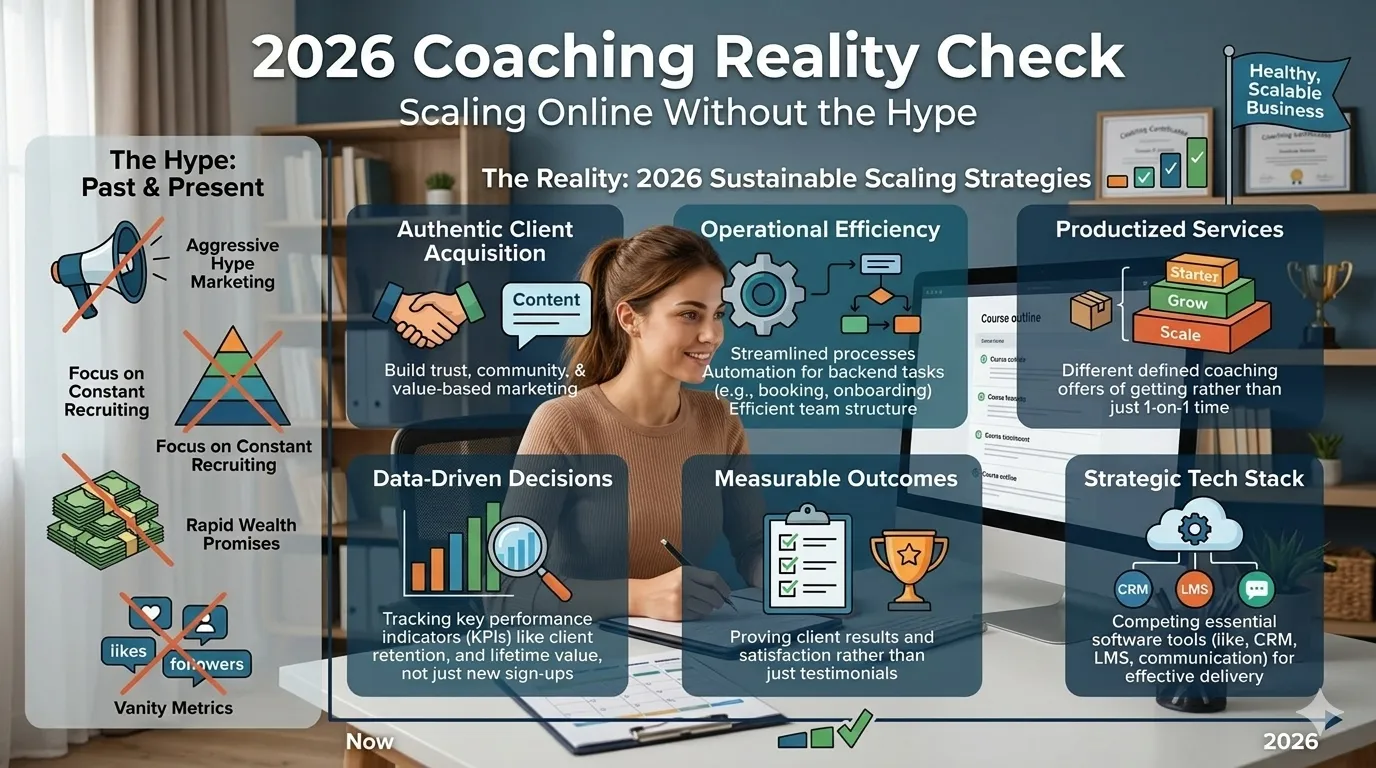
In 2026, the path to scale online coaching is clear. It relies establishing a portfolio, using AI tools systematically and focusing on quality over quantity. The following steps are non-negotiable in this regard:
- Niche Down
- Build Audience
- Use AI to Automate While Retaining Human Touch
- Focusing on Measurable Outcomes Rather Than Endless Posting
Summing Up:
In conclusion, the future of online coaching in 2026 and beyond lies in employing smart technologies to handle administrative tasks while focusing on building strong connections with clients. In the coming years, the businesses that will succeed will be those that use technology intelligently and focus on clear goals rather than chasing unrealistic targets.
Citations:
- https://zipdo.co/ai-in-the-business-coaching-industry-statistics/?utm_source=chatgpt.com
- https://www.delenta.com/
- https://www.learndash.com/
- https://sophiecarr.com/how-to-scale-your-coaching-business-for-success-using-online-systems/#:~:text=1.,a%20feature%2Drich%20course%20platform.
- https://originperf.com/
- https://www.wellnesswarriorway.com/
- https://www.hatchcoaching.com/
FAQs (Frequently Asked Questions):
Q1. What is AI learning?
AI learning refers to the learning process that is assisted by AI-led tools and software.
Q2. Will AI replace human coaches in the future?
AI will not replace human coaching; rather, it will assist the coaches who are willing to scale their businesses, reach a bigger audience, and use AI to handle admin-related tasks.
Q3. How can online coaches build their credibility?
Online coaches can build their credibility by choosing specific niches and developing a loyal audience. They can also develop online courses to develop a strong portfolio online.
Q4. What role can AR/VR play in coaching in the future?
While immersive technologies like these are still in infancy, they have the potential to transform the online learning landscape, provided they are developed and leveraged systematically in this regard.