
E-learning implemented as a new and adaptable method of learning. Nevertheless, in the case of the use of K2 (Kindergarten 2) and early primary, several institutions and families encounter serious difficulties.
Children at the K2 stage are five to six years old. They are acquiring elements of cognitive, behavioral, and emotional bases. Their focus, control over digital devices, and ability to follow the instructions in structured online formats are still developing.
Lack of acknowledgment of these developmental realities when designing the kindergarten online classes results in frustration instead of engagement. Parents feel overwhelmed. Teachers feel stretched. There is operational pressure on administrators.
Digital learning in itself is not a problem. The problem is the implementation and design of K2 e-learning.
K2 learner Developmental needs
The K2 learners taught mostly by interacting, repeating, visually stimulating, and guided learning. They have a short attention span, and their learning has a strong relationship with physical and emotional involvement.
The developmental discrepancy is evident when a long virtual session or the delivery of passive content is the foundation of early childhood digital education. Children lose interest easily since the model of learning is not in line with the information processing of children at this age.
K2 e-learning should be based on brief learning cycles, narrative instruction, prompt interaction, and systemic reinforcement. These elements considered to make the successful implementation of the best technology platform meaningful without them.
The Secret Tax on Parents in K2 Online Learning
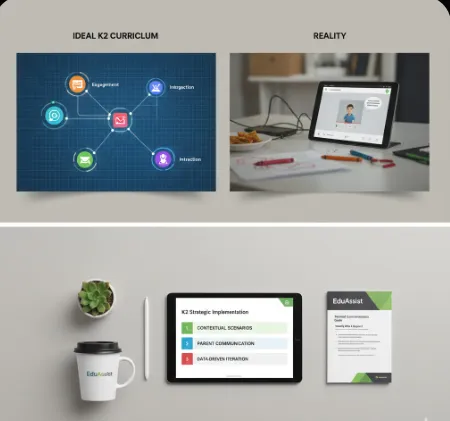
The level of parental involvement that need is one of the major challenges of e-learning at K2. In contrast to older students, K2 students do not have the ability to open platforms on their own, work with assignments, and solve technical problems.
This puts pressure on families who can employ. Under the conditions when the hybrid schedules are variable, or the virtual classes demand uninterrupted supervision, the parents should reorganize work patterns to fit the needs of learning support. In the long run, this generates emotional and professional tension.
The participation of parents in online learning is imperative at this point, but it should be organized realistically. Schools must have communication networks, foreseeable time structure, and streamlined processes that acknowledge the truth of contemporary households.
The responsibility will be all on families without institutional support.
Digital Education Instructional Design Iss
The biggest reason behind the failure of K2 e-learning is the fact that technology is implemented too fast, and instructional design is not properly adjusted. Most institutions rushed to adopt LMS platforms, in which they thought that all they could transfer to the classroom would be adequate online.
Nonetheless, online learning platforms demand a reconstruction of pedagogy, in particular that of early childhood.
The instructional design in K2 environments should take into account the attention span, engagement triggers, cognitive load, and emotional presence. Equally, this lessens the effectiveness of repeating the classroom lectures in a virtual environment.
The digital classroom is reactive as opposed to structured when learning experience design is not present. The attendance reduces, the level of participation declines, and the learning outcome impairs.
LMS Implementation in the Absence of Pedagogical Alignment

The learning goals should not substitute but assisted by technology.
If LMS implementation is made without teacher training, usability test, accessibility validation, and clear operations planning, there will be more confusion throughout the system.
The usability is especially important in online classes, K2. Interfaces have to be easy, navigation should be easy for the user, and directions should be easily understood by the parents and children.
Educational establishments investing in systematic LMS implementation plans experience increased participation and minimal system crashes. Companies that do not take this step will often end up in the same frustration.
Virtual Classroom Management at the Early Grades
A virtual classroom with K2 learners will not manage using the same set of skills as with older students. Children at a young age react to the well-organized schedule, visualization, and brief interactive periods.
Live sessions that last longer, uncontrolled audio settings, and the absence of participation criteria can all be overwhelming to both the teachers and students.
Digital facilitation is an acquired aspect. Educators require models of engagement, microlearning approaches, and hybrid cohort administration methods. In the absence of this support, it would be hard to maintain classroom stability.
Behind the Scenes Operational and Staffing Pressures
Most of the K2 e-learning predicaments are indicators of underlying real operations. The lack of staff, the absence of training in digital pedagogy, the fast change of the policy, and the lack of communication can all affect the quality of the implementation.
These are hardly deliberate difficulties. Nevertheless, unplanned and unreviewed, small holes become systemic problems.
Learning institutions should have strategic partners who are aware of learning science and execution.
EduAssist Strengthens K2 E-Learning Systems
At EduAssist, we consider early childhood digital education as a niche design issue. Our knowledge of instructional design, the implementation of LMSs, quality assurance, and learning analytics enables institutions to shift from a response to problems rather than methodical enhancement.
Our starting point is matching the learning objectives to the principles of developmental psychology. K2 courses are redesigned to encompass interactive storytelling, brief engagement cycles, and models of reinforcement-based assessment.
The next thing is to make sure that LMS platforms are put in place strategically. This consists of accessibility compliant, usability testing, SCORM, and xAPI validation, and formalized teacher onboarding programs.
Parental communication design is also important. Having clear weekly schedules, having simplified login procedures, and responsive support systems makes life less stressful and engages better.
Through learning experience construction and operational planning, EduAssist can create sustainable, connected digital learning structures out of fragmented systems.
Does K2 E-Learning improve over time?
Students gain independence and digital literacy as they go up the grades ladder. Nonetheless, early experiences in the K2 have a major effect on subsequent patterns of engagement.
Disengagement habits might persist when digital learning in the early grades is ill-structured. It creates confidence, flexibility, and digital capability when purposefully planned out.
Its aim is not at the abolition of digital learning in K2. It is aimed to plan it right at the beginning.
Developing Trust in Early Childhood Schooling
EduAssist transports advanced expertise in design and validation of learning experiences, LMS implementation, and data-based performance metrics, to enable institutions provide believable and quantifiable K2 digital learning programs.
Finally, K2 E-Learning Designing K2 E-Learning to be Real-World Successful
The problem of K2 e-learning is actual. They impact all the families, teachers, and administrators. But these are not permanent and unsolvable.
Early childhood digital learning may be efficient and sustainable with the help of the proper design of instruction, thoughtful implementation of LMS, high-quality teacher training, and reasonable ways of parent involvement.
The issue is not technology. The distinguishing factor is design.
Change Your K2 Digital Learning System with EduAssist
EduAssist can be used in case your institution is facing low kindergarten online kindergarten classes, inconsistent hybrid frameworks, or difficulties in implementing LMS.
Our team is a specialist in the development of structured, measurable, and developmentally aligned K2 e-learning environments.
Re-expense your early-grade digital learning system with clarity and confidence by contacting EduAssist today.
Frequently Asked Question
Why is K2 e-learning different from online learning for higher grades?
K2 students need supervised learning, brief learning cycles, interactive learning, and instructional design at their developmental level. Their mental development is very different compared to the students of a higher age.
What is the duration of successful K2 online sessions?
Interactive reinforcement activities with short learning segments of about 15 to 20 minutes are usually more effective with this age group.
What are the reasons why most schools fail to implement K2 LMS?
Popular pitfalls are high-speed implementation with no instructional redesign, scanty teacher training, and inadequate usability testing among the youthful learners.
What are the ways of mitigating parental stress in K2 online education?
Through the adoption of foreseeable timeframes, streamlined electronic systems, effective communication systems, and organized care delivery.
And what is the role of EduAssist in enhancing the success of digital education in early childhood?
By designing learning experiences, implementing LMSs strategically, testing quality assurance, ensuring accessibility, and ensuring constant data-driven improvement.