
It Becomes an Operational Crisis When a Simple Update.
A regulation change in LMS.
A product specification is dynamic.
A workflow step is revised.
You go to your LMS to revise the course and the system stops you.
This is made clear by the message: This course cannot be edited since learners are registered.
This is not uncommon for organizations that utilise restrictive platforms like the learning module of ADP. It’s routine.
A 10-minute change of content would take the form of a complete rebuild. Reporting will be disjointed. There is a weakened compliance confidence. Instructional teams exhaust themselves.
This is not merely an inconvenience of the it.
It is a structural workflow problem.
The True Issue: LMS Course Editing Restraints.
Most of the applications close the course after enrollment. The system does not allow structural edits even when it has been completed by all the learners.
The majority of the LMS systems attach a course record to:
- Enrollment data
- Completion timestamps
- Assessment scores
- SCORM tracking variables
Once the course is enrolled, editing is dangerous to corrupted historical records and thus the course is locked. This is technically logical, but it generates extreme operational strain.
Operational Impact
- Reconstructing Entire Courses – Error-prone and time-consuming.
- Fragmentation – Completion history split between versions Reporting.
- Compliance Risk- Obsolete training puts the organization at risk.
- Instructional Burnout- Teams can spend more time attending to restrictions than enhancement of learning.
Working Solutions: Tactical and Strategic Solutions to Problems.

Solution 1: External SCORM Hosting
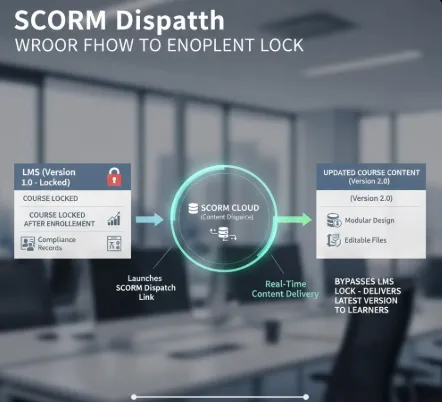
Store your SCORM file on the Internet and connect it to the elearning platform. Such platforms as SCORM Cloud offer dispatch solutions.
How It Works:
- External upload of SCORM package.
- Load the slim wrapper into LMS.
- It launches hosted content
- Edita hosted the SCORM file without rebuilding the course on the Education Management System.
Benefits:
- Ensures continuity of reporting.
- Erases complete course reconstruction.
- Reduces turnaround time
Risks: Reliance on third-party hosting and governance needs.
Solution 2: Structural Improvement
Divide massive courses into smaller units (e.g., 6 x 10-minute units).
Advantages:
- Only updated affected modules.
- Maintains past completion records.
- Minimizes the fragmentation of reporting.
- Enhances learner interaction.
It is a workflow optimization strategy and design.
Solution 3: Version Control Governance of Education Management System.
Unless it can be duplicated:
- Use version numbering (v1.0, v2.0)
- Export completion data, then delete old courses.
- Keep records of change and documentation of release.
Ensures the integrity of reporting and audit preparedness.
Solution 4: Test LMS Fit
The need to update and comply regularly can be a sign that your LMS architecture is not suitable. Such platforms as Docebo or iSpring Solutions offer:
- Course cloning
- Edit-after-enrollment flexibility
- Version tracking
- The preservation of historical reporting.
Migration is supposed to be strategic and data-based.
Actual Case Study: Quarterly Regulatory Reports.
Industry: Manufacturing
Requirement: Revise compliance education every quarter.
Before Optimization:
- Lock on course because of enrolment.
- Full rebuild required
- Split version reporting.
- Audit preparation complex
After Optimization:
- Content compliance: Modularized.
- SCORM hosted externally
- Implemented version governance.
- only affected supplanted.
Outcome:
- Reduced rebuild time by 50–70%
- Reporting integrity is continuous.
- Improved audit confidence
- Reduced burnout of instructional teams.
Consumption: LMS Constraint Response Matrix
| LMS Constraint | Short-Term Solution | Long-Term Strategy |
|---|---|---|
| Immortal after enrollment (course locked once learners are registered) | SCORM dispatch hosting via platforms like SCORM Cloud | Modular course architecture with update-ready design |
| No duplicate capability (cannot clone active courses safely) | Structured versioning (v1.0, v2.0) + archival backups | Migration to a flexible elearning platform such as Docebo |
| Fragmentation in reporting after rebuilds | Export and archive historical completion logs before updates | LMS with built-in version control and unified reporting (e.g., iSpring Solutions) |
Frequently Asked Questions
Why is it not possible to edit a course once the learners enroll?
This platforms provide courses that are locked to secure the data on course completion, assessment grades, and reporting integrity. The editing process may interfere with history.
Is it possible to update a course built in SCORM without reconstructing it?
Yes. Best allocation: Host SCORM externally (e.g. SCORM Cloud) and connect it to the LMS to update it without re-creating the course.
What to do to keep LMS version control safe?
Protect audit integrity with structured version naming, export reports before archiving, and maintain a documented change log.
Is modular course design less work?
Yes. The update of only impacted modules saves time during rebuilds, maintains completion data, and enhances the engagement of learners.
In which cases might an organization want to change LMS?
In the case of frequent updates, fragmented reporting, high rebuild cycles, and increasing compliance risk, look at the platforms such as Docebo or iSpring solutions.
Does it meet the requirements of an industry in external SCORM hosting?
Yes, under the condition of the correct completion tracking, hosting is of a security standard, and governance documentation is kept.
The way Organizations are reacting.
- Compliance Auditing the flexibility of LMS.
- Re-structuring courses into ecosystems.
- Adopting version control.
- Testing SCORM dispatch hosting.
- Comparison of LMS architecture with update requirements.
Thought-provoking organizations shift from reactive reconstruction to proactive governance.
EduAssist: EduAssist Structured LMS Solutions.
Limitations to LMS editing are a silent struggle for many teams, and they believe that rebuilding is customary. It isn’t.
EduAssist assists organizations that are:
- Getting LMS reporting problems.
- Experiencing regular compliance training refreshers.
- Controlling version control anarchy.
- Indecisive of whether to migrate or optimize.
Our evidence-based LMS suitability review is:
- No vendor bias
- No forced migration
- Unambiguous suggestions in accordance with your operational reality.
Test Your Free LMS Suitability Test.
When your instructional team is redesigning courses at a rate that is higher than the rate of learning outcomes, it is time to conduct a systematic evaluation.
EduAssist will assist you in determining:
- Tactical fixes, such as SCORM hosting: Sufficient or not?
- need to redesign structurally in a modular way.
- The need to evaluate the LMS long-term.
No longer allow the constraints of LMS to determine your learning strategy.
Create a system that grows as your organization grows.