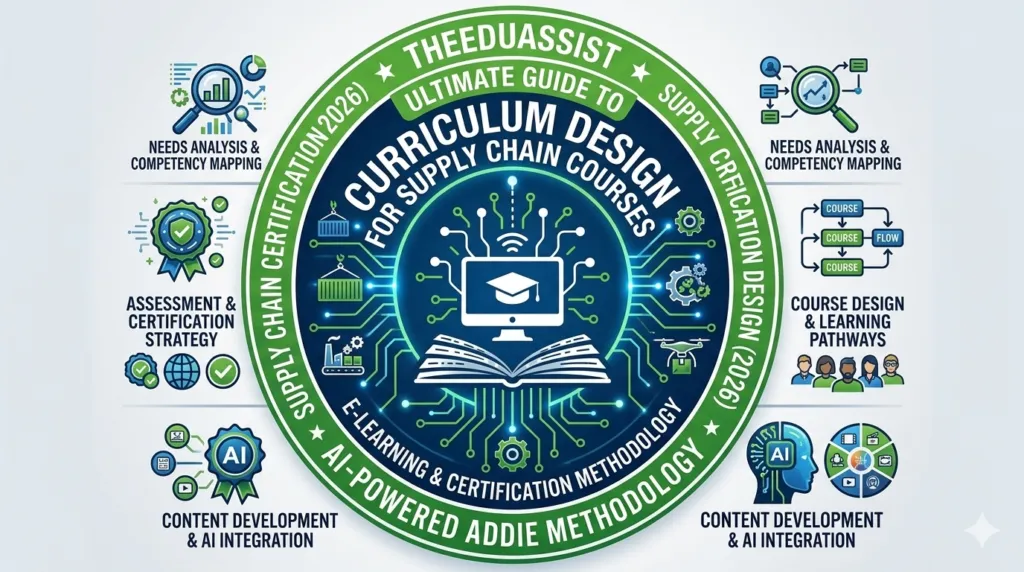
In today’s volatile global economy marked by geopolitical disruptions, AI-driven automation, sustainability mandates, and e-commerce surges supply chain professionals are in high demand.High-quality Curriculum Design for supply chain courses do more than prepare learners for certification exams or job interviews they build practical decision-making skills that drive real business impact: reduced costs, resilient networks, and faster innovation. The U.S. Bureau of Labor Statistics and industry reports project strong growth in logistics and operations roles through 2030, with employers prioritizing skills in digital transformation, risk management, and ethical sourcing. Professional certifications like the ASCM (Association for Supply Chain Management) Certified Supply Chain Professional (CSCP) remain gold standards, with updated 2026 exam content emphasizing end-to-end visibility, sustainability, and technology trends.
This guide shows instructional designers, training leaders, universities, and corporate L&D teams how to create compelling, compliant, and results-oriented supply chain courses. It blends proven Curriculum Design (ADDIE framework), interactive multimedia, and AI-powered certification tools to deliver engaging online learning that boosts completion rates, retention, and on-the-job performance.
Step 1: Analyze Needs and Market Context for Curriculum Design (ADDIE – Analysis Phase)
Start with a thorough needs assessment. Supply chain learners are typically mid-career professionals, operations managers, analysts, or new entrants balancing full-time work with upskilling. Key pain points include complex global networks, real-time decision-making under uncertainty, and integrating emerging tech like AI and IoT.
Market Insights (2026):
- Demand for AI-integrated supply chain skills is exploding—courses from Coursera, MIT, and Wharton highlight predictive analytics, digital twins, and sustainable design.
- Certifications like CSCP, CPSM, or specialized AI+ Supply Chain credentials differentiate candidates.
- Corporate buyers (e.g., manufacturers, retailers) seek measurable ROI: improved forecasting accuracy, lower inventory costs, and compliance with ESG standards.
AI Acceleration Tip: Use tools like ChatGPT Enterprise or Claude to analyze job postings on LinkedIn, ASCM exam outlines, and learner feedback from platforms like Coursera. Prompt example: “Summarize top skill gaps in 2026 supply chain job descriptions and align with CSCP Module 8 on technology trends.”
Step 2: Design the Curriculum Design with Backward Planning (ADDIE – Design Phase)
Adopt backward design: Begin with desired outcomes (certification readiness + applied skills), then map assessments and content. Align objectives to Bloom’s Taxonomy for progression from “understand” to “apply,” “analyze,” and “create.”
Sample Learning Objectives (40–60 Hour CSCP-Aligned Course):
- Understand: Explain supply chain models, demand patterns, and forecasting techniques.
- Apply: Design a basic supply chain network using optimization principles.
- Analyze: Evaluate supplier risks and recommend mitigation strategies in a simulated disruption scenario.
- Evaluate/Create: Optimize a sustainable supply chain using AI tools and present a digital twin recommendation.
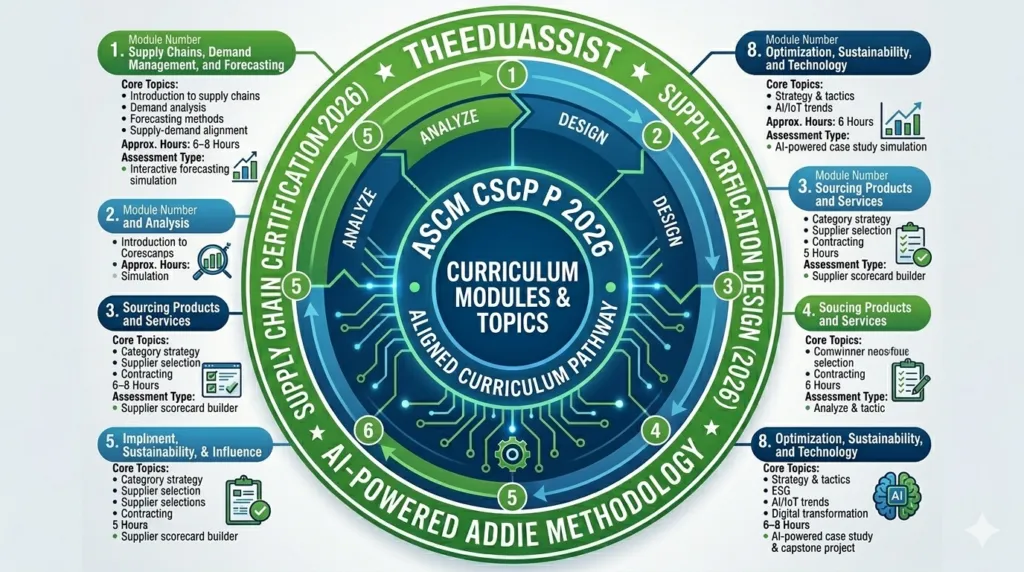
Modular Curriculum Outline (Based on 2026 CSCP Content):
| Module | Core Topics (Aligned to CSCP 2026) | Approx. Hours | Assessment Type |
|---|---|---|---|
| 1. Supply Chains, Demand Management, and Forecasting | Introduction to supply chains, demand analysis, forecasting methods, supply-demand alignment | 6–8 | Interactive forecasting simulation |
| 2. Global Supply Chain Networks | Design & optimization, end-to-end visibility, metrics & reports | 6 | Network mapping exercise |
| 3. Sourcing Products and Services | Category strategy, supplier selection, contracting | 5 | Supplier scorecard builder |
| 4. Internal Operations and Inventory | Planning, capacity control, inventory management, continuous improvement | 6 | Inventory optimization game |
| 5. Forward and Reverse Logistics | Distribution, transportation, trade compliance, reverse flows | 5 | Logistics decision branching scenario |
| 6. Supply Chain Relationships | Customer & supplier collaboration | 4 | Relationship mapping tool |
| 7. Supply Chain Risk | Risk identification, analysis, response | 5 | Risk simulation (disruption scenario) |
| 8. Optimization, Sustainability, and Technology | Strategy & tactics, ESG, AI/IoT trends, digital transformation | 6–8 | AI-powered case study & capstone project |
This structure mirrors ASCM’s eight-module CSCP framework while incorporating hot topics like sustainability and technology.
AI in Design: Platforms like isEazy Author, Articulate 360 AI, or LearnWorlds can auto-generate objectives, outlines, and quiz banks from CSCP PDFs or prompts.
Step 3: Develop Engaging Curriculum Design with Interactive Multimedia (ADDIE – Development Phase)
Passive lectures won’t cut it in supply chain training—learners need to experience bullwhip effects, warehouse disruptions, or supplier negotiations.
Best Practices for Interactivity:
- Simulations & Games: Use 3D virtual environments (e.g., Articulate Storyline) for airport cargo warehouse risk assessments or logistics operations. Learners navigate realistic scenes, identify hazards, and input data into mock software—ideal for high-stakes fields like aviation logistics.
- Branching Scenarios: Tools like Genially or Storyline let learners choose sourcing strategies or crisis responses, with immediate feedback on outcomes (cost, delay, sustainability impact).
- Gamification & Micro-Simulations: Leaderboards, inventory optimization games, or “beer game” variants teach demand variability. Platforms like SC Training (formerly EdApp) or AdaptiveU support mobile-first, bite-sized modules.
- Multimedia Mix: Short expert videos (Synthesia AI avatars), interactive dashboards for network design, clickable infographics, and AR overlays for warehouse layouts.
Aim for 50%+ interactive elements—research shows this dramatically improves knowledge retention and transfer in technical fields.
AI Superpowers: Feed regulatory or case-study data into authoring tools for rapid prototyping. Use AI video generators for customized demos of tools like C3.ai or Coupa.
Step 4: Integrate AI Certification Tools for Assessment & Credentialing (ADDIE – Development/Implementation)
Modern courses must offer seamless, secure certification to compete with platforms like Coursera or AI CERTs.
AI-Powered Certification Features:
- Adaptive Assessments & Proctoring: AI tools (e.g., AI+ Supply Chain certification platforms) deliver proctored online exams with 50-question formats, real-time identity verification, and cheating detection. Passing thresholds (e.g., 70%) lead to shareable digital badges.
- Personalized Learning Paths: LMS platforms (Docebo, 360Learning) use AI to adjust difficulty based on performance—e.g., extra modules on AI forecasting for weaker learners.
- Auto-Generated Credentials: Integrate with blockchain or AI platforms for instant certificates upon completion, including micro-credentials for specific modules (e.g., “AI in Demand Forecasting”).
- Hands-On AI Tool Mastery: Embed practice with real tools (ChatGPT for data cleaning, predictive models in C3.ai or Zebra) and AI-powered challenges that auto-grade submissions.
Compliance Note: Ensure courses align with ASCM standards for CSCP prep or corporate CE requirements. Include disclaimers for state-specific or industry certifications.
Step 5: Implement, Evaluate, and Iterate Curriculum Design (ADDIE – Implementation & Evaluation)
Delivery Options:
- Fully online self-paced (most popular for working professionals).
- Blended: Instructor-led webinars + simulations.
- LMS Integration: Track progress, issue certificates, and report to HR systems.
Kirkpatrick-Level Evaluation:
- Reaction: NPS surveys.
- Learning: Pre/post quizzes + simulation scores (target 85%+ pass rates).
- Behavior: Follow-up manager feedback on applied skills (e.g., better risk assessments).
- Results: Track business metrics like reduced lead times or cost savings.
AI Analytics Edge: Heatmaps, dropout predictions, and A/B testing of scenarios help refine content annually—especially as AI and sustainability evolve.
Common Pitfalls to Avoid
- Overloading theory without simulations.
- Ignoring mobile optimization (field teams study on phones).
- Underusing AI—treat it as an accelerator, not a replacement for SME review.
- Static content—update for 2026+ trends like digital twins and generative AI in procurement.
Conclusion:
Designing supply chain courses in 2026 is an opportunity to blend rigorous curriculum design standards (like CSCP modules) with cutting-edge interactive multimedia and AI certification tools. The result? Engaged learners who don’t just pass exams—they lead resilient, sustainable, and intelligent supply chains.
Start today: Map your target audience to the 8-module outline above, prototype one simulation in Articulate Storyline or Genially, and test an AI-proctored quiz. Whether you’re an independent provider, university, or corporate trainer, these methods cut development time while delivering measurable impact.
The future of supply chain education is interactive, intelligent, and immediately applicable—and your course can be at the forefront. Ready to build it? Review the latest ASCM CSCP outline, experiment with one AI authoring tool, and launch a pilot module this quarter. The supply chains of tomorrow start with the courses you design today.
References:
https://www.coursera.org/courses?query=supply%20chain%20design
https://training.safetyculture.com/blog/10-interactive-elearning-tools
https://aapscm.org/american-certified-supply-chain-artificial-intelligence-analyst-acsai
FAQs:
1. What is curriculum design in supply chain eLearning?
Curriculum design is the strategic planning of course content, learning objectives, assessments, and interactive resources. In supply chain courses, it ensures learners gain practical skills, exam readiness (e.g., CSCP), and applied knowledge using AI-driven tools.
2. How do I make my Curriculum Design of supply chain courses interactive?
Incorporate simulations, branching scenarios, gamification, AR/VR, and dashboards. Platforms like Articulate 360, Genially, and LearnWorlds allow learners to engage in realistic logistics decision-making, warehouse management, and forecasting exercises.
3. Which AI tools enhance Curriculum Design course creation?
AI tools accelerate course design, generate quizzes, create multimedia content, and personalize learning paths. Examples include ChatGPT for content generation, Synthesia for AI video lessons, and predictive analytics platforms for hands-on forecasting exercises.
4. How do AI certification tools improve learning outcomes?
AI-powered certification tools provide adaptive assessments, real-time proctoring, and automated credential issuance. Learners receive micro-credentials or digital badges, ensuring skills mastery and credibility in logistics and supply chain roles.
5. How can I align courses with professional certifications?
Use frameworks like ASCM CSCP, CPSM, or AI+ Supply Chain micro-certifications. Map modules, assessments, and interactive content to certification objectives, ensuring compliance with 2026 standards and industry best practices.
6. What mistakes should I avoid in Curriculum Design of supply chain eLearning?
Avoid overloading theory without interactivity, ignoring mobile optimization, underutilizing AI, and leaving content static. Update regularly to include trends like digital twins, AI in procurement, and sustainability practices.
7. How do I measure the success of my Curriculum Design of supply chain courses?
Follow Kirkpatrick’s 4-level evaluation:
- Reaction – Learner satisfaction (NPS surveys)
- Learning – Pre/post quizzes and simulation scores
- Behavior – Manager feedback on applied skills
- Results – Business impact (e.g., reduced lead times, cost savings, improved forecasting)
8. Can small teams or solo educators create these courses?
Absolutely. With modern LMS platforms, AI authoring tools, and interactive templates, even small teams can develop professional, certification-aligned supply chain courses efficiently and cost-effectively.
Authored By: Atiqa Sajid http://www.linkedin.com/in/atiqa-sajid-747b57137