

The Hidden Dilemma of AI in Learning.
AI has taken the role of the new creative assistant and, in certain instances, the unforeseen author of corporate and academic courses. Consider the following example: you are looking through an e-learning module created by a colleague, and it sounds as if you went to ChatGPT and set it to write without any human involvement.
There is no personality, no pedagogy, no context, just generic text which technically contains information but does not teach. This is not a far-fetched notion: this is an actual issue that the instructional design community is talking about:
Context: Check out this discussion on Reddit. https://www.reddit.com/r/instructionaldesign/comments/1qgn894/how_are_we_responding_to_colleagues_and_others/?utm_source=share&utm_medium=web3x&utm_name=web3xcss&utm_term=1&utm_content=share_button
This is a problem that many IDs struggle with day in and day out: the workforce relies on it as a crutch, and the output seems to be of high quality when it is, in fact, not very helpful to the learners.
But what do you do without making a professional issue a battle at work place? Let’s break it down.
The Real Issue: It has to do with Quality, not robotic.
The main problem is not about Artificial intelligence itself; it is the way it is applied. This is what is occurring in most organizations:
1. Lack of Academic Integrity
Artificial intelligence does not check facts automatically. It content that is not reviewed is untrue or deceptive. Students or employees receive information that cannot be considered technically justifiable and reliable.
2. Zero Instructor Perspective.
Artificial intelligence can synthesize knowledge; however, it is unable to interpret it, put it into perspective, or give subtle examples, which rely on human experience. IDs bring on the value of real learning there.
3. No Narrative or Throughline
Artificial intelligence usually makes discontinuous text. The modules can include lists, definitions, and examples, but no flow, coherence, or cognitive progression.
4. Policy and Compliance Gaps
A lot of organizations need to be recognized in the case of its use. In case colleagues fail to do so, it becomes a governance problem and liability.
5. Workplace Politics
In this case, It abuse is sometimes mixed with office politics. An example of this is that a colleague can get promoted too fast or can be rewarded due to being fast instead of quality, thus enhancing resentment.
The Solution: Think Like an Instructional Designer.
It is all about strategy rather than emotion. Structured thinking, pedagogy, and learner-centered approaches are introduced to the table through IDs – capitalize on that.
1. Restructure the Situation: It is about Learners, not Colleagues.
Replacement of this person, who misused artificial intelligence in this course, is dangerous to learners.
Actionable Steps:
- Content of the maps to the learning objectives.
- Point out gaps, inaccuracies, or inconsistencies.
- Give your feedback in terms of results and danger.
Example:
The learning outcomes in Module 2 are not aligned, and there are also false terms that might create confusion for the learners. Suggest changes to define goals and address mistakes.
2. Use Policy as Leverage
In case your institution must disclose AI, then this is your objective anchor.
Sample Disclosure:
The content developed in this module, will be examined and edited by an instructional designer in order to be pedagogically consistent and accurate.
The policy-based criticism does not allow personalization of discussions.
3. Give Actionable Feedback
Don’t just say “it’s bad.” Offer specific, realistic guidelines.
| Issue | Recommendation |
|---|---|
| Missing learning objectives | Restate with verbs of Bloom’s Taxonomy. |
| Disconnected modules | Insert narrative connecting sections. |
| No assessments | Add formative and summative assessment. |
4. Model an AI-Assisted Quality Revision
Show, don’t just tell. To make your feedback tangible, you should provide a sample, and this shows your expertise.
Before:
Leadership implies coming up with a team.
After:
Leadership can be defined as the capacity to guide a team toward common objectives. Students will be able to contrast transformational and transactional leaders and make use of frameworks in a case study.
5. Develop a repeatable Quality Assurance Workflow.
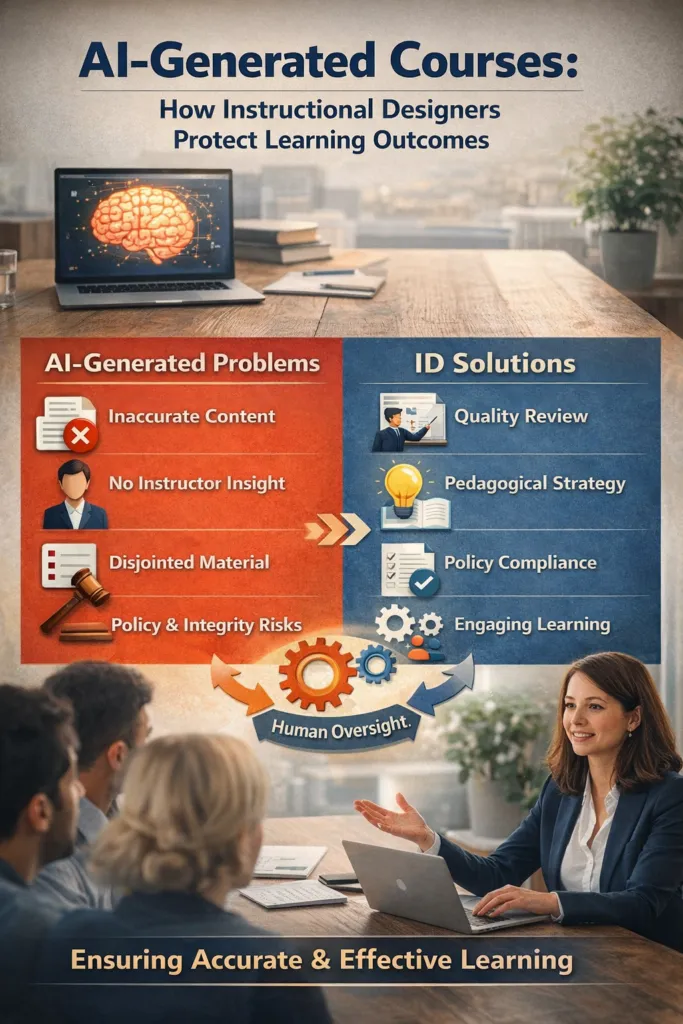
Suggest a workflow in such a way that its output will increase the learning process without quality deterioration:
- SME review for accuracy
- Pedagogy and alignment review of ID.
- artificial intelligence assisted draft creation
- ID optimization to narrative flow.
- AI disclosure compliance check.
This makes human control core.
AI Best Practices for IDs
It is a tool, not a replacement:
Best for:
- Composing thoughts and synopses.
- Brainstorming content
- Coming up with sample questions.
Avoid:
- Unreviewed final content creation.
- Unattributed AI output
- Complicated pedagogical choices in the absence of ID within them.
Bad vs Good AI Content: Real-life examples.
Bad AI content:
Time management refers to scheduling. It helps you succeed.
Why it fails:
- No measurable outcomes
- Generic language
- No actionable steps
Good AI content:
At the conclusion of this lesson, students will be able to:
- Detail time management with the Eisenhower Matrix.
- Set priorities with case scenarios.
- Develop a daily schedule using time-management strategies.
Frequently Asked Questions
Q1: Isn’t AI drafting efficient?
A: Only if reviewed by experts. Quality without efficiency is a wasted effort.
Q2: Will AI be able to replace instructional designers?
A: No. IDs guarantee alignment of the curriculum, context, and learning outcomes.
Q3: What do you think is the best way to be a critic without being offensive?
A: Concentrate on risk and policy compliance of learners, rather than effort and personality.
A: Draft -> SME reviewing -> ID reviewing -> AI support -> final refinement and disclosure.
Q5: How to ensure quality fast?
A: Templates, checkpoints, and standards. Quality enters the working process.
Conclusion:
It is here to stay. Independent AI content undermines learning and institutional integrity. IDs have to be efficient in Artificial intelligence and human judgment.
Strategic response to misuse is a safeguard to learners, will be a leadership quality, and will maintain standards. Real discussions evidence https://www.reddit.com/r/instructionaldesign/comments/1qgn894/how_are_we_responding_to_colleagues_and_others/?utm_source=share&utm_medium=web3x&utm_name=web3xcss&utm_term=1&utm_content=share_button
This is already becoming a real, practical challenge as indicated by.
Call to Action

We assist the instructional designers at EduAssist:
- Establish the course quality requirements.
- Establish review and governance systems.
- Educate teams about the ethical use of it.
- Post case studies and peer knowledge