
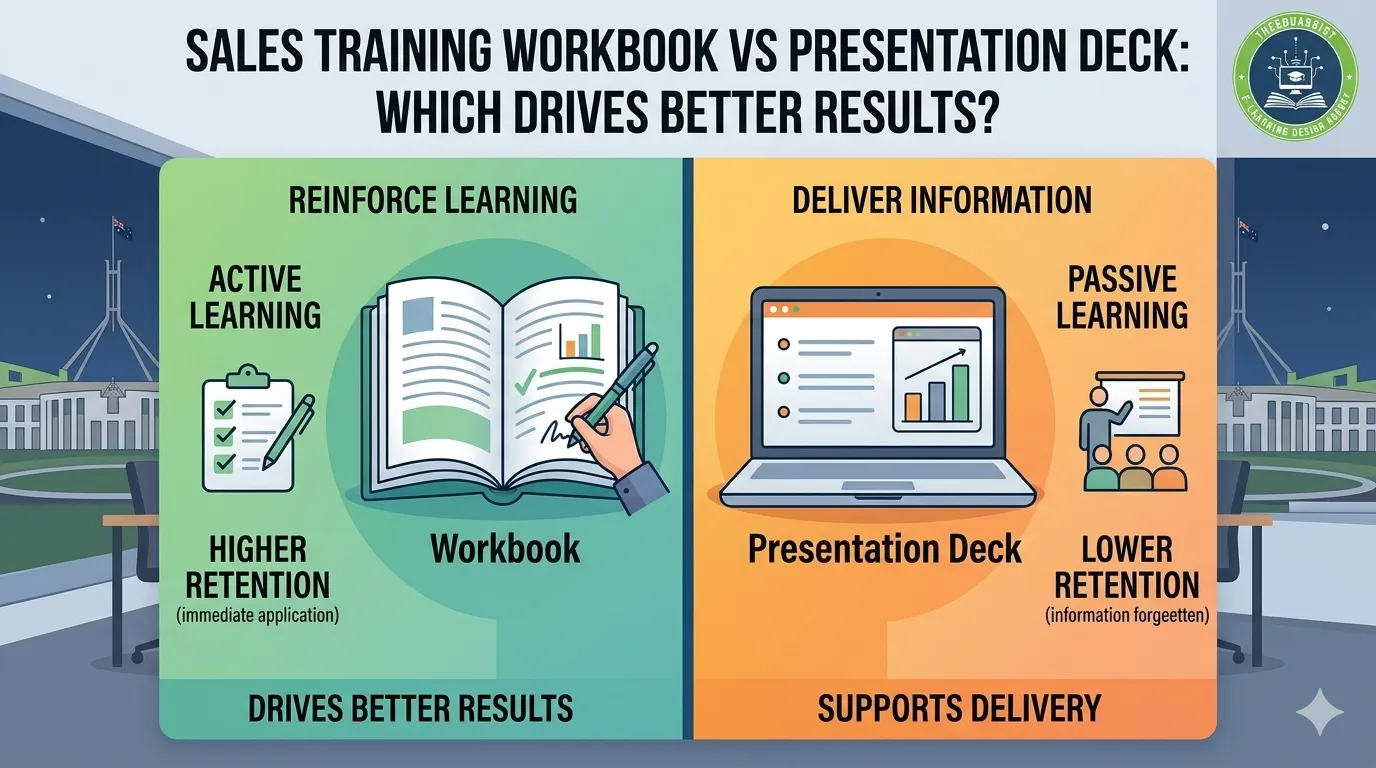
Sales training materials like workbooks and presentation decks are key tools for equipping sales teams but their impact differs in retention, application, and real-world results. Insights from TheEduAssist and case studies across US cities like New York reveal when each format excels.
Effective sales training can make or break a team’s performance. Choosing the right format workbooks or presentation decks is critical to ensure knowledge retention, skill application, and measurable sales outcomes. However,decks engage participants visually and foster real-time interaction, workbooks provide hands-on exercises, role-playing scenarios, and practical tools that reinforce learning long after the training session ends.
Real-world case studies from US cities like New York, Kansas City, and Palo Alto show how companies leverage these tools to drive tangible improvements in revenue, team growth, and customer engagement. Therefore, from TheEduAssist and industry research, this guide explores when workbooks outperform decks, when decks excel, and how combining both formats leads to optimal results.
By understanding the strengths, weaknesses, and ideal applications of each approach, sales leaders can design training programs that not only educate but also translate into measurable success on the field. This article will help you make informed decisions for your sales team, ensuring that every dollar invested in training delivers maximum ROI.
Core Differences
- Workbooks provide interactive, self-paced resources—worksheets, role-playing exercises, and sales playbooks—that enable ongoing practice and reference.
- Presentation decks deliver concise, visual storytelling during live sessions, emphasizing engagement through 10–11 slides for better retention.
TheEduAssist combines both in tailored programs, offering trainer guides and playbooks alongside live workshops.
Sales Training Workbook Strengths:
Workbooks foster deeper learning through hands-on application:
- Retention improves via practice (up to 50% in group discussions vs. 5% in lectures).
- Support long-term behavior change with post-training follow-ups and performance tracking.
- In US sales training programs, they reduce turnover by 20% and boost quota attainment. mural
Presentation Deck Advantages:
Presentation decks drive immediate engagement:
- Visual storytelling increases conversion by 18%, and personalized decks lift win rates by 50%.
- Ideal for pitches and deal-closing sessions, especially interactive decks.
- US sales pilots show decks outperform generic slides, driving revenue growth across cities.
US Cities Case Studies of Sales Training:
- Sales negotiations pilots in cities including New York boosted sales volume and profitability using structured sessions with decks.
- Time Out New York doubled its sales team, emphasizing practical tools for market insight.
- SOCO Sales Training in Chicago, Los Angeles, and New York combined workbook-style playbooks with interactive delivery, improving proficiency. giglioco
| Aspect | Workbook Results | Presentation Deck Results | Source |
|---|---|---|---|
| Retention | 50% via practice | 22% higher engagement | mural, vibe |
| Revenue Impact | $4.53 ROI per $1 spent | 20–30% conversion rise | globibo |
| US City Rollout | Turnover down 20% | Pipeline growth in NY/LA | globibo, giglioco |
| TheEduAssist Fit | Playbooks for ongoing use | Workshops with custom content | Program details |
When Sales training Workbooks Win?
Use workbooks for post-training reinforcement, enabling on-the-job application and measurable competency improvement (38% observed).
TheEduAssist’s playbooks are ideal for high-turnover US markets, providing teams with actionable, trackable progress. theeduassist
When Presentation Decks Dominate?
Choose decks for live pitches or pilot sessions, where visuals and storytelling drive quick wins. Multi-city expansions show win rates up to 58% when using deck-focused delivery. kitahq
Real US city case studies highlight how sales training workbooks drive measurable sales improvements through hands-on reinforcement. giglioco
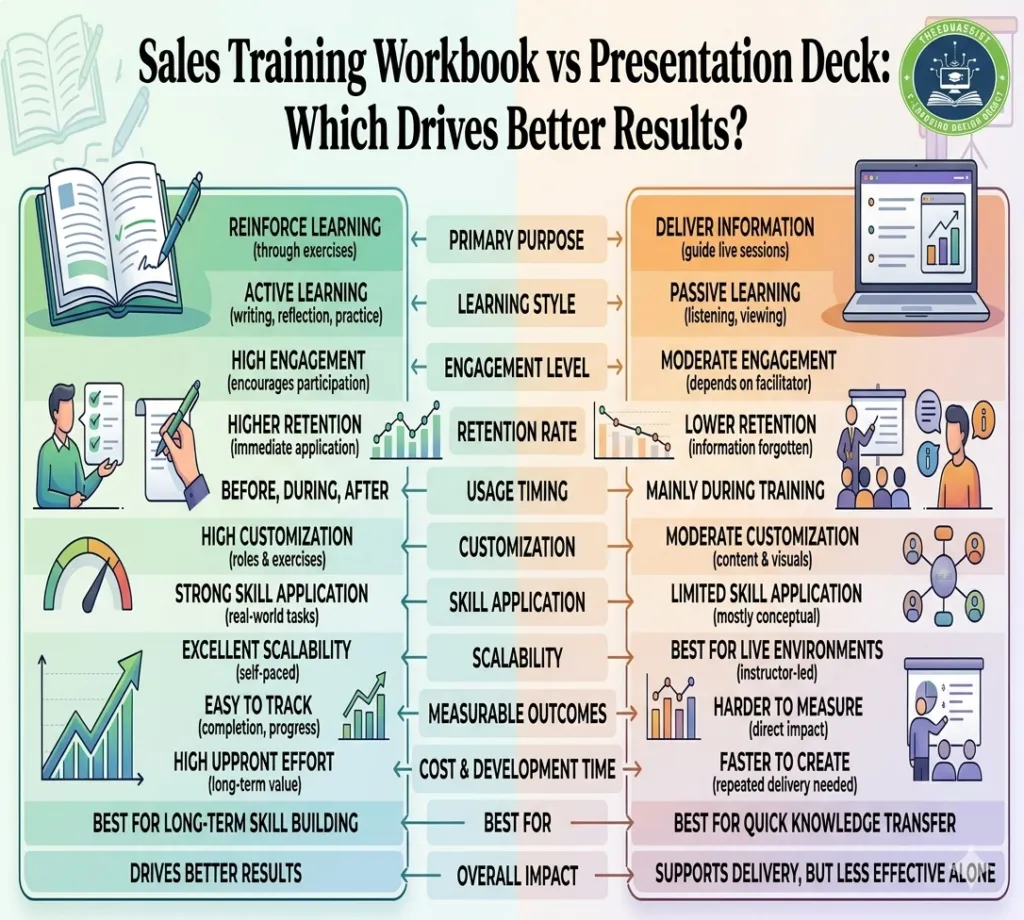
Sales Training Workbook vs Presentation Deck: Which Drives Better Results?
| Criteria | Sales Training Workbook | Presentation Deck |
|---|---|---|
| Primary Purpose | Reinforce learning through exercises and application | Deliver information and guide live sessions |
| Learning Style | Active learning (writing, reflection, practice) | Passive learning (listening, viewing) |
| Engagement Level | High – encourages participation and accountability | Moderate – depends on facilitator delivery |
| Retention Rate | Higher – learners apply concepts immediately | Lower – information may be forgotten quickly |
| Usage Timing | Before, during, and after training | Mainly during training sessions |
| Customization | Highly customizable for roles, scenarios, and exercises | Moderately customizable (content and visuals) |
| Skill Application | Strong – includes real-world tasks and action plans | Limited – mostly conceptual understanding |
| Scalability | Excellent for self-paced and remote learning | Best for live or instructor-led environments |
| Measurable Outcomes | Easy to track progress, completion, and performance | Harder to measure direct impact |
| Cost & Development Time | Higher upfront effort but long-term value | Faster to create but may need repeated delivery |
| Best For | Long-term skill building and behavior change | Quick knowledge transfer and presentations |
| Overall Impact | Drives better results through consistent practice | Supports delivery but less effective alone |
New York: Time Out Expansion
Time Out New York doubled its sales team from 5 to 10 members and used tailored sales training with probing questions and client research tools, akin to workbook exercises. However,this approach boosted business acumen and client engagement by emphasizing preparation before pitches, leading to sustained revenue growth in a competitive media market. giglioco
Kansas City: Hangers Cleaners
In Kansas City, Missouri, Hangers Cleaners leveraged localized sales strategies via practical tools like customer service playbooks and delivery optimizations after training. Founder Joe Runyan’s team grew market share against giants like Procter & Gamble by applying workbook-style tactics. Meanwhile, partnering with local businesses and charities, resulting in expanded customer bases. makingthatsale
Palo Alto: Lucid Motors
Lucid Motors in Palo Alto, California, implemented sales training with interactive workshops, role-playing, and consultative selling materials for their EV expansion. These workbook elements enhanced partner skills and customer interest, fostering sales growth in the luxury EV sector. klozers
| City | Company | Workbook Impact | Key Outcome |
|---|---|---|---|
| New York | Time Out | Probing questions, research tools giglioco | Doubled sales team size |
| Kansas City | Hangers Cleaners | Service playbooks, local ties makingthatsale | Beat corporate rivals |
| Palo Alto | Lucid Motors | Role-playing exercises klozers | Higher partner engagement |
TheEduAssist Recommendation:
TheEduAssist integrates both formats custom workshops (presentationdeck-like) plus workbooks and playbooks for maximum results. Meanwhile, this hybrid approach:
- Increases sales figures and retention.
- Outperforms single-format training.
- Aligns formats with training phase: decks for delivery, workbooks for mastery. infoprolearning
Bottom Line: For measurable sales success, don’t choose one over the other combine interactive decks for live engagement with workbooks for long-term application.
Conclusion
In modern sales training, the debate between workbooks and presentation decks isn’t about choosing one it’s about using both strategically. High-performing sales teams and experts like TheEduAssist—recognize that effective sales training requires a balance of engagement and application.
Presentation decks play a vital role in sales training delivery, enabling trainers to communicate key concepts through structured, visually engaging sessions. However, without reinforcement, even the most impactful sales training sessions can lose effectiveness over time. This is where workbooks become essential.
Sales training workbooks, a core part of TheEduAssist approach, ensure that learning is applied in real-world scenarios through exercises, role-playing, and continuous practice. This transforms sales training from a one-time event into an ongoing performance system.
Real-world case studies across US cities show that organizations using a blended sales training model combining decks for delivery and workbooks for reinforcement achieve higher retention, improved sales competency, and stronger ROI.
For sales leaders and course creators, the takeaway is clear:
- Use presentation decks to deliver engaging sales training sessions
- Use workbooks to reinforce and sustain sales training outcomes
With proven frameworks from TheEduAssist, this hybrid approach ensures that sales training doesn’t stop at learning it drives real, measurable business results.
FAQs: Sales Training Workbook vs Presentation Deck
1. What is the difference in sales training between a workbook and a presentation deck?
In sales training, a workbook is an interactive tool with exercises and practical applications, while a presentation deck is used to deliver sales training content visually during live or virtual sessions. TheEduAssist combines both for maximum effectiveness.
2. Which format is better for results?
The best sales training results come from a blended approach. TheEduAssist recommends using presentation decks for engagement and workbooks for retention and real-world application.
3. Why are workbooks important in programs?
Sales training workbooks are essential because they reinforce learning through practice. According to TheEduAssist, they help sales teams apply concepts, improve skills, and achieve measurable performance improvements.
4. When should presentation decks be used in sales training?
Presentation decks should be used in sales training during onboarding, workshops, and live sessions where structured delivery and visual storytelling are critical an approach widely used in TheEduAssist programs.
5. How does sales training improve ROI with workbooks?
Sales training improves ROI when workbooks are used because they enable continuous learning and practical application. TheEduAssist integrates workbooks to ensure long-term impact and higher conversion rates.
6. Can small teams benefit from TheEduAssist methods?
Yes, small teams can benefit significantly from TheEduAssist sales training methods by combining decks for learning and workbooks for ongoing practice, ensuring consistent growth without large budgets.
7. What is the most effective modern strategy?
The most effective sales training strategy is a blended model. TheEduAssist uses a combination of presentation decks, workbooks, coaching, and performance tracking to maximize engagement and results.
References:
https://flevy.com/download/25-case-studies-on-sales-strategy-263
https://www.rainsalestraining.com/blog/sales-training-ideas
Authored By: Atiqa Sajid http://www.linkedin.com/in/atiqa-sajid-747b57137