
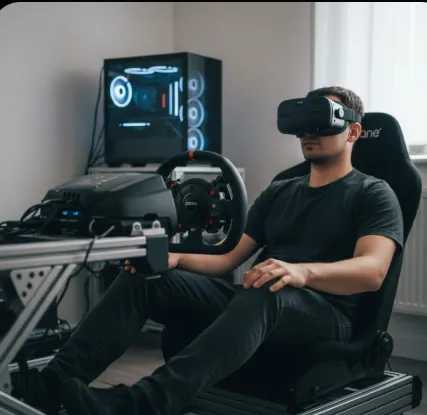
You are in your Simlab GT1 Evo cockpit, start Assetto Corsa, and are feeling that it is a day in VR. You boot up your Meta Quest 3 and imagine that you are immediately in the cockpit. Instead, you wait. You reconnect. You restart. You troubleshoot.
The experience must be smooth to the sim racers, who are also spending money on high-end hardware. You should not be like an experiment whenever you want to race. Consistency is even more required in case you play mostly Assetto Corsa Evo, Assetto Corsa Rally, or F1 25.
This is not regarding the immersiveness of VR. It concerns the question of whether your AR/VR system is good enough to allow competitive sim racing to take place without friction.
Learning the Heart of the Problem
The Real Problems: Not graphics, but Stability
Performance or resolution is the assumption made by the majority of sim racers. The problem is, in fact system architecture. Quest 3 is a VR headset aimed to be used as an independent device. It uses PC video streaming when used as PC sim racing.
Then you have four important jobs that are being performed simultaneously by your system: rendering the game, encoding the video, sending the signal (over USB or Wi-Fi), and decoding it within the headset. The possible instability is added in each layer.
Immersion can be destroyed by even a slight inconvenience in USB bandwidth, software compatibility, or network conditions. Even in competitive racing, lags in the latency can influence head tracking precision and frame pacing.
These Weak Points are revealed by Sim Racing
Sim racing requires long-lasting performance. Racing is a long process that needs a steady frame timing, unlike short VR sessions. Head tracking has to be unobtrusive and immediate. When jittering or lagging, spatial awareness will fall apart.
The disappointment that you feel is not accidental. There is a discrepancy between VR architecture that is based on streaming and the high consistency required by simulation racing.
Does the Meta Quest 3 Provide a Trustworthy Experience?
Yes -But Only with Controlled Optimization
It is possible to make the Quest 3 much more stable; however, it involves removing variables.
It requires a complete wiring installation. Seated sim racing is presented with unwanted randomness with Wireless VR. A good quality USB connection straight into your motherboard lowers signal instability. Switching wireless off is a sure way of avoiding background conflicts.
It is also important to perform tuning. Most users pursue a better refresh rate, yet stability is preferable to the maximum values. It is often possible to smooth the performance by locking the headset to a fixed refresh rate, by eliminating extraneous graphical overhead, and by optimizing the use of the GPU power settings.
The Quest 3 has the potential to be a fairly dependable experience when properly configured. Nonetheless, it remains based on the software ecosystem of Meta. Friction may sometimes be reintroduced by updates, compatibility shifts, or background services.
In case you have a low tolerance level when it comes to occasional troubleshooting, this dependency is a long-term issue.
Native PCVR: A Structurally Simpler Solution
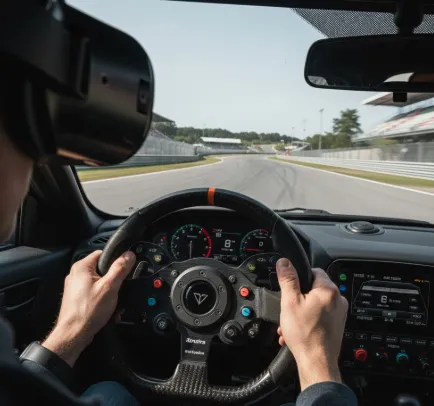
Doing away with the Streaming Layer
Native PCVR headsets are directly connected via DisplayPort and video compression, and streaming is completely done away with. A reduced number of layers leads to a reduced number of failure points.
The Valve Index has been one of the most trustworthy PCVR systems for sim racing. Its resolution might not be as good as the more recent headsets, but its ecosystem maturity and direct connection design offer uniform performance. After being set up, it will act predictably.
Another alternative is the HP Reverb G2, which has a reputation for cockpit display and crystal clear graphics, although there is a long-term platform support aspect.
To those who prefer the highest level of visual fidelity, the Pimax Crystal has high resolution and a wide field of view. It is, however, more expensive to tune and needs more investment.
The difference in architecture is decisive. Native PCVR does away with compression, minimizes latency, and streamlines the workflow. You switch it on, start your game, and run.
Sim Racing Comparison of Performance
Quest 3 (Wireless)
Wireless VR is convenient, but it creates dependency on the network. Wi-Fi networks, even the powerful ones, may vary. This might be sufficient in casual VR gaming. It is not usually so in the case of competitive racing.
Quest 3 (Optimized Wired Setup)
A wired Quest setup is much more reliable. It decreases latency and eradicates network instability. Nevertheless, it is also based on streaming software layers.
Original PCVR (Valve Index Case)
Direct display connection is the most consistent. It has no streaming compression and has low external dependency. Its most powerful strength is stability.
Which Decision to make in your Racing Setup?
Organized optimization is the next sensible action in case you already have Quest 3. Go wireless-free, set your refresh rate, and optimize your graphics card settings with sim racing games in mind.
Test your configuration on several tests. In case the experience grows stable and predictable, then you might not require new hardware.
When it remains incongruent with a disciplined configuration, it implies that the restriction is structural but not adaptable. Then, the investment in a native PCVR headset would be a long-term strategic move.
Frequently Asked Questions
Does wireless VR have a place in competitive sim racing?
The wireless VR can be used under perfect conditions, but it possesses variables that can influence the consistency. Wired or native PCVR is usually favored by competitive racers as it is more reliable.
Is increased refresh rate necessarily a boost to VR performance?
Not necessarily. Maximum refresh rate is not important to sim racing, and stability and uniform frame pacing are much more important.
Is the Valve Index outdated?
Newer headsets are superior to it in display resolution. But regarding the reliability and ecosystem stability, it has been considered one of the most reliable PCVRs.
Is it better to change to triple monitors?
Triple monitors are unsurpassed in ease of use and provide no headset discomfort. Nevertheless, VR has better depth perception and immersion. It is a matter of preference between reliability and immersion.
Will Quest 3 ever be a real plug-and-play?
It can be made much more reliable with proper wiring optimization. Nevertheless, it will never rely on software layers, which native PCVR headsets do.
Conclusion
The process of trying to find an excellent AR/VR solution is not about trying to find the latest headset. It is having your system in line with your performance expectations.
Reliability is of more interest than hype to the sim racers. Optimized Quest 3 is capable of providing good results. When you need to achieve absolute predictability and prefer to do as little troubleshooting as possible, native PCVR is a structurally simpler way to do it.
You should be able to focus, not be interrupted by immersion.
Call to Action
When you are creating the world to play a game, simulate, or enter a business, a structured assessment creates the difference between frustration and success.
Learn more about how performance-based system design can make disjointed arrangements into fluid immersive experiences at eduassist.com.
Since the most appropriate technology is the one that performs at the time and place of need.