
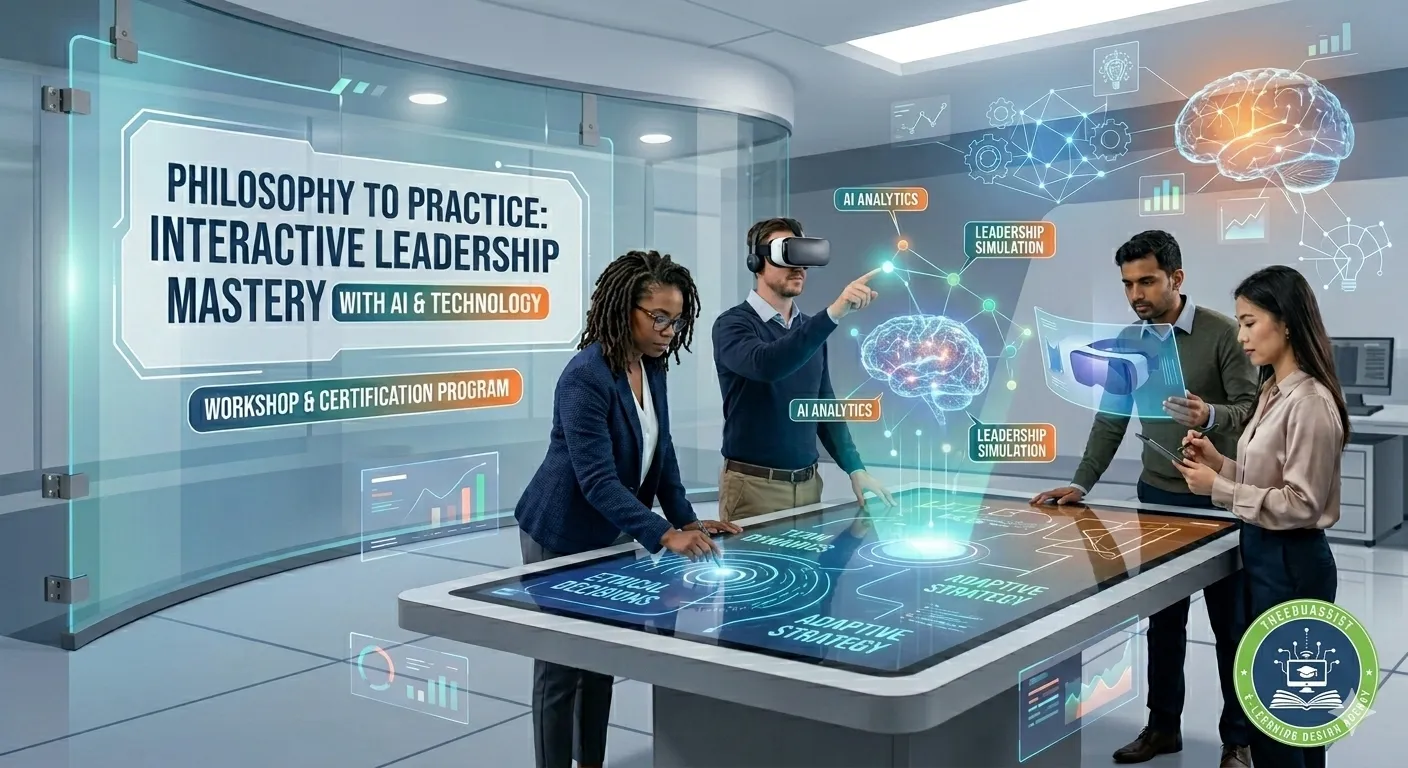
In today’s fast-evolving business landscape, Interactive Leadership has emerged as the most effective way to translate personal leadership philosophies into real-world impact. Leaders no longer succeed by simply sharing ideas from paper they must deliver experiential, engaging programs that combine self-reflection, real-time application, and measurable growth.
At TheEduAssist, we specialize in helping visionary leaders like you move from a written philosophy to powerful, high-engagement training formats: one-on-one coaching, 3-hour group presentations, and multi-session classes. By weaving in AI, cutting-edge technology, and proven interactive components grounded in adult learning principles, these programs deliver transformative results while meeting the demands of modern workplaces in the US and Australia.
Leadership is no longer just about vision and authority; it is increasingly about how leaders interact—with people, systems, and technologies. In the age of AI‑driven work, the bridge between leadership philosophy and daily practice is Interactive Leadership: a style grounded in shared participation, open communication, and co‑creation of value. When combined with AI and immersive technologies, Interactive Leadership evolves from a nice‑to‑have mindset into a measurable, scalable capability that organizations can teach, track, and refine.
What is Interactive Leadership?
Interactive Leadership is a people‑centric leadership style in which leaders emphasize collaboration, information‑sharing, and empowerment rather than top‑down control. Classical work by Judy Rosener highlights its core traits:
- Encouraging participation in decisions and work processes.
- Sharing power and information widely.
- Building others’ self‑worth and excitement about their work.
In modern terms, this translates into inclusive decision‑making, psychological safety, and the ability to draw insights from diverse stakeholders before acting. Interactive leaders listen actively, co‑design solutions, and treat followers as partners, not just subordinates.
From Philosophy to Practice
A leadership philosophy often starts with abstract values trust, transparency, empowerment but Interactive Leadership turns those values into concrete behaviors. Organizations now operationalize this philosophy through:
- Simulation‑based exercises: leaders step into realistic scenarios (e.g., conflict, change, or crisis) and practice interactive behaviors such as asking open questions, inviting input, and testing alternatives.
- Feedback loops: sessions are recorded and reviewed, enabling leaders to see how their tone, body language, and inclusive habits affect others; coaches then link these observations directly back to the original leadership philosophy.
In this way, Interactive Leadership becomes a repeatable practice: leaders learn to:
- Pose questions before giving answers.
- Delegate decision‑making authority along with context.
- Reward collaboration, not just individual performance.
AI as a Coaching Partner:
Artificial intelligence is transforming how Interactive Leadership is taught and reinforced. AI‑powered platforms now:
- Offer real‑time feedback on tone, clarity, and empathy during coaching or role‑play conversations.
- Use dynamic role‑play avatars to simulate employees, stakeholders, or customers, allowing leaders to practice interactive behaviors in safe, repeatable environments.
Beyond training, AI supports day‑to‑day Interactive Leadership by:
- Surfacing team sentiment and engagement data, helping leaders adjust their interaction style timely.
- Recommending collaborative actions for example, nudging a leader to invite quieter members into a discussion or to redistribute tasks to build others’ capabilities.
In short, AI becomes a “mirror” and “coach” that helps leaders align daily decisions with their interactive leadership philosophy.
Interactive Leadership in Human–AI Teams:
As organizations deploy AI systems, leadership must mediate the relationship between humans and machines. Research frameworks show that leadership shapes four key axes of human–AI interaction: trust, transparency, ethics, and shared control. An Interactive Leadership approach in this context means:
- Co‑design: involving both technical teams and end users in AI system design.
- Transparency: explaining how AI models work and why certain decisions are made.
- Shared accountability: positioning leaders as facilitators who balance algorithmic outputs with human judgment.
Such leaders do not treat AI as a black‑box tool to command, but as a collaborative partner whose outputs are discussed, challenged, and refined exactly the dialogic spirit that defines Interactive Leadership.
Immersive Technologies and Experiential Learning:
Interactive Leadership thrives when learning is experiential, not just theoretical. Virtual reality (VR) and immersive learning platforms now:
- Create high‑fidelity simulations of team conflicts, negotiations, and change‑management scenarios.
- Track engagement metrics, decision‑making patterns, and communication styles, linking them to interactive‑leadership competencies such as empathy, inclusiveness, and adaptability.
For example, a leader might navigate a simulated merger in VR, experimenting with different participatory strategies—such as holding inclusive town halls or forming cross‑functional design teams then see how each approach affects virtual “team morale” and performance. This immediate feedback loop turns Interactive Leadership from an abstract ideal into a data‑informed practice.
Why Interactive Leadership Matters More Than Ever in 2026?
Traditional lecture-style leadership training often fails to create lasting behavior change. Interactive Leadership, by contrast, emphasizes active participation, immediate application, and personalized feedback methods proven to boost retention and performance.
Research shows that when leaders engage in experiential learning role-plays, simulations, group challenges, and 360-degree feedback they see significantly higher improvements in self-awareness and effectiveness. Programs that combine 360 feedback with structured action planning and coaching can increase leadership performance by up to 60% according to follow-up ratings from colleagues.
In 2026, the rise of hybrid and remote teams has made Interactive Leadership essential. Leaders must master facilitation in both in-person and virtual settings, using technology to create immersive experiences that feel personal even at scale.
Market Demand for Interactive Leadership in the US and Australia:
The demand for high-quality, technology-enhanced leadership development is surging in both markets.
United States:
The US leadership development program market is valued at approximately USD 7.22 billion in 2025 and is projected to reach USD 13.18 billion by 2035, growing at a CAGR of 6.2%. North America continues to dominate global spending, driven by tech, finance, healthcare, and professional services sectors that prioritize future-ready leaders skilled in AI collaboration and inclusive decision-making.
Key demographics include mid-level managers and emerging leaders (the largest segment), C-suite executives focused on succession planning, and Millennials/Gen Z moving rapidly into leadership roles. Women now hold about 46% of manager positions but remain underrepresented at senior levels, creating strong demand for inclusive Interactive Leadership programs.
Australia:
Australia’s corporate leadership training market is experiencing even faster growth. Valued at USD 1,561.6 million in 2025, it is forecast to reach USD 2,923.8 million by 2032 at a robust CAGR of 9.37%. The broader leadership development segment is expected to grow from USD 1.46 billion in 2025 to USD 3.22 billion by 2035 (8.2% CAGR).
Australian organizations face skills shortages, high middle-manager burnout (44% report frequent burnout), and a push for culturally aware, resilient leadership. Demand is especially strong among large enterprises and SMEs seeking blended, technology-enhanced programs that deliver measurable ROI through 360 feedback and interactive formats.
Turning Your Leadership Philosophy into Interactive Leadership Programs:
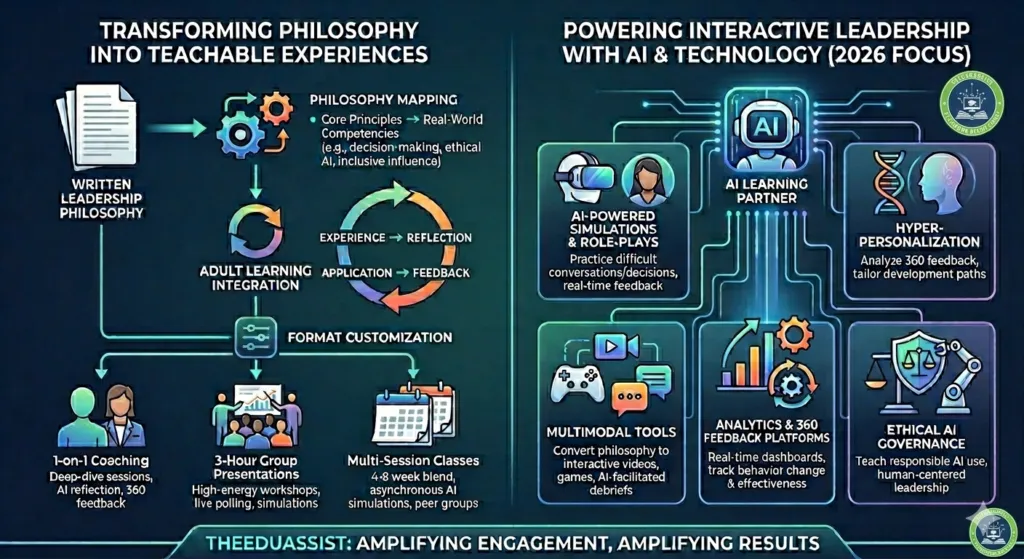
You’ve already written your philosophy on paper. The challenge is turning it into teachable, repeatable experiences. Here’s how TheEduAssist designs Interactive Leadership programs that make your unique philosophy come alive:
- Philosophy Mapping We extract core principles and map them to real-world leadership competencies (e.g., decision-making under uncertainty, inclusive influence, ethical AI use).
- Adult Learning Integration Every module follows proven principles: experience → reflection → application → feedback.
- Format Customization:
- 1-on-1 Coaching: Deep-dive personalized sessions using AI-powered reflection tools and 360 feedback.
- 3-Hour Group Presentations: High-energy interactive workshops with live polling, breakout simulations, and immediate application exercises.
- Multi-Session Classes: 4–8 week programs blending live sessions, asynchronous AI simulations, and peer accountability groups.
Powering Interactive Leadership with AI & Technology
2026 is the year AI moves from content creator to active learning partner. In Interactive Leadership programs designed by TheEduAssist, we integrate:
- AI-Powered Simulations & Role-Plays: Leaders practice difficult conversations or strategic decisions with AI coaches that provide real-time feedback.
- Hyper-Personalization: AI analyzes 360 feedback and learning data to tailor development paths to each participant’s strengths and gaps.
- Multimodal Tools: Convert philosophy statements into interactive videos, scenario-based games, or AI-facilitated team debriefs.
- Analytics & 360 Feedback Platforms: Real-time dashboards track behavior change and program effectiveness.
- Ethical AI Governance: Modules teach leaders how to use AI responsibly while maintaining human-centered leadership.
These tools don’t replace the facilitator they amplify engagement and scale impact across formats.
Proven Benefits of Interactive Leadership Programs
Organizations investing in well-designed Interactive Leadership see:
- Higher employee engagement and lower turnover
- Faster leadership pipeline development
- Improved team performance through better communication and decision-making
- Measurable ROI via pre/post 360 assessments and program evaluation
Leaders report greater confidence, clearer purpose alignment, and the ability to translate philosophy into daily practice exactly what you want when teaching others.
Conclusion:Ready to Bring Your Leadership Philosophy to Life?
Interactive Leadership is no longer a nice-to-have—it’s the standard for forward-thinking organizations in the US and Australia. By combining your authentic philosophy with AI, technology, and truly interactive experiences, you can create training that doesn’t just inform—it transforms.
At TheEduAssist, we partner with leadership consultants, HR professionals, and visionary executives to design and deliver custom Interactive Leadership programs tailored to your exact philosophy and delivery preferences (1-on-1, 3-hour workshops, or full classes).
Whether you’re in Lahore preparing to serve clients globally or already targeting US and Australian markets, we provide end-to-end support: curriculum design, technology integration, facilitator training, and program evaluation.
Take the next step today.
Contact TheEduAssist to schedule a discovery call. Let’s turn your written leadership philosophy into powerful, AI-enhanced Interactive Leadership experiences that leaders will remember and apply for years to come.
TheEduAssist Empowering leaders through smarter, more interactive training solutions.
References:
https://finance.yahoo.com/news/leadership-development-program-market-reach-140000488.html
https://www.researchgate.net/publication/277010728_Leveraging_the_impact_of_360-degree_feedback
https://www.skillshub.com/blog/trends-in-professional-development
https://www.expertmarketresearch.com/reports/united-states-leadership-development-program-market
https://www.kenresearch.com/australia-executive-education-and-ld-market
Frequently Asked Questions (FAQs)
What is Interactive Leadership?
Interactive Leadership is an experiential approach to leadership development that emphasizes active participation, real-time application, simulations, and personalized feedback instead of traditional lectures. It combines your unique leadership philosophy with AI tools, technology, and interactive elements to create engaging and effective training programs.
Who is this Interactive Leadership training designed for?
This training is ideal for mid-level managers, emerging leaders, senior executives, and HR/L&D professionals in the US and Australia. It suits organizations seeking modern, technology-enhanced leadership development that delivers measurable results through 360 feedback and practical application.
What formats are available for Interactive Leadership programs?
Programs can be delivered in three main formats:
- 1-on-1 Coaching: Personalized deep-dive sessions with AI-powered tools and 360 feedback.
- 3-Hour Group Presentations: High-energy interactive workshops with live polling and simulations.
- Multi-Session Classes: In-depth 4–8 week programs combining live sessions with asynchronous AI activities.
How does AI enhance Interactive Leadership training?
AI is used for realistic role-play simulations, hyper-personalized learning paths based on 360 feedback, real-time analytics, and automated scenario-based exercises. This makes Interactive Leadership programs more engaging, scalable, and effective at driving behavior change.
Do I need technical skills to run Interactive Leadership programs?
No advanced technical skills are required. TheEduAssist provides full support including curriculum design, technology integration, facilitator training, and ready-to-use tools so you can focus on delivering your leadership philosophy confidently.
How can TheEduAssist help me develop my Interactive Leadership programs?
TheEduAssist offers end-to-end support — from mapping your written philosophy into structured content, designing interactive modules, integrating AI and technology, to program evaluation and 360 feedback implementation. We help create professional programs tailored for the US and Australian markets.
What results can participants expect from Interactive Leadership training?
Participants typically experience improved self-awareness, stronger communication and decision-making skills, higher confidence, and the ability to apply leadership philosophy in daily practice. Organizations benefit from better engagement, faster leadership pipeline development, and measurable ROI through pre/post assessments.
Is Interactive Leadership suitable for both in-person and virtual delivery?
Yes. Interactive Leadership programs are designed to work effectively in both in-person and hybrid/virtual environments using technology tools that maintain high engagement regardless of format.
Authored By: Atiqa Sajid http://www.linkedin.com/in/atiqa-sajid-747b57137