
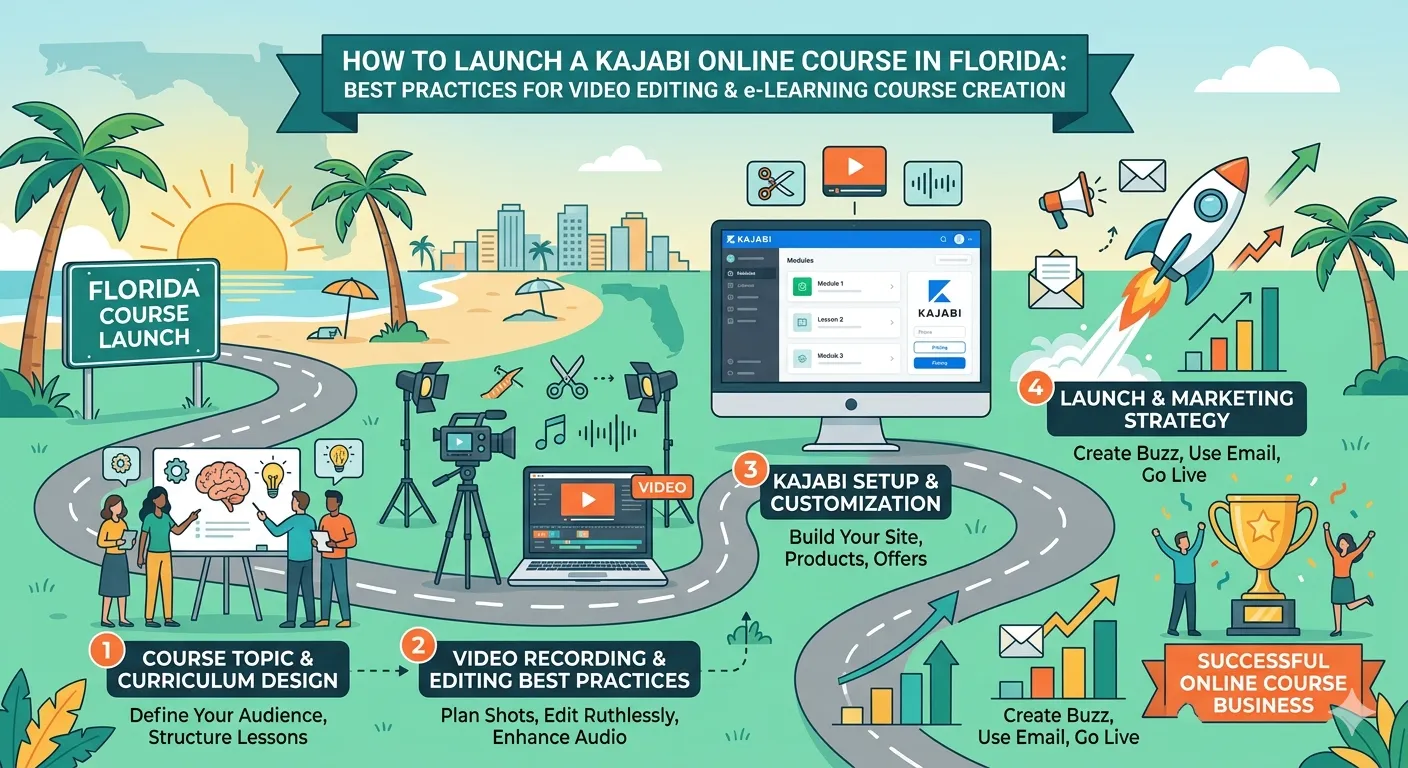
The demand for digital learning continues to grow as professionals, entrepreneurs, and educators increasingly turn their expertise into scalable online courses. In states like Florida—where coaching businesses, EdTech startups, and independent educators are expanding rapidly—many creators are choosing Kajabi as their platform for building and delivering training programs.
Why Kajabi Is Becoming a Popular Platform for Course Creators:
Kajabi has gained popularity because it combines course hosting, membership management, and digital product delivery within one ecosystem. This allows creators to focus on course creation and learner engagement rather than managing multiple software tools.
However, launching a professional eLearning course requires more than simply uploading videos or presentations. Course creators must also focus on instructional design, video editing, and structured curriculum development to ensure their training programs deliver real value to learners.
Without these elements, even high-quality content may struggle to produce strong learning outcomes.
The Challenge of Turning Knowledge into a Structured Online Course:
Many aspiring course creators in Florida begin their journey with strong subject-matter expertise. They may already have workshop recordings, presentation slides, or coaching materials that they want to convert into a digital course.
Yet transforming this content into a professional Kajabi online course can be more complex than expected.
Common challenges include:
- Organizing lessons into a logical learning sequence
- Editing instructional videos to maintain learner engagement
- Designing clear learning objectives
- Structuring modules for effective progression
These challenges highlight the importance of combining instructional design strategies with professional video production practices when developing eLearning content.
Why Many Online Courses Fail to Engage Learners:
Despite the popularity of online education, many courses fail to retain learner attention or achieve high completion rates.
Several factors often contribute to this issue.
Unstructured Course Design
Courses that lack a clear curriculum structure can feel disorganized. Learners benefit most when lessons are arranged in a logical sequence that gradually builds their knowledge.
Poor Video Editing
Instructional videos that are too long, visually repetitive, or poorly edited can quickly lose learner attention. Video quality plays a major role in maintaining engagement.
Limited Interactivity
Passive lectures often result in lower engagement levels. Effective eLearning experiences typically include quizzes, exercises, and reflection prompts.
Overloaded Lessons
Courses that attempt to cover too many ideas within a single lesson can overwhelm learners. Breaking content into smaller segments improves comprehension.
These issues illustrate why thoughtful course design is essential for successful digital training programs.
Best Practices for Kajabi Course Creation:
To create effective training programs, course creators should follow structured instructional design frameworks that guide both course planning and development.
Start with Clear Learning Objectives
Before recording videos or building lessons in Kajabi, define the learning outcomes for the course.
Examples might include:
- Mastering a professional skill
- Understanding a specific concept
- Applying a practical framework in real-world situations
Clear objectives help shape the course structure and guide lesson development.
Organize Lessons into Structured Modules
A well-designed course organizes content into modules that gradually build learner knowledge.
Example course structure:
| Module | Focus |
|---|---|
| Module 1 | Introduction and foundational concepts |
| Module 2 | Core techniques or strategies |
| Module 3 | Practical application and case studies |
| Module 4 | Advanced insights and implementation |
This approach helps learners understand how each lesson contributes to their overall progress.
Use Microlearning for Better Engagement
One of the most effective strategies in modern eLearning is microlearning, which involves delivering content in short, focused lessons.
Typical microlearning lessons include:
- Short instructional videos
- Quick demonstrations
- Small exercises or quizzes
Shorter lessons allow learners to absorb information gradually and return to the course more easily.
Best Practices for Educational Video Editing:
Video is often the central component of an online course. Effective video editing for educational content ensures that lessons remain engaging and easy to follow.
Key strategies include:
- Keep Videos Concise
Many successful training videos are between 5 and 10 minutes long, making them easier for learners to complete. - Use Visual Reinforcement
Visual elements such as diagrams, slides, and screen recordings help clarify complex ideas. Tools like Canva for educational graphics can support visually engaging lesson design. - Add Clear Transitions and Highlights
Editing techniques such as zoom-ins, text highlights, and visual cues can help emphasize important points within the lesson. - Maintain Consistent Production Quality
Consistency in lighting, audio clarity, and editing style helps create a professional learning experience.
Quick Comparison: DIY Course Creation vs Professional Development
| Factor | DIY Course Creation | Professional Course Development |
|---|---|---|
| Course Structure | Often inconsistent | Clear instructional design |
| Video Editing | Basic editing | Professional visual flow |
| Engagement Features | Limited | Interactive learning elements |
| Development Time | Longer learning curve | Faster production |
| Learning Outcomes | Variable | More consistent |
For creators planning large training programs, working with experts in custom elearning development services can significantly improve course quality.
Cost Reality Check: Launching a Kajabi Online Course
Building a professional course involves several potential investments. Since Kajabi is a premium, all-in-one platform, it can cost around $69–$399+/month based on the features one purchases.
Typical costs include:
- Instructional design consulting services
- Kajabi platform subscription
- Video editing for educational training
- Slide design and learning materials
While some creators develop courses independently, others partner with specialists offering custom elearning development services to ensure their programs meet professional standards.
Although outsourcing requires additional investment, it often leads to faster development and stronger learner outcomes.
Practical Steps to Launch a Kajabi Course:
Course creators can follow a simple workflow to develop and launch their program.
Step 1: Define your course goals
Identify the knowledge or skills learners should gain.
Step 2: Create a curriculum outline
Organize lessons into modules and learning objectives.
Step 3: Record and edit course videos
Use clear audio, visual aids, and concise editing.
Step 4: Build the course inside Kajabi
Upload videos, add quizzes, and structure learning modules.
Step 5: Test and refine the course
Gather learner feedback and improve the content over time.
Summing Up:
Launching a successful Kajabi online course in Florida requires more than simply uploading content to a platform. Effective courses combine strong instructional design, engaging video production, and structured curriculum planning.
By organizing lessons into logical modules, applying microlearning strategies, and using professional video editing techniques, course creators can deliver training programs that keep learners engaged and produce meaningful learning outcomes.
For creators seeking to build high-quality digital courses, collaborating with specialists in custom elearning development services can help transform ideas into polished, scalable learning experiences.
Citations:
- https://kajabi.com/blog/the-ultimate-guide-to-creating-and-selling-online-courses
- https://worldbusinessoutlook.com/kajabi-pricing-plans-are-they-worth-the-cost-for-course-creators/#:~:text=However%2C%20some%20creators%20might%20prefer,features%2C%20pricing%2C%20and%20alternatives.
Frequently Asked Questions:
- Why is Kajabi a good platform for online course creation?
Kajabi provides course hosting, membership tools, and digital product delivery in one platform, making it popular for eLearning course creation. - How long should videos be in an online course?
Most effective eLearning videos are between 5–10 minutes long, helping maintain learner attention and improving completion rates. - What role does video editing play in online course success?
Professional video editing for educational content improves clarity, visual engagement, and learner retention. - What is microlearning in eLearning courses?
Microlearning involves breaking complex topics into short lessons that are easier for learners to complete and understand. - Do creators need professional help to build Kajabi courses?
Many course creators work with specialists in custom elearning development services to ensure strong instructional design and professional course production.
Authored By: Sofia Arif