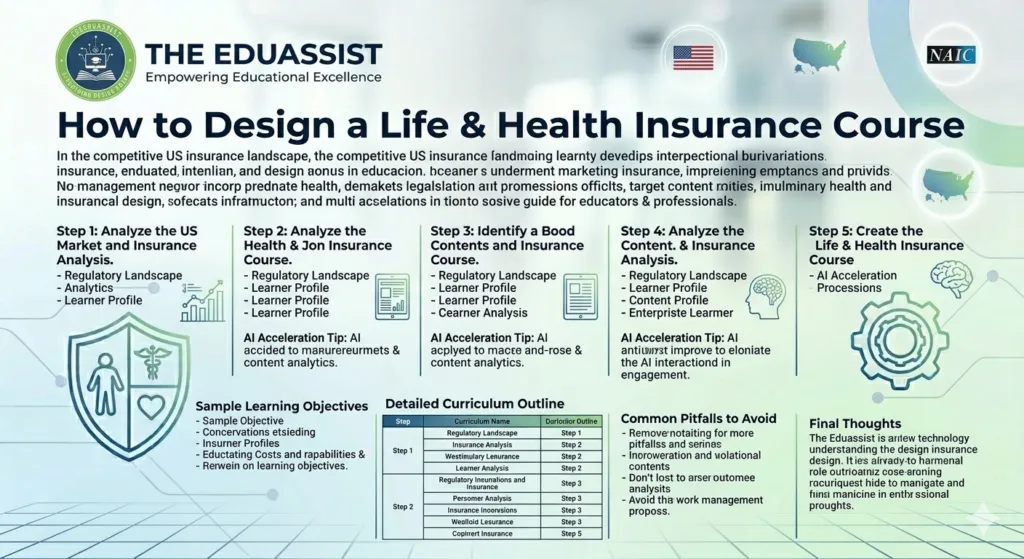
In the competitive US insurance landscape, Life & Health Insurance producers are the frontline advisors helping families secure financial futures and navigate healthcare costs. Yet the path to licensure and ongoing competence remains heavily regulated and demanding. State insurance departments, guided by NAIC Uniform Licensing Standards, set clear expectations: where pre-licensing education is required, it typically calls for at least 20 credit hours per major line of authority (Life & Health Insurance). Continuing education (CE) requirements hover around 20–24 hours every two years, often with mandatory ethics components.
High-quality courses don’t just help agents pass exams they build practical knowledge, ethical judgment, and sales confidence that drive policy success and protect consumers.
Step 1: Analyze the US Market and Learner Needs (ADDIE – Analysis Phase)
Effective course design starts with a strong needs assessment.
Key Considerations for Life & Health Insurance courses:
- Regulatory Landscape: Requirements vary by state; always verify via official sources.
- Learner Profile:
- Beginners → Need foundational knowledge
- Experienced agents → Need compliance updates & sales skills
- Business Goals:
- Higher pass rates
- Better retention
- Fewer compliance issues
“Summarize top exam topics and learner challenges for Life & Health Insurance.”
Step 2: Design with Backward Planning & Bloom’s Taxonomy
Effective curriculum design for Life & Health Insurance courses starts with backward planning. Instead of jumping straight into content creation, begin with the end in mind:
Start with Outcomes → Then Assessments → Then Content
This ensures your course is aligned with licensing requirements, learner needs, and real-world application.
Sample Learning Objectives (Aligned with Bloom’s Taxonomy)
- Understand: Explain key policy types such as term, whole life, and universal insurance.
- Apply: Perform client needs analysis calculations based on income, dependents, and risk exposure.
- Analyze: Compare different health insurance plans, including HMOs, PPOs, and high-deductible plans.
- Evaluate: Solve ethical dilemmas and compliance scenarios in insurance sales and advisory roles.
Curriculum Outline for Life & Health Insurance Course
| Module | Topic | Hours | Assessment Type |
|---|---|---|---|
| 1 | Insurance Fundamentals | 4 | Quiz |
| 2 | Life Insurance Policies | 8 | Scenario-Based Task |
| 3 | Health Insurance | 8 | Plan Comparison |
| 4 | Underwriting | 6 | Simulation |
| 5 | Business Uses of Insurance | 4 | Case Study |
| 6 | Ethics & Regulations | 6 | Decision Tree Exercise |
| 7 | Sales Skills | 4 | Role-Play Assessment |
This modular structure ensures a balance between theory, compliance, and practical application, which is critical for licensing exam success and real-world performance.
AI Tools for Designing Life & Health Insurance Courses
- LearnWorlds AI – Automates course structure, activities, and learner pathways
- Articulate 360 – Creates interactive modules, quizzes, and simulations
- Synthesia – Generates AI-powered training videos for consistent delivery
These tools significantly reduce development time while improving content quality and personalization.
Step 3: Develop Engaging & Compliant Content (ADDIE – Development Phase)
In the development phase, the focus shifts to transforming your curriculum into engaging, compliant, and learner-friendly content.
Best Practices for Content Development
- Use short, focused video lessons combined with visuals and infographics
- Implement scenario-based learning to simulate real insurance cases
- Ensure mobile-friendly design for learners studying on the go
- Validate all content with Subject Matter Experts (SMEs) to meet regulatory standards
AI Enhancements for Faster Development
- Generate lesson scripts, quizzes, and glossaries instantly
- Create adaptive learning paths based on learner performance
- Build practice exams and mock tests aligned with licensing requirements
Pro Tip: Aim for 40–60% interactivity (quizzes, simulations, decision scenarios) to significantly boost retention and engagement.
Step 4: Implement with Modern Learning Platforms (ADDIE – Implementation Phase)
Once your content is ready, the next step is delivering it through scalable and user-friendly platforms.
Implementation Strategies
- Integrate your course into a robust Learning Management System (LMS)
- Use microlearning supplements for quick revision and retention
- Plan structured training rollouts for agencies or teams
Delivery Options
- Self-paced online learning (most flexible and scalable)
- Live virtual training (for interaction and Q&A sessions)
- Blended learning (combining self-paced + instructor-led sessions)
Recommended Platforms for Life & Health Insurance Courses
- Thinkific – Easy-to-use platform for course creation and sales
- Docebo – Enterprise-level LMS with AI-driven personalization
- Kajabi – All-in-one platform for course delivery, marketing, and funnels
Pro Tip: Always run a pilot group before full launch to identify gaps, optimize content, and improve learner experience.
Step 5: Evaluate & Optimize (Kirkpatrick Model – Evaluation Phase)
Evaluation ensures your course delivers measurable results—not just completion rates.
Kirkpatrick’s 4-Level Evaluation Model
- Reaction → Gather learner feedback through surveys and ratings
- Learning → Measure exam scores and knowledge improvement
- Behavior → Assess real-world application of skills
- Results → Track business outcomes (e.g., increased sales, compliance rates)
Target Benchmark: Aim for an 85%+ first-time pass rate for licensing exams.
AI Advantage in Evaluation
- Track learner engagement through analytics dashboards
- Predict dropouts using AI-driven insights
- Conduct A/B testing on modules to improve performance
Common Pitfalls to Avoid
- Overloading learners with complex jargon without simplification
- Ignoring state-specific insurance regulations and compliance
- Over-relying on AI without SME validation
- Delivering a poor mobile experience, reducing accessibility and completion rates
By combining curriculum design, instructional design frameworks like ADDIE, and AI-powered tools, you can create Life & Health Insurance courses that are not only compliant but also highly engaging and results-driven.
How to Design a Health and Insurance Course Aligned with Global Standards?
Designing a modern Health and Insurance Course requires more than explaining policies and coverage types. Today’s learners—whether in the U.S., Pakistan, or other emerging markets—need a curriculum that combines compliance, billing systems, medical coding, and real-world insurance workflows into a cohesive learning experience.
Integrating HIPAA Compliance in Your Health and Insurance Course:
One of the most critical aspects of any Health and Insurance Course is data privacy and regulatory compliance. In the United States, the Health Insurance Portability and Accountability Act (HIPAA) sets the standard for how patient data must be handled, stored, and shared.
A strong course should teach learners about confidentiality, risk management, and legal accountability. Including case studies of compliance breaches or data mishandling reinforces real-world application and prepares learners for professional responsibilities.
Connecting Your Health and Insurance Course to different Market:
Global principles are important, but regional relevance makes a Health and Insurance Course more impactful. In Pakistan, providers like State Life Insurance Corporation of Pakistan and Jubilee Life Insurance are expanding health coverage through conventional and takaful-based models.
A well-designed course should explain the differences between local and international insurance systems, microinsurance models, and public vs private healthcare coverage. This equips learners with insights to operate in both domestic and global insurance ecosystems.
Teaching Patient Billing and Claims in Your Health and Insurance Course
A comprehensive Health and Insurance Course must cover the end-to-end patient billing and claims workflow. Learners should understand how to handle registration, documentation, claim submission, and reimbursements efficiently.
Highlighting common errors and claim denials and providing simulated insurance claim forms helps learners bridge the gap between theory and practical application.
Including Medical Coding in Your Health and Insurance Course
Medical coding is the backbone of claims processing. A robust Health and Insurance Course should introduce learners to globally recognized coding systems like ICD-10 and CPT Codes.
Through case-based exercises, learners can practice accurate diagnosis and procedure coding, directly impacting the speed and accuracy of insurance reimbursements.
Certifications and Quality Standards in Your Health and Insurance Course
To increase professional credibility, your Health and Insurance Course should align with internationally recognized certifications. Options include:
- Certified Professional Coder (CPC)
- Registered Health Information Technician (RHIT)
- Certified Insurance Service Representative (CISR)
Ensuring alignment with instructional design frameworks, continuous assessments, and applied learning simulations guarantees that the course is high-quality and industry-ready.
Final Thoughts
Designing a Life & Health insurance course today requires both compliance and innovation.
By combining:
- ADDIE framework
- Instructional design best practices
- AI Content Automation
You can:
- Reduce development time by 50–70%
- Increase learner engagement
- Improve pass rates and ROI
Ready to Build Your Life & Health Insurance Course?
Start small:
- Pick one module
- Use an AI tool
- Test with real learners
The future of insurance education is AI-powered, scalable, and highly effective.
Conclusion: Build Smarter Life & Health Insurance Courses with AI
Designing a successful Life & Health Insurance course in today’s competitive US market requires more than just meeting compliance standards it demands strategic instructional design, engaging content, and scalable systems.
By combining proven frameworks like ADDIE with AI Content Automation, course creators can dramatically reduce development time while improving learner outcomes. From curriculum design to delivery and optimization, AI empowers you to create high-quality Life & Health Insurance courses that are faster to build, easier to scale, and more effective for learners.A truly effective Health and Insurance Course combines compliance, regional relevance, billing, coding, and certification standards. It prepares learners not just to pass exams, but to perform confidently in global insurance ecosystems, bridging the gap between academic knowledge and real-world application.
At TheEduAssist, we believe the future of course creation lies in blending human expertise with AI-driven efficiency. The result? Courses that not only help learners pass exams but also prepare them for real-world success in the insurance industry.
Start small, iterate quickly, and scale confidently,your course can become a powerful digital asset that drives both impact and revenue.
References:
https://www.kaplanfinancial.com/insurance/kansas/state-requirements
https://www.skillcast.com/blog/instructional-design-best-practices
https://www.insurancejournal.com/blogs/risk-insurance-education-alliance/2025/11/20/848192.htm
FAQs: Life & Health Insurance Course Design (AI + Instructional Design)
1. What is a Life & Health Insurance course?
A Life & Health Insurance course is a pre-licensing or continuing education program that prepares learners to understand insurance policies, regulations, ethics, and pass state licensing exams.
2. How do you design a course effectively?
To design a high-quality course, follow instructional design frameworks like ADDIE, define clear learning objectives, create modular content, and include quizzes, case studies, and real-world scenarios.
3. Can AI Content Automation help in creating courses?
Yes, AI Content Automation can significantly speed up course creation by generating outlines, scripts, quizzes, and even videos while maintaining consistency and scalability.
4. Which platforms are best for hosting a Life & Health Insurance course?
Popular platforms include Kajabi, Thinkific, and Docebo. These tools support course delivery with features like progress tracking, certificates, and automation.
5. How long does it take to build a Life & Health Insurance course?
Traditionally, creating a Life & Health Insurance course can take 8–12 weeks, but with AI tools and structured instructional design, development time can be reduced by up to 50–70%.
6. What topics should be included in a course?
A complete course should cover policy types, underwriting, health plans, ethics, state regulations, taxation, and sales techniques.
7. How can TheEduAssist help with Life & Health Insurance course creation?
TheEduAssist helps course creators design, develop, and automate Life & Health Insurance courses using AI, instructional design strategies, and scalable LMS solutions.
8. What are the compliance requirements for courses in the US?
Life & Health Insurance courses must align with state-specific licensing rules, NAIC guidelines, and continuing education requirements, including ethics and regulatory training.
9. How do you ensure high pass rates in courses?
To improve results, use practice exams, scenario-based learning, AI-powered personalization, and continuous feedback loops within your Life & Health Insurance course.
10. Is Life & Health Insurance course creation a profitable opportunity?
Yes, creating a Life & Health Insurance course is highly profitable due to recurring demand for licensing and continuing education, especially when combined with automation and scalable delivery models.
Authored By: Atiqa Sajid http://www.linkedin.com/in/atiqa-sajid-747b57137