In today’s digital workplace, executive assistants play a strategic role in supporting leadership, managing workflows, and coordinating business operations. To prepare them for these evolving responsibilities, organizations need professionally designed training programs built using instructional system design and modern eLearning strategies.
A skilled instructional designer can transform complex workplace knowledge into engaging, interactive, and technology-driven learning experiences. Through videos, slides, and a structured module, executive assistants can develop the skills needed to excel in modern corporate environments.
This guide explains what instructional designers do, how training modules are developed, and why organizations invest in instructional design services to train tech-savvy executive assistants.
What Do Instructional Designers Do in Executive Assistant Training?
Many organizations ask, “What do instructional designers do?”
An instructional designer is responsible for creating structured learning experiences that improve knowledge retention, job performance, and learner engagement. Using research-based instructional strategies, designers build training that aligns with workplace goals and learner needs.
Their responsibilities include:
- Conducting learning needs analysis
- Designing course outlines and learning objectives
- Creating an instructional design storyboard plan
- Developing interactive eLearning content
- Producing training videos and slides
- Evaluating learning performance and outcomes
Through specifically designed instruction, executive assistants can quickly learn practical workplace skills.
Understanding Instructional Design:
Instructional system design is the systematic process of developing educational and training materials in a way that ensures effective learning outcomes. It involves analysing learners’ needs, defining learning objectives, and designing instructional materials that help learners acquire knowledge and practical skills. In modern instructional design courses and corporate training programs, this process is used to create structured learning experiences that are both engaging and measurable.
According to the Association for Educational Communications and Technology (AECT), effective instructional design integrates principles from cognitive psychology, educational theory, and proven teaching strategies to create meaningful learning experiences. This approach is widely used in eLearning development, corporate training, and custom eLearning course development to ensure that learners achieve clear performance outcomes.
In the context of training tech-savvy executive assistants, instructional design helps transform complex professional tasks into structured learning modules that include videos, interactive slides, and real-world scenarios.
Key Principles of Instructional Design:
Effective instructional design services rely on several core principles that guide the creation of impactful training modules.
Learner-Centered Approach:
A learner-centered approach is fundamental in specifically designed instruction. Training programs should prioritize the needs, experience levels, and learning preferences of adult learners. Executive assistants often learn best when training is practical, scenario-based, and directly connected to workplace responsibilities. Instructional designers must therefore tailor learning materials to ensure relevance, engagement, and real-world application.
Interactive Content:
Interactive learning plays a critical role in electronic learning environments. Incorporating elements such as quizzes, simulations, and multimedia presentations increases engagement and supports deeper understanding.
Research by Prince (2004) highlights that active learning strategies significantly improve knowledge retention and learner engagement. By involving learners in activities rather than passive content consumption, training programs become more effective and memorable.
Clear Learning Objectives:
One of the most important steps in instructional system design is defining clear learning objectives.
Many organizations ask:
- What is a learning objective?
- What are the objectives of learning?
- How to write a learning objective?
Learning objectives describe what learners should know or be able to do after completing a training module. When objectives are specific and measurable, they help learners understand expectations and allow instructors to evaluate learning outcomes effectively.
Example Learning Objective:
Learners will be able to manage executive calendars, coordinate meetings, and organize digital documentation using modern productivity tools.
Feedback and Assessment:
Continuous feedback is essential in instructional design courses and professional training programs. Assessments allow instructors to measure learner progress and reinforce understanding.
Research by Hattie & Timperley (2007) demonstrates that timely and constructive feedback significantly improves learning outcome. Incorporating quizzes, performance tasks, and reflective activities helps learners consolidate knowledge and apply new skills effectively.
Developing Training Modules for Executive Assistants:
When designing training modules for executive assistants, instructional designers should focus on developing core professional competencies that support executive leadership and organizational productivity.
Communication Skills:
Effective communication is a critical skill for executive assistants. Training modules should cover:
- Professional written communication
- Email and report writing
- Active listening techniques
- Business etiquette and communication protocols
Strong communication training enables assistants to interact confidently with executives, clients, and stakeholders.
Technology Proficiency:
Modern executive assistants must be comfortable using a wide range of digital tools. Training modules should therefore include instruction on:
- Productivity software and office applications
- Data management systems
- Virtual collaboration platforms
- Digital workflow tools
Integrating technology training ensures that executive assistants remain efficient and adaptable in digitally driven workplaces.
Time Management and Organization:
Executive assistants often manage multiple priorities simultaneously. Instructional design modules should teach strategies such as:
- Task prioritization frameworks
- Calendar and meeting management
- Workflow planning techniques
- Organizational productivity tools
These skills allow assistants to support executive leadership more effectively and maintain smooth operational workflows.
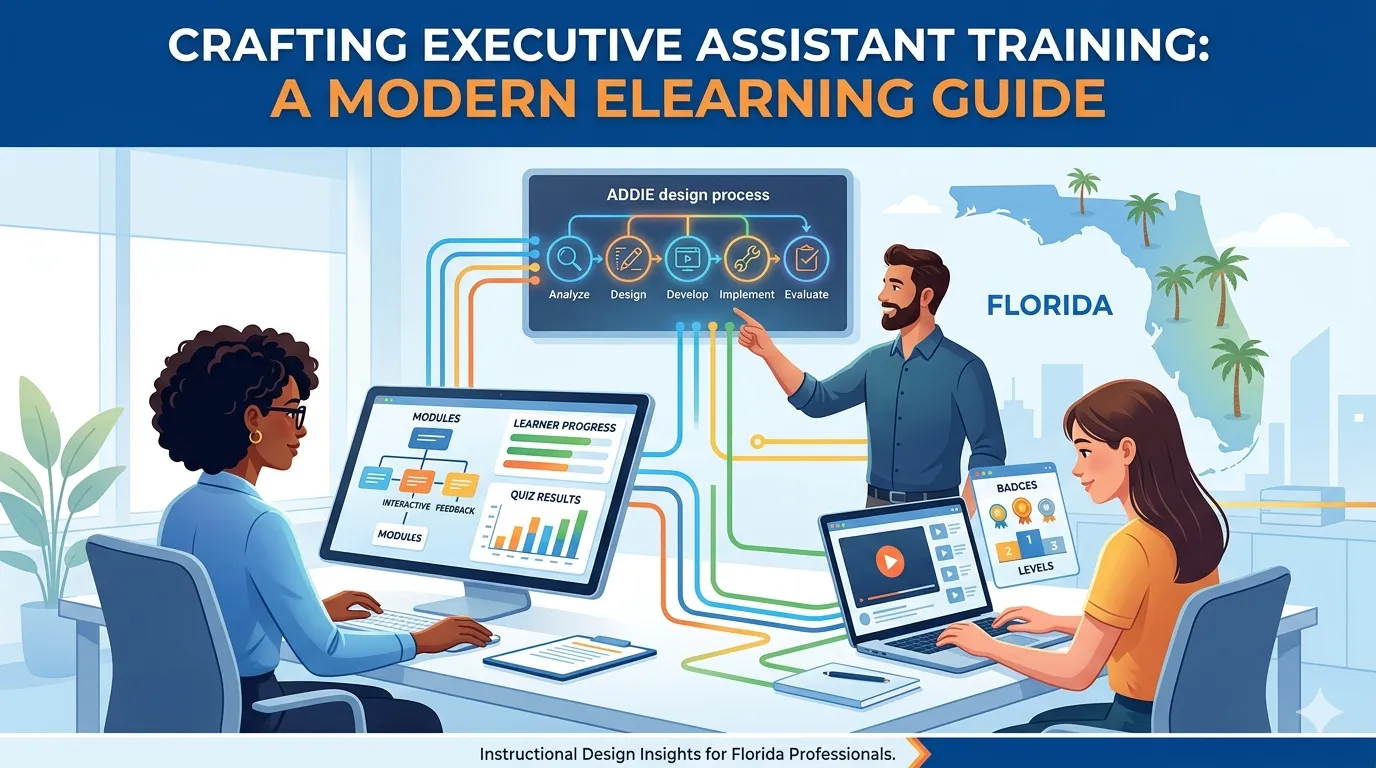
The instructional system design process typically includes:
1. Analysis
- Identify training needs
- Understand learner profiles
- Determine workplace skill gaps
2. Design
- Create a course outline
- Define terminal learning objectives
- Develop instructional design storyboards
3. Development
- Produce videos, slides, and interactive content
- Build digital learning modules
4. Implementation
- Deliver training via microlearning platforms or LMS systems
5. Evaluation
- Measure learning retention and performance outcomes.
This systematic approach ensures that executive assistants receive high-quality tech-enhanced learning experiences.
Key Components of an Executive Assistant Training Course:
A successful instructional design course or corporate training program includes several learning formats to support different learning styles.

1. Interactive eLearning Modules:
Modern electronic learning programs combine multimedia content with real-world scenarios.
Topics may include:
- Executive communication strategies
- Calendar and meeting coordination
- Digital productivity tools
- Project management support
- Confidential information handling
Interactive quizzes and scenario-based learning improve learning retention and engagement.
2. Video-Based Learning:
Training videos help demonstrate real workplace situations and improve understanding.
Examples include:
- Professional communication demonstrations
- Workflow automation tutorials
- Virtual meeting coordination
- Executive task management strategies
Organizations often integrate full-service video production into training programs to enhance learner engagement.
3. Slide-Based Microlearning:
Short visual presentations break down complex information into easy-to-understand lessons.
Slides may cover:
- Digital collaboration tools
- Organizational workflow systems
- Professional etiquette and communication
- Problem-solving frameworks
Microlearning slides support quick skill development for busy professionals.
The Importance of Learning Objectives in Training Design:
Clear learning goals are essential in professional training programs.
Many organizations ask:
- What is a learning objective?
- What are the objectives of learning?
- How to write a learning objective?
A strong learning objective describes what learners will know or be able to do after training.
Example:
Terminal Learning Objective:
Executive assistants will be able to manage executive calendars, coordinate meetings, and prioritize administrative tasks using digital productivity tools.
Well-written learning objectives guide the entire instructional design course development proces.
Tools Used in eLearning Development:
Modern eLearning development and custom eLearning course development rely on advanced authoring tools and learning platforms.
Common tools include:
eLearning Authoring Tools
- Articulate Storyline
- Articulate Rise
- Adobe Captivate
- iSpring Suite
- Camtasia
- Elucidat
Learning Management Systems (LMS):
Training programs are often delivered through best LMS platforms, such as:
- Moodle
- Canvas
- TalentLMS
- Docebo
- LearnDash
- Thinkific
- Teachable
These platforms allow organizations to track learner progress and measure training success.
Benefits of Instructional Design Services for Organizations:
Companies invest in instructional design services to build scalable, professional training programs.
Key benefits include:
- Improved Learning Retention:
Interactive content and structured learning pathways improve knowledge retention.
- Consistent Training Experience;
Standardized modules ensure every learner receives the same quality training.
- Faster Skill Development:
Specifically designed instruction allows learners to gain practical skills quickly.
- Scalable Digital Learning:
Organizations can deliver training globally using custom eLearning development services.
Career Path: Masters in Instructional Design:
Professionals interested in designing corporate training programs often pursue a masters in instructional design or masters in training and development.
These programs teach:
- Learning experience design
- Curriculum development
- Educational technology integration
- Research-based instructional strategies
- Digital learning solution development
Graduates can work as:
- Instructional designers
- Learning experience designers
- Learning developers
- Curriculum designers
- Corporate training specialists
Instructional Design Courses for Learning Professionals:
Individuals who want to develop digital learning programs can enroll in instructional design courses.
These courses teach how to:
- Design course outlines and curriculum structures
- Develop instructional design storyboards
- Create custom learning solutions
- Build eLearning content development projects
- Design learning and development strategies
Instructional design courses are ideal for educators, trainers, HR professionals, and content creators.
The Future of Executive Assistant Training:
As workplaces become increasingly digital, executive assistants must adapt to new technologies and workflows.
Future training programs will incorporate:
- AI-powered learning systems
- Personalized learning environments
- Interactive simulations
- Data-driven learning analytics
- Digital collaboration platforms
Through modern instructional system design, organizations can prepare executive assistants to become strategic partners to leadership teams.
Conclusion:
Executive assistant training is evolving rapidly as businesses adopt digital workflows and advanced communication systems. By applying instructional system design principles, organizations can create engaging training programs that develop real-world skills.
Instructional designers play a vital role in this process by creating interactive modules, videos, slides, and structured learning pathways. Through instructional design courses, research-based strategies, and custom eLearning development, training programs can deliver measurable learning outcomes.
Investing in professional instructional design services ensures that executive assistants gain the knowledge, confidence, and technical expertise needed to support modern executives and drive organizational success.
Citation:
- AECT. (2001). The definition of educational technology.https://scholar.google.com.pk/scholar?q=AECT.+(2001).+The+definition+of+educational+technology.+Retrieved+from+AECT&hl=en&as_sdt=0&as_vis=1&oi=scholart. Retrieved from AECT
- Hattie, J., & Timperley, H. (2007). The Power of Feedback. Review of Educational Research, 77(1), 81-112.
- Prince, M. (2004). Does Active Learning Work? A Review of the Research. Journal of Engineering Education, 93(3), 223-231.https://scholar.google.com.pk/scholar?q=Prince,+M.+(2004).+Does+Active+Learning+Work%3F+A+Review+of+the+Research.+Journal+of+Engineering+Education,+93(3),+223-231.&hl=en&as_sdt=0&as_vis=1&oi=scholart
FAQ:
1. What does an instructional designer do for executive assistant training in Florida?
An instructional designer in Florida creates customized training programs for executive assistants, focusing on practical skills, time management, communication, and technology tools. They design interactive eLearning modules that enhance productivity and workplace efficiency for executive assistants in cities like Miami, Orlando, Tampa, and Jacksonville.
2. Why should I hire a Florida-based instructional designer for executive assistant training?
Hiring a local instructional designer ensures that the training content aligns with the specific business culture, industry standards, and compliance requirements in Florida. They can provide tailored solutions for organizations in Fort Lauderdale, Tampa, and Miami, using interactive learning strategies and local case studies.
3. What topics are covered in executive assistant training modules designed by experts?
Florida instructional designers typically cover:
- Calendar management and scheduling
- Business communication and professional etiquette
- Project management and reporting
- Confidentiality and compliance best practices
- Digital tools like Microsoft Office, Google Workspace, and CRM platforms
- Soft skills development, including leadership support and problem-solving
4. Can executive assistant training modules be customized for my business in Florida?
Yes! Instructional designers in Florida specialize in customizing eLearning courses for businesses in Miami, Orlando, and Jacksonville. They create content that matches your company’s workflow, industry, and employee skill levels, ensuring a high return on investment.
5. How long does it take to develop executive assistant training modules in Florida?
The timeline depends on course complexity and company needs. Typically, a well-designed program for executive assistants in Tampa, Fort Lauderdale, or Miami can take 4–8 weeks from needs assessment to final module delivery.
6. Are Florida-based instructional designers experienced in online training for executive assistants?
Absolutely. Many instructional designers in Florida use the latest eLearning platforms, LMS systems, and virtual classroom tools to deliver engaging, on-demand training for executive assistants. This ensures accessibility for teams in Orlando, Jacksonville, and beyond.
7. How can I find a top instructional designer in Florida for executive assistant training?
You can find experts by searching for instructional designers or eLearning specialists in major Florida cities like Miami, Orlando, Tampa, and Fort Lauderdale. Look for professionals with experience in executive assistant training, curriculum design, and measurable learning outcomes.
8. What are the benefits of executive assistant training in Florida?
Organizations in Florida benefit from:
- Enhanced efficiency and productivity of executive assistants
- Improved organizational communication and workflow
- Tailored training that addresses local business practices
- Scalable eLearning programs for multiple locations like Miami, Tampa, and Orlando
9. How much does it cost to hire a Florida instructional designer for executive assistant training?
Costs vary based on course complexity, customization, and delivery method. On average, executive assistant training modules in Florida can range from $3,000 to $15,000, depending on the scope and level of interactivity.
10. Can executive assistant training modules be updated regularly in Florida?
Yes. Instructional designers in Florida design flexible and scalable modules that can be updated as your business processes evolve, ensuring your executive assistants always receive the latest training