
InAnother common complaint in any industry that has not been provided with SETA standards has remained a constant:
People undergo training and get certificates, but they are yet to commence actual employment.
Employers deplore the fact that the applicants lack on-the-job skills that meet the SETA requirements. Students are deceived by the courses that offer them a career, only to get lost and disappointed. Lack of alignment with SETA standards in training providers becomes a problem of credibility, recognition, and compliance, whereas the governments continue to worry about the increasing skills gaps and unemployment levels.
Then what is the failure to match training results with industry-ready skills?
It is not an issue of lack of training; it is an issue of lack of a standardised, quality-assured, industry-aligned training. Here is where SETA standards come in.
There are SETA standards that are there to introduce order, credibility, applicability, and actual deliverables in the process of skills development. But many people still ask:
- What is SETA?
- Why does it matter?
- Is it only for institutions?
- What does it mean to my day-to-day, my career and my self-esteem?
This article does so in a very clear, practical and honest way.
What Is SETA?
SETA is an abbreviation known as the Sector Education and Training Authority.
It is a governmental institution in South Africa that was founded under the Skills Development Act and which has a sole mission:
To have education and training that result in real, employable skills that are in tandem with industry requirements.
Every SETA has its particular economic direction, i. e., education, IT, construction, health, or finance. As opposed to a uniform methodology, SETAs acknowledge that various industries need varying skills, standards, and abilities.
In simple terms:
- SETA interrelates learning and actual work.
- SETA relates training to industry.
- SETA links individuals with opportunity.
What Are SETA Standards?
The standards, structures and quality mandates that control the way training is are called SETA standards.
Training is:
- Designed
- Delivered
- Assessed
- Moderated
- Recognized
Through these standards, training is not haphazard, not obsolete and not unrelated to the workplace.
Without SETA standards:
- Any person could issue certificates.
- There would be a lack of uniformity in skills.
- Qualifications would not be trusted by the employer.
- Learners would feel cheated.
SETA standards safeguard employees, employers and the economy.
What Are the Sources of the SETA Standards?
SETA standards are not arbitrary. They are based on nationally accepted frameworks:
Skills Development Act (SDA)
This act requires systematic skills training to minimise unemployment and enhance productivity.
National Qualifications Framework (NQF)
Identifies level of qualification, credits and learning outcomes.
South African Qualifications Authority (SAQA)
Manages quality control and national fame.
Industry Stakeholders
Individual employers, subject-matter experts, unions, and professional bodies are involved in determining real skill requirements.
This implies that SETA standards are legally based, nationally oriented and industry knowledgeable.
Types of SETA Programmes
They are SETA standards that are used in various learning paths:
Learnerships
- Integrate theory and experience at work.
- Result in nationally qualified competencies.
Skills Programmes
- Brief, intensive training on job skills.
- Perfect for upskilling or reskilling.
Apprenticeships
- Work-based, practical occupational training.
Occupational Qualifications
- Straighthand in line with actual jobs.
- High weightage on practical competence.
Each genre considers the various needs of learners and levels of career development.
Examples of SETAs by Sector
To render this viable, given that industry-specific SETAs are:
- ETDP SETA Education, Training and Development.
- MICT SETA- Media, Information and Communication Technologies.
- CETA -Construction Education and Training.
- FASSET Finance, Accounting and Auditing.
- HWSETA-Health and Social Development.
- MERSETA -manufacturing and engineering.
- BANKSETA -Banking and Financial Services.
Every SETA makes training relevant with respect to real-world sector challenges and demands.
Where we use SETA Standards in eLearning
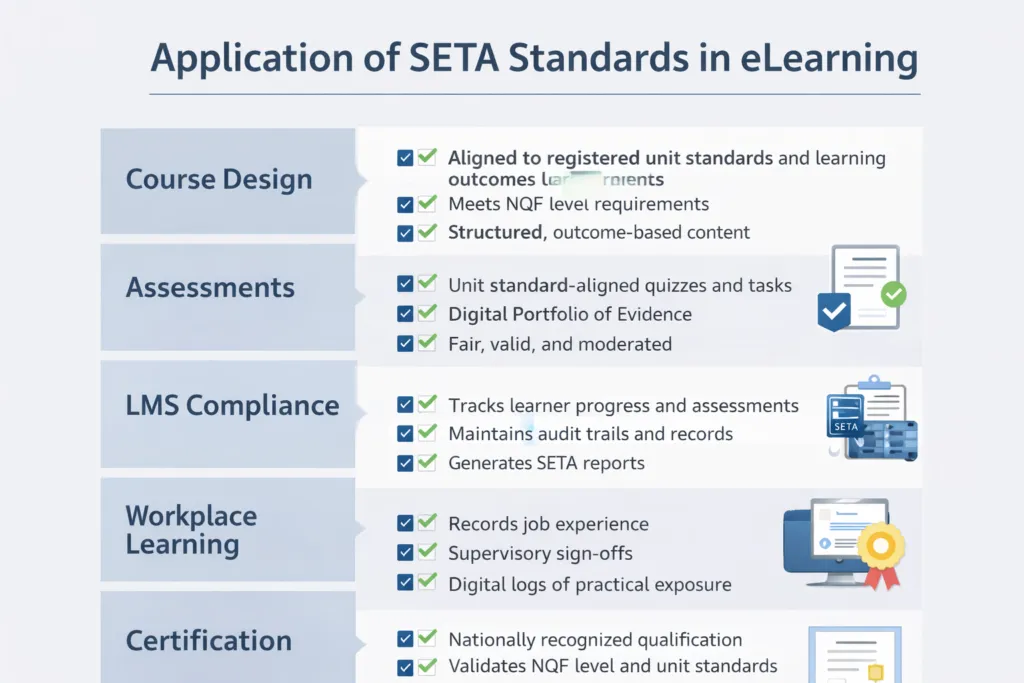
SETA standards are essential in making eLearning credible, compliant, and outcome-driven, and not convenient. They are used throughout the digital learning process, from course design to certification.
eLearning Course Design and Structure
At the course design stage, SETA standards are applied to make sure that the course is aligned with:
- Registered unit qualifications or standards.
- Defined learning outcomes
- Credit values and NQF levels
In eLearning, this means:
- All modules correspond to a particular unit standard outcome.
- The order of the information is not arbitrary.
- Goals of learning are quantifiable and evaluable.
This stops the possibility of having an online course that is badly developed and yet appears professional.
Digital Learning Instructional Design
Even online learning has SETA standards that regulate the development of learning material:
- Outcome-based lessons that are chunked.
- Task-based learning and scenario-based learning.
- Simulations and examples in the industry.
This ensures that eLearning:
- Represents actual work activities.
- Acquires useful mastery, rather than passive observation.
- Passes the criteria of formal accreditation.
Web-Based Tests and Knowledge Examinations
Digital assessment design is highly utilized with the SETA standards:
- Unit standardized online quizzes.
- Evidence provided in the form of practical assignments.
- Simulations and case studies.
- LM submission of Portfolio of Evidence (PoE)
Assessments must be:
- Valid
- Fair
- Reliable
- Moderated
This turns eLearning into watch-and-click learning into verifiable learning.
Learning Management Systems (LMS)

Seta Standards are applied by the use of LMS platforms to control:
- Registrations and enrolment of learners.
- Presence and activity monitoring.
- Assessment submissions
- Storage of evidence and audit trail.
- Compliance- SETA reporting.
An LMS is no longer a content host, but a compliance and quality tool.
Blended Learning Models
eLearning can be used in blended learning environments, where SETA standards permit the combination of:
- Online theory delivery
- Online classes with the instructor.
- Observation at the workplace and learning.
Especially important is this to:
- Learnerships
- Apprenticeships
- Occupational qualifications
eLearning facilitates theory and SETA practical application.
Learning Documentation at Workplace
Seta standards are applied in eLearning to:
- Record experience on the job digitally.
- Upload supervisor sign-offs
- Track task completion
- Authenticate real-world exposure.
This addresses a big issue: how to demonstrate practical learning in online programmes.
Online Training Providers Accreditation
The training providers through eLearning should implement the SETA standards by:
- Gain accreditation
- Maintain approval status
- Pass inspections and visits.
This includes:
- Digital content quality
- LMS functionality
- Assessor, moderator qualifications.
- Records and data security of learners.
eLearning is not formal and is considered without SETA alignment.
Certification and Recognition of the Learner
The SETA standards guarantee that certificates that are awarded by eLearning:
- Are nationally recognized
- Carry NQF credits
- Are trusted by employers
- Eligible for funds and grants.
This directly works with fear of:
Will this online course really count?
Company eLearning and Skills Learning
SETA standards are applied in corporations by:
- Make eLearning consistent with Workplace Skills Plans (WSP).
- Annual Training Reports (ATR) Support.
- Assert discretionary and mandatory grants.
- Ensure legal compliance
This renders eLearning as a strategic business resource, rather than training content.
Quality Control and Continuous Improvement
SETA standards promote standards-based eLearning improvement by:
- Observing performance among learners.
- Checking the effectiveness of the assessment.
- Modifying content to suit industry changes.
- Assuring cross-cohort uniformity.
This eliminates out-of-date, obsolete online training.
Key Components of SETA Standards
Accredited Training Providers
Under the authority of the Board of Trustees are the Accredited Training Providers.
To become a provider, one should satisfy severe conditions:
- Skilled facilitators and evaluators.
- Authorised learning resources.
- Proper assessment systems
- Perpetual reporting and audits.
Unit Standards and Qualifications
Each programme has:
- Clear outcomes
- Defined competencies
- Credit values
- Assessment criteria
Assessment & Moderation
Assessment of learners is fair by way of:
- Practical assessments
- Evidence portfolios
- Internal and external moderation.
Workplace Learning
The training should be based on actual job activities, but not theory.
Why Do We Use SETA Standards?
Without them, there will be no meaning in training.
SETA standards:
- Guard students against poor courses.
- Make employers have confidence in qualifications.
- Make sure that there is uniformity.
- Match skills and economic demand.
- Facilitate access to grants and funds.
They make learning a competence, rather than a certification.
Where Do We Require the SETA Standards?
SETA standards are needed in:
- Academies and training institutions.
- Corporate learning and development.
- Government skills training.
- Apprenticeship and learnerships.
- Online and blended learning systems.
The contemporary eLearning settings should abide by it to receive recognition and credibility.
Significance and Importance of SETA Standards
- Reduce skills mismatch
- Improve employability
- Strengthen industries
- Contribute to the growth of the country.
- Establish equitable provision of opportunities.
They make sure that the development of skills is not hazardous.
The Future of SETA Standards
The future of SETA lies in:
- Online and hybrid education compliance.
- Better integration in the workplace.
- Occupationally relevant micro-credentials.
- Data-driven skills planning
- Greater industry co-operation.
Work will keep on changing, thus SETA standards will keep adapting, yet their essential purpose will be relevancy and quality.
Typical Problems With SETA Standards
Complicated Compliance Processes
Remedy: Documented and organised LMS.
Poorly Apprehended Requirements
Intervention: Provider and employer training and orientation.
Badly Constructed Learning Content
Solution: Unit-based instructional design.
Weak Workplace Opportunities
Remedy: A good employer collaboration.
The only thing is that there are challenges which can be overcome by using the right strategy.
Conclusion
The reason why there are SETA standards is that unstructured training makes people fail.
They provide a sense of clarity in the learning process, confidence in a career, and credibility in skills development.
They make education more practical.
Where skills count, standards count- and SETA is the point of origin of that standard.
Frequently Asked Questions
Is SETA only for South Africa?
Yes, SETA is a South African system, but its principles are all over the world.
Is online course development capable of meeting SETA standards?
Yes, when designed, evaluated and moderated appropriately.
Are the learners the direct beneficiaries?
Precisely, it is through recognition, employability, and confidence.
Is SETA accreditation mandatory?
It is imperative to know qualifications and funded programmes.