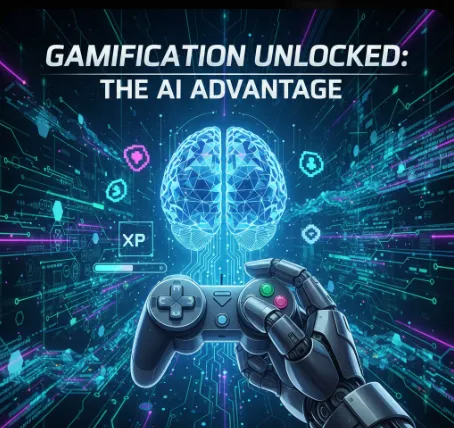
A full Gamification Guide 2026 that defines what gamification is, its application when and where, its purposes, advantages, difficulties, the future of gamification, and how EduAssist.com facilitates the solutions of gamification.
What Is Gamification ?
Gamification is the act of introducing game-like features, including points, levels, challenges, rewards, progress tracking, and feedback systems, to non-game contexts. Gamification, as applied to this Gamification Guide 2026, is not about playing games but a known set of motivational techniques to prompt engagement, learning, performance, and change of behavior.
In actuality, lots of individuals have trouble with motivation, as learners become no longer interested in education, workers become not engaged in training and development, shoppers give up on platforms, and individuals lose habits. Gamification is a direct solution to these issues, as it makes the experiences more interactive, rewarding, and goal-oriented.
Why We Use Gamification
Gamification is necessary since conventional systems can easily fail to engage people. Lack of feedback, repetitive processes, and static content lower motivation. Gamification brings in intention, success, and rewards.
The main reasons why gamification is employed are:
- It enhances interaction with the users.
- It enhances memory and comprehension of learning.
- It promotes uniformity and addictiveness.
- It increases performance and productivity.
- It enhances attachment to platforms and brands.
Gamification is successful as it corresponds to the inherent human tendencies people enjoy the process of progress, achievement, and recognition. With proper utilization, gamification will turn work into fun.
Where Gamification Plays a Winning Hand

There are numerous areas of gamification in industries and in everyday life:
Education and eLearning
Gamification is designed to keep the learners motivated with the help of quizzes, badges, progress tracking, and interactive challenges. Students experience less pressure and curiosity.
Corporate Training and HR
Gamification is applied in organizations during onboarding, skill development, compliance training, performance tracking, and also to engage employees.
Customer Engagement and Marketing.
Gamification is applied through the use of loyalty programs, reward points, referral programs, and interactive campaigns to enhance retention and conversions of customers.
Health and Wellness
Gamification is applied in fitness apps, mental wellness, and habit-tracking applications to promote healthy practices.
Personal Development and Productivity.
Gamification can be used by task managers and goal-tracking applications that reinforce the focus, organization, and consistency of users.
The Role of Gamification
Gamification plays a role in filling the intention-action gap. There are so many individuals who desire to learn, better, or do something better, but they did not motivated. Gamification presents feedback, structure, and encouragement.
Gamification transforms passive consumption into active participation in learning. It also makes the action of the individual consistent with the organizational objectives in business. It improves user experience and retention in the long term on an online platform.
Purpose of Gamification.
Gamification is important since it solves one of the largest contemporary challenges, which is attention and engagement. On the one hand, in a world of distractions, gamification makes systems shine through and be effective.
Its significance lies in:
- Enhancing the learning outcomes.
- Narrowing the gap of dropouts and disengagement.
- Promoting good behavioral change.
- Fostering continuous improvement.
- Developing quantifiable performance systems.
Key Points;
Good gamification systems have several similar components:
- Clear goals and objectives
- Organised activities or problems.
- Real-time feedback systems.
- Rewards and recognition
- Progress visibility
- Comparison or social interaction.
These are the main points that guarantee that gamification does not look superficial.
Types of Gamification
Structural Gamification
Introduces such a feature as points and badges without altering the main content.
Content Gamification
Converts either the learning or work material into the form of a story or challenge-based experiences.
Behavioral Gamification
Targets the construction of certain behaviors, e.g., consistency, participation, or completion.
The correct form of gamification is determined by the goals, audience, and context.
Gamification relates to this Areas;
Gamification is also very close to several professional areas:
- Education and EdTech
- The Human Resources and Talent Development.
- Customer Experience and Marketing.
- UX/UI Design
- Health and Wellness
- Software and Product Development.
These disciplines apply gamification in enhancing engagement, efficiency, and results.
Challenges of Gamification
However, gamification may fail even with its advantages in the case of poor design. Common challenges include:
- Excessive dependence on rewards rather than intrinsic motivation.
- Lack of personalization
- Complicated or perplexing systems.
- Unaligned objectives and measurements.
- Short-term involvement with no long-term effect.
Gamification Problems: How to Solve Them.
The issues of gamification can be resolved with a consideration of design and strategy:
- Begin with user issues, not game aspects.
- Connect gamification objectives with actual results.
- Balance compensates learning, mastery, and autonomy.
- Using data and feedback to enhance processes.
- Make experiences straightforward, simple, and significant.
Good gamification is in the interests of the user.
The use of Gamification in life and in profession.
Gamification in everyday life enables individuals to remain adherent to habits, learning, fitness, and productivity. It brings progress that is visible and rewarding.
Gamification enhances the completion of training, employee involvement, teamwork, and monitoring performance in professional areas. It turns tension into inspiration and perplexity into understanding.
The way EduAssist.com assists gamification.

EduAssist.com offers strategic and viable gamification services aimed at real-life engagement issues. Our support includes:
- Gamification strategy and consultation.
- Gamified learning and training system design.
- Interaction-oriented user experiences.
- Performance monitoring and analytics.
- Constant optimization and enhancement.
Gamification is not only effective, but it is also scalable and goal-oriented, which is guaranteed by EduAssist.com.
Gamification Future 2026.
The future of gamification is smart, customized, and engaging. The trends defining gamification include:
- AI-driven personalization
- Evidence-based behavioral knowledge.
- AR/VR integration with learning.
- Adaptive reward systems
- Outcome-based and skill-based gamification.
Gamification will further develop from basic mechanics into strategy-level experience design.
Conclusion
This Gaming Guide 2026 describes the mechanism of gamification, its importance, application, and the solution of actual issues. Gamification can be used to enhance learning, productivity, engagement, and satisfaction in industry and everyday life when it is designed with a purpose.
Gamification has ceased to be an optional tool, but it is an extremely potent instrument of contemporary systems.
Frequently Asked Questions
What is gamification?
Gamification is the application of game-like design features in a non-game context to enhance motivation and interest.
What is the significance of gamification?
It assists in enhancing participation, learning results, output, and behavior modification.
What are the common locations of gamification?
Training, corporate education, marketing, health, productivity tools, and digital platforms.
What are typical gamification problems?
Clumsy design, insufficient customization, and excessive emphasis on incentives.
The question is, how does EduAssist.com foster gamification?
EduAssist.com offers plan, design, execution, and optimization of efficient gamification systems.