
A new thread on Reddit has highlighted an often-overlooked offer in the EdTech market: free installation of Moodle, provided you purchase and manage your VPS hosting with a provider like Cloudzy.
The proposal seems strong at first sight. You are provided with a working LMS with no technical setup fee. You own the hosting. You control billing. No subscription fees to use the platform regularly. This is a strategic victory for the teachers, trainers, and small organizations that are attempting to cut expenses.
But under the same offer, there is a larger question of operation that many learning professionals do not find out until it is put into practice: who maintains the infrastructure when the installer is gone?
This paper examines the structural, technical, and strategic realities of free Moodle setups offered, so you can make a better-informed decision based on long term sustainability rather than short-term savings.
Why Moodle Has Remained the Favourite of Most Educators
Moodle has been credited with reason all over the world. It is free, open-source, and can be customized, and is heavily used by universities, corporate L&D departments, and individual course authors. Its architecture enables institutions to create very structured learning paths, deploy powerful assessment frameworks, and have third-party extensions.
Strategically, Moodle is symbolic of ownership. You are not bound to per-user SaaS cost. You retain control over data. You will define the system to fit your teaching philosophy.
In the case of small organizations, start-ups, and pilot projects, this appears perfect. You do not need to spend money on costly LMS subscriptions to receive complete freedom.
But as much as autonomy is accompanied by responsibility, the responsibility also usually falls outside of pedagogy into the area of server administration.
The Least Understood Infrastructure Layer

When a person claims a free Moodle setup, the most they are likely to give in this case is an installation and preliminary setups. They can set up the database, create access to the administration, and make the platform available to your server.
However, the server itself exists on a Virtual Private Server (VPS).
Cloudzy is one of the VPS providers that will provide you with a dedicated virtual environment in which Moodle will run. This is an environment that is powerful and flexible. Active management of it is also necessary.
When you decide to go self-hosted, you are going to become responsible for:
- Server security hardening
- Firewall configuration
- Installation of the SSL certificates
- PHP version compatibility
- Database optimization
- Regular system updates
- Automated backups
- Performance scaling
These are not a single-time activity. They are repetitive working processes.
These duties would be considered non-core competencies to professionals with training in education, instructional design, or corporate training strategy. The emotional tension is created when you start not caring about course quality but server diagnostics.
The Psychological Effect of Technical Overload
The initiation of LMS by many course creators is quite enthusiastic. They have visions of organized modules, measures of learner interaction, and development. The technical backend is seen as an obstacle in the form of a setup that is temporary and can be overcome.
But there is no single barrier to infrastructure complexity. It is ongoing.
In cases where the plugins are not compatible after the updates, when the web hosting environment starts to run poorly in relation to the load, and when a change in the version of PHP starts to disrupt the functionality, then that is the moment that the learning project turns into a technical troubleshooting project.
This change has an impact on motivation. It delays course launches. It introduces uncertainty.
Practically, the same sentiment is often expressed by many teachers:
“I just wanted to teach. I did not anticipate that I was going to be a system administrator.”
This affective interference does not constitute a capability failure. It is a conceptual mismatch between the pedagogical knowledge and the management of infrastructure.
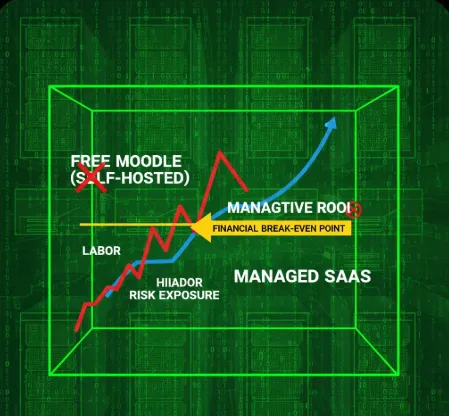
This Is the Real Price of Free

Open-source applications such as Moodle are affordable in terms of money, as no licensing fees are involved. However, open-source does not kill the cost of operation.
Time, risk exposure, and strategic distraction are part of the total cost of ownership.
Time cost is accrued when troubleshooting takes the place of instructional development. Risk exposure will be high in case security updates are postponed or configured improperly. Strategic distraction is where planning of growth takes the form of postponement on grounds of technical instability.
Economically, it is not about the fact that Moodle is free. The issue is whether unmanaged hosting fits within your organizational ability.
Technical maintenance in most small teams is reactive and not proactive. Issues are handled when they occur instead of being averted by managing systems in an organized manner.
When Self-Hosted Moodle Will Be the Best Choice
The problem of oversimplification should be avoided. Self-hosted Moodle can be strategically strong.
Companies that have in-house IT knowledge tend to have complete control over their servers. Open-source architecture may be preferable to universities that need compliance customization or sophisticated development of their plugins. Learning and development departments that have DevOps in place can use Moodle to easily integrate into existing infrastructure ecosystems.
The VPS hosting is not an intimidating issue in such settings. It is expected.
The decisive difference is in the readiness of operations. In case your organization possesses the technical literacy and maintenance expertise that is needed, self-hosted Moodle can save long-term licensing expenses and expand the freedom of customization.
This lack of such preparedness makes infrastructure a bottleneck.
The Greater EdTech Dilemma: Power Versus Identity
This discourse is a manifestation of a bigger trend in digital learning ecosystems. Companies have a strategic dilemma of either ownership or convenience.
Autonomy is provided by self-hosted systems. Managed SaaS solutions are easy.
Data control and customization are possible through ownership. Particularity saves on the complexity of operations.
There is no superiority in either of the two models. The right model will require consideration of scale, resources, and long-term goals.
But a large number of small learning projects fail to realise the complexity of the infrastructure that grows exponentially as the number of users grows.
What might be a pilot project may turn out to be a system critical to performance that helps in revenue generation and trust in learners. Reputational risk exists at that point when there is downtime or instability of data.
The Reason Behind Stalling LMS Projects
When consulting observations are made within the EdTech space, one common factor comes out. Small teams first use self-hosted Moodle to reduce expenses. The system works satisfactorily within a couple of months. Gradually, additions and updates lead to friction, as well as more traffic.
Performance slows. There are increased technical mistakes. Updates feel risky. Scaling involves reconfiguring servers.
At some point, the organization is confronted with a choice between investing in professional technical management or transferring to a managed solution.
This shift is usually seen to follow preventable stress and wasted productivity.
The quality of Moodle is not the main problem at the center. It is the lack of planning of operations.
Creating a Sustainable LMS Strategy from Day One
A sustainable LMS ecosystem needs more than installation. It requires governance.
This includes:
- Defined update schedules
- Checking of backup procedures
- Security monitoring
- Optimization standards of performance
- Obvious technical responsibility
The environment of a self-hosted LMS is susceptible without the following.
The infrastructure decisions made should be in line with the growth goals. Assuming that you are trying to create a scalable learning business, then its operational foundation should be able to support it and not hold it back.
The Way EduAssist Will Help in the Success of LMS in the Long Term
When you have to choose between the low-cost VPS hosting and the expensive SaaS subscriptions, organized advice is necessary.
EduAssist collaborates with educators, start-ups, and training organizations to use Moodle in a strategic, as opposed to a reactive manner. The strategy does not only concentrate on the installation but on the long term operational stability, security configuration, and planning the scalable architecture.
Organizations can easily evade the technical overwhelm trap through matching infrastructure with learning objectives. The emphasis is on the right place, i.e., experience of learners, quality of instruction, and outcomes.
Sustainability comes as a result when LMS implementation is treated as a system and not as a setup activity.
Frequently Asked Questions
Will Moodle Be Appropriate for Small Training Companies?
Moodle can indeed be very appropriate for small training businesses, provided it is configured and maintained. Technical management capacity is an important factor to consider.
What Is the Most Significant Threat of Moodle-Based VPS Hosting?
The main threat is the poor maintenance of the server, which may lead to security lapses, downtime, or slow performance.
Does Free Moodle Configuration Suffice to Operate a Stable LMS?
The installation is not the last stage. Stability lies in constant updates, monitoring, and optimization.
How Am I Going to Know Whether I Should Self-Host or Not?
Determine your technical capabilities, expansion strategies, and infrastructure capacity tolerance. In case your organization is not an IT organization, then professional assistance might be recommended.