
Between Course Completion and Quantifiable Skill Development
Corporate training has been dramatically changed in the last ten years. Organizations can no longer be content with course completion rates, attendance records, and printed certificates. The current business executives demand quality performance growth, observable skills development, and a direct linkage between investments towards training and business results.
The current labor force is demanding flexibility, customization, and relatability. Meanwhile, the HR heads require analytics, the leadership teams require ROI, and the compliance departments require accuracy. The overcoming of the challenge is no longer regarding the content delivery. It is concerning capability creation.
This paper will discuss the changing future of corporate training programs, the constraints of the existing LMS systems, the emergence of learning platforms powered by AI, and the possibility of organizations selecting solutions that are in line with actual skill development.
The Issue of Corporate Training Challenge: Why the Conventional Methods Are Not Enough
Decades ago, corporate learning used to be based on Learning Management Systems, where course hosting and course tracking were the main focus. Applications like Moodle, TalentLMS, and Docebo have been critical in the arrangement of online training material. Yet, the majority of the traditional LMS settings were constructed on the principles of administration and not on performance enhancement.
The cycle in organizations is repeated everywhere, with employees graduating through the modules assigned, tests passed, and certificates awarded, and yet the performance in the workplace has not improved. The existence of this gap is indicative of a more serious structural problem. The completion of the course does not necessarily mean the acquisition of skills.
Also, training is usually viewed within an organization as a form of compliance and not as a way of growth. The workers hurry down the modules to get back to business, the managers perceive training measures as checkboxes, and the leadership has difficulty correlating learning processes with key performance measures.
What has been born is a saturated training platform market and continued unhappiness with the quality of learning.
The Move to Skill-Based Corporate Training
Contemporary training platforms in corporations do not rely on content libraries. It has turned the focus on skill mapping, competency frameworks, and quantifiable improvement.
Learning related to skills starts with determining role-specific skills. Rather than generic courses, the organizations establish their definition of excellence in each job function. Salespeople need various skills compared to the operations managers or technical engineers. After mapping these competences, paths of learning may be built around bridging quantifiable skill gaps.
The strategy will make training more of a performance strategy than a passive one. It provides answers to key questions that conventional systems have a hard time with:
- What are the weaknesses in this department?
- What does this training program do for business objectives?
- Is there a demonstrable improvement in employees in the long run?
Learning efforts in unplanned skill mapping usually end up being isolated to strategic goals.
Artificial Intelligence-Based Learning Systems: Hype or Reality?

Artificial Intelligence has taken the center stage in the discussions on corporate upskilling. AI-assisted platforms will deliver personalization, automation, and high-level analytics. Nonetheless, the AI implementations are not all equal.
Other platforms integrate AI capabilities with existing LMS platforms. In such situations, AI helps in search, recommendations, or tagging of content. Although it is useful, this method is not a fundamental redesign of the learning architecture.
On the contrary, AI-native platforms are designed to accommodate adaptive learning models internally. These systems dynamically change the learning paths according to the performance of the users, create practice simulations, and, in real time, offer feedback loops. Sites such as Sana Labs are some of the examples of this trend, where adaptive intelligence is applied to the core experience.
Learning systems based on AI have enormous benefits once applied responsibly. They can customize learning experiences, bring forth pertinent material depending on the job needs, and deliver insights that enable leaders to make critical choices. Nevertheless, AI will not substitute the instructional design knowledge. Artificial intelligence is likely to create content that should be validated using expertise in regulated industries like medical care or finance to verify the validity and legality of this content.
The best solutions are a combination of AI capabilities and systematized learning science.
Microlearning and Adaptive Learning: Learning in the New Workplace
Workforce inattention, hybrid work, and workload on operations have redefined the way training has to be presented. Long sessions and modules that last several hours are becoming ineffective.
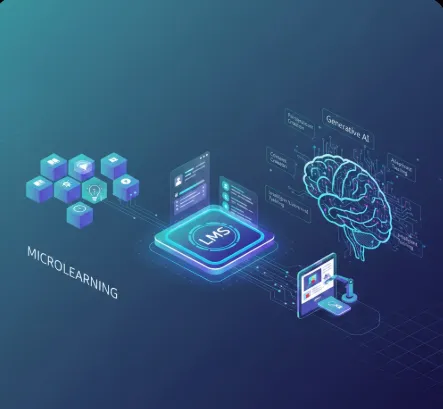
Microlearning, which refers to brief and targeted units of instruction, enhances retention and use. Microlearning can be combined with adaptive technology, which makes it even more powerful. Adaptive systems adjust the difficulty of the content, change practice scenarios, and optimize learning routes based on real-time performance indicators.
The design assists in managing cognitive load, reaffirming knowledge through repetition, and incorporating learning into work processes, without breaking it down into isolated events.
The hybrid of microlearning and AI-guided adaptation is among the most prominent tendencies in the development of the workforce.
The Measuring What Matters: Between Completion Rates and Performance Analytics
Lack of proper measurement has been one of the most endemic weaknesses in corporate training. There is a tendency to use the conventional LMS reporting based on the enrollment rates and completion rates. Though applicable in compliance audits, these measures are not indicative of growth in capabilities.
Contemporary platforms give preference to skill progress dashboards, heat maps of competencies, and performance trends. Organizations can track by linking training data to business KPIs:
- Productivity improvements
- Minimization of operational errors
- Sales conversion increases
- Decreed reduction of compliance incidents
- Certification performance
Evidence-based transparency transforms training into an administrative cost rather than a strategic investment.
Applications of Skill-Based Platforms in the Real World
Role-specific simulations and AI-based feedback loops are commonplace in sales enablement settings where organizations tend to achieve faster onboarding and better negotiation results. Employees do not read pre-recorded content; instead, they are exposed to structured practice scenarios that are consistent with the problems they face in real life.
The scenario-based learning with adaptive assessments is also helpful in minimizing risk exposure in compliance-intensive industries. Employees do not just engage in theoretical training: they are put into practice, making decisions under pseudo-pressure.
The tech businesses that have invested in technical upskilling enjoy the competency framework that is consistent with their technology stack in reality. This makes training consistent with internal tools and processes and not with industry generic standards.
At the same time, across industries, alignment between the design of learning and measurable business effect is the success factor.
Raising Awareness of AI in Corporate Training: Overcoming the Most Frequent Concerns
Numerous executives doubt the reliability of AI in the learning environments that are high stakes. The existing models of AI can be utilized successfully in drafting, creating scenarios, and providing feedback. Nevertheless, organizations will have to balance out human errors by maintaining human control.
Cost efficiency is another major common concern. Although systems based on AI might need initial investment, the long-term gains of personalization and automation of administration will usually pay off the costs of implementation.
The Future of Workforce Development corporate training
Corporate training is evolving, which is more of a move towards performance enablement. Most successful organizations do not view learning as a strategic growth engine but as a compulsory exercise.
The future of corporate training solutions incorporates skill mapping, adaptive training, AI-led feedback, and business-relevant analytics. Such systems do not just disseminate information. They cultivate capability.
With the heightening competition and the fast-changing nature of industries, the agility of the workforce is an attribute to look forward to. Firms with a focus on formal, quantifiable upskilling will beat the firms with content-driven models that have not been updated.
The Reason Why EduAssist Believes in Performance-Driven Learning
Our corporate training strategy at EduAssist is to fit the instructional design with quantifiable business results. Instead of focusing only on the features of a platform, we assist organizations in applying systematic skills models, streamlining LMS systems, and adding AI in learning processes responsibly.
We are also experienced in compliance training, workforce development strategy, adaptive learning design, and data-driven evaluation models. We not only make sure that training systems are technologically superior, but also sound pedagogically.
Should your organization be considering corporate training platforms or needs to redesign its learning architecture, EduAssist can provide some strategic advice to your operational scenario.
See eduassist.com to learn how we can assist you in establishing a corporate training infrastructural future-ready in terms of performance.
Frequently Asked Questions
Q1: Do conventional LMS platforms have any use?
A: They are good at administration and compliance; however, other tools are required when it comes to skill-based learning.
Q2: What is the measure of ROI of corporate training?
A: Associate learning programs with performance indicators such as productivity, sales, compliance, and a reduction of errors.
Q3: Does AI take over instructional designers?
A: No, AI assists in content creation and feedback; however, designers offer strategy, context, and quality control.
Q4: What is corporate learning based on?
A: It is concerned with mapping role-specific skills, closing gaps, and quantifying actual employee performance change.
Q5: What is the advantage of AI corporate training?
A: AI exchanges learning paths, adjusts the difficulty in real-time, gives feedback, and assists leaders with analytics.
Q6: Are microlearning and adaptive learning effective?
A: Yes, brief focused lessons with corrective feedback enhance the retention, use, and on-the-job performance.
Conclusion
Corporate training is in a new era. The discussion has ceased being about hosting courses to facilitating performance. The future of workforce development is being defined by skill-based frameworks, adaptive learning systems, integration of AI, and analytics-driven decision-making.
Those organizations that accept such a transformation will not only enhance the engagement of employees but will also lead to quantifiable growth of the business.
It is no longer a question of which platform is the most featured. It is the solution that actually develops skills, bridges gaps, and promotes performance excellence in the long-term.
For firms that are willing to leave course completion behind and adopt capability development, it is high time.