
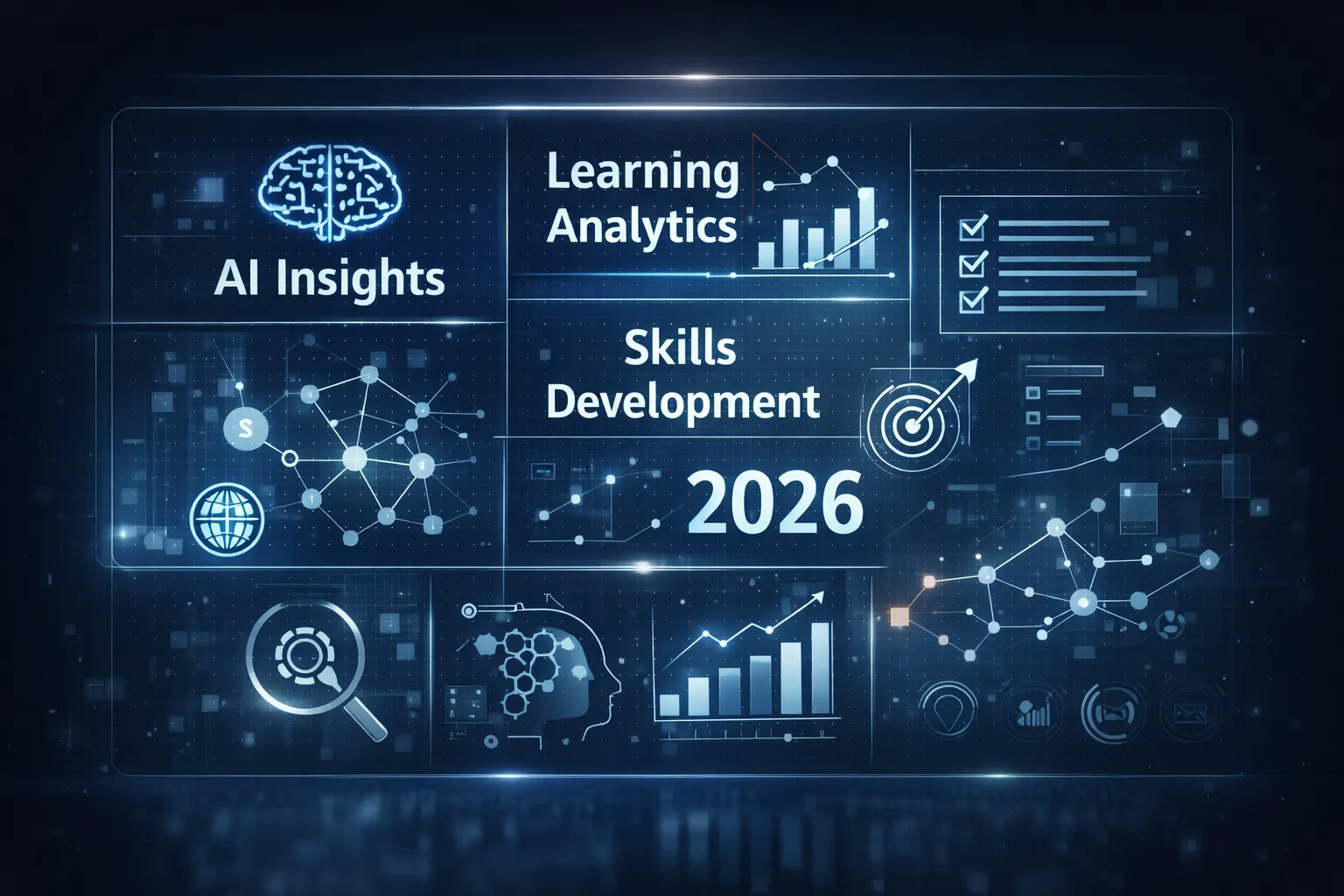
- The Emergence of AI in Learning and Development.
- What Are the AI Insights in Learning and Development?
- The Reason why Organizations are making use of AI in Learning and Development.
- Learning and development are the two areas where AI can be used most.
- The 7 AI Insights that are developing the future of learning and development in 2026.
- The Future of Learning and Development : Role of AI
- Important AI Applications in Learning and Development.
- Conclusion
Learn the 7 best AI insights to change Learning and Development in 2026. Understand the future of human development at work through artificial intelligence, personalized learning, skills-based training, and analytics.
The Emergence of AI in Learning and Development.
Artificial Intelligence (AI) is no longer a new topic of Learning and Development (L&D); it is currently a driving force of organizational training, upskilling, and future-proofing their staff. In 2026, AI is revolutionizing the process of designing instruction, interacting with learners, measuring performance, and planning the workforce.
The modern world presents organizations with rapid technological change, shifting job roles, and a growing skills gap. The conventional training models do not keep up. The AI-driven learning solutions will solve these issues by providing smarter, faster, and more personalized learning processes. The article elaborates on the 7 best AI insights that will influence Learning and Development in 2026, specifically in the area of practical uses, future influence, and strategic value.
What Are the AI Insights in Learning and Development?
Insights into AI in L&D are the facts that are acquired using artificial intelligence technology in the form of machine learning, natural language processing, and predictive analytics. These insights aid organizations in knowing more about the learners, determining the areas of skills deficit, and maximizing content and training in line with the business interests.
Instead of a hypothesis, AI insights offer evidence-based decision-making, which enhances learning effectiveness and efficiency and increases scalability.
The Reason why Organizations are making use of AI in Learning and Development.
The use of AI in business training and learning is prompted by the following serious needs:
- Handling big and heterogeneous groups of learners.
- Providing individualized instruction at scale.
- Economizing training costs and development time.
- Determining the precise effect of learning.
- Skill training of the employees
- by way of training.
AI will be mandatory in 2026 and essential to any organization that is competitive due to its emphasis on lifelong learning and employability.
Learning and development are the two areas where AI can be used most.
AI facilitates the L&D throughout the learning lifecycle:
- Skills mapping, learning needs analysis.
- Instruction design and content creation.
- Student interaction and online mentoring.
- Assessment and evaluation
- The analytics and reporting of learning.
- Planning and reskilling of the workforce.
These functions make AI one of the main pillars of contemporary learning systems.
The 7 AI Insights that are developing the future of learning and development in 2026.

Artificial Intelligence-based Individualized Learning Paths
Personalized learning driven by AI has become more mature in 2026. Artificial Intelligence applications examine the roles of learners, their level of skills and performance, and their preferences to provide personalized learning experiences.
The appropriate content is delivered to learners at the right time, minimizing cognitive overload and maximizing their knowledge. This change enhances learner satisfaction and improves the learning process.
Skills, Intelligence, and Skills-Based Learning Models
The insights of AI help organizations shift away from conventional course catalogs to learning ecosystems based on skills. AI compares the existing workforce competencies with the future job demands and finds gaps.
This perception-based strategy enables the L&D teams to focus on high-performance skills and develop specific learning interventions in line with the business strategy.
Artificial Intelligence-based Content Generation and Educational Design
Instructional designers can now use AI to create course outlines, assessments, and microlearning modules and checks of knowledge. Human expertise and AI efficiency constitute best practice in 2026.
This partnership minimizes the development cycle but ensures quality and consistency of instruction.
Predictive Learning Analytics and Performance Insights
The 2026 AI-enabled learning analytics are beyond the scope of descriptive reporting. Predictive models are used to recognize learners who may disengage during the training and predict the training results.
This understanding can enable L&D teams to act in advance and enhance achievement rates and educational efficiency.
Virtual Coaches/Intelligent Learning Assistants
AI-powered chatbots and virtual learning assistants offer real-time instructions, respond to questions of learners, and re-establish important ideas. These tools will serve as scaling support in LMS platforms in 2026.
They promote learner independence at a lower level of dependence on the instructors.
Microlearning and Just-in-Time Training Optimization
AI knowledge can be used to provide microlearning material at the moment it is required by learners. It is suggested that short and focused modules should be considered depending on the task needs, the performance gaps, and the workflow.
This strategy enhances retention and facilitates learning within the workflow.
Future Skills Forecasting/Strategic Workforce Planning
AI links learning information to the workforce plan in 2026. The AI insights are used by organizations to forecast the skills that they will need in the future and align training investments and support long-term talent strategies.
This makes L&D more of a strategic partner and not a support function.
The Future of Learning and Development : Role of AI
AI will keep on becoming a support tool and not a strategy enabler. Its role will include:
- Empowering lifelong learning models.
- Nurturing reskilling on an organizational level.
- Increasing access to learning.
- As a decision-making tool, real-time insights help improve decision-making.
Those organizations that responsibly embrace AI will achieve a sustainable competitive edge in talent development.
Important AI Applications in Learning and Development.
By 2026, AI will have several important duties:
- Promoting fair and ethical learning advice.
- Securing the privacy and information of learners.
- Enriching, and not displacing, human instructional expertise.
- Supporting businesses with the outcomes of learning.
To ensure effectiveness and trust, the adoption of AI should be responsible.
Conclusion
The best AI insights that are likely to transform Learning and Development in 2026 are marked with a definite change towards personalization, skill intelligence, predictive analytics, and strategic alignment. AI allows organizations to provide meaningful, scalable, and future-ready learning experiences.
Through responsible usage of AI-driven insights, L&D leaders can make training more of a reactive task rather than a proactive one in driving success in the organization.
With the future of work still being in its development, the relevance of AI-driven Learning and Development will continue to be the foundation of workforce resilience and progress.