Online education is developing rapidly over the past decade, yet by 2026, it expects to reach a turning point. The concept of Artificial Intelligence (AI) is no longer an experimental feature, but rather a fundamental force in online course design, delivery, personalization, and scaling.
The classical approach to course development was also frequently challenged by the issues of generic material, lack of learner interaction, slowness in the development process, and low relevance to the requirements of the job market. The AI is solving these problems through allowing smarter content development, adaptive learning pathways, real-time analytics, and outcome-driven training models.
This paper discusses the purpose of AI, its uses in online course generation, the issues it addresses, and how education providers can use it successfully in 2026 with a practical eye on student achievements and industry applicability.
What Is Artificial Intelligence (AI)?
Artificial Intelligence is a computer-based system that can carry out functions that are designed to be taken up by human intellect. Such activities involve data learning, pattern recognition, language knowledge, decision making, and content generation.
AI in Online Education Includes:
- Machine Learning (ML): Systems that learn through data provided by the learners and become better with time.
- Natural Language Processing (NLP): Chatbots, content creation, and auto-feedback.
- Predictive Analytics: Predicts the behavior, performance, and risk of drop-off among learners.
- Generative AI: Generates text, quizzes, simulations, videos, and tests.
As opposed to substituting teachers, AI is a force multiplier, augmenting human knowledge with robotization, intelligence, and scalability.
Traditional Dilemmas of Online Course Development
Before the adoption of AI, creators of courses and training organizations had to deal with recurrent issues:
- Expensive and time-consuming content development.
- Courses that are personalized but have minimal personalization.
- Low levels of engagement and poor dropout rates.
- The impossibility of measuring actual skill acquisition.
- Lack of alignment of course outcomes and industry needs.
These problems usually lead to the production of certificates that were not competent, which was frustrating to the learners, employers, and even the regulators.
How AI Will Change Online Course Creation by 2026.
Artificial Intelligence Assisted in Course Design and Content Creation
Al AI saves much time and effort on designing courses. By 2026, it is possible to have teachers employing AI to:
- Develop systematic course plans in line with learning goals.
- Transform uncodified subject-matter knowledge into learner-friendly courses.
- Automatically generate quizzes, assignments, and case studies.
- Localize and translate the information to a global audience.
This enables the instructional designers to concentrate on the pedagogy and practical use of the education as opposed to unending content generation undertakings.
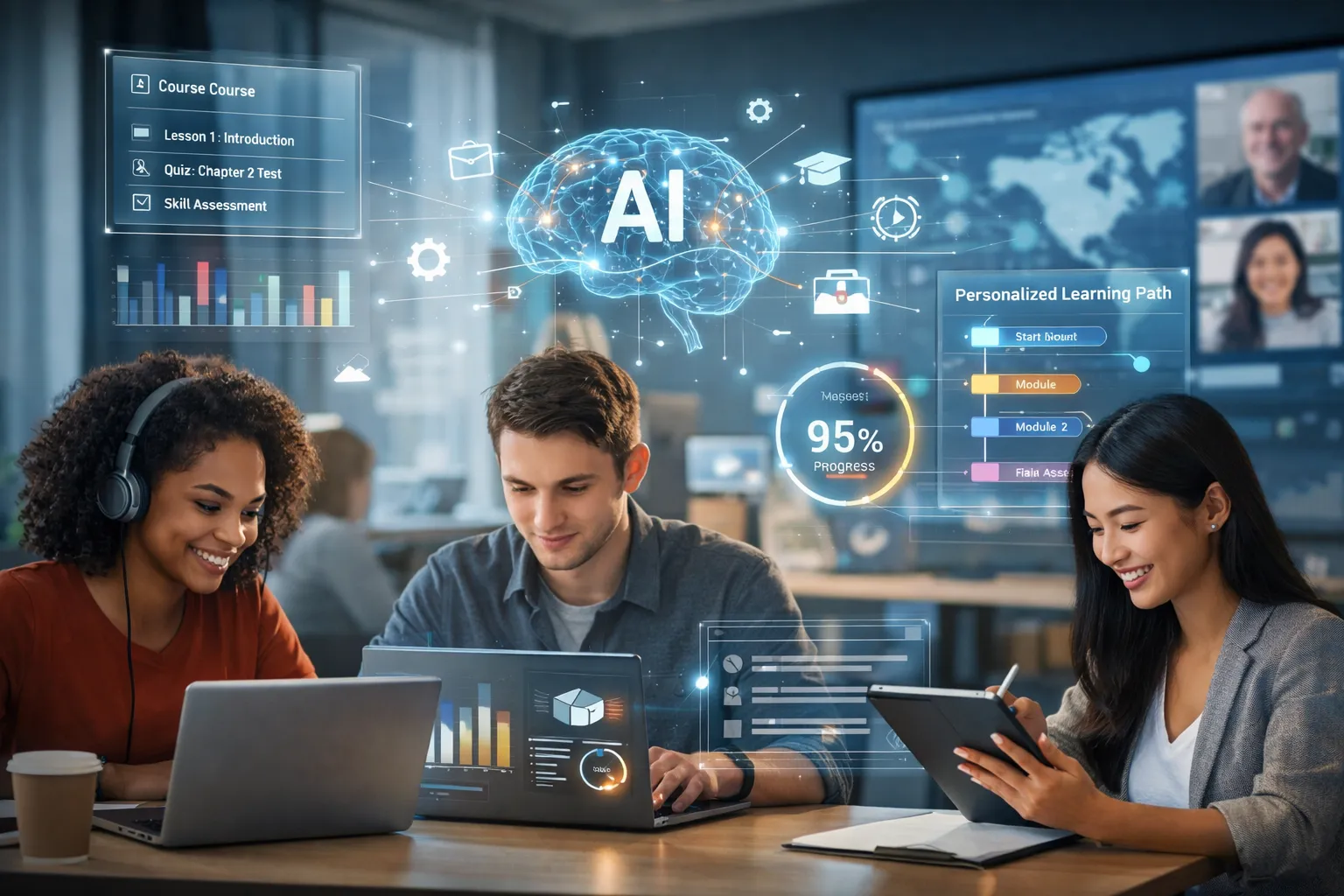
An Individualized Learning Plan for all learners.
True personalization is one of the most significant alterations that AI causes.
The data that AI systems analyze includes the learners, such as:
- Prior knowledge
- Learning pace
- Assessment performance
- Engagement patterns
According to this, the platform dynamically adjusted:
- Content difficulty
- Module sequencing
- Practice exercises
- Feedback and support
Consequently, learners are no longer overwhelmed and disengaged. Every learner has a personal learning path that is geared towards success.
Smart Tests and Live Result Feedback.
There are conventional tests where abilities are tested, but not competency. AI-driven assessments in 2026 are:
- Adaptive (questions modified depending on the learner’s response)
- Skills-based, as opposed to memorization skills.
- Marked automatically with extensive commentary.
- In line with industry competency models.
AI also identifies the gaps in learning at an early stage and prescribes curative content, making sure that they get them mastered before moving on.
Artificial Intelligence Tutors/Learning Assistants.
Virtual tutors and chatbots are now AI-based and offer 24/7 learner support. These tools can:
- Respond to course-related questions instantly.
- Elaborate complicated ideas in others.
- Direct learners with assignments.
- Provide inspirational hints and cues.
This constant encouragement radically enhances the confidence and rates of learners, particularly in self-paced Internet courses.
Evidence-based Course Enhancement.
AI helps course creators to shift their assumptions to evidence-based decisions.
With learning analytics, AI can recognize:
- What is the most difficult module for learners?
- Where learners lose interest or leave school.
- What should be included in the content to result in improved performance outcomes?
Instructors are then able to revise content, modify assessments, and enhance instructional design to develop living courses that can adjust to the needs of the learners.
Jobs Training Industry Training.
By 2026, AI will facilitate the connection between education and employment by:
- Matches between course results and actual job descriptions.
- Synchronise competencies to industry requirements (e.g., SETA, NVQs, or industry frameworks).
- Automatic updating of content depending on the market trend.
This makes the learners not only certified but also qualified and employable.
Problem-Solving Impact of AI in Online Education
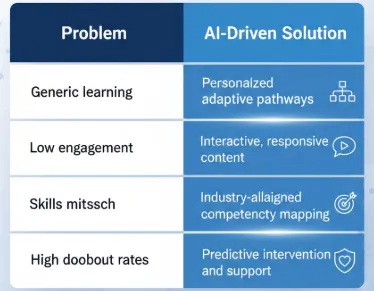
Online Education: Problem-Solving Effect of AI.
AI is a solution to the following problems of online learning:
The EduAssist application is used to create courses by AI.
EduAssist does not use AI as a shortcut, but rather as a strategic instrument of quality education.
EduAssist provides support to:
- Outcome-based course design
- Competency-aligned assessments
- Individualized student experiences.
- Adherence to industry and regulatory regulations.
- Flexible, future-proof training designs.
It is all about learning, which results in actual competence, professional advancement, and organizational contribution.
Responsible and Ethical Application of AI in Education.

Although the advantages of AI are enormous, they must be used responsibly. In 2026, best practices include:
- Having human control over the instructional decisions.
- Protecting the privacy of data and learner permission.
- Fighting AI bias in content and assessments.
- The application of AI in augmenting, but not substituting, the teacher.
EduAssist focuses on the ethical implementation of AI, which makes it trustworthy, transparent, and learner-centered.
The Future Perspective: What is the Future?
In the future, AI will go on reshaping online education by:
- Simulations based on immersion with AI.
- CHIN’s Performance analytics Skill validation
- Artificial intelligence-powered lifelong learning profiles.
- Greater combining of education and workforce.
Those organizations that embrace change early will be at the forefront of the next generation of competency-based digital learning.
Conclusion
AI is fundamentally altering the way online courses are designed, in 2026 it will make the learning experience more personalized, efficient, engaging, and relevant to the needs of the real world. It addresses old-fashioned issues of scalability, relevance, and learning achievement, and empowers teachers to concentrate on what is important: meaningful learning experiences.
AI will not be the future of the online learning process; it is the here and now.
Call to Action
EduAssist can assist you in utilizing AI effectively and responsibly if you are an education provider, training organization, or enterprise, and want to develop smarter, outcome-driven online courses.
Learn to transform what you have learned into practical ability. Create the course of tomorrow, with EduAssist.
Frequently Asked Questions
Does artificial intelligence substitute instructors in distance education?
No. AI assists instructors with automation of routine functions and insights, whereas the teachers work on mentorship, design, and critical thought.
Can AI-generated content be trusted?
With the help of subject-matter experts and quality models, AI-generated content is capable of being very accurate and fruitful.
Is AI the answer to learner dropouts?
Yes. AI anticipates disengagement early and initiates timely interventions, which lead to a great improvement in the rate of completion.
Is AI applicable in all industries?
The AI-based creation of courses is applicable in all sectors, such as education, IT, health care, manufacturing, and oil and gas, which require the necessary customization.
What is different about EduAssist and AI?
EduAssist combines AI with competencies, industry fit, and ethical management – making sure that learning results in ability in the real world, rather than certification.