AI‑driven e‑learning video production is rapidly reshaping how food businesses train staff, enforce compliance, and scale knowledge across global teams. For an organization like The EduAssist, this shift represents a powerful opportunity to position E‑Learning as both a brand promise and a scalable delivery engine. By combining AI‑assisted video tools with pedagogically sound instructional design, The EduAssist can build high‑impact, research‑backed training programs tailored specifically for the food and beverage industry.
The food industry faces relentless pressure: strict regulatory compliance (HACCP, FSMA, allergen controls), high employee turnover, multilingual workforces, and the constant need for practical skills in hygiene, processing, and safety. Traditional training methods struggle with these demands, but E-Learning Video especially when powered by AI delivers scalable, engaging, and measurable results.
This revised ultimate guide strengthens the original with deeper integration of recent peer-reviewed research from ScienceDirect, Springer, educational technology journals, and FAO resources. It emphasizes evidence on video effectiveness, AI-generation equivalence to human videos, multimedia learning principles, and food-specific applications. All claims are grounded in cited studies for credibilit
Why E‑Learning Video Is Essential for the Food Industry:
The food industry is highly regulated, labor‑intensive, and geographically dispersed. Traditional classroom‑based training struggles to keep pace with new food‑safety regulations, allergen‑management requirements, and customer‑service expectations. E‑Learning any learning supported by digital tools, especially when delivered online addresses these challenges by:
- Delivering consistent content to kitchens, cafeterias, and packaging plants worldwide.
- Reducing downtime and cost by enabling remote, self‑paced learning.
- Tracking progress and compliance through LMS dashboards and assessments.
Research on food‑industry training platforms shows that E‑Learning improves knowledge retention, reduces training‑related lost time, and supports standardized onboarding. For Te EduAssist, this means E‑Learning is not just a label; it’s the core system that connects instructional design, technology, and business outcomes.
How AI Transforms E‑Learning Video Production
Modern AI tools are now capable of automating large parts of the video production workflow, from script generation to editing and localization. When applied to E‑Learning, this capability allows creators to:
- Generate scripts from learning objectives.
- Turn those scripts into scene‑by‑scene storyboards.
- Produce AI‑voiced narrations and multilingual dubbing.
- Reuse visual assets across multiple modules (e.g., kitchen scenes, hand‑washing sequences).
Key AI‑driven capabilities for E‑Learning video include:
- Text‑to‑video generation, where prompts describing scenes are turned into short clips.
- Auto‑editing, which adds transitions, subtitles, and music based on pacing and audience profile.
- Asset libraries, enabling repeated use of standardized shots (e.g., thermometer calibration, allergen labeling).
For Te EduAssist, this means an AI‑driven E‑Learning video pipeline can:
- Rapidly update training content when new regulations or standards are introduced.
- Maintain a consistent visual and audio brand across all food‑industry modules.
- Scale production without proportional increases in time or staffing.
Core E‑Learning Video, Use Cases in the Food Sector
Several research‑informed use cases demonstrate where AI‑driven E‑Learning video delivers the highest impact:
1. Food Safety and Hygiene Compliance
Public‑health and policy‑implementation studies describe E‑Learning courses that help inspectors and food‑business operators monitor compliance with healthier‑food‑environment policies. These E‑Learning modules often combine:
- Short explanatory videos.
- Policy summaries.
- Interactive quizzes and scenario‑based assessments.
For Te EduAssist, this translates into:
- AI‑generated inspection simulations (e.g., “good vs. non‑compliant” store layouts).
- E‑Learning playlists that walk auditors through real‑world audit steps.
- Visual timelines of how to document and report violations.
All of these can be indexed and described using the keyword E‑Learning to improve SEO and topical authority.
2. Front‑of‑House and Kitchen Staff Training
Hospitality training research shows that E‑Learning modules built on short videos, interactive tasks, and gamified quizzes are highly effective for:
- Food safety and hygiene.
- Allergen awareness.
- Customer‑service protocols.
AI‑driven video can create:
- Role‑play scenarios where staff practice responding to allergy‑related questions.
- Demo‑videos of correct hand‑washing, temperature checks, and storage procedures.
- “What‑went‑wrong” clips that highlight unsafe practices.
These E‑Learning assets can be embedded in a mobile‑friendly LMS, so restaurant staff can train on‑the‑go between shifts.
3. Onboarding and Leadership Development
Studies of management trainees in small fast‑food restaurants indicate that E‑Learning is perceived positively when it is:
- Intuitive and mobile‑ready.
- Linked to real‑world tasks.
- Structured in short, digestible modules.
By embedding AI‑generated micro‑videos into an onboarding E‑Learning journey, Te EduAssist can:
- Shorten ramp‑up time for new managers.
- Reinforce leadership, communication, and team‑management skills.
- Use analytics to identify who needs additional coaching.
In messaging, this becomes: “E‑Learning for Smarter Food‑Industry Leadership.”
How AI Enhances E‑Learning Video Effectiveness:
Academic and industry research on AI in digital learning and food‑industry applications highlights several ways AI strengthens E‑Learning:
1. Personalized Learning Paths
AI‑driven systems analyze how learners interact with E‑Learning videos—completion rates, quiz scores, replay patterns and then recommend tailored follow‑up modules. For the food industry, this might mean:
- Assigning extra hygiene‑refresher videos to employees who repeatedly fail temperature‑control assessments.
- Flagging high‑performers for advanced leadership modules.
Te EduAssist can position this as: “AI‑Personalized E‑Learning for Food‑Industry Teams.”
2. Adaptive E‑Learning Video Scenarios
AI can power branching‑video scenarios where each learner choice leads to a different outcome. For example:
- If a learner selects an incorrect food‑storage method, the system replays the scene with corrected narration and on‑screen prompts.
- If they handle an allergy‑related question correctly, they unlock a “customer‑service mastery” badge.
This transforms static E‑Learning videos into interactive, decision‑based experiences.
3. Rapid Localization and Multilingual Delivery
International food‑safety and compliance courses often require translation into multiple languages and adaptation to local regulations. AI‑driven tools can:
- Dub E‑Learning videos into multiple languages.
- Swap on‑screen text and labels to reflect regional standards.
- Modify contextual imagery (e.g., local store layouts or packaging formats).
For Te EduAssist, this supports the tagline: “Globally Scalable, Locally Relevant E‑Learning for the Food Industry.”
Technical Architecture for AI‑Driven E‑Learning Video
From a technical and production‑design perspective, AI‑driven E‑Learning video rests on three core layers:
1. Learning‑Design Layer (Curriculum)
Before any AI video is generated, the E‑Learning curriculum must be structured into modular objectives and assessments. Typical food‑industry modules might include:
- Food safety foundations (cross‑contamination, personal hygiene, temperature control).
- Allergen management and labeling.
- Customer‑service protocols and incident response.
- Leadership and team‑management basics.
Each module becomes a reusable script template that AI can populate with scene descriptions, dialogue, and on‑screen text.
2. AI E‑Learning Video Generation Layer
This layer uses AI tools to:
- Generate short clips from text prompts.
- Assemble sequences into coherent E‑Learning videos.
- Add subtitles, voice‑overs, and background music automatically.
For Te EduAssist, this can be framed as an E‑Learning video engine that turns learning objectives into production‑ready clips.
3. LMS and Analytics Layer
Once AI‑generated videos are ready, they are integrated into an LMS that:
- Tracks completion and quiz scores.
- Sends automated reminders.
- Flags under‑performing learners for remediation.
Modern LMS platforms for the food industry emphasize mobile access, progress dashboards, and compliance reporting making them a natural home for AI‑driven E‑Learning content.
Best Practices for E‑Learning Video Design
Drawing from research on online learning and corporate training, here are key design principles for E‑Learning video in the food industry:
1. Micro‑Video Structure
- Keep videos between 2–5 minutes, each focused on a single skill or concept.
- Examples:
- “How to calibrate a fridge thermometer.”
- “Steps to handle a customer who reports an allergic reaction.”
Research shows that short, task‑based E‑Learning videos are more likely to be completed and remembered.
2. Scenario‑Based Storytelling
Use realistic workplace scenarios instead of abstract explanations:
- “Good vs. bad practice” kitchen scenes.
- Customer‑service role‑plays.
- Emergency‑response simulations.
AI can generate these scenarios and then package them into branching‑quiz formats.
3. Multisensory Scaffolding
Effective E‑Learning videos combine:
- Visual demonstrations (real or animated).
- Clear audio narration.
- On‑screen text highlighting key rules or safety points.
AI tools can synchronize these elements, ensuring subtitles match the narrator’s pace and key terms appear at the right moment.
4. Gamification and Feedback Loops
Gamification elements badges, progress bars, and leaderboards have been shown to increase engagement in food‑service training. AI can personalize these:
- Suggest a “Food Safety Champion” badge for staff who complete all hygiene‑related E‑Learning videos.
- Offer “fast‑track” pathways for high‑performing learners.
Positioning Te EduAssist Around “E‑Learning Video”
For your website, the keyword E‑Learning should anchor both content architecture and value propositions. Here’s how you can structure this in Markdown‑friendly headings and content blocks.
1. Core Messaging
Headline suggestions:
AI‑Driven E‑Learning Video Production for the Food IndustryScalable E‑Learning Solutions for Food Safety and Staff TrainingTransform Your Food Business with AI‑Powered E‑Learning
Value proposition paragraph (customizable):
Te EduAssist specializes in AI‑driven E‑Learning video production for the food industry. Our platform turns complex food‑safety regulations, customer‑service protocols, and leadership frameworks into engaging, short‑form video modules that teams can access anytime, anywhere. By combining instructional‑design best practices with AI‑assisted video tools, we help food businesses scale training, ensure compliance, and boost performance without expanding their training teams.
2. Content Pillars (SEO‑Friendly)
Structure your site around E‑Learning‑focused pillar pages:
E‑Learning for Food Safety ComplianceE‑Learning Video Production for Restaurants and Food ChainsE‑Learning for Onboarding and Leadership in Food Service
Each page can summarize relevant research, then link to case studies or downloadable templates.
3. Call‑to‑Action Examples
Use clear CTAs on each page:
Download our AI‑Driven E‑Learning Template for Food-Safety TrainingBook a consultation to design an E‑Learning video curriculum for your food businessRequest a demo of our E‑Learning video production platform
Research‑Backed Opportunities for The EduAssist E‑Learning Video
You can emphasize several concrete opportunities in your article, each backed by academic or industry research:
- AI‑assisted E‑Learning for food‑safety inspectors
- Offer video‑based inspection simulations and policy‑implementation courses.
- AI‑powered crew‑training for food‑service brands
- Deliver mobile‑first E‑Learning video modules on hygiene, service, and allergen management.
- AI‑generated leadership and soft‑skills content
- Create E‑Learning playlists that help managers practice feedback, conflict resolution, and team‑motivation techniques.
In each section, you can reference open‑access repositories (DOAJ, CORE, PubMed Central, etc.) and major research databases (ScienceDirect, SpringerLink, Web of Science, Scopus) as sources without requiring access yourself.
The Proven Power of E-Learning Video in Vocational and Food Safety Training
E-Learning Video consistently drives superior knowledge retention, engagement, and behavior change compared to text or lectures vital where mistakes risk public health.
A 2016 review of effective educational videos highlights that well-designed videos reduce cognitive load while promoting active processing, making them ideal for demonstrating procedures like proper sanitation or temperature monitoring. Video-based health education on food poisoning first aid significantly improved adolescents’ knowledge, attitudes, and behaviors (p < 0.001) versus control groups using leaflets.
Systematic reviews confirm video-based learning enhances cooking skills and culinary nutrition outcomes through visual demonstration and step-by-step guidance. In safety education, video formats in e-learning environments improve achievement and provide rich interactivity, though learner autonomy requires strong design.
FAO’s eLearning Academy promotes video for agrifood systems training, offering mobile-friendly, multilingual modules that support just-in-time learning in low-bandwidth settings common across food supply chains.
2. Cognitive Foundations: Applying Mayer’s Theory to E-Learning Video Design:
Richard Mayer’s Cognitive Theory of Multimedia Learning (CTML) provides the scientific backbone for effective E-Learning Video. Key assumptions include dual channels (visual/pictorial and auditory/verbal), limited capacity, and active processing. Core principles for video include:
- Segmenting: Break complex topics (e.g., HACCP principles) into short, manageable chunks with learner-paced control.
- Coherence: Remove extraneous material to avoid overload.
- Signaling: Use cues like arrows or highlights for critical steps (e.g., cross-contamination points).
- Personalization: Conversational style increases engagement.
- Modality & Redundancy: Pair narration with visuals rather than on-screen text.
These principles converge on recommendations: keep videos concise (ideally under 6–10 minutes), embed questions for active learning, and align with engagement elements like on-screen instructor presence where beneficial.
In food industry contexts, CTML-guided videos excel at teaching psychomotor skills (knife handling, PPE use) and procedural knowledge (critical control points) while minimizing overload during shift-based training.
3. AI-Driven Production: Speed, Scale, and Comparable Outcomes:
Traditional video production is slow and expensive. AI transforms it via text-to-video, avatar generation, script automation, and synthetic voices.
Recent experimental studies provide strong evidence:
- AI-generated instructional videos (AIIV) performed as well as traditional recorded videos (RV) in facilitating learning, with higher retention in some language-learning contexts and no significant differences in transfer.
- Randomized trials show no statistically significant differences in knowledge gains between human-recorded and AI-generated (avatar) lecture videos. Both groups achieved comparable post-test improvements, with production time reduced dramatically (hours vs. days/weeks).
- Another large-scale experiment (447 participants) found equivalent exam performance between human-made and AI-generated teaching videos, though learners slightly preferred the human version for experience and perceived credibility.
These findings hold across management, language, and general instructional content directly transferable to food safety modules. AI tools (LLMs for scripting, generative avatars, auto-editing) enable rapid updates for new regulations or facility-specific risks while maintaining learning efficacy.
In food manufacturing, AI further supports behavior monitoring, predictive risk analysis, and personalized training feedback—creating closed-loop systems for sustained safety culture.
4. AI E‑Learning Video Applications Tailored to the Food Industry:
AI intersects powerfully with food systems:
- Computer Vision & Deep Learning: For quality control, defect detection, and safety monitoring principles extend to training videos showing real-time visual examples of contamination or spoilage.
- Generative AI: Enhances predictive analytics, food design, and personalized learning pathways in agrifood.
- Food Safety Behavior: AI-assisted cycles monitor compliance (hand hygiene, PPE), evaluate culture, and deliver real-time feedback via adaptive E-Learning Video modules.
- Broader Impact: AI optimizes traceability, fraud detection, and supply chain training content that can be dynamically incorporated into videos.
Practical examples include AI-generated scenarios for allergen management, branching videos for decision-making in processing lines, and multilingual modules for global teams.
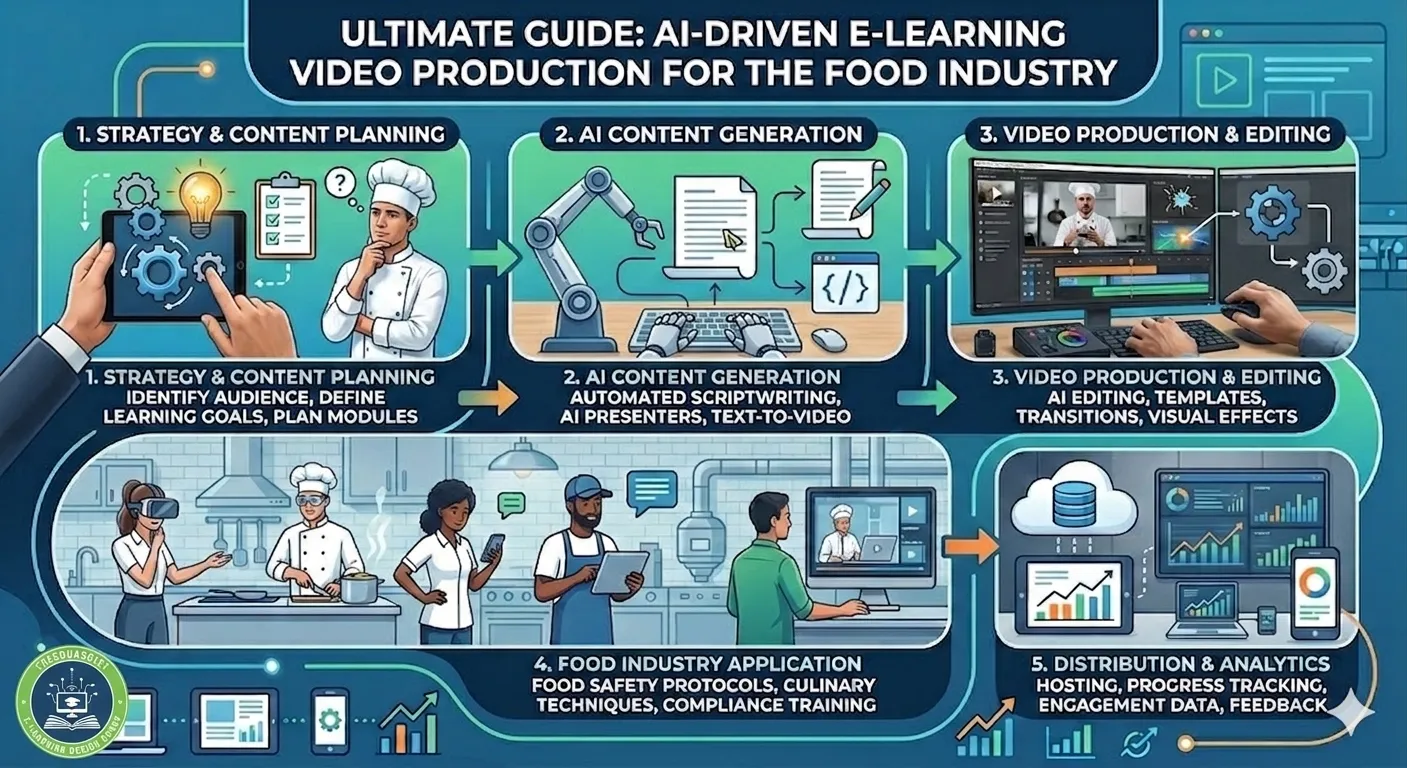
5. Step-by-Step Framework for Creating High-Impact AI-Driven E‑Learning Video
- Needs Assessment: Align with Bloom’s taxonomy and learner profiles (e.g., line workers vs. supervisors). Reference FAO methodologies for vocational relevance.
- Script & Content Design: Use LLMs with CTML prompts segment, signal, personalize. Incorporate food-specific examples and regulatory language.
- Asset Generation: Generate avatars/voices, visuals, and B-roll. Ensure accessibility (captions, transcripts, mobile optimization).
- Interactivity & Active Learning: Embed quizzes, hotspots, and branching (e.g., “Choose corrective action”). Follow signaling and segmenting principles.
- Production & Testing: Assemble in authoring tools. Test for cognitive load and engagement.
- Deployment & Analytics: Integrate with LMS. Track completion, quiz scores, and behavioral indicators. Use AI for adaptive pathways.
- Iteration: Leverage learner data and A/B testing. Update rapidly with new AI capabilities.
This workflow cuts production time while adhering to evidence-based design.
6. Best Practices for Engagement and Retention
- Apply Mayer’s principles rigorously.
- Keep segments short and paced for attention.
- Combine video with practice or blended elements.
- Ensure cultural sensitivity and inclusivity in avatars/ examples.
- Focus on measurable outcomes: knowledge, skills, and observed behaviors (e.g., audit compliance).
Research on annotated and interactive videos shows added value through reduced cognitive load and enhanced performance.
7. Measuring Success and ROI
Use pre/post assessments, retention tests, behavior observation, and incident rate tracking. Studies confirm comparable or equivalent gains from AI videos versus human ones, with massive efficiency gains. Industry benchmarks (e.g., faster onboarding, lower error rates) align with reduced training costs and improved safety culture.
8. Challenges, Ethics, and the Road Ahead
Challenges include potential lower perceived engagement with AI avatars (address via hybrid approaches), data privacy, bias in generative models, and digital access gaps.
Ethical considerations: transparency about AI use, inclusive representation, and avoiding over-automation that diminishes human connection.
Future trends: Deeper integration of generative AI with computer vision for immersive simulations, real-time adaptive videos, and cross-sector applications from food safety behavior monitoring to personalized nutrition training.
Conclusion: Leverage E-Learning Video for a Safer, Smarter Food Industry
Backed by rigorous evidence from ScienceDirect, Springer, CTML research, comparative AI studies, and FAQ practices, AI-Driven E-Learning Video offers equivalent learning outcomes to traditional methods at a fraction of the time and cost while enabling scalability and personalization unmatched by prior approaches.
At The EduAssist, we translate this research into custom solutions: AI-powered food safety modules, HACCP training libraries, hygiene demonstrations, and full compliance programs tailored to your operations.
AI‑driven E‑Learning video production is rapidly becoming the backbone of modern food‑industry training, enabling food businesses to scale knowledge, ensure compliance, and onboard staff more efficiently than ever before. For Te EduAssist, anchoring your brand around the keyword E‑Learning paired with AI‑generated videos, structured curricula, and LMS integration creates a clear, research‑informed value proposition: you’re not just producing videos; you’re building adaptive, scalable learning ecosystems for kitchens, cafés, and food‑service chains.
By combining instructional‑design best practices (micro‑videos, scenario‑based learning, gamification) with AI tools that automate scripting, editing, and localization, Te EduAssist can deliver fast‑iterating, mobile‑friendly E‑Learning modules that align with global food‑safety standards and local business needs. This positions your platform as a bridge between academic/industry research and practical, on‑the‑ground training perfect for positioning your site as a thought‑leadership hub in AI‑powered E‑Learning for the food industry..
References:
- AI in food industry automation: applications and challenges – Frontiers in Sustainable Food Systems
→ Discusses AI, automation, and data‑driven systems in food‑industry workflows, useful for framing AI‑assisted E‑Learning platforms. - AI, e‑learning and automation converge to benefit food manufacturing – Provisioner
→ Examines how AI‑driven e‑Learning platforms upskill food‑manufacturing workforces and integrate with automation. - E‑Learning methodologies and good practices (UNESCO‑style handbook)
→ Provides a solid theoretical foundation for structuring E‑Learning curricula, including micro‑videos and scenario‑based learning. - Micro‑learning: bite‑sized training for better retention in food safety – EnsureIQ
→ Shows how short, modular E‑Learning videos improve food‑safety knowledge retention. - Micro‑learning: an effective way to enrich food safety training – Global Food Safety Resource
→ Explains how micro‑learning reduces training time and improves behavior change in food‑safety programs. - Why your food safety compliance training needs microlearning technology – Qstream
→ Describes how small, AI‑ or LMS‑driven micro‑learning modules can be used in food‑safety E‑Learning. - How AI helps in the food industry – Throughput World
→ Useful for positioning AI‑driven E‑Learning in the broader context of food‑industry digital transformation.
Frequently Asked Questions (FAQs)
Q1. What is E‑Learning in the food industry?
E‑Learning in the food industry refers to any digital training delivered online—especially via short videos, interactive modules, and quizzes that helps staff learn food safety, hygiene, customer service, and compliance standards. It replaces purely classroom‑based training with scalable, trackable, and often mobile‑friendly learning experiences.
Q2. How does AI improve E‑Learning video for food training?
AI automates script generation, scene creation, voice‑overs, and editing, allowing faster production of consistent, high‑quality food‑safety and service videos. It also supports personalization, branching scenarios, and multilingual dubbing, so one E‑Learning module can be reused and adapted across regions and teams.
Q3. Why use E‑Learning Video instead of traditional classroom training for food staff?
E‑Learning reduces downtime, lowers training costs, and standardizes content across locations. It also enables anytime‑anywhere access (especially on mobile), instant progress tracking, and quicker updates when regulations change—critical for food‑safety and compliance training.
Q4. Can AI‑driven E‑Learning videos replace in‑person supervision?
AI‑driven E‑Learning videos cannot fully replace in‑person mentoring or immediate supervision, but they significantly reduce the burden by handling foundational knowledge (e.g., hand‑washing, allergen protocols, SOPs). Supervisors can then focus on hands‑on coaching and performance feedback.
Q5. How can Te EduAssist help a food business implement E‑Learning Video?
Te EduAssist can help by:
- Auditing your training needs (hygiene, service, leadership).
- Designing modular E‑Learning curricula with AI‑driven video production.
- Integrating these modules into an LMS with tracking, quizzes, and gamification.
- Providing ongoing updates as regulations or standards change.
Q6. Are there research‑backed benefits of E‑Learning Video for food‑safety training?
Yes. Studies and industry reports show that well‑designed E‑Learning for food safety improves knowledge retention, standardizes compliance, and reduces training‑related losses in productivity. Online food‑safety training is also recognized by regulators as a valid way to certify staff when backed by clear assessments.
Q7. What role does AI play in compliance and certification through E‑Learning Video?
AI plays a supporting role: it helps generate and update visual content, simulate real‑world scenarios, and personalize learning paths. However, final certification typically still depends on logged completion, quiz scores, and sometimes in‑person verification, all of which can be tracked through the E‑Learning platform.
Q8. How long should E‑Learning videos be for food staff?
For maximum engagement and retention, E‑Learning videos for food staff should typically be 2–5 minutes long, focusing on one specific skill or concept (e.g., thermometer calibration, allergy handling, or customer complaint response). This aligns with best practices in e‑learning methodologies and micro‑learning research.
Authored By: Atiqa Sajid http://www.linkedin.com/in/atiqa-sajid-747b57137