


Online education is developing rapidly over the past decade, yet by 2026, it expects to reach a turning point. The concept of Artificial Intelligence (AI) is no longer an experimental feature, but rather a fundamental force in online course design, delivery, personalization, and scaling. The classical approach to course development was also frequently challenged by the issues of generic material, lack of learner interaction, slowness in the development process, and low relevance to the requirements of the job market. The AI is solving these problems through allowing smarter content development, adaptive learning pathways, real-time analytics, and outcome-driven training models. This paper discusses the purpose of AI, its uses in online course generation, the issues it addresses, and how education providers can use it successfully in 2026 with a practical eye on student achievements and industry applicability. What Is Artificial Intelligence (AI)? Artificial Intelligence is a computer-based system that can carry out functions that are designed to be taken up by human intellect. Such activities involve data learning, pattern recognition, language knowledge, decision making, and content generation. AI in Online Education Includes: As opposed to substituting teachers, AI is a force multiplier, augmenting human knowledge with robotization, intelligence, and scalability. Traditional Dilemmas of Online Course Development Before the adoption of AI, creators of courses and training organizations had to deal with recurrent issues: These problems usually lead to the production of certificates that were not competent, which was frustrating to the learners, employers, and even the regulators. How AI Will Change Online Course Creation by 2026. Artificial Intelligence Assisted in Course Design and Content Creation Al AI saves much time and effort on designing courses. By 2026, it is possible to have teachers employing AI to: This enables the instructional designers to concentrate on the pedagogy and practical use of the education as opposed to unending content generation undertakings. An Individualized Learning Plan for all learners. True personalization is one of the most significant alterations that AI causes. The data that AI systems analyze includes the learners, such as: According to this, the platform dynamically adjusted: Consequently, learners are no longer overwhelmed and disengaged. Every learner has a personal learning path that is geared towards success. Smart Tests and Live Result Feedback. There are conventional tests where abilities are tested, but not competency. AI-driven assessments in 2026 are: AI also identifies the gaps in learning at an early stage and prescribes curative content, making sure that they get them mastered before moving on. Artificial Intelligence Tutors/Learning Assistants. Virtual tutors and chatbots are now AI-based and offer 24/7 learner support. These tools can: This constant encouragement radically enhances the confidence and rates of learners, particularly in self-paced Internet courses. Evidence-based Course Enhancement. AI helps course creators to shift their assumptions to evidence-based decisions. With learning analytics, AI can recognize: Instructors are then able to revise content, modify assessments, and enhance instructional design to develop living courses that can adjust to the needs of the learners. Jobs Training Industry Training. By 2026, AI will facilitate the connection between education and employment by: This makes the learners not only certified but also qualified and employable. Problem-Solving Impact of AI in Online Education Online Education: Problem-Solving Effect of AI. AI is a solution to the following problems of online learning: The EduAssist application is used to create courses by AI. EduAssist does not use AI as a shortcut, but rather as a strategic instrument of quality education. EduAssist provides support to: It is all about learning, which results in actual competence, professional advancement, and organizational contribution. Responsible and Ethical Application of AI in Education. Although the advantages of AI are enormous, they must be used responsibly. In 2026, best practices include: EduAssist focuses on the ethical implementation of AI, which makes it trustworthy, transparent, and learner-centered. The Future Perspective: What is the Future? In the future, AI will go on reshaping online education by: Those organizations that embrace change early will be at the forefront of the next generation of competency-based digital learning. Conclusion AI is fundamentally altering the way online courses are designed, in 2026 it will make the learning experience more personalized, efficient, engaging, and relevant to the needs of the real world. It addresses old-fashioned issues of scalability, relevance, and learning achievement, and empowers teachers to concentrate on what is important: meaningful learning experiences. AI will not be the future of the online learning process; it is the here and now. Call to Action EduAssist can assist you in utilizing AI effectively and responsibly if you are an education provider, training organization, or enterprise, and want to develop smarter, outcome-driven online courses. Learn to transform what you have learned into practical ability. Create the course of tomorrow, with EduAssist. Frequently Asked Questions Does artificial intelligence substitute instructors in distance education? No. AI assists instructors with automation of routine functions and insights, whereas the teachers work on mentorship, design, and critical thought. Can AI-generated content be trusted? With the help of subject-matter experts and quality models, AI-generated content is capable of being very accurate and fruitful. Is AI the answer to learner dropouts? Yes. AI anticipates disengagement early and initiates timely interventions, which lead to a great improvement in the rate of completion. Is AI applicable in all industries? The AI-based creation of courses is applicable in all sectors, such as education, IT, health care, manufacturing, and oil and gas, which require the necessary customization. What is different about EduAssist and AI? EduAssist combines AI with competencies, industry fit, and ethical management – making sure that learning results in ability in the real world, rather than certification.

Teachability: How to Improve Learning and Retention in Education
What Is Teachability and Why It Matters. Teachability is the openness, the willingness of a learner, and the capability of acquiring new knowledge and skills. It transcends intellect or previous experience. A very instructable person is inquisitive, open to criticism, and accommodating to change learning behaviors. In contemporary learning and training, the issue of teachability is important since: Even well-planned courses are not going to have an effect without teachability. Learning is faster, deeper, and sustainable with great teachability. Introduction of Learning Strategies to Improve Teachability. The first place to start improving teachability is deliberate strategies of learning that promote engagement, reflection, and practice. It always observe that learners with structured methods of teaching and learning remember more and perform better in the long run. The Teaching Strategies that Work: Research-Based. Teachability is dependent on research-based instructional strategies that have been proven to aid in understanding and memory. The most influential methods are: Such strategies enhance retention of learning, besides enhancing the significance of learning. Developing Habits that Promote Teachability. Teachability is also enhance the fact that the learners develop habits that serve to support learning. These include: The integration of effective learning techniques with purposeful habits can help learners to be more flexible and receptive to teaching. Better Learning Retention through Personal Learning Environments. A personal learning environment enables the learner to have the choice of how, where, and when they learn. Learners are more likely to learn when they feel that they control the learning process as opposed to depending on the formal classrooms. How to create a Personal Learning Environment that Works. A personal learning environment is an effective environment that involves tools, resources, and routines to suit personal needs. Examples include: These environments complement various learning styles and enable learners to learn the content in a more in-depth manner. Personal Learning Environment and Retention in learning. The retention of learning enhances when the learners deal with the same content several times and through varying forms. A personal learning environment will permit: Teachability and long-term understanding are highly enhanced by supporting the content in several different touchpoints. The use of Instructional System Design for Effective Learning. Instructional system design offers a systematic approach to the development of learning experiences that align the objectives, content, delivery, and assessment. Teachability is beneficial when the instruction is well-designed and learner-oriented. The Instructional Design in Teachability. Effective instructional design takes into account information processing among learners. It gears towards clarity, relevance, and interaction instead of content overload. Proper designing of instructional systems would assure: When students learn about expectations and the reasons why it is important, they become more instructable. Instructional Design Training and Skill Building. Individuals taking instructional design coursework get an understanding of how human beings learn and retain knowledge. These courses emphasize: When these principles are used, teachers and trainers will be able to develop tailored learning solutions that can make the process of teachability more effective in various audiences. Effectiveness and Teachability of Training. The effectiveness of training is directly related to teachability. Regardless of the level of the technology or the content taught, training does not work when learners are detached or incapable of practicing what they are taught. Learner teachability in eLearning Development. The contemporary development of eLearning is based on flexibility and engagement. Digital learning is more teachable when it involves: They are the components that make the learners have the knowledge of what to learn and how to utilize it. Terminal Learning Objectives and Measurable Outcomes. The explicit terminal learning objectives aid the learners to be focused and motivated. In situations where the learner has been given the result that he or she is striving to achieve, teachability goes up because: This understanding enhances memory of the learning process, as well as the effectiveness of training in general. Different Teachability in Formats of Learning. The learning delivery affects the teachability. Digital and face-to-face approaches have their advantages. Advantages of Face-to-face Learning. Although there is an increase in digital learning, face-to-face learning still has advantages as far as they are teachable. These include: Face-to-face learning can also increase motivation and emotional involvement, which contributes directly to teachability. Maximized Impact of Blended Learning. Blended learning is an integration of electronic devices and actual teaching. This will aid in teaching since it provides: The equilibrium of formats will provide learners with a high degree of engagement and better learning retention. Making Lessons Learnable in the Workplace. Teachability is a skill that is highly appreciated in the work environment. The companies are looking after the employees capable of adapting, learning, and embracing the change. Instructional and Professional Development. Employees who are highly teachable: This turns out to be among the important factors in long-term career achievement, which is called teachability. Bespoke Organization Learning Solutions. The method of enhancing teachability in organisations is achieved through investment in custom learning solutions, which are tailored to the workforce of organisations. These solutions consider: With learning that corresponds to actual needs, there is more engagement and effectiveness of training. Challenges that Lessen Teachability. Although teachability is possible to build, there are some limiting factors that must be considered: The ability to face these challenges by designing intelligently and focusing on the needs of the learner makes teaching more effective, and outcomes are enhanced. Useful Advice to Enhance Teachability. These are practical methods to enhance teachability by learners and educators: These measures create trust, understanding, and inspiration. Conclusion One of the fundamental competencies that defines the ability of people to learn and use new knowledge is called teachability. Learners and organizations can enhance learning retention and performance by employing strategic learning processes, ensuring conducive individual learning conditions, and employing the principles of instructional system design. Once the teachability is placed in the center stage, then education is made significant, training becomes more efficient, and growth is made continuous. Teachability is not a choice in a world where change is inevitable. Frequently Asked Questions What is teachability? Teachability is the skill to
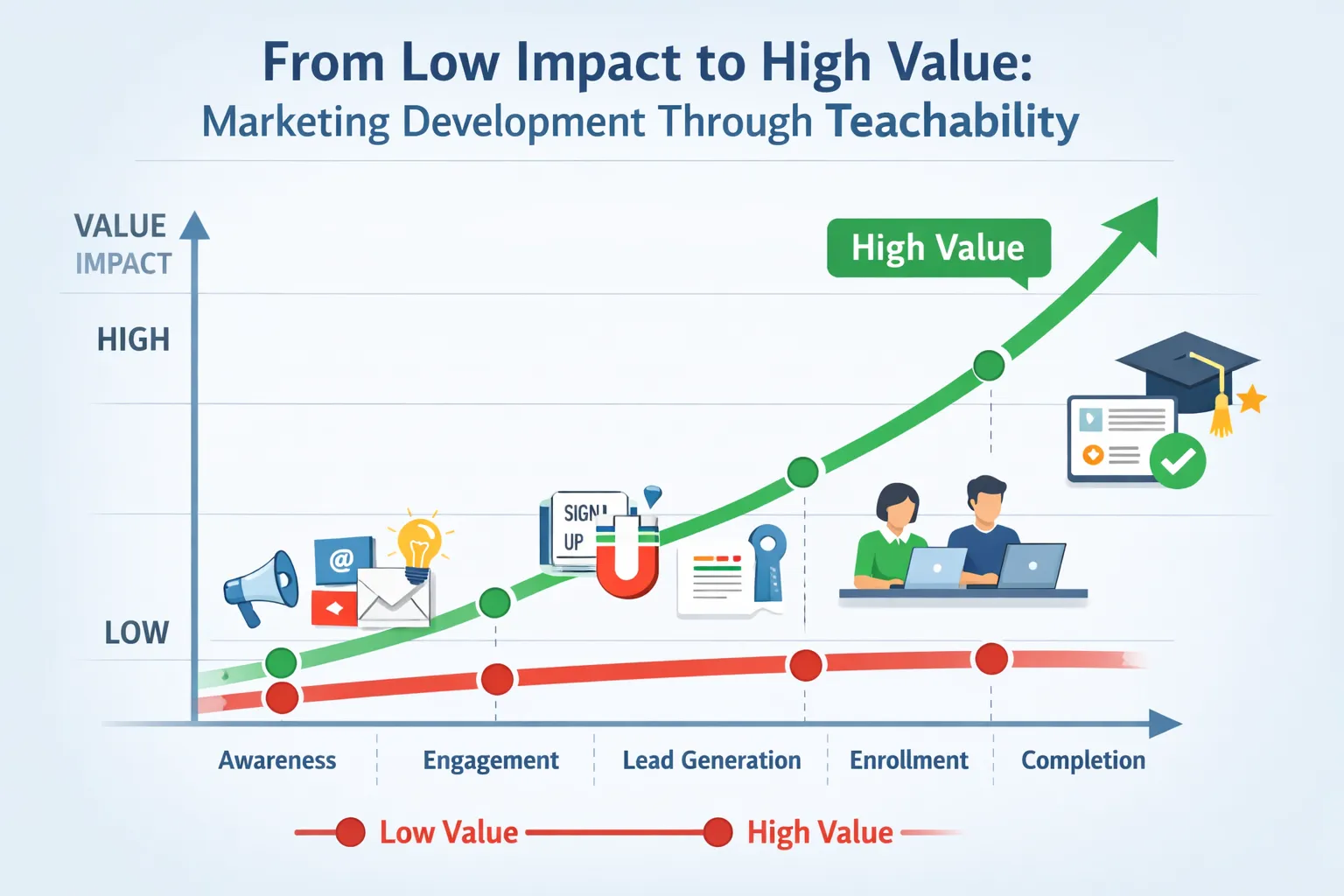
How to Promote Your Online Course by Using Teachability Principles 2026
The development of an online course is a success. It is altogether another challenge to market it successfully. Teachability is one of the effective factors that make people enroll, but most educators pay much attention to ads, platforms, and promotions instead. The greatest marketing strategy will not work unless learners feel that your course is easy to digest, practical, and relevant. In this guide, you will know how you can sell an online course based on teachability. Rather than following the fads, you will find out how clarity of learning value, comprehension of the audience, and shrewd digital approaches interact to get the appropriate learners and transform them into active students. Understanding Your Learners Before You Market It is necessary to learn what is meant by teachability in marketing before examining the strategies to market your course. Teachability is the belief of learners concerning their ability to: When the focus of marketing emphasizes teachability, it creates trust quicker than glitzy offers. A highly teachable course: This is what lays the groundwork for successful online education marketing tactics. Before You Market: Understand Your Learners The process of marketing starts much earlier than when you finally decide on a course platform over the Internet or create advertisements. Establish the Learning Preparedness of Your Audience Ask yourself: Teachability relies on the readiness of the audience. An excellent course can be given and not make the conversion unless marketed to the appropriate level of learning. Targeting Your Audience in Terms of Teachability Powerful audience targeting is concerned with: The marketing copy ought to depict how your course is able to teach the learners on a step-by-step basis. Marketing an Online Course by Showcasing Learning Outcomes Selling features rather than results is one of the greatest errors of strategic marketing online. Change From “What is Included” to “What Learners Can Do” Instead of: 20 worksheets and video modules. Try: This skill will be usable at the end of this course in a manner that you will not guess. This strategy strengthens teachability and curbs enrollment reluctance. Demonstrate Academic Improvement Some of the best course promotion tips would be: These factors are visual demonstrations that learning is organized and attainable. Select the Appropriate Online Course Platform Your online course platform is not a tool only to host it; it is part of your marketing message. Resources That Facilitate Learning Clarity Choose platforms that allow: A cluttered appearance sends a negative message concerning learnability. Platform Messaging Matters Your sales page structure also influences sales. Careful headings, easy descriptions, and coherent structure will help to assure learners that your course is not going to overwhelm them. Marketing Content That Builds Trust and Authority The best approach to content marketing is teaching first, then selling. Teach First, Sell Second Content marketing strategies include: This makes you a mentor and not a salesperson. Relate Content with Course Learning All the content must respond to: This strategy aligns with online learning solutions and builds long-term brand trust. Social Media Marketing That Focuses on Learning, Not Hype Most creators fail in social media marketing because they focus on visibility instead of value. Share Learning Experiences, Not Only Deals Successful social content contains: This strengthens teachability and encourages enrollment. Strategic Digital Media Use Consistency counts more than quantity. Select the platforms your audience frequents: Email Marketing That Converts, Not Just Leads Email marketing is one of the most effective tools for building trust and conversions when done right. Email Learning to Reduce Learning Anxiety Instead of pushy sales emails, write: This strategy creates leads who already trust your teaching style. Teachability-Based Email Sequences A strong email sequence: This keeps messaging aligned with learning value. Online Strategy Marketing with Value Demonstration Teachability is most effective when learners experience it before enrolling. Provide Free Learning Opportunities Free resources such as: Enable prospective students to test your teaching style. This is one of the best online course creation tips for boosting enrollment. Use Data to Perfect Learning Messaging Track: These insights improve both course design and marketing strategies. Common Pitfalls That Harm Teachability Even the best-designed courses fail when marketing sends the wrong messages. Avoid: Clarity always converts better than confidence. Measuring Marketing Success Success in online education marketing strategies goes beyond revenue. Look at: High teachability leads to referrals, testimonials, and sustainable growth. Conclusion Learning is personal. Individuals do not simply purchase courses; they invest in: Knowing how to sell an online course using teachability makes every strategy more efficient: In a crowded digital market, teachability is what makes your course stand out—and succeed. Frequently Asked Questions How to market an online course best?Concentrate on the teachability: demonstrate to the learners that your course is understandable, well-organized, and practical. Use social media, email, and content marketing to emphasize results. What do I do to sell my course without being salesy?Free resources, share tips, mini-lessons. Prefer the value of letters, and a natural introduction to your course. What is the best online course platform in terms of marketing?Select platforms that have simple navigation, progress tracking, and interactive features—they make teaching easier. How can email marketing bring leads?Send course trailers, tips, and mini-lessons. An effective sequence of emails creates trust and spurs enrollment. What can I do with social media to advertise my course?Publish short tutorials, learner success stories, and educational material. Teach, not just promote. How do I measure marketing success?Pay attention to course activities, completion rates, email statistics, and learner feedback rather than just sales.

Smart Learning Strategies to Remember More & Perform Better
Learning does not mean studying more, but learning smarter. The difference between poor performers and confident problem solvers is often reduced to a single factor: learning strategies. When learners know how to learn, they can retain information longer, are able to apply the information to a greater extent, and are able to perform more confidently in a real-life scenario. The traditional memorization methods are now not sufficient in the current dynamic education and workplace atmosphere. Learning strategies that are practical and aid in understanding, adaptability, and lifelong development are required by students, professionals, and organizations. This guide describes what learning strategies are, why they are important, and how you can use research-supported strategies to enhance the results of learning. What are Learning Strategies? these are the ways or systems whereby learners process, learn, and remember information effectively. These strategies make people active, reflective, and practical instead of passive reading or listening. Learning strategy assists learners to: The strategies find extensive application in schools, universities, corporate training, and training design. The reason why Learning Strategies are more important than ever The current generation of learners is overwhelmed with information. In the absence of a proper learning and development strategy, knowledge is disjointed and easily lost. The main advantages of effective learning strategies: Educational research findings have shown that learners who use research-based instructional strategies do much better than those who use passive study techniques. Learning Strategies (Types and examples) Various students require different styles. The best and most popular strategies are listed below. Cognitive Learning Strategies Cognitive learning strategies are intervention methods that involve employing the mind to learn.Cognitive learning strategies refer to those intervention strategies that require the use of the mind to learn. These concern processing and processing information. Examples include: These are frequently subjects in an instructional design course or an instructional system design program. Metacognitive Learning Strategies Learning Strategies: About metacognition, the strategies can be classified into two groups: metacognitive learning strategies and information processing strategies. Metacognition refers to thoughtful thinking. Students who employ this method: This is a key strategy in the planning and development of training and leadership programs. Active Learning Strategies Active learning transforms passive learners into active learners. Examples include: Such strategies are very much aligned with research-based instructional strategies. Microlearning Strategies Microlearning is content delivered in brief and focused sessions. Why it works: Microlearning is an idea that is often applied by a number of organizations to facilitate ongoing learning. Learning vs Teaching Strategies Learning Strategies Teaching Strategies Concentrate on student behavior Concentrate on the teacher’s presentation Promote self-direction Tend to be content-centered Enhance the long-term retention Enhance the short-term understanding Individual adaptable Standardized to groups Good learning results occur when the two strategies are combined. The role of Instructional System Design in the Support of Learning Strategies Instructional system design can assure that the instructional strategies are planned throughout training programs and not introduced at random. Key components include: An effective system will be designed to match learning activities with actual performance objectives. Creating a Personal Learning Environment A personal learning environment provides the learners with ownership of learning. Creating the elements of a successful personal learning environment: This model promotes lifelong learning and career development. Learning tips that are applicable in practice Tip 1: Set Clear Learning Goals Know what success is before you begin. Assess objectives in relation to the terminal learning objective. Tip 2: Separate Content into small snatches Available microlearning techniques will help prevent overload and enhance attention. Tip 3: Teach What You Learn The process of explaining concepts to others makes them stronger in understanding and remembering. Tip 4: Put Knowledge into Practice Having practised is much stronger than rereading notes. Tip 5: Reflect Regularly Ask: Infographic: Strategy Framework of Effective Learning This cycle is the focus of the contemporary models of learning and development strategies. The pitfalls that the learners can fall into These errors can be avoided to a large extent, which will enhance learning. Professional Training Learning Strategies Structured strategies are used in organizations to: A variety of corporate programs are a combination of instructional design courses, a micro-learning platform, and performance-based assessments. The selection of the appropriate Learning strategy Learning Objective Strategic Approach Suggestion Retention of knowledge Cognitive strategies Application of skills Active learning Self-enhancement Self-monitoring techniques Learning on the job perpetually Microlearning Professional development Self learning Frequently Asked Questions In simple words, what are learning strategies? Strategies in learning are those approaches that enable you to perceive, store, and apply information in a better manner. What is the relevance of learning strategies? They enhance memory, interaction, and problem-solving, and ultimately lessen the time of study. Do learning strategies benefit professionals? Yes. They are popular in training of corporations, equipping of leadership, and learning of skills. Are the research-supported learning strategies? Yes. A good number of them are research-based instructional methods that have been found to improve learning. What are the ways to begin using learning strategies? Keep it small: establish objectives, divide content into bits, knowledge reflection, and implementation. Final Thoughts Intelligence and effort are not in themselves sufficient factors to learn. It is concerned with applying the appropriate strategies when it is appropriate. As a student, an educator, or a professional, you can redesign your approach to learning and problem-solving with the help of Theduassist’s structured and research-based methods. By matching your learning objectives with known strategies that modern tools and tools supported by the instructional system design enable you to accomplish, you develop skills that don’t wear out; instead, you develop what combines into knowledge.

Gamification 2026: How to Boost Engagement, Learning, and Productivity
A full Gamification Guide 2026 that defines what gamification is, its application when and where, its purposes, advantages, difficulties, the future of gamification, and how EduAssist.com facilitates the solutions of gamification. What Is Gamification ? Gamification is the act of introducing game-like features, including points, levels, challenges, rewards, progress tracking, and feedback systems, to non-game contexts. Gamification, as applied to this Gamification Guide 2026, is not about playing games but a known set of motivational techniques to prompt engagement, learning, performance, and change of behavior. In actuality, lots of individuals have trouble with motivation, as learners become no longer interested in education, workers become not engaged in training and development, shoppers give up on platforms, and individuals lose habits. Gamification is a direct solution to these issues, as it makes the experiences more interactive, rewarding, and goal-oriented. Why We Use Gamification Gamification is necessary since conventional systems can easily fail to engage people. Lack of feedback, repetitive processes, and static content lower motivation. Gamification brings in intention, success, and rewards. The main reasons why gamification is employed are: Gamification is successful as it corresponds to the inherent human tendencies people enjoy the process of progress, achievement, and recognition. With proper utilization, gamification will turn work into fun. Where Gamification Plays a Winning Hand There are numerous areas of gamification in industries and in everyday life: Education and eLearning Gamification is designed to keep the learners motivated with the help of quizzes, badges, progress tracking, and interactive challenges. Students experience less pressure and curiosity. Corporate Training and HR Gamification is applied in organizations during onboarding, skill development, compliance training, performance tracking, and also to engage employees. Customer Engagement and Marketing. Gamification is applied through the use of loyalty programs, reward points, referral programs, and interactive campaigns to enhance retention and conversions of customers. Health and Wellness Gamification is applied in fitness apps, mental wellness, and habit-tracking applications to promote healthy practices. Personal Development and Productivity. Gamification can be used by task managers and goal-tracking applications that reinforce the focus, organization, and consistency of users. The Role of Gamification Gamification plays a role in filling the intention-action gap. There are so many individuals who desire to learn, better, or do something better, but they did not motivated. Gamification presents feedback, structure, and encouragement. Gamification transforms passive consumption into active participation in learning. It also makes the action of the individual consistent with the organizational objectives in business. It improves user experience and retention in the long term on an online platform. Purpose of Gamification. Gamification is important since it solves one of the largest contemporary challenges, which is attention and engagement. On the one hand, in a world of distractions, gamification makes systems shine through and be effective. Its significance lies in: Key Points; Good gamification systems have several similar components: These are the main points that guarantee that gamification does not look superficial. Types of Gamification Structural Gamification Introduces such a feature as points and badges without altering the main content. Content Gamification Converts either the learning or work material into the form of a story or challenge-based experiences. Behavioral Gamification Targets the construction of certain behaviors, e.g., consistency, participation, or completion. The correct form of gamification is determined by the goals, audience, and context. Gamification relates to this Areas; Gamification is also very close to several professional areas: These disciplines apply gamification in enhancing engagement, efficiency, and results. Challenges of Gamification However, gamification may fail even with its advantages in the case of poor design. Common challenges include: Gamification Problems: How to Solve Them. The issues of gamification can be resolved with a consideration of design and strategy: Good gamification is in the interests of the user. The use of Gamification in life and in profession. Gamification in everyday life enables individuals to remain adherent to habits, learning, fitness, and productivity. It brings progress that is visible and rewarding. Gamification enhances the completion of training, employee involvement, teamwork, and monitoring performance in professional areas. It turns tension into inspiration and perplexity into understanding. The way EduAssist.com assists gamification. EduAssist.com offers strategic and viable gamification services aimed at real-life engagement issues. Our support includes: Gamification is not only effective, but it is also scalable and goal-oriented, which is guaranteed by EduAssist.com. Gamification Future 2026. The future of gamification is smart, customized, and engaging. The trends defining gamification include: Gamification will further develop from basic mechanics into strategy-level experience design. Conclusion This Gaming Guide 2026 describes the mechanism of gamification, its importance, application, and the solution of actual issues. Gamification can be used to enhance learning, productivity, engagement, and satisfaction in industry and everyday life when it is designed with a purpose. Gamification has ceased to be an optional tool, but it is an extremely potent instrument of contemporary systems. Frequently Asked Questions What is gamification? Gamification is the application of game-like design features in a non-game context to enhance motivation and interest. What is the significance of gamification? It assists in enhancing participation, learning results, output, and behavior modification. What are the common locations of gamification? Training, corporate education, marketing, health, productivity tools, and digital platforms. What are typical gamification problems? Clumsy design, insufficient customization, and excessive emphasis on incentives. The question is, how does EduAssist.com foster gamification? EduAssist.com offers plan, design, execution, and optimization of efficient gamification systems.

Education Is The Key Of Success, its future 2026
The basis of personal development, social development, and development in the world is education. It does not so much depend on classes, textbooks, or even degrees; education defines how individuals think, act, make choices, and contribute to society. Education has been the most significant in a fast-changing world as it affects careers and lifestyles, economies, and future generations. This paper will answer the questions: what is education, why do we need education, the purpose of education in life, why education is important to children, the most effective reasons why education matters, the relevance of education in the contemporary world, sources of educational success, the scope of education, its importance, and others. What Is Education? Education refers to the learning, experience, teaching, and training of gaining knowledge, raw skills, values, beliefs, and habits. It makes people know more about the world and makes them ready to struggle with the difficulties of life. Education may be formal, e.g., schooling, higher education, or informal e.g., learning by experience, interaction, and self-study. In whatever shape it may take, education is one of the most important activities in developing character, enhancing skills, and driving people towards meaningful lives. Why Do We Need Education? Education is necessary as it gives a purpose and a guideline. In the absence of education, people can hardly know their rights, duties, and opportunities. We need education to: Education gives one the power to transcend boundaries and come up with improved prospects for oneself and for others. Education and Its role in Life Education has a far greater effect on normal day-to-day life than one might be aware of. Education assists persons to make simple decisions and deal with complex situations effectively and responsibly. Education is helpful in everyday life: A well-educated individual is in a better position to cope with change, the acquisition of new skills and responsibilities at home, at work, and in society. The Value of Education in Children This is particularly vital in children since they are given a basis for their future through education. The kind of thinking patterns, behavior, values, and attitudes developed through early education remain lifelong. Reasons Education Is Important to the Children The children who are educated become grown-up, assured adults able to make a valuable contribution to society. Education aids in ending the poverty cycles and provides equal opportunities to every child, irrespective of their background. Top Reasons Why Education Is Important Education Enhances Professional Prospects Education exposes one to more job prospects and professional development. Employers place high importance on qualified, learned, and flexible people who can make good contributions. Education Gives Strength and Self-Sufficiency Knowledge builds self-confidence. The educated ones tend to be more expressive, take the initiative, and make their own decisions. Education Promotes Critical Thinking Education also trains individuals to think critically and solve problems by resolving them instead of accepting information at face value. Education Enhances Equality People with various social and economic backgrounds get equal opportunities through education, thus inequality and discrimination are minimized. Education Favors Economic Growth A well-trained and competent workforce enhances productivity, innovation, and economic stability. Education Is Necessary for Other Reasons Education has a wider influence beyond career and income, which affects society as a whole. Education: The above advantages demonstrate that education is not a personal gain, but a social requirement. Education in the Contemporary World Education in the present-day world has been developed in a number of ways. Innovation, globalization, and technology have changed the way people learn or work. Conventional education is not sufficient anymore. Modern education focuses on: Education now needs to equip learners with future careers that are yet to be determined, as well as the challenges that are evolving faster. Practical, engaging, and courses that are relevant to the needs of the real world can encourage learners to attain personal and professional success. Education Is Important in Society The value of education is not confined to individuals but to the whole society. Societies that have been educated are more stable, innovative, and progressive. Education: The society that attaches importance to education invests in the future and guarantees further development and sustainability. Scope of Education The field of education is very large, and it is constantly growing. It includes: Due to the development of industries, the level of education expands and encompasses new skills, technology, and modes of learning. Conclusion Personal success and the development of society are supported by education. It creates personalities, empowers societies, and fuels economic development. From childhood education up to lifelong education, education affects all the stages of life. In a contemporary, rapidly evolving society, education should be practical, inclusive, and responsive. Through investment in quality education, individuals can open up opportunities, societies can be less unequal, and nations can head to a greater, more sustainable future. Education is not the preparation for life; it is life. Frequently Asked Questions So What Is the Value of Education in Life? Education assists people to be informed, skilled, confident, and aware, in order to make informed choices to live responsibly. What Is the Usefulness of Education in Everyday Life? Education enhances communication, problem-solving, money management, health consciousness, and flexibility. And What Is the Significance of Education to Children? Education is the foundation of the future of a child as it develops skills, values, confidence, and social awareness. What Does Education Play in the Contemporary World? Education equips a person with the changing technology, careers, and lifelong learning. So What Is the Extent of Education Now? The education area encompasses formal studies, skill training, internet learning, and lifelong development.

How to Apply SETA Standards in Digital and Blended Learning Environments
InAnother common complaint in any industry that has not been provided with SETA standards has remained a constant:People undergo training and get certificates, but they are yet to commence actual employment. Employers deplore the fact that the applicants lack on-the-job skills that meet the SETA requirements. Students are deceived by the courses that offer them a career, only to get lost and disappointed. Lack of alignment with SETA standards in training providers becomes a problem of credibility, recognition, and compliance, whereas the governments continue to worry about the increasing skills gaps and unemployment levels. Then what is the failure to match training results with industry-ready skills? It is not an issue of lack of training; it is an issue of lack of a standardised, quality-assured, industry-aligned training. Here is where SETA standards come in. There are SETA standards that are there to introduce order, credibility, applicability, and actual deliverables in the process of skills development. But many people still ask: This article does so in a very clear, practical and honest way. What Is SETA? SETA is an abbreviation known as the Sector Education and Training Authority. It is a governmental institution in South Africa that was founded under the Skills Development Act and which has a sole mission: To have education and training that result in real, employable skills that are in tandem with industry requirements. Every SETA has its particular economic direction, i. e., education, IT, construction, health, or finance. As opposed to a uniform methodology, SETAs acknowledge that various industries need varying skills, standards, and abilities. In simple terms: What Are SETA Standards? The standards, structures and quality mandates that control the way training is are called SETA standards. Training is: Through these standards, training is not haphazard, not obsolete and not unrelated to the workplace. Without SETA standards: SETA standards safeguard employees, employers and the economy. What Are the Sources of the SETA Standards? SETA standards are not arbitrary. They are based on nationally accepted frameworks: Skills Development Act (SDA) This act requires systematic skills training to minimise unemployment and enhance productivity. National Qualifications Framework (NQF) Identifies level of qualification, credits and learning outcomes. South African Qualifications Authority (SAQA) Manages quality control and national fame. Industry Stakeholders Individual employers, subject-matter experts, unions, and professional bodies are involved in determining real skill requirements. This implies that SETA standards are legally based, nationally oriented and industry knowledgeable. Types of SETA Programmes They are SETA standards that are used in various learning paths: Learnerships Skills Programmes Apprenticeships Occupational Qualifications Each genre considers the various needs of learners and levels of career development. Examples of SETAs by Sector To render this viable, given that industry-specific SETAs are: Every SETA makes training relevant with respect to real-world sector challenges and demands. Where we use SETA Standards in eLearning SETA standards are essential in making eLearning credible, compliant, and outcome-driven, and not convenient. They are used throughout the digital learning process, from course design to certification. eLearning Course Design and Structure At the course design stage, SETA standards are applied to make sure that the course is aligned with: In eLearning, this means: This stops the possibility of having an online course that is badly developed and yet appears professional. Digital Learning Instructional Design Even online learning has SETA standards that regulate the development of learning material: This ensures that eLearning: Web-Based Tests and Knowledge Examinations Digital assessment design is highly utilized with the SETA standards: Assessments must be: This turns eLearning into watch-and-click learning into verifiable learning. Learning Management Systems (LMS) Seta Standards are applied by the use of LMS platforms to control: An LMS is no longer a content host, but a compliance and quality tool. Blended Learning Models eLearning can be used in blended learning environments, where SETA standards permit the combination of: Especially important is this to: eLearning facilitates theory and SETA practical application. Learning Documentation at Workplace Seta standards are applied in eLearning to: This addresses a big issue: how to demonstrate practical learning in online programmes. Online Training Providers Accreditation The training providers through eLearning should implement the SETA standards by: This includes: eLearning is not formal and is considered without SETA alignment. Certification and Recognition of the Learner The SETA standards guarantee that certificates that are awarded by eLearning: This directly works with fear of: Will this online course really count? Company eLearning and Skills Learning SETA standards are applied in corporations by: This renders eLearning as a strategic business resource, rather than training content. Quality Control and Continuous Improvement SETA standards promote standards-based eLearning improvement by: This eliminates out-of-date, obsolete online training. Key Components of SETA Standards Accredited Training Providers Under the authority of the Board of Trustees are the Accredited Training Providers. To become a provider, one should satisfy severe conditions: Unit Standards and Qualifications Each programme has: Assessment & Moderation Assessment of learners is fair by way of: Workplace Learning The training should be based on actual job activities, but not theory. Why Do We Use SETA Standards? Without them, there will be no meaning in training. SETA standards: They make learning a competence, rather than a certification. Where Do We Require the SETA Standards? SETA standards are needed in: The contemporary eLearning settings should abide by it to receive recognition and credibility. Significance and Importance of SETA Standards They make sure that the development of skills is not hazardous. The Future of SETA Standards The future of SETA lies in: Work will keep on changing, thus SETA standards will keep adapting, yet their essential purpose will be relevancy and quality. Typical Problems With SETA Standards Complicated Compliance Processes Remedy: Documented and organised LMS. Poorly Apprehended Requirements Intervention: Provider and employer training and orientation. Badly Constructed Learning Content Solution: Unit-based instructional design. Weak Workplace Opportunities Remedy: A good employer collaboration. The only thing is that there are challenges which can be overcome by using the right strategy. Conclusion The reason why there are SETA standards is that unstructured training makes people

MOOCs and IT Education: A Practical Guide for Learners in 2026
Education is changing radically. The old system of classrooms, fixed time schedules, and the location-based models of learning can no longer serve the requirements of the rapidly evolving digital economy. By 2026, MOOCs will have become a platform of learning, no longer experimental, but the fundamental support of world education, specifically in IT and technology disciplines. MOOCs provide a viable solution to this massive challenge of the current time: the increasing discrepancy between the necessary skills on one hand and talent on the other hand. This paper brings out the overall problem-solving information about MOOCs, what they are, why we need them, where and how they apply, their importance, challenges, and how they will be used in the lives of learners in the future. What Are MOOCs? MOOCs (Massive Open Online Courses) refer to online courses that are aimed at sustaining participation and open access to many people through the internet. MOOCs are neither limited by geography, age, nor academic status as opposed to traditional courses. Any person having an internet connection can enroll. A typical MOOC includes: The MOOCs will cease to be mere introductory courses in the year 2026. They have also expanded to include advanced IT skills, including artificial intelligence, cybersecurity, cloud computing, data science, DevOps, and software engineering, which are frequently related to real-world job roles. Why Do We Need MOOCs? The Skills Gap Problem The imbalance between what traditional education provides and what the industries require is one of the most critical challenges on a global scale. The world is becoming technologically advanced, and the change in technology is much faster in comparison to the change in the university curriculum. MOOCs can fill this gap through the provision of up-to-date industry-related content. Accessibility and Inclusion. University education is costly and not readily available to students in the developing world or career workers. MOOCs eliminate financial and geographical limitations, allowing all people to obtain high-quality education. Lifelong Learning Requirement. Learning in IT and digital professions does not end when one graduates. New instruments, frameworks, and methodologies are being introduced annually. MOOCs facilitate continuous learning, which is self-paced, and will be necessary in 2026. Where Are MOOCs Used? MOOCs are integrated into various sectors now: MOOCs have been applied in IT education in particular as a quicker substitute to traditional degrees, particularly at the entry and mid-tier workers. How Do MOOCs Help Learners? Hands-On and Work-Based Learning. Contemporary MOOCs emphasize practical learning and projects, laboratory, and real-life case studies. Students never passively receive information but put skills into practice. Individualized Learning Process. Students have an opportunity to learn at a pace they like, repeat lessons, and combine school and work or life. Career Advancement Most MOOCs correspond to professional qualifications and employer-delivered credentials, which enhance employability and career mobility. Self-Reliance and Confidence. The self-directed mastery of in-demand skills enables the learners to gain confidence and develop as more self-motivated problem solvers. The MOOCs and IT Education. By 2026, the definition of IT education will no longer be based on degrees. MOOCs are strategic in that they: The MOOCs allow students to transition to practice more quickly than the traditional paradigms, which has made the model especially helpful in technology-intensive jobs. Significance of MOOCs in 2026 MOOCs are important because of their magnitude and flexibility. The same quality material can be offered to millions of learners at the same time. For IT education, this means: MOOCs do not substitute traditional education, but they make it complementary and more significant. Significance of MOOCs to both Individuals and Organizations. For Individuals For Organizations Most institutions have MOOCs as part of their learning and development strategies in 2026. The Future of MOOCs Technology and expectations of the learners define the future of MOOCs: MOOCs are going to become career ecosystems as opposed to being one-course. The way MOOCs change the life of a reader. MOOCs have practical benefits in life to readers and learners: MOOCs enable people to control their learning processes in a fast-changing world. Challenges of MOOCs MOOCs have their challenges, notwithstanding the advantages: Nevertheless, in 2026, most solutions are tackling these challenges by working with structured learning journeys, community-driven frameworks, and mentored frameworks. Conclusion MOOCs no longer exist as an alternative in 2026 but rather as a necessary part of modern education and particularly in the area of IT and technology. They address actual challenges associated with access, relevance, cost and speed of learning. The issues are still present, but the advantages greatly exceed the constraints. MOOCs are the instruments that can help those learners who are ready to own their development to create high-quality and future-oriented careers. Call to Action To remain competitive in the sphere of IT and digital services, you should begin eduassist.com to think of learning as a process that should be ongoing. Find out MOOCs that match your interests, devote time to regular study, and implement the skills in practice. The future is left to those who continue learning. Frequently Asked Questions Are MOOCs valuable in 2026?Yes. MOOCs provide industry skills and credentials when they are selected strategically. Are MOOCs going to substitute a traditional degree?They are not necessarily going to supplant degrees, but can augment or even replace formal education in some IT occupations. Can MOOCs be used among beginners?Yes. Most MOOCs begin with basic levels and move to higher subjects. How do employers view MOOCs?Skills, projects, and certifications are increasingly becoming more important to employers than formal credentials. What is the greatest challenge?Being consistent and self-disciplined can be resolved by using structured learning plans.

Why Learners Skip Pop-Ups and How Better Design Changes That
Find out how professional Pop-Up Design and Editing can enhance user engagement, learning, and digital experiences. Discover the importance of pop-ups, their various forms, common issues, and how EduAssist empowers companies to create meaningful and learner-centered experiences.EduAssist Services / About EduAssist Why This Little Component Warrants Large Profiles Have you ever clicked a word for its meaning, received instant feedback on an online test, or found a brief instruction right when you needed it? That quick, timely, useful moment is the power of pop-up design. The modern-day digital world does not require long explanations or lengthy pages from the user. They desire proper information when it is needed. It is there that pop-ups quietly come in and do the heavy lifting. They mentor, nurture, and teach when properly created. Poorly designed ones perplex, frustrate, or become neglected. This is the reason why Pop-Up Design and Editing is an essential component of eLearning Solutions, company training ,Corporate Training Services, websites, and digital platforms- and why organizations have been seeking professionals such as EduAssist to do it with. What Is a Pop-Up? A pop-up is an aerial entity on the screen that is overlaid with already present material in order to represent a message, direction, or interaction, without redirecting the user from his or her current activity. Pop-ups are designed to: The pop-ups are contextual, concentrated, and short, unlike full pages. When required, they come-and when the task is accomplished, they disappear. User Experience (UX) Design – authoritative UX resource or Wikipedia What Is Pop-Up Editing? The art of pop-up editing involves pop-up editing and designing to make sure that it is: Editing goes beyond grammar. It includes: In EduAssist Instructional Design Services, pop-up editing will make sure that every word, icon, and interaction has a purpose. Applications of Pop-Up Design and Editing Pop-ups are ubiquitous and usually are unnoticed, but are necessary. In eLearning and Corporate Training Microlearning Concept Resource On Digital Platforms and Websites Website Usability / Nielsen Norman Group In Workplace Tools and Applications Pop-ups are used wherever clarity is required by the users without interruption. What is the Reason for Pop-up Design and Editing? Since individuals do not read manuals and behave in the same manner. Users today: Pop-ups serve such needs by providing just-in-time information, not too early, not too late. Without proper pop-up design: The importance of Pop-Up Design Like Never Before Pop-ups might be small, yet their influence is great. Well-designed pop-ups: They are used in bridging the gap between knowing and doing in corporate learning. In computer products, they lower the level of confusion and frustration. This is why pop-up design is not a visual supplement, but it is a strategic and UX tool.Cognitive Load Theory Types of Pop-Ups Knowledge of the types of pop-ups can be used to make them right. Informational Pop-Ups Rapid explanations, definitions, or explanations. Instructional Pop-Ups Progressive instructions in the course of tasks or learning activities. Interactive Pop-Ups Decision points or branching scenarios, or Quizzes.[Internal Link – Interactive Learning & Branching Scenarios] Feedback Pop-Ups Immediate feedback on user actions, either in the form of correct, incorrect, or improvement recommendations. Notification and Alert Pop-Ups Notifications, alarms, assurances, or computer messages. The types have their use and must be designed and edited carefully. The Use of Pop-Up in Life We live with the assistance of pop-ups: They also perform in learning environments as a silent coach- they lead without being excessive. At work, they avoid making mistakes even before they occur. Significance and Impact of Efficient Pop-Up Design In cases where pop-ups are implemented properly, they: Badly implemented pop-ups, in turn, can: This is the reason why skilled design and editing are needed. Difficulties in Pop-Up Design and Editing There are numerous organizations that face challenges with pop-ups due to the following reasons: Web Accessibility Guidelines ,WCAG The use of Pop-Up Design and Editing to Our Advantage Pop-ups that are intelligently crafted: Avoiding misunderstanding, they convert into understanding and study into practice. How Eduassist helps in Pop-Up Design and Editing EduAssist knows that pop-ups are not merely design elements, but also learning moments. Our approach combines: We help organizations: Custom eLearning Content DevelopmentQuality Assurance & Testing Pop-ups do not disrupt learning, but make it more effective with EduAssist. Conclusion Pop-Up Design and Editing can be considered a minor aspect of internet experiences, but it can have a significant impact on the way individuals study, communicate,and act. Pop-ups, when strategically designed: At EduAssist, we hold the view that we should not underestimate the power of interactions, and pop-ups are among the most effective methods to make the process of learning meaningful. Frequently Asked Questions What is pop-up design in eLearning? eLearning pop-up design provides immediate explanations or feedback, or guidance without interrupting the learning process. What is the significance of pop-up editing? Editing will make sure that pop-ups are transparent, succinct, and easy to find, as well as they meet the requirements of learning. Are corporate training pop-ups a good idea? Yes, professionally designed, they enhance the engagement, accuracy, and retention. Are bad design pop-ups destructive to users? Yes. Pop-ups that have been overused or those that are not clear can annoy users and become counterproductive. Why did EduAssist design and edit the pop-up? EduAssist combines instructional strategy, content expertise, and UX design to create pop-ups that truly support learning and performance.
A Practical 2026 Guide in Using Skool for Real Estate Lending Sales Training
The Real Issue in Real Estate Lending Sales Training. The real estate lending sales reps work in one of the most challenging sales environments. They must learn complex loan products, adhere to stringent compliance regulations, deal with emotionally charged buyers, and close deals even under pressure. However, the greater part of lending organizations continues to use obsolete training models, PDF manuals, lengthy presentations and a single initial onboarding session. The outcome is foreseeable: disoriented sales representatives, inconsistent messages, compliance issues and missed deals. Here, Skool-based training system, which is video-driven and has AI quizzes, would be a viable and current solution, not a trend, but a solution to actual operations issues. What is the Skool-Based Training System of Real Estate Lending Sales Reps? Skool-based training system is a community-based training where training, discussion, accountability and performance development occur in a single location. In the case of real estate lending sales reps, this system will usually involve: Skool does not provide passive learning but active participation and constant improvement. Why Real Estate Lending Sales Teams Need a Modern Training Approach Conventional LMS Solutions Are incompatible with the Sales Reality. There is no performance oriented LMS . Sales reps use login, take courses and forget the content. Knowledge that is lent is subject to change. Lending guidelines, regulations and interest rates vary at a very fast rate. Permanent training resources age at a very rapid pace. Real-life situations are the best teachers for Sales Reps. Mortgage sales are conversational and circumstantial. The reading theory does not train reps on objections by borrowers in their lives. The participation is a significant issue. Delays in finishing courses and general content cause low retention and low completion rates. The application of video-based learning in the training of mortgage sales. Effective selling enablement of lending teams includes video learning at the center of the task. Video benefits Sales Reps. Popular Video subjects of Lending Sales Reps. The length of the video is usually 5-10 minutes, practical and scenario video-driven, which is based on what reps encounter daily. AI Quiz and the Real Estate Lending Training. AI-driven quizzes transform the training into the ability to consume content. The Difference between AI Quizzes. Example Use Cases This makes sure that sales reps are not only equipped to use the knowledge but also to take courses. Essential Plans to develop a successful Skool Training System. Graphical Role-Based Learning Paths. Separate content for: Take Microlearning in place of Long Courses. Divide complicated subjects into mini-lesson tasks which can be put into practice. Combine Community Discussions. Encourage reps to: Implement Gamification Wisely. The involvement is encouraged by points, levels and recognition without being compelled to compete. Keep on Changing Content. Training needs to change according to market conditions and regulatory changes. Issues That Typically Plague the Readers and The Solution of this System. The issue with addressing the problem was identified as the slow onboarding of new sales reps. Solution: Video learning paths are structured, lessening ramp-up time. Problem 2: Ineffective Sales Messaging. Solution: Centralized content will make sure that all reps are using the same approach. Problem 3: Low Knowledge Retention. Resolution: AI quizzes will strengthen learning through active recall. Problem 4: Insufficient Training Involvement. Solution: Interaction with the community brings more accountability and engagement. Problem 5: Compliance Risks Solution: Scenario-based tests are used to check decision-making before real interaction. Why Organizations Prefer Skool Over Traditional LMS Platforms Skool is not a system as much as it is a learning environment, a learning ecosystem. Future Scope: The Direction This Model Will Take. Real estate lending sales training will be concentrated on the future under: Companies embracing the practice of adaptive and community-based training today will be in a better position to handle the changes in regulatory and market conditions in future. Call to action EduAssist specializes in creating structured and learner-oriented systems of training, rather than content generation. EduAssist helps by: The objective is clarity, consistency and effectiveness of learning in the long term. Conclusion The old system of real estate lending sales training is ineffective when it is stagnant, dull, or uninvolving. Sales reps require real-life preparation, constant reinforcement and practical learning. An AI-based and video-based Skool system of training provides solutions to all these issues as it makes training more consistent with the working process of sales reps. It is not the selling of courses, it is the development of competence, trust and stability in a challenging industry.