Creating an online course is no longer just about uploading videos and hoping students complete them. In 2026, successful course creators are focusing heavily on Kajabi drip course setup strategies to improve engagement, retention, and learner outcomes.
The problem with many self-paced courses is simple:
Students binge-watch a few lessons, become overwhelmed, lose momentum, and never finish the program.
That’s where Kajabi drip content becomes powerful. Instead of releasing everything at once, Kajabi allows creators to unlock lessons gradually over time. This creates structure, accountability, and stronger learning progression.
For educators, coaches, and membership creators using Kajabi, drip learning has become one of the most effective ways to:
- Improve course completion rates
- Increase student engagement
- Reduce overwhelm
- Build anticipation
- Encourage consistent participation
- Support cohort-based learning
What Is Kajabi Drip Content?
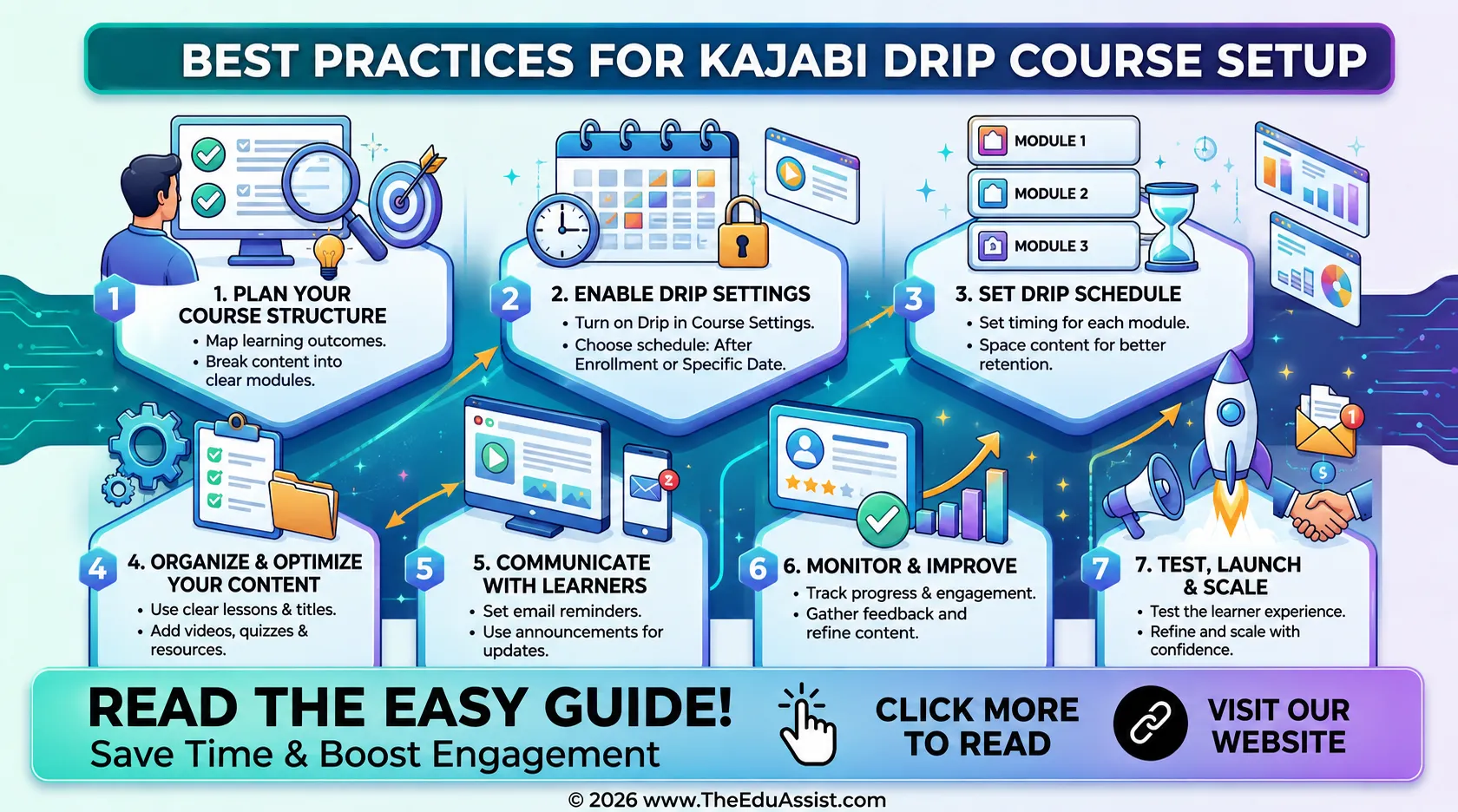
Kajabi drip content is a feature that releases course modules gradually instead of giving students immediate access to the full curriculum.
Creators can unlock modules based on:
- Days after purchase
- Specific calendar dates
- Cohort schedules
- Enrollment timing
Example:
- Module 1 unlocks immediately
- Module 2 unlocks after 7 days
- Module 3 unlocks after 14 days
Kajabi also supports automated drip notifications, synced community discussions, and aligned live coaching sessions.
Why Drip Courses Work Better Than Traditional Self-Paced Courses
Structured pacing improves:
- Retention
- Completion rates
- Cognitive engagement
- Participation
- Accountability
Research shows that learner engagement is one of the strongest predictors of successful online learning outcomes.
Best Practices for Kajabi Drip Courses
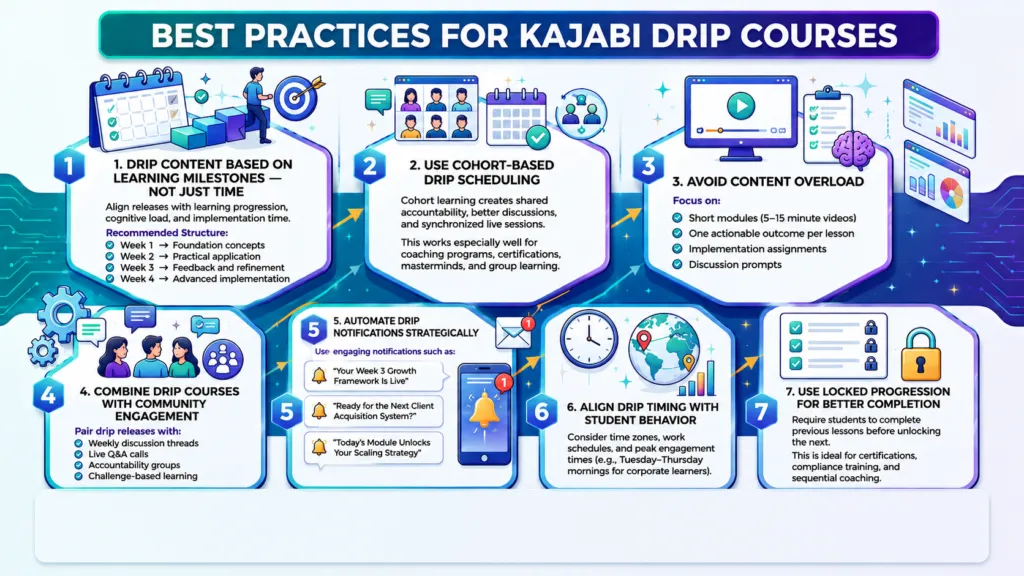
1. Drip Content Based on Learning Milestones — Not Just Time
Align releases with learning progression, cognitive load, and implementation time.
Recommended Structure:
- Week 1 → Foundation concepts
- Week 2 → Practical application
- Week 3 → Feedback and refinement
- Week 4 → Advanced implementation
2. Use Cohort-Based Drip Scheduling
Cohort learning creates shared accountability, better discussions, and synchronized live sessions. This works especially well for coaching programs, certifications, masterminds, and group learning.
3. Avoid Content Overload
Focus on:
- Short modules (5–15 minute videos)
- One actionable outcome per lesson
- Implementation assignments
- Discussion prompts
4. Combine Drip Courses with Community Engagement
Pair drip releases with:
- Weekly discussion threads
- Live Q&A calls
- Accountability groups
- Challenge-based learning
5. Automate Drip Notifications Strategically
Use engaging notifications such as:
- “Your Week 3 Growth Framework Is Live”
- “Ready for the Next Client Acquisition System?”
- “Today’s Module Unlocks Your Scaling Strategy”
6. Align Drip Timing with Student Behavior
Consider time zones, work schedules, and peak engagement times (e.g., Tuesday–Thursday mornings for corporate learners).
7. Use Locked Progression for Better Completion
Require students to complete previous lessons before unlocking the next. This is ideal for certifications, compliance training, and sequential coaching programs.
Common Mistakes in Kajabi Drip Course Setup
- Releasing content too slowly (loses momentum)
- Releasing too much too fast (causes overwhelm)
- Ignoring community engagement
- No clear outcome path or milestones
- Weak automation and reminders
How Long Should a Drip Course Take?
- Mini-course: 5–14 days
- Skill-based program: 4–8 weeks
- Certification/Coaching: 8–12 weeks
- Membership: Ongoing drip
Weekly module releases (4, 8, or 12-week structures) tend to perform best.
Kajabi Drip Courses for Different Business Models
- Coaches — Use drip for accountability and implementation
- Membership Creators — Release monthly premium content
- Corporate Trainers — Structure phased L&D systems
- Educators & EdTech — Improve curriculum pacing and retention
Final Thoughts
The best Kajabi drip courses are strategically structured learning journeys that reduce overwhelm, improve engagement, and increase completion rates.
In 2026, successful creators combine instructional design, cohort learning, automation, microlearning, community engagement, and smart drip sequencing to deliver premium learning experiences.
References
- https://www.kajabi.com/blog/how-to-build-an-online-course-on-kajabi
- https://cepa.stanford.edu/content/persistence-patterns-massive-open-online-courses-moocs
- https://link.springer.com/article/10.1007/s10639-020-10362-6
- https://www.frontiersin.org/journals/education/articles/10.3389/feduc.2022.1074435/full
- https://www.kajabi.com/blog/course-drip-by-date-cohort-programs
- https://help.kajabi.com/articles/products/courses/schedule-and-drip-content-in-courses
FAQs
How to drip content in Kajabi?
Kajabi allows creators to release modules gradually based on days after purchase, specific dates, or cohort schedules. Configure this inside the course product settings.
What is drip course content?
Drip course content refers to lessons released gradually over time instead of all at once. This improves pacing, accountability, and learner engagement.
How long should a drip take?
Most Kajabi drip courses perform well between 4–12 weeks with weekly release schedules. The ideal length depends on course complexity.
How to set up a drip campaign?
A strong drip campaign includes structured lesson releases, automated emails, community prompts, progress reminders, and live accountability touchpoints.
How long should a drip campaign last?
Most educational drip campaigns work best between 30–90 days, depending on transformation depth.
Ready to Build High-Engagement Kajabi Drip Courses?
Whether you’re building:
- a coaching program,
- certification academy,
- membership community,
- corporate L&D training,
- or custom elearning experience,
…the right kajabi drip course setup can dramatically improve course completion rates, learner engagement, and long-term customer retention.
At TheEduAssist, we help course creators design scalable Kajabi learning ecosystems with:
- strategic drip content structures,
- Kajabi automation,
- community systems,
- funnel optimization,
- curriculum development,
- and conversion-focused course experiences.
If you’re ready to create a Kajabi course students actually complete, our consulting services can help you build a smarter, more profitable online learning business.
Authored By: Sofia Arif