
In-house vs outsourcing eLearning models both work well, but they serve different needs because outsourcing offers speed while in-house teams provide brand control. Consequently, most leading companies in 2026 use a smart hybrid of both. This choice is the most vital decision L&D leaders face this year, especially as the global market tops $600 billion. Whether you build internally or hire an agency, your choice will impact your budget, speed, and the learner experience. This guide provides a clear breakdown and a simple framework to help you choose the right path.
What Is eLearning Development in 2026?
Before we dive into the comparison of in-house vs outsourcing eLearning, we must define the scope of modern development. Today, creating a course is about more than just slides. It involves a complex mix of technical and creative skills.
Specifically, the process now includes:
- Instructional Design: This is the foundation where you structure goals and content flow.
- Course Authoring: This involves building modules in tools like Articulate 360 or Adobe Captivate.
- Multimedia Production: This includes high-end video, 3D animation, and professional voiceovers.
- LMS Integration: This ensures the content works perfectly on platforms like Moodle or Docebo.
- AI Personalization: Modern courses use AI to adapt to each learner’s speed and style.
- Global Localization: This means translating and culturally adapting content for international teams.
Because the scope is so wide, many companies realize they cannot do everything alone. This is exactly where the in-house vs outsourcing eLearning debate begins to take shape.
The Case for In-House eLearning Development
Building an internal team means hiring your own instructional designers and developers. While this requires a major upfront investment, the long-term benefits can be massive for the right organization.
1. Deep Brand Alignment
First and foremost, an internal team lives and breathes your company culture. They understand your “voice” and your specific compliance needs from day one. Consequently, they don’t need a month of onboarding to understand what your brand stands for.
2. Speed of Small Updates
Additionally, an in-house team is much faster at making small changes. For example, if a company policy changes on Monday, your internal team can update the course by Tuesday. In contrast, an external vendor might take two weeks to process a new work order.
3. Total Intellectual Property Control
Furthermore, when you build internally, you own everything. You own the source files, the assets, and the logic. This is vital for companies in highly regulated fields like finance or healthcare. Therefore, if you want full control over your data, the in-house vs outsourcing eLearning choice leans toward internal teams.
4. Long-Term Economic Value
Most importantly, in-house development becomes more economical over time. If you produce more than 30 hours of content per year, the cost per hour of content drops significantly after the second year. While the initial setup is expensive, the “cost-per-unit” eventually becomes lower than agency rates.
5. Direct SME Access
Finally, internal designers have direct access to your Subject Matter Experts (SMEs). They can walk down the hall or send a quick Slack message to verify a fact. This reduces the “back-and-forth” that often slows down external projects.
The Risks of Internal Teams
However, there are serious downsides to consider. First, the upfront cost is very high. In 2026, a basic team of three, a designer, a developer, and a manager, will cost between $250,000 and $350,000 annually.
Second, hiring is difficult because skilled eLearning talent is currently in short supply. Therefore, it might take you six months just to find the right people. Finally, internal teams are hard to scale. If you suddenly need ten courses in one month, your small team will likely burn out.
The Case for Outsourcing eLearning Development
Outsourcing means hiring a specialized agency or a network of freelancers. In 2026, about 74% of companies use some form of external help for their in-house vs outsourcing eLearning needs.
1. Incredible Speed to Market
The biggest advantage of outsourcing is speed. A professional agency has multiple designers working at once. While an internal team might take 12 weeks to build a complex module, an agency can often finish it in four. Consequently, if you have a tight deadline, outsourcing is the clear winner.
2. Access to Niche Skills
Moreover, agencies bring specialized skills that you likely don’t have in-house. Do you need a 3D medical animation? Or perhaps a VR safety simulation? An agency already has these experts on staff. Thus, you don’t have to hire a full-time animator for a one-time project.
3. Financial Flexibility
Because you pay per project, you don’t have a fixed monthly payroll. This is a huge benefit for companies with “peaky” training needs. You can spend $50,000 in Q1 and $0 in Q2. Therefore, your budget remains flexible and responsive to the market.
4. Cutting-Edge Technology
Agencies must stay ahead to survive. As a result, they already use the latest AI authoring tools and advanced data tracking. By outsourcing, you get the benefit of their $100,000 software stack without having to buy it yourself.
The Downsides of Outsourcing
On the other hand, outsourcing has its own hurdles. First, the “onboarding” phase can be slow. An agency might take a few tries to get your brand’s tone exactly right. Second, there is a risk of vendor dependency. If your favorite agency closes or raises its prices, your entire training pipeline could be at risk. Finally, the per-project cost is higher. You are paying for the agency’s expertise and their overhead, which can be expensive for simple tasks.
Real-World Case Study: IBM’s Massive Success
IBM provides a perfect example of how to handle the in-house vs outsourcing eLearning dilemma. They needed to reskill over 300,000 employees on Cloud and AI technologies in less than two years.
Building all of that content internally was physically impossible. Consequently, IBM partnered with several external vendors. By doing this, they delivered training 60% faster than their old methods. Most importantly, they saved $116 million in productivity costs.
However, they did not fire their internal L&D team. Instead, the internal team focused on the high-level strategy and quality control. This proves that you don’t always have to choose just one side.
How to Decide: The 4-Question Framework
To help you make the right in-house vs outsourcing eLearning decision, answer these four simple questions:
1. What is your annual volume?
If you need less than 15 hours of finished content per year, you should outsource. However, if you need more than 30 hours, an internal team is a better investment.
2. How fast do you need it?
If you have a deadline in under 8 weeks, an agency is almost always the better choice. They have the “manpower” to sprint, whereas your internal team is likely already busy.
3. Is the content highly proprietary?
If you are teaching a secret company process, keep it in-house. On the other hand, if you are teaching “General Leadership Skills,” outsourcing is perfectly safe.
4. Is L&D a core business strategy?
If training is how you win in the market, you must own that capability internally. But if training is just a support function, you should outsource it to save on management stress.
The Rise of the Hybrid Model in 2026
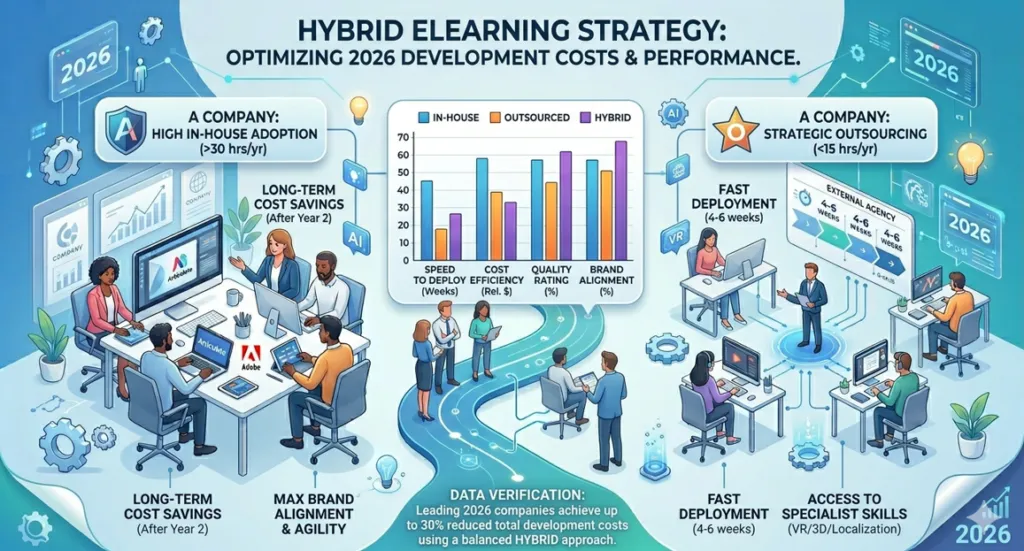
In 2026, the “all or nothing” approach is dying. Instead, the hybrid model is becoming the gold standard for in-house vs outsourcing eLearning.
In a hybrid setup, your internal team handles the “brains,” while the agency handles the “muscles.”
- Your Team: Handles strategy, SME interviews, and final approval.
- The Agency: Handles graphic design, video editing, and technical coding.
According to recent studies, companies using this model report 34% higher learner satisfaction. Furthermore, they see a 28% faster deployment time. This is because the internal team doesn’t get bogged down in technical “busy work,” and the agency doesn’t get lost in “company politics.”
Furthermore, if you are looking to scale your training quickly, you can explore our professional eLearning development services to build high-impact courses today.
How AI is Changing the Math
We cannot discuss in-house vs. outsourcing eLearning without mentioning AI. In 2026, AI tools have changed the cost of development.
Generative AI now allows one designer to do the work of three. Because tools can now create voiceovers, images, and even basic code, internal teams can produce more content than ever before. Consequently, the “threshold” for hiring an internal team has dropped. You no longer need a team of ten to stay in-house. Today, a team of two equipped with AI can often handle a large workload.
Conclusion
To finish, the in-house vs outsourcing eLearning debate has no single winner. Instead, the best choice depends on your volume, your budget, and your speed.
If you are just starting, we suggest outsourcing. This is because it lets you learn what works without a big financial risk. However, as your company grows, you should move your main strategy in-house.
The bottom line is simple. The best model in 2026 is the one that helps you give great training to your learners right when they need it. Whether you build it or buy it, the goal remains the same. Better performance comes through better learning.
References
- Global Market Insights eLearning Market Forecast 2024–2032
- Enterprise Guide to eLearning Outsourcing 2026
- In-house vs Outsourcing Software Development 2026 Comparison
- E-Learning Market Size, Share and Growth Analysis 2026
Frequently Asked Questions
Is outsourcing actually cheaper?
In the short term, yes. You avoid the high cost of benefits, taxes, and software licenses. However, if you have a constant stream of work for five years, the internal team will eventually cost less.
How do I vet an outsourcing partner?
Always ask for a “pilot project.” Don’t sign a $100,000 contract on day one. Instead, give them one small module. This lets you see how they handle your feedback.
Can small businesses afford in-house teams?
Usually, the answer is no. For a small business, the overhead of a full-time designer is too high. Therefore, small firms should use freelancers or AI-powered tools to stay lean.
Which is more scalable: in-house or outsourcing eLearning?
Outsourcing is more scalable because external agencies can quickly add more staff to your project. In contrast, internal teams are limited by their fixed size.
Does in-house or outsourcing eLearning provide better data security?
In-house work is generally more secure. This is because your private data never leaves your own servers. However, many agencies now use very strong encryption.
How does the hybrid model reduce eLearning development costs?
The hybrid model saves money by keeping your experts focused on strategy. Meanwhile, you can send time-consuming technical tasks to a more affordable external agency.
Authored by: Laiba Ayaz